
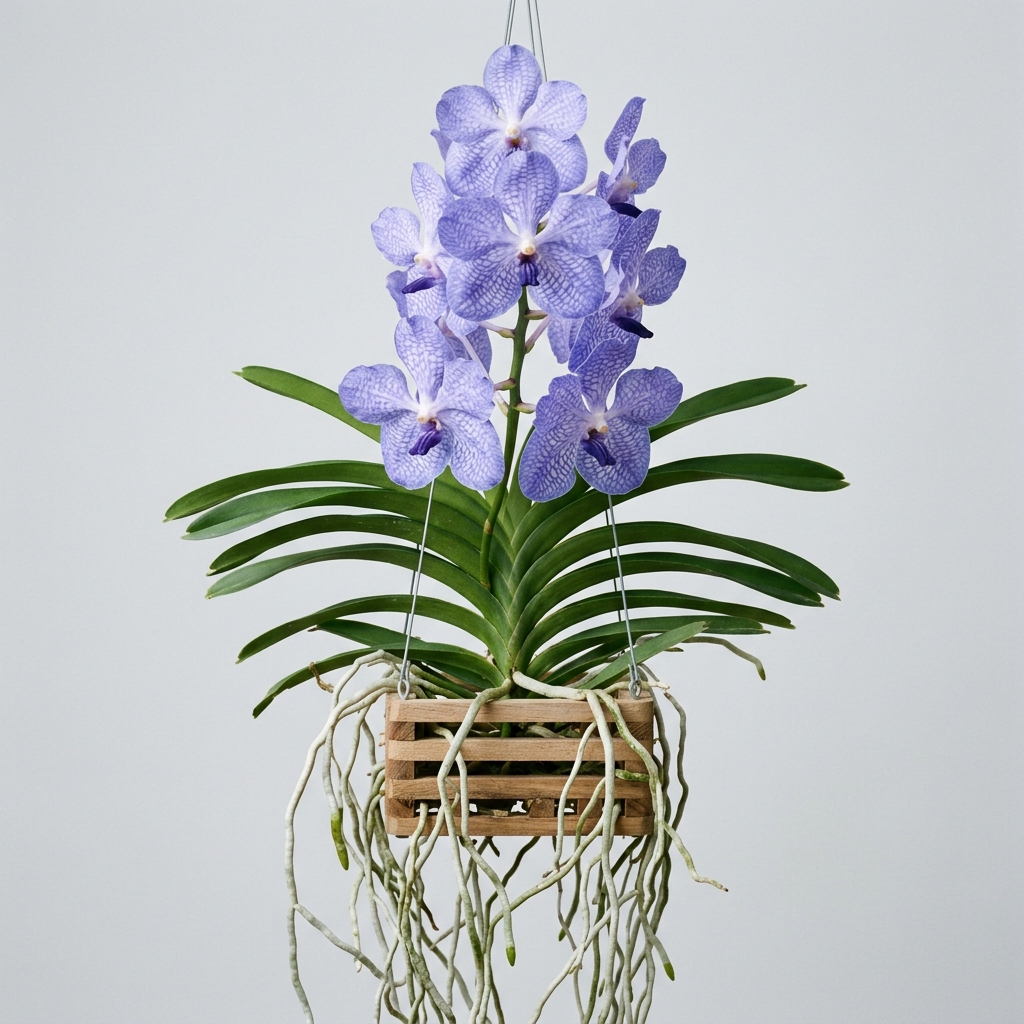
Vanda coerulea, commonly known as the blue orchid or blue vanda, is one of the most celebrated species in the orchid family due to its rare, naturally occurring blue-violet coloration. Native to the high-altitude regions of northeastern India, Myanmar, and Thailand, this monopodial epiphyte has captured the fascination of horticulturists for centuries. Its upright growth habit and striking aerial root system make it a dramatic centerpiece in any tropical plant collection.
Cultivators highly prize Vanda coerulea not only for its aesthetic brilliance but also for its historical role in orchid hybridization. As a parent to countless modern blue Vanda hybrids, this species passes on its cold tolerance and distinct tessellated flower patterns. While it requires specific attention to humidity and airflow, successful growers are rewarded with long-lasting, spectacular displays of cool-toned blossoms.
💡 Did You Know?
Vanda coerulea is one of the very few orchid species capable of producing true blue flowers, a color highly elusive in the plant kingdom. In its native habitats of India and Myanmar, it is historically known as the Autumn Lady's Tresses. Because of over-collection in the wild, it was once highly endangered, but widespread laboratory propagation has successfully preserved this magnificent species for modern growers.
🌿 Botanical Overview
Vanda coerulea is a monopodial epiphyte, meaning it grows upward from a single stem with alternating, strap-like leaves arranged in a fan shape. In its native habitat, it clings to the rough bark of deciduous trees in open oak forests, where it is exposed to bright sunlight and strong winds. This environment has shaped its unique physiological adaptations, including thick, velamen-coated aerial roots designed to absorb moisture rapidly from the air.
Unlike many other lowland Vanda species that demand constant tropical heat, Vanda coerulea thrives at higher elevations, typically between 800 and 1,700 meters above sea level. This montane origin endows the plant with a distinct preference for cooler night temperatures, which are essential for triggering its blooming cycle. Its robust growth habit allows mature specimens to reach heights of over two feet, producing multiple active root tips that drape elegantly below the foliage.
🌸 Flower Characteristics
The flowers of Vanda coerulea are renowned for their distinctive tessellated or checkered pattern, where darker blue-violet veins traverse a lighter lavender or pale blue background. Each inflorescence can carry anywhere from 5 to 15 flat, long-lasting flowers, measuring up to 3 to 4 inches in diameter. The sepals and petals are broadly obovate and often slightly twisted, presenting a full, rounded silhouette.
The lip, or labellum, is comparatively small, deep violet-blue, and features three lobes with a short spur at the base. The flowers are arranged on a sturdy, sub-erect spike that emerges from the leaf axils, arching gracefully above the foliage to maximize visibility to natural pollinators.
Fragrance & Bloom Profile
While some wild forms of Vanda coerulea are virtually unscented, certain cultivated varieties and select clones exhibit a faint, sweet fragrance, particularly during the warmest hours of the day. However, fragrance is not consistently documented as a primary trait across all specimens, and many growers cultivate this species purely for its visual impact.
The blooms are exceptionally durable, often remaining fresh on the plant for six to eight weeks if kept in a cool, stable environment. The intensity of the blue coloration is highly dependent on light and temperature; cooler night temperatures during bud development typically yield deeper, more vibrant blue hues.
Parentage & Hybrid Lineage
As a true species, Vanda coerulea does not have hybrid parentage, but its genetic legacy in orchid breeding is monumental. It is the primary source of blue pigmentation in the Vanda genus, most famously serving as a parent to Vanda Rothschildiana (a cross between Vanda coerulea and Vanda sanderiana).
Horticulturists have spent decades line-breeding Vanda coerulea to improve flower size, flatness, and color intensity. While wild-type specimens often feature narrower, more starry petals, modern line-bred cultivars boast exceptionally round, overlapping segments and intense indigo coloration, though their exact ancestral lines are sometimes undocumented in general grower registries.
🌱 Growing Conditions
To cultivate Vanda coerulea successfully, replicating its native montane habitat is key. It requires very bright, filtered light; a slight yellow-green tint to the leaves indicates optimal light levels, whereas dark green leaves suggest insufficient light. High light is crucial for robust growth and reliable flowering.
💡 Care Tip
Ensure your Vanda coerulea receives strong, continuous air movement. Because these orchids are typically grown bare-root with high , stagnant air is their greatest enemy, quickly leading to fungal infections and crown rot. Running a small fan nearby can make a dramatic difference in their overall health.
Temperature management is another critical factor. While it tolerates warm daytime temperatures up to 85 degrees Fahrenheit (29 degrees Celsius), it requires a distinct drop at night, ideally down to 50 to 60 degrees Fahrenheit (10 to 15 degrees Celsius) during the autumn months to initiate flower spikes. Constant high humidity of 70% to 80% coupled with strong, continuous air movement is essential to prevent stagnant moisture from causing rot.
Watering, Feeding & Potting Media
Due to its epiphytic nature, Vanda coerulea is most commonly grown bare-root in slatted wooden or plastic baskets, allowing its extensive root system to hang freely. This setup requires daily watering—often twice a day during hot summer months—by thoroughly soaking the roots until they turn from silvery-white to a vibrant green.
Feeding should be frequent but dilute. A balanced, water-soluble orchid fertilizer applied weekly at a quarter or half strength during the active growing season supports its vigorous growth. In winter, watering frequency should be reduced slightly, allowing the roots to dry quickly, and feeding should be minimized until active root growth resumes in spring.
Blooming Season & Care Notes
Vanda coerulea typically initiates its blooming cycle in late summer to autumn, with flowers opening in the cooler months of autumn and early winter. Once the flower spike begins to emerge from the leaf axil, avoid changing the plant’s orientation relative to the light source, as this can cause the buds to twist or develop unevenly.
After the blooms have faded, the spike should be cut back close to the stem using sterilized shears. Repotting or basket maintenance is best performed in early spring when new root tips begin to emerge. Because Vandas dislike root disturbance, it is often best to simply place the old basket directly inside a larger one, filling any gaps with large chunks of charcoal or tree fern fiber.
⚠️ Common Issues
⚠️ Common Mistake
A frequent mistake is potting Vanda coerulea in standard, fine orchid bark or potting soil. Their thick, air-loving roots require immediate drying after . Suffocating them in dense media will rapidly lead to root rot and plant decline. Always opt for open wooden baskets or extremely coarse, chunky media.
- Dehydration:
Silvery, shriveled roots and wrinkled, leathery leaves indicate insufficient watering or low humidity. - Root Rot:
Occurs when roots remain wet for too long in poorly drained media or stagnant air, leading to black, mushy roots. - Crown Rot:
Water trapped in the crown of the plant can cause rapid decay; always water early in the day so the foliage dries by nightfall. - Bud Blast:
Sudden drops in humidity, drafts, or extreme temperature fluctuations can cause developing buds to yellow and drop off. - Pests:
Thrips and spider mites can target the tender flower buds and leaf undersides, requiring treatment with insecticidal soap or neem oil.
❓ Frequently Asked Questions
How do I encourage my Vanda coerulea to bloom?
To trigger blooming, ensure the plant receives very bright light and a distinct drop in night temperatures during the late summer and early autumn. A temperature differential of 15 to 20 degrees Fahrenheit between day and night is often necessary to initiate flower spikes.
Can Vanda coerulea be grown indoors without a greenhouse?
Yes, but it requires careful management. Grow it in a very bright south- or east-facing window, use a humidifier to maintain high humidity levels, and provide a small fan to ensure constant air circulation around the bare roots.
Why are the roots of my Vanda coerulea turning brown and dry?
Brown, dry, or brittle roots are typically a sign of severe dehydration or low humidity. Healthy Vanda roots should be thick, silvery-white when dry, and turn bright green immediately upon watering.
What is the best way to water a bare-root Vanda?
The most effective method is to thoroughly spray or submerge the entire root system in room-temperature water for 10 to 15 minutes until the roots turn completely green. This should be done daily, or twice daily during hot weather.
⭐ Final Growing Notes
While Vanda coerulea presents a unique set of challenges for the novice grower, its unmatched blue-violet blooms and dramatic growth habit make it one of the most rewarding orchids to cultivate. By providing bright light, cool night temperatures, high humidity, and excellent airflow, you can successfully recreate the montane canopy environment this spectacular species needs to thrive for decades.
🌱 Propagation Tip
Monopodial orchids like Vanda coerulea do not divide like sympodial orchids. Propagation is typically achieved through top cuttings once the plant has grown tall and developed several robust aerial roots along the upper stem, or by carefully detaching basal offsets, known as keikis, once they have established their own independent root systems.
⭐ Expert Advice
To achieve the deepest, most vibrant blue flowers, expose the plant to significant day-to-night drops (about 15 to 20 degrees Fahrenheit) as the flower spikes begin to emerge in late summer. This differential stimulates the accumulation of anthocyanin pigments, intensifying the rich blue-violet coloration of the developing buds.

Leave A Comment