
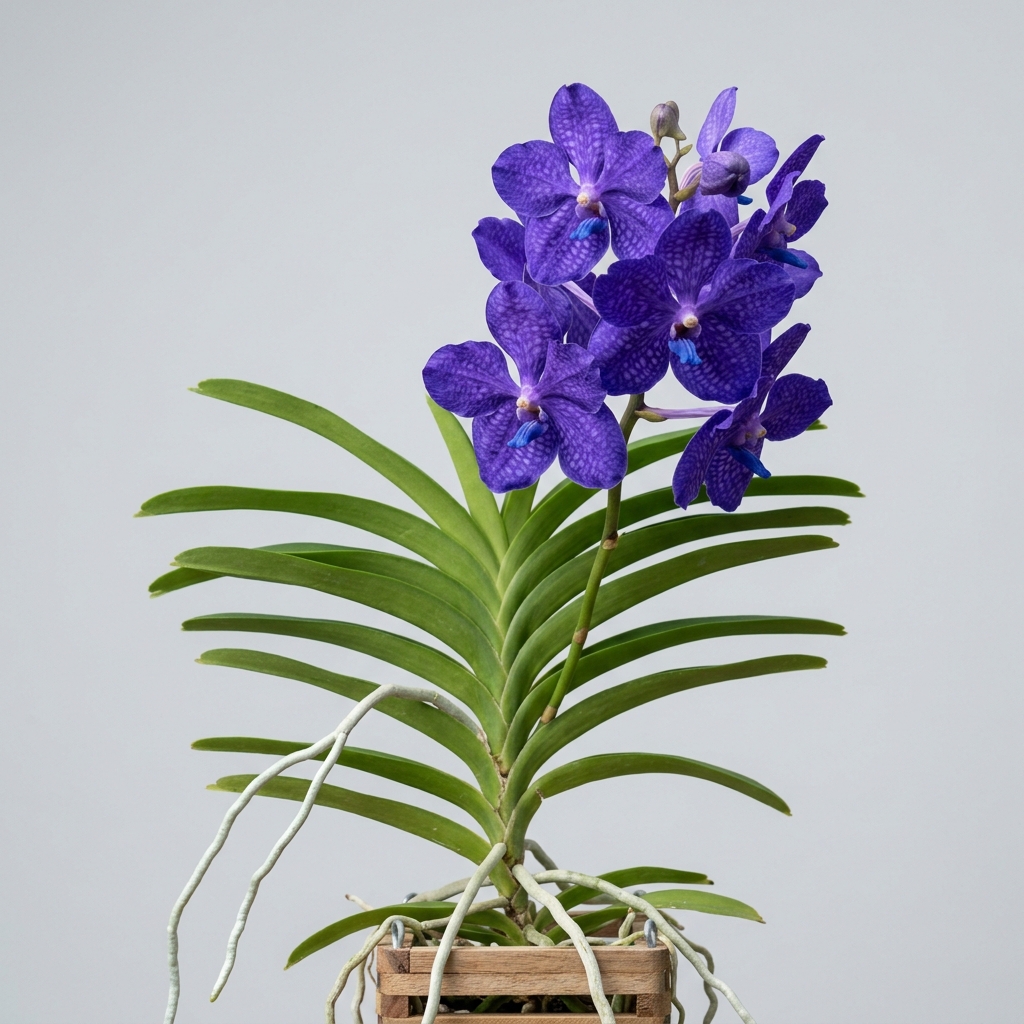
Vanda Pachara Delight is one of the most celebrated blue-flowered orchid cultivars in the horticultural world, highly prized for its intense, saturated violet-blue blooms and robust growth habit. As a monopodial hybrid, this orchid produces striking, strap-shaped leaves that grow in a neat, fan-like arrangement, serving as a dramatic backdrop for its spectacular floral displays. Growers around the globe seek out this cultivar not only for its exceptional color depth but also for its willingness to bloom multiple times a year when provided with optimal tropical conditions.
Unlike many terrestrial or semi-terrestrial orchids, Vanda Pachara Delight thrives as an epiphyte, relying on a massive network of thick, silvery aerial roots to absorb moisture and nutrients directly from the air. Its flowers feature a distinct tessellated or checkered pattern across the petals and sepals, a characteristic inherited from its ancestral lineage. Whether suspended in wooden baskets or mounted on plaques, this cultivar brings an exotic, architectural elegance to greenhouses, sunrooms, and warm-climate gardens.
💡 Did You Know?
The striking blue color of Vanda Pachara Delight is inherited from Vanda coerulea, a species native to the cool, high-altitude regions of Asia. This ancestral background gives the cultivar a slightly more resilient nature and a unique ability to produce true blue pigments, which are exceptionally rare in the orchid world.
🌿 Botanical Overview
Vanda Pachara Delight is a hybrid orchid that exemplifies the classic growth habit of the Vandaceous group. It is a monopodial epiphyte, meaning it grows upward from a single stem, producing alternating, strap-like leaves that are leathery and deeply channeled. The plant does not possess pseudobulbs, which are water-storing organs common in other orchid families; instead, it relies on its thick, succulent leaves and extensive aerial root system to survive periods of dryness.
The root system of this cultivar is particularly impressive. Covered in a thick layer of velamen—a spongy, silvery-white tissue—the roots are highly adapted to absorbing atmospheric moisture and nutrients rapidly. In cultivation, these roots are typically left to hang freely in the air, allowing them to dry quickly after watering, which mimics their natural canopy environment.
🌸 Flower Characteristics
The defining feature of Vanda Pachara Delight is its magnificent floral presentation. The flowers are large, often reaching three to four inches in diameter, and are borne on strong, upright or slightly arched inflorescences that emerge from the leaf axils. Each spike can carry anywhere from eight to over a dozen closely spaced, flat-faced blooms that create a dense, colorful cluster.
The petals and sepals are broad, overlapping, and exhibit a rich, velvety texture. Their color ranges from a deep, saturated indigo to a vibrant violet-blue, decorated with a darker, web-like tessellation pattern that adds incredible visual depth. The small, concentrated lip or labellum sits at the center, often displaying a slightly darker hue that draws pollinators toward the column.
Fragrance & Bloom Profile
While some Vandaceous orchids are known for intense perfumes, the fragrance profile of Vanda Pachara Delight is not consistently documented in common grower references. Some hobbyists report a very faint, sweet scent during the warmest hours of the day, while others note that the cultivar is virtually unscented. The primary appeal of this orchid remains its visual impact rather than its olfactory presence.
The blooms are remarkably long-lasting, often remaining pristine on the plant for six to eight weeks. Because it is an opportunistic bloomer, a healthy, mature specimen can produce flower spikes two to three times a year, provided it receives sufficient light, warmth, and regular fertilization.
Parentage & Hybrid Lineage
The exact hybrid lineage of Vanda Pachara Delight involves complex breeding lines within the Vanda genus. In common horticultural databases, it is recognized as a registered grex resulting from crosses that heavily feature Vanda coerulea, which is the primary source of the blue coloration and tessellated patterns seen in modern blue Vandas.
Because hybrid registrations can sometimes involve proprietary or historically complex crosses, some aspects of its exact ancestral percentages remain subject to minor variations in commercial trade references. Nonetheless, the influence of cool-to-warm-growing blue species in its background gives this cultivar a slightly wider temperature tolerance than some of its ultra-tropical relatives.
🌱 Growing Conditions
To cultivate Vanda Pachara Delight successfully, replicating its native canopy environment is essential. It requires very bright, indirect light. While it can tolerate some direct morning sun, hot afternoon sun can scorch the foliage. High light levels are critical for triggering the blooming cycle; plants grown in insufficient light will produce lush green leaves but fail to initiate flower spikes.
💡 Care Tip
To keep your Vanda Pachara Delight hydrated in dry indoor environments, try soaking the entire root system in a bucket of room- water for 20 to 30 minutes every morning, allowing the roots to dry completely by afternoon.
Temperature: wise, this cultivar thrives in warm to intermediate conditions, ideally between 65°F and 85°F (18°C to 29°C) during the day, with a slight drop at night to stimulate growth. High humidity levels of 70% to 80% are crucial, especially when the plant is grown bare-root. Excellent air movement must be maintained at all times to prevent fungal pathogens from settling on the damp leaves or roots.
Watering, Feeding & Potting Media
Watering Vanda Pachara Delight is a daily commitment when grown in traditional bare-root baskets. The roots should be thoroughly soaked or misted until they turn from a silvery-white to a vibrant, deep green. During hot summer months, twice-daily waterings may be necessary. If grown in a climate with lower humidity, some growers place the roots in a highly porous basket with large chunks of charcoal or coarse fir bark to retain a touch of moisture without suffocating the roots.
Feeding should be frequent but dilute. A balanced, water-soluble orchid fertilizer applied at quarter-strength weekly (often referred to as “weakly, weekly”) works best. Ensure the plant is thoroughly watered with plain water before applying fertilizer to prevent chemical burns on the sensitive root tips, and flush the root system periodically to prevent salt buildup.
Blooming Season & Care Notes
While Vanda Pachara Delight can bloom at almost any time of the year, peak flowering typically occurs in the spring and autumn. When a new flower spike is detected emerging from the leaf axils, avoid changing the plant’s orientation to the light source, as the spike will naturally grow toward the light and can become twisted if the basket is rotated.
After the flowers have completely faded, cut the spike off near the base using a sterile cutting tool. Repotting or basket replacement is rarely needed unless the wooden basket begins to decay. If the plant outgrows its current basket, simply place the old basket directly inside a larger one, allowing the roots to continue their outward growth undisturbed.
⚠️ Common Issues
Despite its vigor, Vanda Pachara Delight can encounter several cultivation challenges:
⚠️ Common Mistake
A frequent error is potting this orchid in standard, dense potting soil or fine bark. Vanda roots require constant exposure to fresh air; suffocating them in heavy media will rapidly lead to root rot and plant decline.
- Dehydration:
Indicated by shriveled, leathery leaves and dry, brittle roots. Increase watering frequency and humidity immediately. - Root Rot:
Occurs if the roots remain constantly wet in stagnant air or heavy potting media. Roots will turn mushy and black. - Bud Blast:
The sudden yellowing and dropping of unopened buds, usually caused by rapid temperature fluctuations, low humidity, or drafts. - Leaf Spotting: Fungal or bacterial spots can develop if water sits on the leaves overnight. Always water early in the day so the foliage dries by nightfall.
- Pests:
Thrips, scale, and spider mites can occasionally target the tender flower buds or leaf crevices. Treat promptly with horticultural soap or neem oil.
❓ Frequently Asked Questions
How often does Vanda Pachara Delight bloom?
Under optimal growing conditions with high light and consistent feeding, a mature Vanda Pachara Delight can bloom two to three times a year. Each blooming cycle produces flowers that can last up to two months.
Can I grow this orchid indoors without a greenhouse?
Yes, but it requires careful attention to humidity and light. Growing it near a bright south or west-facing window with sheer curtains, using a humidifier, and misting the roots daily can help replicate greenhouse conditions.
Why are the roots of my Vanda turning white?
Silvery-white roots are normal and indicate that the velamen layer is dry. When watered thoroughly, the roots should turn a healthy green color, indicating they have absorbed sufficient moisture.
What should I do if my Vanda is not blooming?
The most common cause of non-blooming is insufficient light. Gradually move your orchid to a brighter location where it receives filtered sunlight, and ensure you are fertilizing regularly with a balanced formula.
⭐ Final Growing Notes
Vanda Pachara Delight remains a benchmark cultivar for orchid enthusiasts seeking the elusive and dramatic blue-violet spectrum in their collection. While its bare-root growth habit and high humidity demands require a more disciplined care routine than common windowsill orchids, the reward of its spectacular, long-lasting blooms makes it an incredibly satisfying and prestigious addition to any tropical plant collection.
🌱 Propagation Tip
Vandaceous orchids do not divide like symmodial orchids. Propagation is typically done by removing 'keikis'—baby plants that occasionally grow from the base of the main stem—once they have developed several strong roots of their own.
⭐ Expert Advice
If you struggle to maintain high , hang your Vanda Pachara Delight above a large tray filled with water and pebbles, or grow it in a large, empty glass vase where the microclimate naturally retains moisture around the roots.

Leave A Comment