
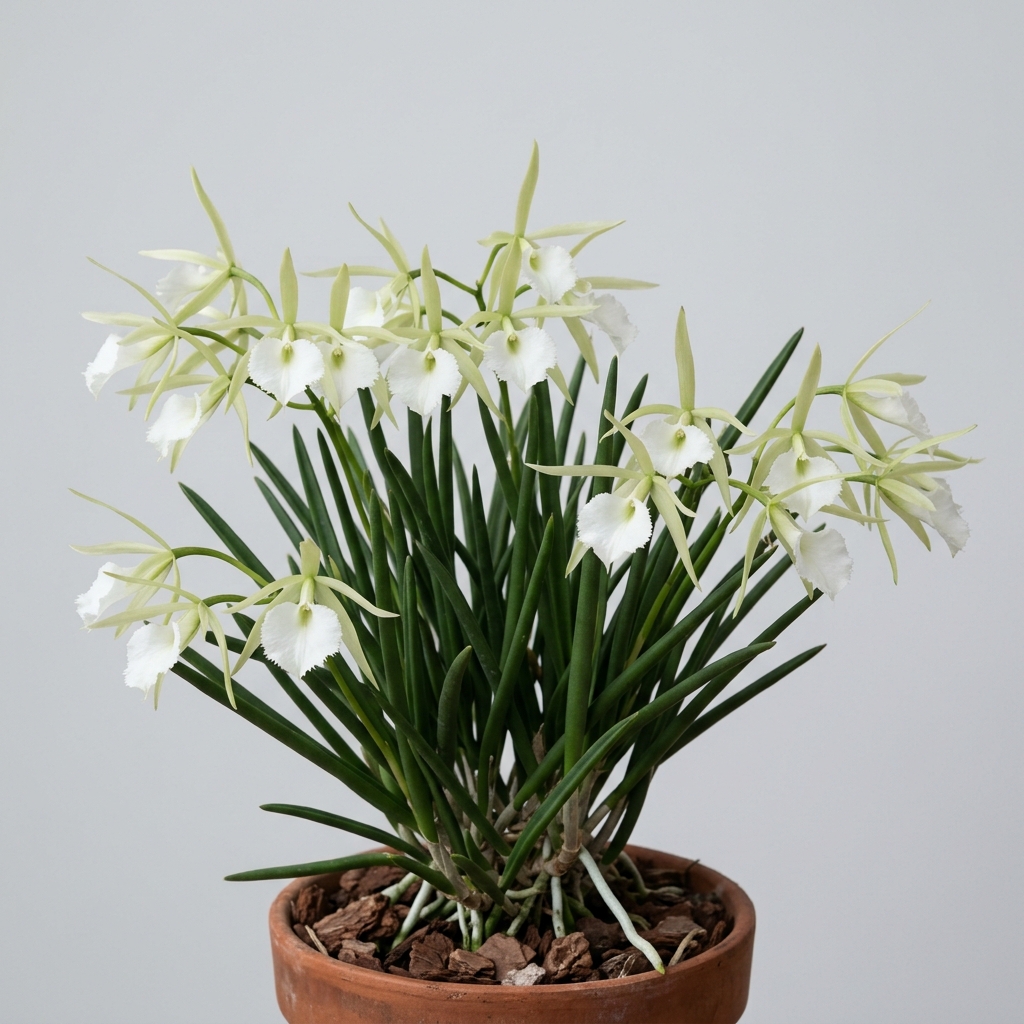
Brassavola Little Stars is a highly celebrated orchid hybrid prized for its ease of culture and elegant, star-shaped blossoms. Belonging to the Brassavola genus, this cultivar is a favorite among both novice and experienced orchid enthusiasts due to its robust growth habit and compact, space-saving footprint. Its slender, pencil-like leaves and clustering growth pattern make it an attractive addition to any indoor or greenhouse collection.
Beyond its structural elegance, this orchid is renowned for its spectacular nocturnal fragrance, which fills the growing area with a sweet, citrusy perfume after dusk. The pale green to pristine white flowers emerge in generous clusters, creating a striking contrast against the dark green foliage. Its resilience and frequent blooming cycles have earned it a permanent place in the collections of growers worldwide.
💡 Did You Know?
The intense nocturnal of Brassavola Little Stars is driven by an internal biological clock that triggers the release of volatile compounds only after dark. This strategy conserves the plant's metabolic energy during the day when its primary pollinators, night-flying sphinx moths, are inactive.
🌿 Botanical Overview
Brassavola Little Stars shows the classic vegetative characteristics of its parentage, featuring slender, terete leaves that are fleshy and channelled. These upright, pencil-like leaves emerge from short, narrow pseudobulbs, forming dense, grassy clumps over time. This growth habit is highly adaptive, allowing the plant to conserve moisture in epiphytic environments where water drains away rapidly.
The root system of this cultivar is exceptionally vigorous, producing thick, white roots with green growing tips. These roots are adapted to clasp onto tree bark or mounting plaques, absorbing moisture and nutrients from the air and passing rain. The overall plant remains relatively compact, rarely exceeding twelve inches in height, making it highly suitable for windowsill cultivation or crowded grow shelves.
🌸 Flower Characteristics
The blossoms of Brassavola Little Stars are distinctly star-shaped, featuring narrow, elongated petals and sepals that drape elegantly around a broad, spade-shaped lip. The petals and sepals typically present a delicate pale green or creamy chartreuse hue, while the prominent lip is a clean, brilliant white, often featuring a faint greenish-yellow throat.
Flowers are produced on upright or slightly arching spikes that emerge from the base of the leaves. Each inflorescence can carry multiple blooms, often ranging from three to six flowers per spike on mature specimens. The flowers are long-lasting, frequently remaining pristine for several weeks, and their open, airy presentation gives the plant a delicate, ethereal appearance when in full bloom.
Fragrance & Bloom Profile
The most captivating feature of Brassavola Little Stars is its powerful nocturnal fragrance. During the daylight hours, the flowers emit virtually no scent, conserving energy. As dusk approaches, chemical pathways within the blooms activate, releasing a rich, sweet perfume that carries notes of citrus, clover, and soft vanilla. This evolutionary adaptation is designed to attract nocturnal moth pollinators in its ancestral habitats.
The blooming cycle is highly rewarding. While the primary flowering period typically occurs in the late autumn and winter months, healthy and well-established specimens are known to bloom opportunistically throughout the year. The onset of new growth often brings a corresponding flush of flower spikes, provided the plant receives adequate light and warmth.
Parentage & Hybrid Lineage
In horticultural records, Brassavola Little Stars is widely recognized as a primary hybrid, generally accepted to be a cross between Brassavola nodosa and Brassavola subulifolia. This combination successfully merges the floriferous nature and compact habit of both parent species, resulting in a hybrid that is often considered easier to grow and more free-flowering than either parent alone.
While some variation can exist among individual seed-grown plants, the grex is remarkably stable in its presentation. Because exact hybridizer details and early registration histories can sometimes vary across historical registries, growers focus on the plant’s reliable performance. It stands as a classic example of successful primary hybridization, capturing the best traits of its wild ancestors.
🌱 Growing Conditions
To thrive, Brassavola Little Stars requires bright, indirect light. It can tolerate some direct morning sun, which encourages robust growth and more frequent flowering. In indoor settings, a south- or east-facing window is ideal. If the leaves develop a light reddish-purple speckling, this is generally a sign that the plant is receiving the maximum safe amount of light, which often triggers heavy blooming.
💡 Care Tip
To encourage maximum flower production, place your orchid in a location where it receives bright, filtered sunlight. A slight purplish freckling on the slender leaves is an excellent indicator that the level is optimal for triggering abundant blooms.
Temperature: wise, this hybrid prefers warm to intermediate conditions. Ideal daytime temperatures range between 75°F and 85°F (24°C to 29°C), with a slight drop at night to around 60°F to 65°F (15°C to 18°C). High humidity, ideally between 50% and 70%, combined with strong air movement, is crucial to prevent fungal issues and mimic the breezy, humid coastal environments of its parent species.
Watering, Feeding & Potting Media
The watering regime for Brassavola Little Stars must respect its epiphytic nature. The roots must dry out rapidly after watering; prolonged wetness at the root zone will quickly lead to root rot. If grown in pots, a highly porous, coarse medium such as large-grade fir bark, charcoal, and perlite is essential. Many growers prefer to cultivate this orchid mounted on cork bark or in open, slatted wooden baskets where the roots can dangle freely in the air.
During the active growing season in spring and summer, water the plant thoroughly as soon as the potting medium dries out. Reduce watering frequency slightly during the cooler winter months when growth slows. Feed the orchid with a balanced, water-soluble orchid fertilizer diluted to one-quarter strength every second or third watering. Flush the pot with pure water periodically to prevent salt buildup.
Blooming Season & Care Notes
The main blooming season begins in autumn and can extend well into winter, though spikes can appear at other times of the year. Once a new leaf matures, keep an eye on the sheath at the leaf base, as this is where the flower spike will emerge. Avoid getting water trapped inside the developing leaf sheaths, as this can cause the emerging buds to rot.
After the flowers fade, allow the spike to dry completely before cutting it back to the base. Repotting or remounting should only be performed when new root tips begin to emerge from the base of the newest pseudobulbs, typically in the spring. This timing ensures the plant establishes itself quickly in its new medium with minimal transplant shock.
⚠️ Common Issues
⚠️ Common Mistake
The most frequent mistake is planting this orchid in heavy, moisture-retentive potting soil or fine bark. Its roots require rapid drying cycles; keeping them constantly wet in dense media will inevitably lead to root rot and plant decline.
- Root Rot: Caused by overwatering or compacted, poorly draining potting media. Roots will turn mushy and brown instead of firm and white.
- Bud Blast: Occurs when developing flower buds dry up and drop before opening, often triggered by sudden temperature drops, low humidity, or drafts.
- Dehydration: Indicated by shriveled, wrinkled leaves and pseudobulbs, usually due to underwatering or a compromised root system that cannot absorb water.
- Pests: Scale insects and mealybugs can hide in the tight crevices at the base of the leaves and sheaths; treat promptly with insecticidal soap or horticultural oil.
- Leaf Spotting: Fungal or bacterial spots can develop if water sits on the foliage overnight or if air circulation is inadequate.
❓ Frequently Asked Questions
How often does Brassavola Little Stars bloom?
Under optimal conditions, this hybrid can bloom multiple times a year. While the primary flowering season is in the autumn and winter, healthy plants that receive high light levels and consistent care will often produce flowers whenever a new growth matures.
Can I grow Brassavola Little Stars mounted on wood?
Yes, mounting this orchid on cork bark or hardwood plaques is highly recommended. Its epiphytic roots thrive when exposed to rapid wet-dry cycles. Mounted plants will require more frequent watering, often daily during hot summer weather, to prevent dehydration.
Why are the leaves on my Brassavola turning reddish-purple?
A light reddish-purple speckling on the terete leaves is a natural response to high light levels, similar to a suntan. This is generally a positive sign indicating that the orchid is receiving sufficient light to trigger abundant blooming, provided the leaves do not show signs of actual scorching.
What should I do if my orchid is not blooming?
The most common reason for a lack of blooms is insufficient light. Gradually move the plant to a brighter location, such as a south-facing window or under quality LED grow lights. Ensuring a slight temperature drop at night can also help stimulate spike production.
⭐ Final Growing Notes
Brassavola Little Stars remains one of the most rewarding and forgiving orchids for indoor and greenhouse growers alike. By providing bright light, excellent air circulation, and a fast-draining root environment, you will be rewarded with a spectacular display of starry, night-scented blossoms year after year.
🌱 Propagation Tip
This cultivar is best propagated by division during the spring repotting cycle. Ensure that each division has at least three to four healthy, mature pseudobulbs with active root growth to guarantee rapid establishment and minimize transplant shock.
⭐ Expert Advice
If growing indoors, utilize a small oscillating fan to maintain gentle, continuous air movement around the foliage. This mimics its natural breezy habitat, accelerates the drying of the media, and significantly reduces the risk of fungal leaf spot diseases.

Leave A Comment