
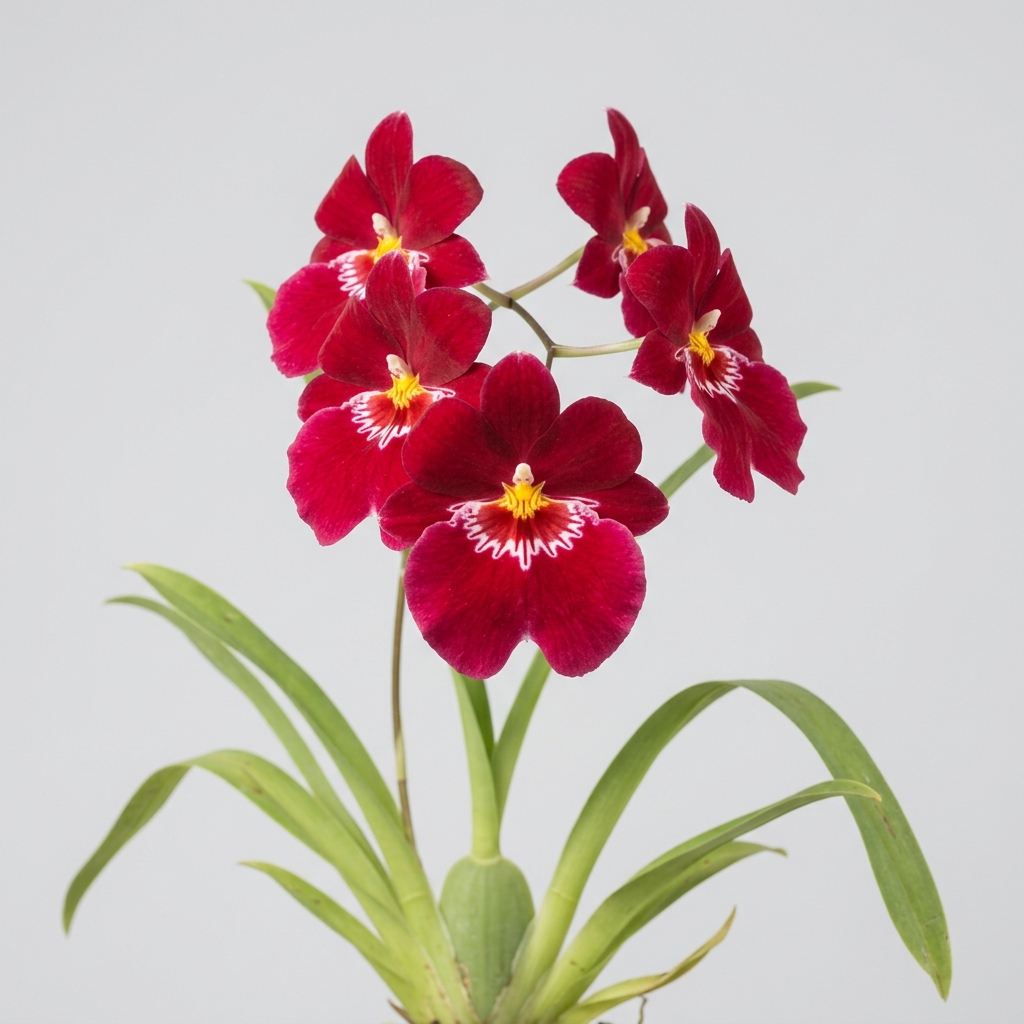
Miltoniopsis Bert Field is a classic and highly celebrated hybrid orchid within the pansy orchid group, beloved by collectors for its dramatic, velvety crimson blooms. This sympodial orchid produces elegant, flattened pseudobulbs topped with light green, strap-like foliage that arches gracefully, creating an attractive specimen even when not in flower. Growers particularly value this cultivar for its striking floral presentation, which brings a bold splash of rich color to indoor growing spaces.
Like most Miltoniopsis, the Bert Field cultivar thrives in cooler, humid conditions that mimic the cloud forests of its ancestral South American habitats. While it has a reputation for being somewhat demanding compared to more forgiving genera like Phalaenopsis, providing consistent moisture, high humidity, and moderate light rewards the grower with spectacular, long-lasting floral displays. Its flat, open-faced flowers emit a delicate, sweet fragrance that fills the growing area during the morning hours.
💡 Did You Know?
The common name pansy orchid comes from the striking resemblance of Miltoniopsis flowers to garden pansies. Unlike true pansies, however, Miltoniopsis Bert Field is a tropical epiphyte that grows on trees in the cool, misty mountain forests of South America, relying on high and constant air movement to thrive.
🌿 Botanical Overview
Miltoniopsis Bert Field belongs to the genus Miltoniopsis, which is distinct from Miltonia, though they were historically grouped together. Often referred to as pansy orchids due to their flat, wide-petaled flowers that resemble garden pansies, these plants are native to the cool, misty montane forests of the Andes in Colombia, Ecuador, and Peru.
The plant features tightly clustered, compressed pseudobulbs that are pale green and wrapped in leaf sheaths at the base. The thin, delicate leaves are highly sensitive to environmental stress, often folding or wrinkling if the plant experiences dry spells or low humidity. This growth habit makes the foliage an excellent indicator of the orchid’s overall hydration and health.
🌸 Flower Characteristics
The flowers of Miltoniopsis Bert Field are the primary draw for orchid enthusiasts. Each inflorescence can carry several large, flat blossoms that measure up to three to four inches across. The petals and sepals are a deep, velvety red or rich burgundy, creating a dramatic contrast against the prominent lip.
The labellum, or lip, is exceptionally large and fan-shaped, featuring a complex mask at its center. This mask typically consists of radiating white lines or halos surrounding a bright yellow crest. This intricate pattern guides pollinators in nature and creates a stunning visual focal point for indoor collectors.
Fragrance & Bloom Profile
A notable feature of Miltoniopsis Bert Field is its pleasant, sweet fragrance, which is often described as reminiscent of roses or citrus. The scent is typically most pronounced during the morning hours when temperatures begin to rise and light levels increase.
The blooms are remarkably long-lasting, often remaining fresh on the spike for four to six weeks if kept in cool, stable conditions. To maximize the lifespan of the flowers, growers should avoid getting water directly on the petals, as this can cause spotting or premature decay.
Parentage & Hybrid Lineage
Miltoniopsis Bert Field is a complex hybrid that traces its lineage back to several cool-growing Colombian species, most notably Miltoniopsis vexillaria and Miltoniopsis phalaenopsis. While specific registration details and exact parental crosses can sometimes vary across historical registration databases, it is widely recognized as a benchmark red hybrid.
This cultivar has been used in later breeding programs to introduce deep red coloration and stable mask patterns to newer Miltoniopsis hybrids. Because of its complex heritage, it shows slightly more vigor than its wild ancestors, though it still retains their strict environmental preferences.
🌱 Growing Conditions
Replicating the cool, humid cloud forest environment is key to successfully growing Miltoniopsis Bert Field. It prefers cool to intermediate temperatures, ideally ranging from 55°F (13°C) at night to no higher than 75°F (24°C) during the day. Prolonged exposure to temperatures above 80°F (27°C) can severely stress the plant and lead to leaf drop.
💡 Care Tip
To keep your Miltoniopsis Bert Field happy, place it in a location with excellent air circulation. Stagnant air combined with high can quickly lead to fungal leaf spot, so a small, gentle fan running nearby can make a significant difference in preventing disease.
Light should be bright but filtered, similar to the dappled light found under a forest canopy. East-facing windows or shaded south-facing windows are ideal. If the leaves turn a dark, dull green, the plant may need more light; if they turn yellow or develop reddish-purple tinting, the light is too intense. High humidity of 60% to 80% combined with gentle, continuous airflow is essential to prevent fungal pathogens.
Watering, Feeding & Potting Media
Unlike many other orchids with thick, water-storing pseudobulbs, Miltoniopsis Bert Field has thin roots and delicate foliage, meaning it cannot tolerate drying out. The potting medium should remain consistently damp but never soggy. Water the plant thoroughly just as the medium approaches dryness.
A fine-grade fir bark mix blended with perlite and chopped sphagnum moss works exceptionally well, as it retains moisture while allowing oxygen to reach the roots. Feed the orchid with a highly diluted, balanced orchid fertilizer (such as a quarter-strength 20-20-20 formula) every two weeks during active growth, flushing the pot with pure water once a month to prevent salt buildup.
Blooming Season & Care Notes
The primary blooming season for Miltoniopsis Bert Field is spring, though healthy, mature specimens may produce a secondary flush of flowers in the autumn. Flower spikes emerge from the axils of the newest pseudobulbs as they mature.
Once the flowers fade, cut the spike down to the base of the pseudobulb. Repotting should be done annually or biennially, ideally in the autumn when cool temperatures return and the plant initiates a flush of new root growth. This prevents the potting medium from decomposing and becoming acidic, which can quickly destroy the orchid’s delicate root system.
⚠️ Common Issues
⚠️ Common Mistake
The most common mistake growers make with this cultivar is letting the potting medium dry out completely between waterings. Unlike Phalaenopsis or Cattleya orchids, Miltoniopsis has very thin, delicate roots that will quickly die if they dry out, leading to severe dehydration and leaf wrinkling.
- Accordion leaves: New leaves wrinkling or folding like an accordion is a classic sign of inconsistent watering or low humidity.
- Root rot: Caused by overwatering, poor drainage, or decomposed potting media, leading to limp, yellowing leaves.
- Bud blast: Sudden dropping or drying of flower buds before they open, usually triggered by rapid temperature fluctuations, drafts, or low humidity.
- Spider mites: These pests thrive in dry conditions and can quickly damage the thin foliage of Miltoniopsis; maintain high humidity to deter them.
- Fungal leaf spotting: Dark spots on the leaves can occur if water sits on the foliage overnight without adequate air circulation.
❓ Frequently Asked Questions
How do I prevent accordion-like leaves on my Miltoniopsis Bert Field?
Accordion-like wrinkling on new leaves is caused by a lack of moisture during the active growth phase. To prevent this, maintain a consistent watering schedule so the potting medium never dries out completely, and ensure the ambient humidity remains between 60% and 80%.
Can I grow Miltoniopsis Bert Field under artificial LED lights?
Yes, this cultivar adapts well to LED grow lights. Position the plant under moderate-intensity LEDs, ensuring the lights are kept at a safe distance to avoid overheating the delicate foliage. Aim for a photoperiod of 12 to 14 hours daily.
Why are the flower buds on my orchid falling off before opening?
This issue, known as bud blast, is typically caused by sudden environmental stress. Common triggers include cold drafts, dry air, rapid temperature spikes, or letting the potting medium dry out completely while the flower spikes are developing.
When is the best time to repot Miltoniopsis Bert Field?
The ideal time to repot is in the autumn when cool temperatures return and the plant initiates a flush of new root growth. Avoid repotting during the peak of summer heat or when the plant is actively developing flower spikes in the spring.
⭐ Final Growing Notes
While Miltoniopsis Bert Field requires a more attentive hand than some of the more common beginner orchids, its breathtaking, velvety red blooms and sweet fragrance make it an incredibly rewarding addition to any collection. By focusing on stable, cool temperatures, high humidity, and consistent moisture, you can enjoy the spectacular pansy flowers of this classic cultivar year after year.
🌱 Propagation Tip
Propagate Miltoniopsis Bert Field by division during repotting in the autumn. Ensure each division has at least three to four healthy, mature pseudobulbs with an active growth point. Avoid dividing the plant too small, as larger clumps recover much faster and bloom more reliably.
⭐ Expert Advice
If you struggle to maintain the high this orchid craves, try placing the pot on a tray filled with pebbles and water, or group it closely with other plants. Just ensure the bottom of the pot never sits directly in the water, which would suffocate the roots.

Leave A Comment