
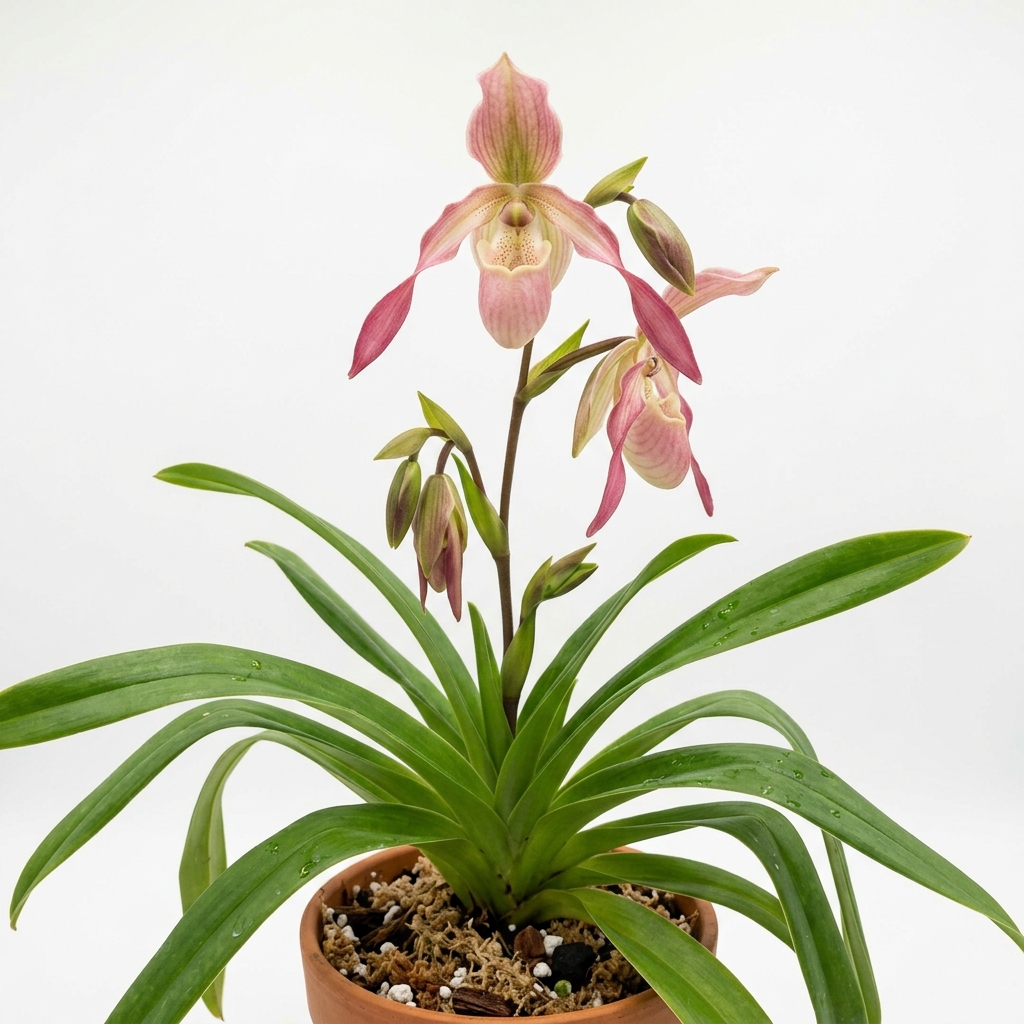
Phragmipedium Sedenii is a historic and highly regarded slipper orchid hybrid that has captivated growers for generations. Known for its elegant sequential blooming habit, this orchid produces soft pink, rose, and cream-colored flowers that open one after another on a single, upright spike. Its enduring popularity stems from its remarkable vigor and its ability to remain in bloom for several months at a time, making it a standout specimen in any indoor collection.
This orchid shows a robust growth habit, forming attractive clumps of long, arching, strap-like green leaves. Unlike some of the more temperamental wild species, Phragmipedium Sedenii possesses excellent hybrid vigor, allowing it to adapt more readily to typical home growing conditions. Dedicated hobbyists value this cultivar for its reliable performance, striking floral presentation, and relatively straightforward care requirements compared to other slipper orchids.
💡 Did You Know?
Phragmipedium Sedenii is part of the Phragmipedium orchid group, a favorite among growers because its flowers, growth habit, and care needs make it useful for comparing cultivated orchids within the same . Observing its leaves, roots, and bloom spikes can help growers understand how this cultivar responds to indoor conditions.
🌿 Botanical Overview
Phragmipedium Sedenii is a classic primary hybrid within the South American slipper orchid genus. Vegetatively, the plant is characterized by its lack of pseudobulbs, a trait common to all slipper orchids. Instead, it stores moisture and nutrients within its thick, fleshy roots and its fan-shaped arrangements of narrow, strap-like leaves. These leaves are bright green, leathery, and can reach lengths of twelve to eighteen inches, creating a handsome, arching foliage display even when the plant is not in flower.
The growth habit is primarily terrestrial or lithophytic, meaning that in nature, its ancestors grew in rich, organic debris on the forest floor or in mossy crevices on wet rock faces. This evolutionary background dictates its preference for a root environment that is constantly damp and highly aerated. Over time, healthy plants will produce multiple offsets or fans from the base, eventually forming a large, multi-growth specimen capable of producing several flower spikes simultaneously.
🌸 Flower Characteristics
The flowers of Phragmipedium Sedenii are celebrated for their delicate color palette and distinctive slipper-like shape. Each bloom features a deeply inflated, pouch-shaped labellum, or lip, which is typically a soft rose-pink on the exterior with a pale, speckled interior. The dorsal sepal is upright and slightly wavy, displaying shades of cream, pink, and light green. The lateral petals are elongated, gracefully drooping, and often exhibit a gentle twist, adding a sense of movement to the overall floral structure.
One of the most notable features of this cultivar is its sequential blooming habit. Rather than opening all its flowers at once, the inflorescence produces one or two blooms at a time. As an older flower begins to fade and drop, a new bud matures and opens further up the spike. This continuous cycle allows a single flower spike to remain active and attractive for several months, with individual flowers typically lasting two to three weeks before shedding cleanly.
Fragrance & Bloom Profile
While some orchid enthusiasts report a very faint, sweet scent from Phragmipedium Sedenii under warm, humid morning conditions, the cultivar is generally considered non-fragrant. Growers select this plant primarily for its visual elegance and exceptional bloom longevity rather than its scent. The lack of a strong fragrance makes it an excellent choice for indoor spaces where strong floral perfumes might be overwhelming.
The blooming profile is highly extended due to the sequential nature of the spike. A mature, healthy plant can produce a flower stem that reaches fifteen to twenty-four inches in height, bearing up to a dozen or more flowers over its lifespan. While the primary blooming periods occur in the spring and autumn, well-established plants grown under optimal conditions can remain in some stage of flower almost year-round.
Parentage & Hybrid Lineage
Phragmipedium Sedenii is a historic primary hybrid resulting from the cross between Phragmipedium schlimii and Phragmipedium longifolium. First registered in the late nineteenth century, this cross successfully combined the desirable traits of both parent species. Phragmipedium schlimii contributed its highly sought-after pink coloration and compact growth habit, while Phragmipedium longifolium lent its robust constitution, sequential blooming habit, and tolerance for a wider range of environmental conditions.
This successful pairing resulted in a hybrid of exceptional vigor, often referred to as hybrid vigor or heterosis. It proved to be far easier to cultivate than either of its parents, making it a staple in early orchid collections and a foundational parent in later Phragmipedium breeding. Today, it remains one of the most widely grown and recognized hybrids within the genus.
🌱 Growing Conditions
To cultivate Phragmipedium Sedenii successfully, growers should aim to replicate the bright, humid, and wet environments of its ancestral habitats. It thrives in bright, filtered indirect light, similar to the conditions preferred by many Phalaenopsis orchids, though it can tolerate slightly higher light levels if humidity and air movement are kept high. Direct, midday sunlight should be avoided, as it can easily scorch the tender, strap-like foliage.
💡 Care Tip
For best results, grow Phragmipedium Sedenii in bright filtered with steady and gentle airflow. Avoid placing the plant in harsh midday sun, but do not keep it in a dark corner; weak is one of the most common reasons cultivated orchids refuse to rebloom.
Temperature: wise, this hybrid is quite adaptable, comfortable in intermediate to warm conditions. Ideal daytime temperatures range between 70°F and 80°F, with a gentle drop to 60°F or 65°F at night. Maintaining a high relative humidity of 60% to 80% is crucial for preventing leaf tip dieback and supporting healthy root development. To prevent fungal and bacterial issues in such humid conditions, continuous, gentle air movement around the plant is essential.
Watering, Feeding & Potting Media
Unlike many epiphytic orchids that require their potting medium to dry out completely between waterings, Phragmipedium Sedenii must remain constantly moist. The root system is highly sensitive to drying out, which can lead to rapid root loss and later decline of the foliage. Many growers use a shallow tray of pure water beneath the pot to ensure constant moisture, provided the potting medium remains fresh and aerated.
Because of this constant moisture, the potting medium must be highly free-draining yet moisture-retentive. A mix consisting of fine-grade fir bark, chopped sphagnum moss, perlite, and charcoal works exceptionally well. Feeding should be done with a highly diluted, balanced orchid fertilizer applied weekly during the active growing season. It is critical to flush the pot thoroughly with pure water between fertilizer applications to prevent the buildup of harmful mineral salts, to which these orchids are highly sensitive.
Blooming Season & Care Notes
While Phragmipedium Sedenii can produce flowers at almost any time of the year, its most prolific blooming periods typically occur during the spring and autumn months. During the blooming cycle, it is important to keep the plant stable and avoid sudden changes in temperature or humidity, which can cause developing buds to blast or drop prematurely. Once a flower spike emerges, it should be staked gently to support the weight of the developing blooms.
A key care note for this sequential bloomer is to never cut the flower spike while it remains green. Even if there are no open flowers, a green spike can continue to produce new buds from its tip for many months. Only when the entire spike turns brown and dry should it be cut back to the base of the fan. Repotting is best performed annually or biennially in the spring, just as new vegetative growths begin to emerge, ensuring the fresh potting media maintains its structural integrity.
⚠️ Common Issues
⚠️ Common Mistake
The most common mistake is by calendar instead of root and potting-media condition. Phragmipedium roots need moisture and air at the same time, so constantly wet bark or sphagnum can lead to root loss even when the leaves still look healthy.
- Leaf Tip Burn: Often caused by the accumulation of mineral salts from tap water or over-fertilization; using pure water sources can mitigate this.
- Root Rot:
Occurs if the potting medium becomes compacted, broken down, and depleted of oxygen, despite the plant’s love for moisture. - Bud Blast:
The premature drying and dropping of flower buds, usually triggered by sudden drafts, low humidity, or extreme temperature fluctuations. - Crown Rot:
A bacterial issue caused by water sitting in the center of the leaf fans overnight; always water early in the day to allow foliage to dry. - Pests:
Mealybugs and spider mites can occasionally hide in the tight crevices of the leaf fans, requiring prompt treatment with horticultural soap.
❓ Frequently Asked Questions
How often should I water my Phragmipedium Sedenii?
This orchid should be watered frequently enough to keep the potting medium consistently damp. Depending on your home’s humidity and temperature, this may mean watering two to three times a week, or keeping the pot in a shallow tray of pure water that is regularly replenished.
Can I grow Phragmipedium Sedenii under LED grow lights?
Yes, this hybrid adapts very well to indoor cultivation under LED grow lights. Position the plant so it receives moderate, diffused light, avoiding placing it too close to high-intensity fixtures which can cause leaf bleaching or heat stress.
Why are the tips of my orchid’s leaves turning black?
Black or brown leaf tips are usually a sign of mineral sensitivity, often caused by dissolved salts in tap water or fertilizer buildup. Switching to rainwater, distilled water, or reverse osmosis water, and flushing the pot thoroughly, typically resolves this issue.
Should I cut the flower spike once the first flower falls off?
No, you should not cut the spike. Phragmipedium Sedenii is a sequential bloomer, meaning it will continue to produce new buds on the same green spike over several months. Only cut the spike when it has turned completely brown and dry.
⭐ Final Growing Notes
Phragmipedium Sedenii remains a quintessential choice for any orchid enthusiast wishing to explore the rewarding world of slipper orchids. By providing consistent moisture, high-quality water, and bright, filtered light, growers can enjoy an almost continuous display of delicate pink blossoms. Its robust hybrid nature and elegant growth habit ensure that it remains a highly satisfying and historically significant addition to both novice and experienced orchid collections alike.
⚕️ Health, Safety & Edibility
Understanding how a plant interacts with people, pets, and the surrounding environment is part of responsible cultivation. This section uses conservative, general guidance and does not replace professional medical or veterinary advice.
Human Safety: Species-specific human toxicity data for Phragmipedium Sedenii is limited. Use conservative handling practices and avoid intentional consumption.
Pet Safety: Pet-specific safety information for Phragmipedium Sedenii is limited, so keep it away from animals that commonly chew plants.
Edibility: Phragmipedium Sedenii should not be treated as edible. Ornamental specimens may contain natural irritants or horticultural residues that make them unsuitable for consumption.
Skin Contact: Skin irritation is not well documented for this plant, but gloves are sensible when repotting, pruning, or handling potting media.
🌱 Propagation Tip
Propagation should be approached patiently. Most home growers should wait for natural keikis or divide only mature, healthy plants when the orchid type allows it. Never remove a young growth until it has strong roots and enough leaves to support itself away from the parent plant.
⭐ Expert Advice
Repot after flowering when fresh root tips begin to appear. This timing helps the plant anchor quickly into new bark or sphagnum and reduces stress, especially for orchids grown indoors where airflow, , and drying speed can change from season to season.

Leave A Comment