
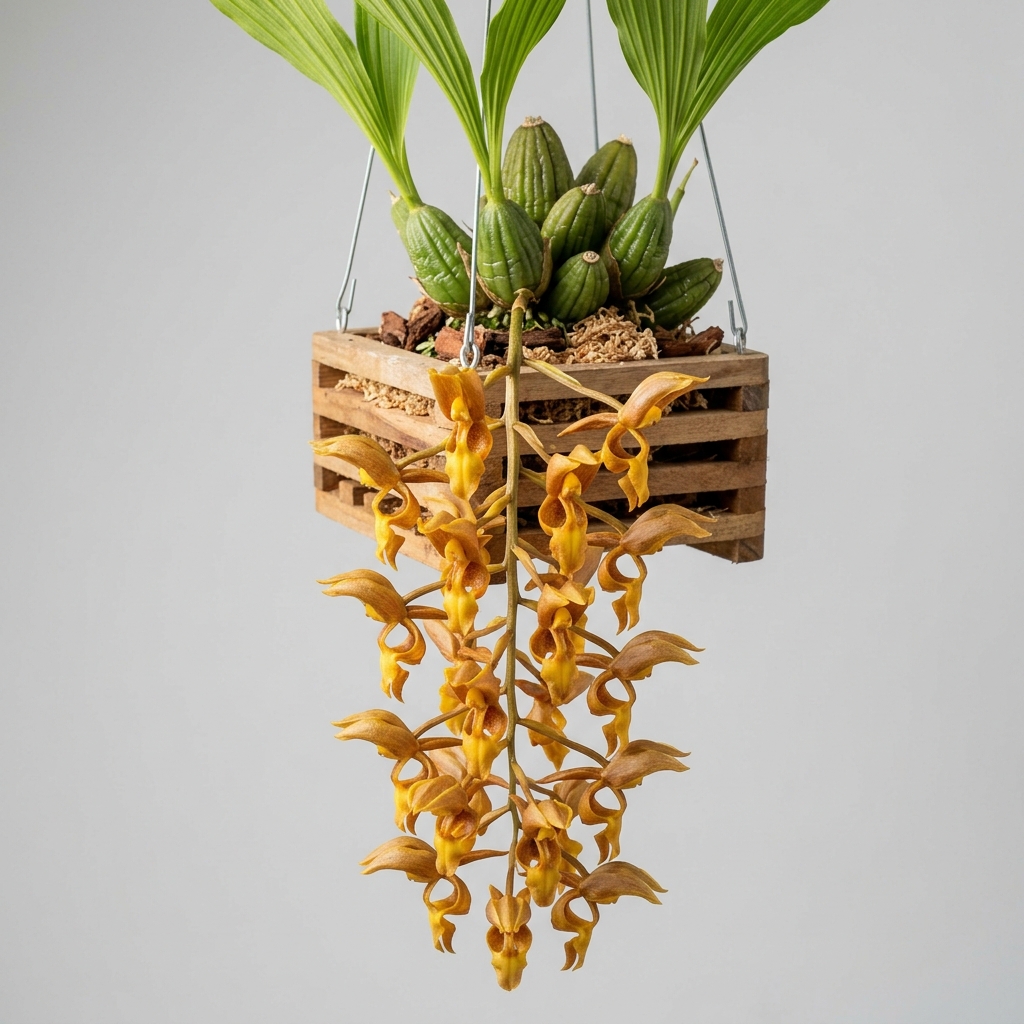
Gongora Galeata is a highly distinctive sympodial orchid species native to the damp, mountainous forests of Mexico, widely celebrated by collectors for its unusual, bird-like floral morphology and pendulous blooming habit. Often referred to as the helmet orchid, this species produces cascading inflorescences that drape elegantly over the sides of its container, making it a spectacular choice for hanging baskets.
Growers value this orchid not only for its architectural growth habit and pleated, bright green foliage but also for its rich, spicy fragrance that can easily fill an entire growing room. While it requires specific attention to humidity and moisture to thrive, its robust growth and reliable seasonal flowering make it an accessible and rewarding choice for intermediate orchid enthusiasts.
💡 Did You Know?
The Gongora is named after Antonio Caballero y Góngora, a bishop of Cordoba and viceroy of New Granada. Gongora Galeata relies on a highly specialized pollination mechanism where male euglossine bees are attracted to the flower's intense , collecting the aromatic oils to use as pheromones to attract female bees.
🌿 Botanical Overview
Gongora Galeata is characterized by its clustered, egg-shaped pseudobulbs that are deeply ribbed and topped by two thin, heavily veined, or plicate, leaves. This vegetative structure is typical of the subtribe Stanhopeinae, to which the genus belongs. The root system is relatively fine and fibrous, adapted to absorbing moisture rapidly from the humid air and organic debris of its native canopy habitats.
In nature, these orchids grow epiphytically on moss-covered tree trunks and branches where they receive excellent air circulation and filtered sunlight. The evolutionary adaptation of pendulous flower spikes allows the plant to present its blooms downward, targeting specific insect pollinators that are attracted to its complex chemical compounds.
🌸 Flower Characteristics
The flowers of Gongora Galeata are remarkably complex, resembling tiny, upside-down birds or helmets in flight. The sepals and petals are typically a warm shade of yellow, orange, or brownish-tan, often with subtle spotting or flushing. The dorsal sepal is hooded over the column, while the lateral sepals are reflexed, giving the bloom its aerodynamic appearance.
The lip, or labellum, is highly modified and structured to guide pollinators, featuring a complex arrangement of horns and fleshy structures. Individual flowers are moderately sized, usually measuring around one to two inches across, and are borne in abundance on long, pendulous spikes that can carry anywhere from 10 to 30 blooms simultaneously.
Fragrance & Bloom Profile
One of the most compelling attributes of Gongora Galeata is its intense, spicy fragrance. The scent is commonly described as a mixture of warm cinnamon, allspice, and cloves, which is emitted primarily during the morning and early afternoon hours when its natural pollinators are active.
While the individual flowers are relatively short-lived compared to some other orchid genera—typically lasting between one and two weeks—the sheer volume of blooms and the potential for multiple spikes to mature at slightly different times can extend the overall display. The fragrance begins almost immediately upon the opening of the buds and remains strong until the flowers fade.
Parentage & Hybrid Lineage
As a naturally occurring species, Gongora Galeata does not have a hybrid parentage, though various selected clones and cultivars exist within cultivation to highlight specific color forms or exceptional vigor. In orchid registration databases, it is recognized as a primary species and has been used occasionally in intergeneric hybridization within the Stanhopeinae subtribe.
Because wild-collected specimens are protected under conservation laws, modern growers should seek out plants propagated through seed or tissue culture by reputable nurseries. When purchasing, documentation regarding specific clonal names or line-bred variations may be limited, so buyers should rely on trusted orchid vendors for accurate labeling.
🌱 Growing Conditions
To cultivate Gongora Galeata successfully, growers must replicate its native cloud forest environment. It thrives in medium to bright, filtered light, similar to the conditions preferred by many Miltoniopsis or Cattleya orchids. Direct, unfiltered afternoon sun should be avoided, as the thin, pleated leaves are highly susceptible to scorching.
💡 Care Tip
Always hang your Gongora Galeata at eye level or higher. Because the flower spikes grow downward through the bottom of the basket, hanging the plant allows you to appreciate the pendulous blooms and prevents the delicate spikes from touching flat surfaces.
Temperature: wise, this orchid prefers intermediate to warm conditions, with daytime temperatures ranging from 70°F to 80°F (21°C to 27°C) and a slight drop at night to stimulate healthy growth. High humidity is crucial, ideally maintained between 60% and 80%, accompanied by continuous, gentle air movement to prevent fungal pathogens from settling on the foliage.
Watering, Feeding & Potting Media
Because of its pendulous flowering habit, Gongora Galeata is almost exclusively grown in open slatted wooden baskets or net pots lined with sphagnum moss. This setup allows the flower spikes to emerge from the base of the pseudobulbs and grow downward without obstruction. A potting medium consisting of fine-grade fir bark mixed with sphagnum moss and perlite works exceptionally well to retain moisture while allowing rapid drainage.
Watering should be frequent and consistent, especially during the active spring and summer growing seasons. The medium should never be allowed to dry out completely, though it must not remain soggy or waterlogged. Feed the plant weekly with a diluted, balanced orchid fertilizer, reducing the frequency and strength during the cooler winter months when growth naturally slows.
Blooming Season & Care Notes
The primary blooming season for Gongora Galeata typically occurs in the late summer and autumn, although well-established plants may produce occasional spikes at other times of the year. The initiation of flower spikes is often triggered by the natural seasonal drop in night temperatures and a slight reduction in day length.
When the pendulous spikes begin to emerge from the bottom or sides of the basket, care must be taken not to disturb the plant or change its orientation abruptly, as this can cause the developing buds to blast. Repotting or dividing should only be performed in the spring, just as new vegetative growth and fresh root tips begin to appear, ensuring the plant has ample time to recover before the next blooming cycle.
⚠️ Common Issues
⚠️ Common Mistake
A frequent mistake is growing this orchid in a standard solid pot. The downward-growing flower spikes will get trapped against the bottom and sides of the pot, causing the buds to rot before they can ever emerge or open.
- Root Rot:
Caused by compacted, poorly draining potting media or overwatering, leading to soft, black roots and declining pseudobulbs. - Bud Blast:
Sudden dropping of flower buds before opening, often triggered by rapid shifts in temperature, low humidity, or drafts. - Leaf Spotting: Fungal or bacterial spots on the thin, pleated leaves, usually resulting from water sitting on the foliage in stagnant air.
- Spider Mites:
Common pests that thrive in dry conditions, feeding on the undersides of the thin leaves and causing silvery webbing and stippling. - Dehydration:
Shriveled pseudobulbs and accordion-like new leaf growth, indicating insufficient watering or low ambient humidity.
❓ Frequently Asked Questions
Why are the leaves on my Gongora Galeata crinkling like an accordion?
Accordion-like growth on new leaves is a classic sign of inconsistent watering or low humidity during the active growth phase. Ensure the potting medium remains evenly moist and increase ambient humidity to prevent the emerging leaves from sticking and folding.
Can I grow Gongora Galeata in a standard plastic pot?
While it is possible to grow young plants in standard pots, it is highly discouraged for mature specimens. Because the flower spikes grow downward from the base of the pseudobulbs, they will become trapped and rot inside a solid plastic pot. Hanging baskets or net pots are essential for successful blooming.
How long do the flowers of Gongora Galeata typically last?
Individual flowers generally last between 7 to 14 days. However, a mature, healthy plant can produce multiple spikes that open sequentially, extending the overall flowering display over several weeks.
What should I do if my orchid stops producing its signature fragrance?
The fragrance of this species is highly dependent on light and temperature. Ensure the plant receives bright, filtered light and that temperatures are warm during the day, as the chemical compounds responsible for the scent are typically released in response to morning warmth.
⭐ Final Growing Notes
Gongora Galeata remains one of the most rewarding and fascinating orchids for collectors who can accommodate its hanging growth habit and humidity requirements. By providing consistent moisture, excellent air movement, and a suitable basket environment, growers are rewarded with an annual display of intricately structured, highly fragrant blooms that represent some of the most remarkable evolutionary adaptations in the orchid family.
⚕️ Health, Safety & Edibility
Understanding how a plant interacts with people, pets, and the surrounding environment is part of responsible cultivation. This section uses conservative, general guidance and does not replace professional medical or veterinary advice.
Human Safety: Species-specific human toxicity data for Gongora Galeata is limited. Use conservative handling practices and avoid intentional consumption.
Pet Safety: Pet-specific safety information for Gongora Galeata is limited, so keep it away from animals that commonly chew plants.
Edibility: Gongora Galeata should not be treated as edible. Ornamental specimens may contain natural irritants or horticultural residues that make them unsuitable for consumption.
Skin Contact: Skin irritation is not well documented for this plant, but gloves are sensible when repotting, pruning, or handling potting media.
🌱 Propagation Tip
Propagate mature specimens by division during spring repotting. Ensure each division has at least three to four healthy, mature pseudobulbs with active root systems. Avoid dividing the plant too frequently, as larger specimens produce far more spectacular, multi-spike displays.
⭐ Expert Advice
To maximize bloom production, provide a slight cooling period in late summer by allowing night temperatures to drop into the low 60s Fahrenheit. This natural differential, combined with a very slight reduction in , helps trigger robust spike initiation.

Leave A Comment