

Dendrobium Dearei is a highly prized species orchid native to the Philippines, celebrated among collectors for its pristine white blossoms and exceptionally long-lasting blooms. Belonging to the nigrohirsute section of the genus Dendrobium, this elegant epiphyte features robust, cane-like pseudobulbs covered in fine black hairs, presenting a striking contrast even when not in flower.
Growers value this orchid not only for its pristine, paper-white flowers with contrasting green throats but also for its adaptable nature under intermediate to warm conditions. Whether grown in a greenhouse, on a bright windowsill, or under dedicated grow lights, it rewards proper care with spectacular, multi-floral displays that can persist for several months.
💡 Did You Know?
Dendrobium Dearei belongs to the Formosae section of orchids, which are uniquely characterized by fine, dark hairs on their stems and leaf sheaths. These hairs help the plant capture moisture from fog and dew in its native Philippine forest canopy, showcasing a fascinating evolutionary adaptation to its epiphytic lifestyle.
🌿 Botanical Overview
Dendrobium Dearei is an epiphytic orchid native to the lowland forests of the Philippines, particularly Mindoro and Mindanao. It grows naturally on tree trunks and branches where it receives bright, filtered sunlight and excellent air circulation. In its native habitat, the plant experiences warm temperatures year-round with high humidity and seasonal rainfall patterns.
The vegetative structure is characterized by erect, cane-like pseudobulbs that can reach heights of 30 to 60 centimeters or more under optimal cultivation. A defining feature of this species, and others in its section (Formosae), is the presence of tiny, dark brown to black hairs covering the leaf sheaths and young stems. These hairs are a natural botanical characteristic and should not be mistaken for pest damage or disease.
🌸 Flower Characteristics
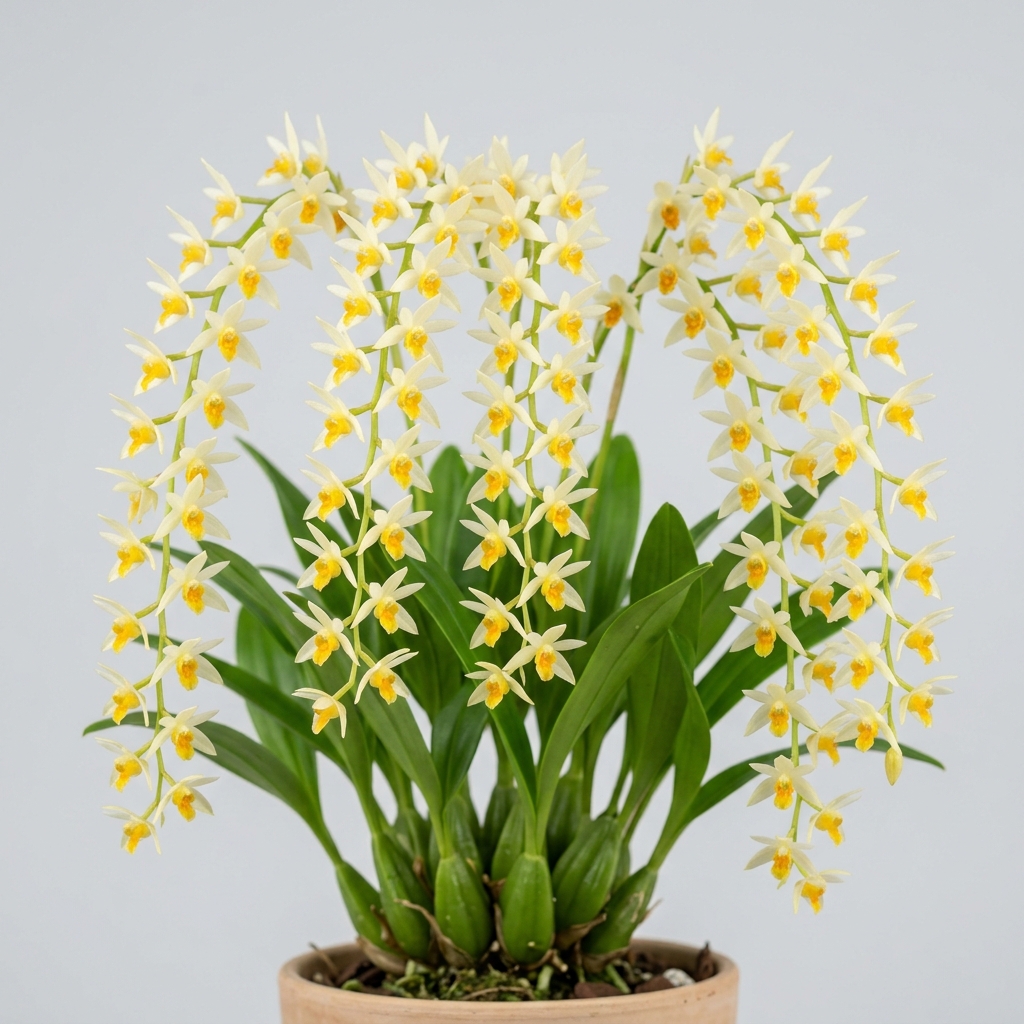
The flowers of Dendrobium Dearei are renowned for their crystalline white texture and structural elegance. Individual blooms typically measure 5 to 7 centimeters in diameter and are produced in clusters from the upper nodes of both old and new canes. The pristine white petals and sepals form a clean, star-like shape that stands out beautifully against the green foliage.
The prominent lip, or labellum, is marked by a soft, yellowish-green to emerald-green throat, which serves as a striking focal point. The flowers are remarkably durable, often remaining fresh on the plant for up to three months if kept in cool, stable conditions. This longevity makes it a favorite for exhibition and home display alike.
Fragrance & Bloom Profile
While some growers report a very subtle, sweet scent during the warmest hours of the day, the fragrance of Dendrobium Dearei is generally considered faint or non-existent in many cultivated specimens. The primary appeal of this orchid lies in its visual presentation rather than its olfactory profile, making it an excellent choice for growers sensitive to strong floral scents.
The blooming cycle is highly rewarding, as flowers emerge in dense, arching racemes. Because the blooms are exceptionally long-lasting, a single specimen can remain in peak display for a significant portion of the year, especially when multiple canes mature at slightly different times. The flowers open sequentially, extending the overall show.
Parentage & Hybrid Lineage
Dendrobium Dearei is a naturally occurring species rather than a man-made hybrid. First described in the late 19th century, it has been used extensively in hybridization programs to introduce pure white coloration, flat flower form, and long-lasting bloom traits to modern Dendrobium hybrids.
Because it is a true species, its genetic lineage is direct and stable. When purchasing this orchid, growers should look for reputable nurseries that propagate specimens via seed or tissue culture rather than collecting them from the wild, ensuring both conservation and plant vigor. This helps preserve the natural populations of this beautiful Philippine native.
🌱 Growing Conditions
To cultivate Dendrobium Dearei successfully, growers should mimic its native tropical canopy environment. It thrives in bright, filtered light, similar to the conditions preferred by many Cattleya orchids. Direct midday sun should be avoided to prevent leaf scorch, but adequate light is essential for robust cane development and abundant flowering.
💡 Care Tip
To prevent fungal issues, always water your orchid early in the morning so the foliage and cane crevices have ample time to dry before nightfall. Good air movement is essential to keep the air fresh around the root zone.
Temperature ranges should ideally be warm to intermediate, with daytime temperatures between 24°C and 30°C (75°F to 86°F) and a slight drop at night to around 18°C to 21°C (64°F to 70°F). High relative humidity of 60% to 80% is highly beneficial, accompanied by continuous, gentle air movement to prevent fungal pathogens from settling on the foliage.
Watering, Feeding & Potting Media
During its active growth phase in spring and summer, Dendrobium Dearei requires frequent watering to keep the potting medium evenly moist but never waterlogged. The roots need to breathe, so a highly porous medium is critical. A mix of medium-grade fir bark, perlite, and charcoal works exceptionally well, though some growers prefer tree fern fiber or mounting the orchid on cork slabs in high-humidity environments.
Fertilize weekly with a balanced, diluted orchid fertilizer at one-quarter to one-half strength during active growth. As growth slows in the late autumn and winter, reduce watering frequency and ease off on fertilizer, allowing the medium to dry out slightly more between waterings, though this species does not require a severe, bone-dry winter rest.
Blooming Season & Care Notes
Dendrobium Dearei typically initiates its main blooming cycle in late spring or summer, though flowers can appear at other times of the year depending on local growing conditions. Buds develop along the upper nodes of mature canes, and once open, they should be kept away from drafts, sudden temperature drops, or direct misting to prevent premature spotting or drop.
After flowering is complete, do not cut the old canes unless they are completely dry, yellow, and shriveled. These canes store vital water and nutrients that support new growth. Repotting should only be done when new root growth is visible at the base of the newest cane, typically in early spring, using a pot that just accommodates the root mass to prevent excess moisture retention.
⚠️ Common Issues
⚠️ Common Mistake
Avoid giving this orchid a severe, bone-dry winter rest. Unlike some deciduous Dendrobium species, Dendrobium Dearei is evergreen and requires moisture year-round to prevent its canes from shriveling and losing vigor.
- Root Rot:
Caused by overwatering or compacted, decomposing potting media that deprives roots of oxygen. - Bud Blast:
Sudden dropping of unopened buds, often triggered by rapid changes in temperature, low humidity, or drafts. - Dehydration:
Shriveled pseudobulbs and wrinkled leaves indicate insufficient watering or a compromised root system unable to absorb moisture. - Pests:
Mealybugs, spider mites, and scale can occasionally hide in the leaf axils or under the fine black hairs of the canes; treat promptly with insecticidal soap or neem oil. - Fungal Leaf Spotting: Dark spots on leaves can develop if water sits on the foliage overnight without adequate air circulation.
❓ Frequently Asked Questions
Why are there black hairs on my Dendrobium Dearei canes?
The fine black hairs on the pseudobulbs and leaf sheaths are a natural botanical characteristic of the Formosae section of Dendrobium orchids. They are completely normal and do not indicate pest damage or disease.
How often should I water my Dendrobium Dearei in winter?
During the winter rest, reduce watering frequency so the potting medium dries out almost completely between waterings, but do not allow the canes to shrivel severely. This species does not require a prolonged, bone-dry rest like some deciduous Dendrobium species.
Can I grow Dendrobium Dearei under LED grow lights?
Yes, this orchid adapts well to indoor cultivation under high-output LED grow lights. Position the plant so it receives bright, indirect light for 12 to 14 hours a day, ensuring the leaves do not touch the light fixtures to avoid heat damage.
Why are the buds on my orchid falling off before opening?
This issue, known as bud blast, is typically caused by environmental stress such as low humidity, cold drafts, sudden temperature fluctuations, or dry potting media during the bud development stage.
⭐ Final Growing Notes
Dendrobium Dearei remains a classic choice for orchid enthusiasts seeking a reliable, show-stopping white bloom. By providing consistent warmth, high humidity, and bright, filtered light, growers can enjoy its pristine blossoms year after year. Its elegant growth habit and exceptionally long-lasting flowers make it a rewarding addition to any diverse orchid collection.
⚕️ Health, Safety & Edibility
Understanding how a plant interacts with people, pets, and the surrounding environment is part of responsible cultivation. This section uses conservative, general guidance and does not replace professional medical or veterinary advice.
Human Safety: No published evidence currently identifies species-specific toxicity concerns for Dendrobium Dearei during normal handling. As with most ornamental plants, it should not be intentionally consumed.
Pet Safety: Published information does not indicate that this orchid commonly poses a toxicity concern for cats or dogs. However, chewing leaves, flowers, roots, or potting media may still cause mild digestive upset.
Edibility: This orchid is cultivated for ornamental display rather than food. Ornamental plants may carry fertilizers, pesticides, or other horticultural treatments that make them unsuitable for consumption.
Skin Contact: Routine handling is not generally associated with skin irritation. Gardeners with sensitive skin may prefer wearing gloves when repotting, pruning, or handling potting media.
🌱 Propagation Tip
While division of large clumps is possible during repotting, ensure each division has at least three to four healthy, mature pseudobulbs with active root systems to guarantee successful establishment and future blooming.
⭐ Expert Advice
When repotting, choose the smallest pot possible that can accommodate the root system for the next two years. Dendrobiums prefer to be slightly root-bound, and excess can retain too much moisture, leading to root rot.

Leave A Comment