

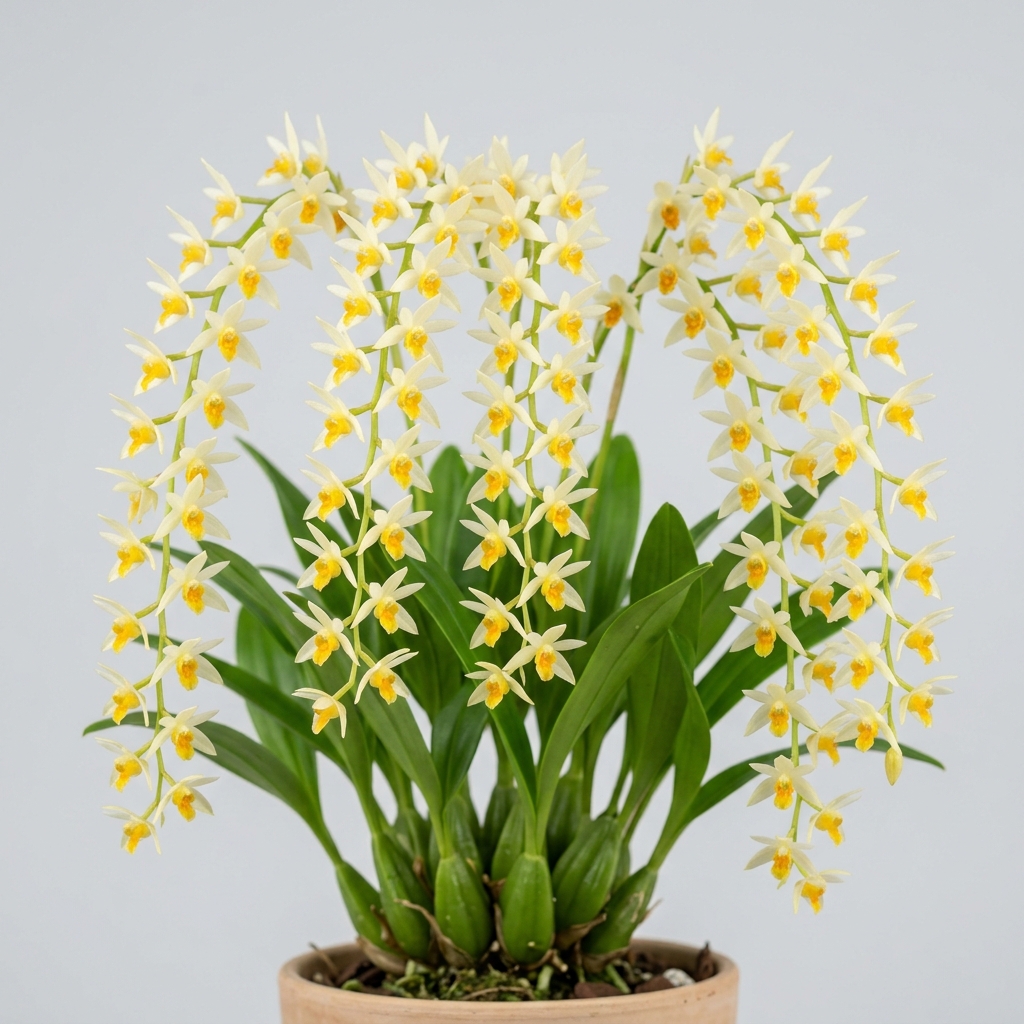
Dendrobium Primulinum is a highly celebrated deciduous orchid species native to the montane forests of Southeast Asia, prized by collectors for its spectacular pendulous growth habit and delicate spring blossoms. This epiphytic orchid naturally grows on tree trunks, producing long, cane-like pseudobulbs that drape gracefully downward, making it an useful selection for basket cultivation or mounted displays. As the winter chill sets in, the plant sheds its leaves in a natural dormancy cycle, preparing for a dramatic burst of color when warmer temperatures return.
Growers are particularly drawn to this species for its striking contrast between the bare, silvery canes of winter and the soft, pastel flowers that emerge in early spring. The blossoms typically feature pale pink or mauve petals and sepals paired with a large, primrose-yellow lip that gives the orchid its specific epithet. While it requires a disciplined approach to seasonal watering, mastering its growth cycle rewards the enthusiast with a curtain of fragrant, long-lasting blooms that epitomize the beauty of the genus Dendrobium.
💡 Did You Know?
The specific epithet primulinum translates to primrose-colored, referencing the soft, delicate yellow hue of the orchid's prominent lip. In its native Asian habitats, this species grows as an epiphyte at elevations up to 1,600 meters, where it experiences distinct wet and dry seasons that dictate its annual growth and flowering cycles.
🌿 Botanical Overview
Dendrobium Primulinum is characterized by its pendulous, tufted pseudobulbs, which can reach lengths of 30 to 50 centimeters. These fleshy, cane-like structures are initially upright but naturally arch downward as they mature and become heavier. During the active growing season in spring and summer, the canes are clothed in alternate, oblong leaves that serve to capture light and store energy for the upcoming blooming cycle.
As autumn approaches, the plant undergoes a distinct physiological shift. The leaves begin to yellow and drop, leaving behind bare, silvery-grey canes marked by prominent nodal rings. This deciduous habit is a survival mechanism designed to conserve moisture during the dry winter monsoons of its native habitat. It is from these seemingly lifeless nodes that the flower buds will develop and emerge in the later spring.
🌸 Flower Characteristics
The flowers of Dendrobium Primulinum are a masterclass in delicate coloration and structure. Each blossom typically measures between 4 to 8 centimeters in diameter, emerging individually or in pairs from the nodes of the leafless canes. The sepals and petals are narrow and spread wide, presenting a soft shade of pale rose, lavender, or light pink.
The defining feature of the flower is its prominent, trumpet-shaped lip, or labellum. The lip is broad, finely fringed or pubescent, and displays a soft primrose-yellow hue, often accented with faint purple striations in the throat. The flowers are borne on short pedicels, aligning themselves along the length of the pendulous canes to create a cascading floral display that is highly sought after in orchid exhibitions.
Fragrance & Bloom Profile
This orchid is widely celebrated for its sweet, pleasant fragrance, which many growers liken to the scent of fresh primroses or honey. The scent is most pronounced during the morning hours when warmth and light stimulate the release of volatile compounds from the flowers. Individual blooms can remain fresh for two to four weeks, depending on environmental conditions. To maximize the lifespan of the flowers, growers should keep the plant in cool, buoyant air and avoid spraying water directly onto the delicate petals.
Parentage & Hybrid Lineage
As a naturally occurring species rather than a man-made hybrid, Dendrobium Primulinum possesses a stable genetic profile shaped by natural selection in the wild. It belongs to the section Dendrobium within the genus, sharing close evolutionary ties with species like Dendrobium aphyllum and Dendrobium parishii. While its wild origin is well-documented across countries such as Thailand, Vietnam, Nepal, and southwestern China, it has also been utilized by hybridizers to introduce pendulous growth habits, cold tolerance, and soft pastel colors into modern Dendrobium grexes.
🌱 Growing Conditions
To cultivate Dendrobium Primulinum successfully, one must replicate the seasonal monsoonal climate of its native habitat. During the active growing phase from spring through early autumn, the plant thrives in bright, filtered light, equivalent to about 50% shade. It prefers warm to intermediate temperatures, with daytime highs of 24°C to 30°C and a slight drop at night to encourage robust vegetative growth.
💡 Care Tip
To ensure a spectacular spring bloom, place your orchid in a cooler room near a bright window during winter. The combination of temperatures around 12°C to 15°C and bright, indirect is essential for triggering bud development along the bare canes.
Good air circulation is critical at all times to prevent fungal pathogens from establishing on the foliage or roots. In the winter, the plant requires a dramatic shift in conditions. It must be kept in a cool environment, with night temperatures dropping to 10°C to 15°C, and exposed to brighter, more direct light to stimulate the initiation of flower buds along the matured canes.
Watering, Feeding & Potting Media
Watering practices must be strictly divided into two distinct phases. During the spring and summer, when new shoots and roots are actively developing, Dendrobium Primulinum requires copious watering and high humidity. The potting medium or mount should be watered thoroughly as soon as it approaches dryness. Weekly applications of a balanced, diluted orchid fertilizer support the rapid development of the new canes.
Because of its pendulous growth habit, this species is best grown mounted on cork bark or tree fern plaques, or planted in hanging wooden baskets filled with a highly porous medium such as coarse fir bark or charcoal. These setups allow the roots to dry rapidly after watering, mimicking the epiphytic conditions of the wild. In late autumn, fertilizer must be discontinued, and watering must be reduced to occasional mistings to prevent the canes from shriveling excessively.
Blooming Season & Care Notes
The highly anticipated blooming season occurs in late winter to early spring, triggered by the cool, dry winter rest. As the flower buds begin to swell at the nodes of the bare canes, growers can gradually increase watering, though fertilizer should be withheld until the flowers have faded and new vegetative growth appears at the base of the plant. After blooming, any old, shriveled canes should not be cut off unless they are completely dry and brown, as they continue to store water and nutrients that support the emerging new leads.
⚠️ Common Issues
⚠️ Common Mistake
The most common error is the plant normally during autumn and winter. Continuing a regular schedule when the leaves begin to drop will rot the root system and cause the plant to produce vegetative shoots instead of flowers.
- Bud Blast:
Sudden temperature fluctuations, drafts, or premature watering during the bud development stage can cause the emerging buds to yellow and drop before opening. - Root Rot:
Overwatering during the winter rest period or using a dense, poorly draining potting medium will quickly lead to root decay. - Spider Mites and Mealybugs: These pests can target the tender new growth in spring; regular inspections and treatment with insecticidal soap are recommended.
- Lack of Flowering: Failing to provide a sufficiently dry and cool winter rest often results in the plant producing vegetative keikis (baby plants) at the nodes instead of flower buds.
❓ Frequently Asked Questions
Why is my Dendrobium Primulinum losing all its leaves in autumn?
This is a completely natural, deciduous process for this species. Dendrobium Primulinum sheds its leaves in late autumn to conserve moisture during its dry winter rest. Do not panic or increase watering; this leaf drop is necessary for the plant to initiate flower buds for the spring bloom.
How dry should I keep the orchid during its winter rest?
The winter rest should be quite dry. Water should be withheld almost entirely, providing only occasional light misting if the canes begin to shrivel severely. A slight wrinkling of the canes is normal and acceptable, but they should not become completely desiccated or flat.
Can I grow Dendrobium Primulinum in a standard plastic pot?
While possible, it is not ideal due to the plant’s naturally pendulous growth habit. The long canes will drape over the sides, making the pot top-heavy and prone to tipping. Growing this species on a mount or in a hanging basket allows the canes to cascade naturally and ensures excellent root aeration.
What should I do with keikis that grow on the canes?
If the plant produces keikis (baby offsets) along the canes, allow them to develop roots that are at least two to three inches long. Once the roots are established, you can gently twist the keiki off the parent cane and pot or mount it individually to create a new plant.
⭐ Final Growing Notes
Dendrobium Primulinum is a rewarding species that brings a touch of wild elegance to any orchid collection. While its strict requirement for a dry winter rest can be intimidating for beginners, adhering to this seasonal rhythm is the key to unlocking its full potential. By providing bright light, abundant summer moisture, and a cool, dry winter dormancy, growers can enjoy the breathtaking spectacle of cascading, pastel-pink blossoms year after year.
⚕️ Health, Safety & Edibility
Understanding how a plant interacts with people, pets, and the surrounding environment is part of responsible cultivation. This section uses conservative, general guidance and does not replace professional medical or veterinary advice.
Human Safety: No published evidence currently identifies species-specific toxicity concerns for Dendrobium Primulinum during normal handling. As with most ornamental plants, it should not be intentionally consumed.
Pet Safety: Published information does not indicate that this orchid commonly poses a toxicity concern for cats or dogs. However, chewing leaves, flowers, roots, or potting media may still cause mild digestive upset.
Edibility: This orchid is cultivated for ornamental display rather than food. Ornamental plants may carry fertilizers, pesticides, or other horticultural treatments that make them unsuitable for consumption.
Skin Contact: Routine handling is not generally associated with skin irritation. Gardeners with sensitive skin may prefer wearing gloves when repotting, pruning, or handling potting media.
🌱 Propagation Tip
This species readily produces keikis along its canes if winter conditions are too warm or wet. Wait until these offsets develop several healthy roots at least two inches long before gently detaching and mounting them on cork bark.
⭐ Expert Advice
When mounting this orchid, secure it so the canes point downwards or horizontally. This mimics its natural cliff-side and tree-trunk growth habit, preventing water from pooling in the crown of new growths and reducing the risk of rot.

Leave A Comment