
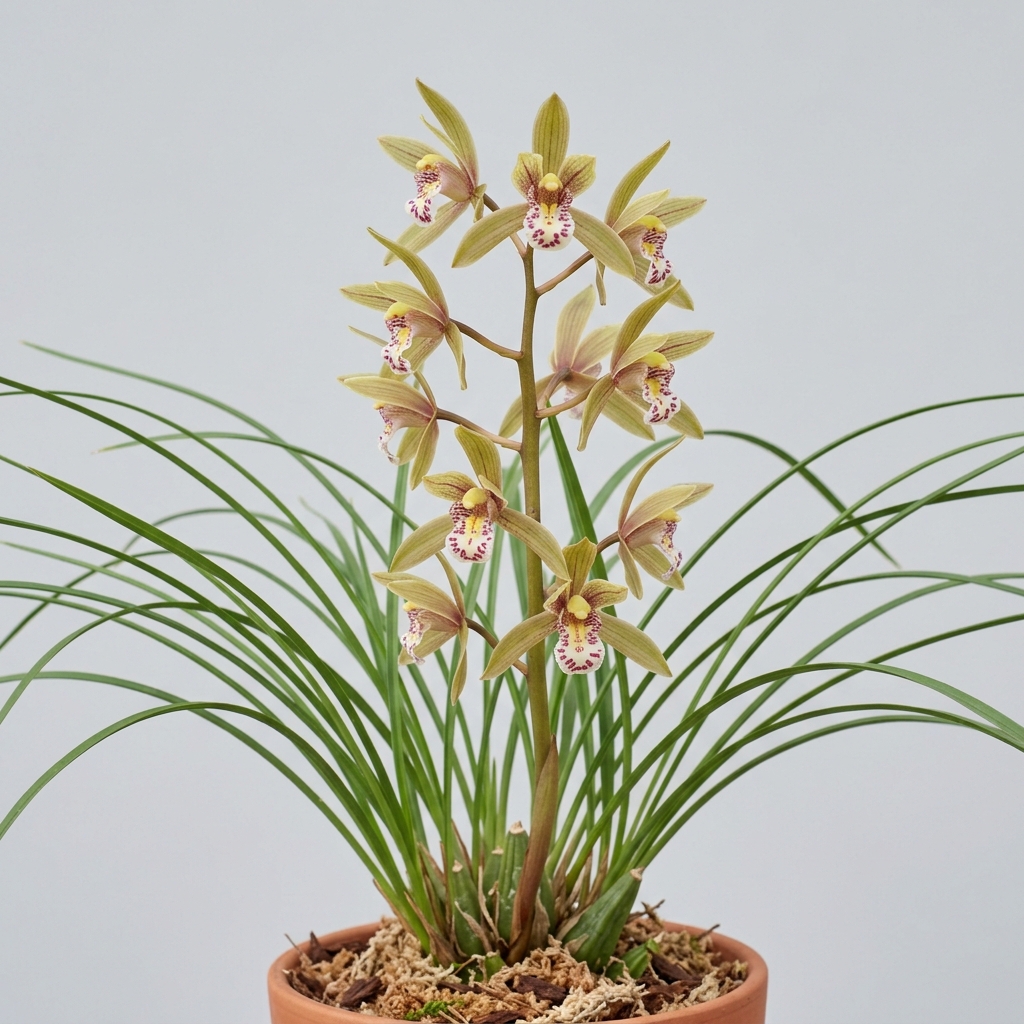
Cymbidium Cyperifolium is a highly esteemed orchid species celebrated for its elegant, grass-like foliage and delicately scented blossoms. Originating from the mountainous regions of East Asia and the Himalayas, this orchid brings a refined, classical aesthetic to any collection. Its slender, arching leaves closely resemble sedge grass, allowing it to blend seamlessly into foliage displays even when not in bloom.
Orchid enthusiasts value this species for its understated beauty and resilient nature. Unlike some of its larger, showier hybrid relatives, Cymbidium Cyperifolium offers a subtle charm characterized by slender flower spikes and a sweet, lingering fragrance. It is an excellent choice for growers seeking a traditional Asian Cymbidium that thrives under cool to intermediate conditions.
💡 Did You Know?
The specific epithet cyperifolium translates to sedge-like leaves, referencing the plant's remarkable visual similarity to common sedge grass. This evolutionary adaptation allows the orchid to blend seamlessly into its native grassy forest floors, providing natural camouflage from herbivores when the plant is not in bloom.
🌿 Botanical Overview
Cymbidium Cyperifolium is a terrestrial or lithophytic orchid native to high-altitude forests across Southern Asia, including parts of India, Nepal, China, and Vietnam. In its natural habitat, it grows in organic litter on forest floors or nestled in rocky crevices where moisture is consistent but drainage is rapid. The plant features small, tightly clustered pseudobulbs that are almost entirely concealed by the bases of its long, linear leaves.
The foliage is a defining characteristic of this species. The leaves are remarkably narrow, thin, and arching, closely mimicking the appearance of sedge grass. This grass-like growth habit makes it highly distinct from the broad-leaved tropical Cymbidiums commonly found in commercial nurseries, lending it a delicate, airy presence in any growing space.
🌸 Flower Characteristics
The inflorescence of Cymbidium Cyperifolium is an upright to slightly arching spike that emerges from the base of the pseudobulb. Each spike typically carries between five and fifteen flowers, depending on the maturity and vigor of the plant. The flowers are moderately sized, usually measuring around four to six centimeters in diameter, and are arranged elegantly along the upper portion of the stem.
The sepals and petals are narrow and lanceolate, presenting a color palette that ranges from pale apple-green to yellowish-brown, often adorned with subtle longitudinal reddish-brown veins. The lip, or labellum, is the visual centerpiece of the flower; it is typically cream-colored or pale yellow, heavily marked with striking reddish-purple spots or stripes. This contrast creates a sophisticated, intricate pattern that rewards close inspection.
Fragrance & Bloom Profile
One of the primary reasons growers cultivate Cymbidium Cyperifolium is its exceptional fragrance. The flowers emit a powerful, sweet, and clean floral scent that can easily fill a small room, particularly during the warmer hours of the morning. This fragrance is often compared to classic Asian miniature Cymbidiums, blending notes of honey and light citrus.
The blooms are remarkably long-lasting, often remaining fresh on the plant for six to eight weeks if kept in cool, stable conditions. The combination of delicate, grass-like foliage and highly fragrant, long-lived flowers makes this species a favorite for indoor display during its blooming cycle.
Parentage & Hybrid Lineage
As a naturally occurring species, Cymbidium Cyperifolium does not have a hybrid parentage. It represents a distinct evolutionary branch within the genus Cymbidium, adapted specifically to cool, mountainous environments. While it is primarily grown as a species by collectors, its desirable traits—such as its compact size, grass-like foliage, and intense fragrance—have occasionally made it a subject of interest for hybridizers aiming to introduce cold-tolerance and scent into modern miniature Cymbidium lines.
In horticultural literature, some variations and subspecies are recognized based on geographic origin and minor floral differences, but these are generally treated under the broad umbrella of the species in general cultivation. Growers should ensure they purchase from reputable nurseries to guarantee true-to-type species specimens.
🌱 Growing Conditions
To cultivate Cymbidium Cyperifolium successfully, growers should mimic its native mountain forest habitat. It thrives in bright, filtered light, similar to the dappled sunlight found under a forest canopy. Direct midday sun should be avoided as it can easily scorch the thin, grass-like leaves, but insufficient light will prevent the plant from producing flower spikes.
💡 Care Tip
To maintain the ideal of fifty to seventy percent without stagnant air, place a small circulating fan near your growing area. Good airflow is essential for preventing fungal pathogens on the thin, grass-like foliage of this species.
Temperature management is crucial for this species. It prefers cool to intermediate temperatures, with daytime highs around 20 to 25 degrees Celsius (68 to 77 degrees Fahrenheit) and a distinct drop at night to around 10 to 15 degrees Celsius (50 to 59 degrees Fahrenheit). A significant night-time temperature drop in late summer and autumn is particularly important, as this environmental cue triggers the initiation of flower spikes.
Watering, Feeding & Potting Media
Cymbidium Cyperifolium requires a potting medium that retains moisture while allowing excellent aeration and drainage. A mix composed of fine-grade orchid bark, perlite, and a small amount of chopped sphagnum moss or peat works exceptionally well. Because of its semi-terrestrial nature, it appreciates a slightly more water-retentive medium than epiphytic orchids, but it must never sit in stagnant water.
Watering should be frequent enough to keep the medium evenly moist but not soggy. During the active growing season in spring and summer, water the plant thoroughly as soon as the top layer of the medium begins to dry. Reduce watering frequency in the winter when growth slows. Feed the orchid with a diluted, balanced orchid fertilizer every two to three weeks during the growing season, flushing the pot with pure water periodically to prevent salt buildup.
Blooming Season & Care Notes
The typical blooming season for Cymbidium Cyperifolium spans from autumn through early winter. As the flower spikes begin to emerge from the base of the pseudobulbs, it is important to keep the plant stable and avoid moving it to areas with drastic temperature fluctuations or drafty conditions, which can cause bud drop.
Once the flowers fade, the old spikes should be cut back to the base of the pseudobulb using sterilized cutting tools. Repotting is best performed in spring, just as new vegetative growth begins. This species dislikes frequent root disturbance, so repotting should only be done every two to three years, or when the potting medium begins to break down and lose its structure.
⚠️ Common Issues
⚠️ Common Mistake
A frequent error is keeping this orchid too dry during its active summer growing phase. Unlike some epiphytic orchids, this semi-terrestrial species prefers consistent, even moisture and can suffer severe leaf tip dieback if allowed to dry out completely.
- Root Rot:
Caused by overwatering or compacted, poorly draining potting media. Ensure the pot has adequate drainage holes and the medium remains airy. - Leaf Tip Burn: Often a sign of low humidity, underwatering, or excessive salt buildup from fertilizers. Use pure water and flush the pot regularly.
- Bud Blast:
The sudden dropping or drying of flower buds, usually triggered by sudden changes in temperature, low humidity, or drafty air currents. - Spider Mites:
These pests thrive in warm, dry conditions and can quickly damage the thin, grass-like foliage. Maintain adequate humidity and wipe leaves regularly. - Scale and Mealybugs: Often found hiding near the bases of the tightly packed leaves or under the pseudobulb sheaths. Treat promptly with insecticidal soap or horticultural oil.
❓ Frequently Asked Questions
How do I trigger blooming in Cymbidium Cyperifolium?
To encourage flower spike initiation, ensure the plant experiences a distinct drop in night-time temperatures during the late summer and early autumn. A drop of about 8 to 10 degrees Celsius (15 to 18 degrees Fahrenheit) between day and night is usually necessary to stimulate blooming.
Can I grow Cymbidium Cyperifolium indoors under LED lights?
Yes, this species can be successfully grown indoors under high-quality, full-spectrum LED grow lights. Position the lights to provide bright, indirect illumination, and ensure you can still provide the necessary cool night-time temperatures required for blooming.
Why are the leaf tips of my orchid turning brown?
Brown leaf tips are commonly caused by dry air, insufficient watering, or a buildup of fertilizer salts in the potting medium. To resolve this, increase local humidity, ensure consistent moisture, and flush the potting mix thoroughly with distilled or rainwater once a month.
How often should I repot Cymbidium Cyperifolium?
This orchid prefers to remain undisturbed and should only be repotted every two to three years. The best time to repot is in the spring, immediately after the blooming cycle has finished and new green shoots begin to emerge from the pseudobulbs.
⭐ Final Growing Notes
Cymbidium Cyperifolium is a rewarding species that brings a touch of wild, mountainous elegance to the home or greenhouse. By respecting its preference for cool temperatures, bright indirect light, and consistent moisture, growers can enjoy its graceful grass-like form and intensely fragrant autumn blooms for many years.
⚕️ Health, Safety & Edibility
Understanding how a plant interacts with people, pets, and the surrounding environment is part of responsible cultivation. This section uses conservative, general guidance and does not replace professional medical or veterinary advice.
Human Safety: Cymbidium Cyperifolium is generally considered non-toxic to humans, though handling.
Pet Safety: This orchid is generally regarded as non-toxic to dogs and cats. Chewing leaves or flowers may still cause mild digestive upset from plant fiber or potting media.
Edibility: Ornamental orchids are not produced for consumption and may contain systemic.
Skin Contact: Direct skin contact rarely causes irritation, but sensitive growers may prefer gloves when repotting, pruning, or handling potting media.
🌱 Propagation Tip
Propagation is best achieved by dividing mature clumps during spring repotting. Ensure each division has at least three healthy, mature pseudobulbs with active roots to guarantee the survival and rapid recovery of the new plants.
⭐ Expert Advice
If your plant is healthy but refuses to bloom, try moving it outdoors to a sheltered, shaded spot in late summer. The natural drop in night-time temperatures is the most reliable trigger for initiating flower spikes.




Leave A Comment