
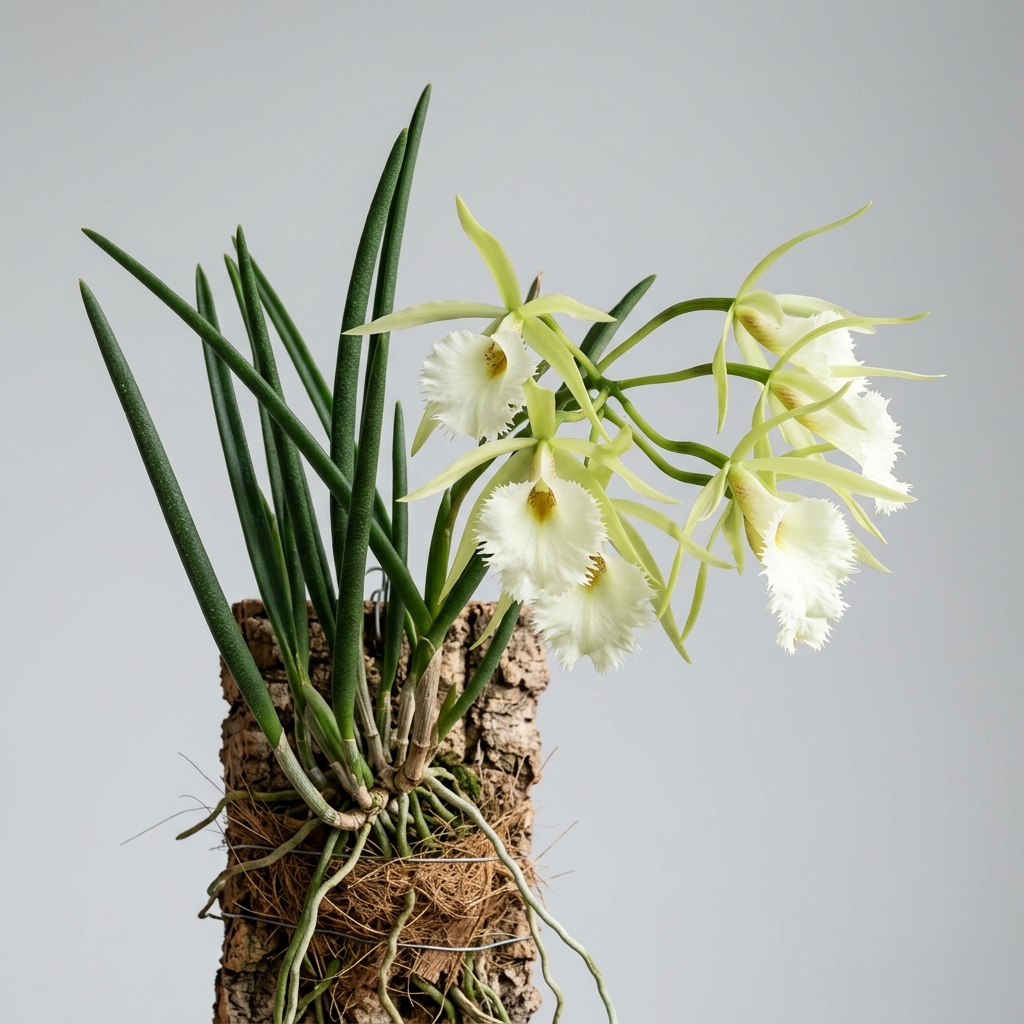
Brassavola Subulifolia is a captivating orchid species celebrated by collectors for its elegant, star-like blossoms and distinctive structural growth. Native to the Caribbean, particularly Jamaica, this resilient epiphyte features slender, terete leaves that resemble succulent pencils, allowing it to conserve moisture in its natural habitat. Orchid enthusiasts highly prize this species for its minimalist aesthetic and its ability to thrive in conditions that might stress more delicate orchid varieties.
Beyond its striking foliage, this orchid is famous for its nocturnal charm, producing clusters of pale green to creamy white flowers that release a potent, sweet fragrance after dusk. It is an ideal choice for intermediate growers looking to expand their collection with a reliable, free-flowering species that adapts well to mounting or basket culture. Its compact habit and robust nature make it a standout performer in home greenhouses and bright indoor growing spaces alike.
💡 Did You Know?
Brassavola Subulifolia belongs to the Brassavola orchid group, where flower presentation is often just as important as . White-flowered cultivars are especially valued indoors because their pale blooms reflect well and pair easily with many home, greenhouse, and display settings.
🌿 Botanical Overview
Brassavola Subulifolia, historically associated with the synonym Brassavola cordata, belongs to the subtribe Laeliinae within the Orchidaceae family. In the wild, it grows as an epiphyte on trees or occasionally as a lithophyte on rocky outcroppings, exposed to bright sunlight and strong coastal breezes. This environmental adaptation has given the plant its characteristic subulate, or awl-shaped, leaves which minimize surface area to reduce water loss during dry spells.
The growth habit is sympodial, with short, slender pseudobulbs that each produce a single, upright leaf. Over time, healthy specimens form dense, grassy clumps that can produce dozens of flowering spikes simultaneously. Understanding this structural adaptation is key to providing the high-light, fast-drying conditions the species requires to flourish in cultivation.
🌸 Flower Characteristics
The flowers of Brassavola Subulifolia are a masterclass in elegant geometry, typically measuring two to three inches in diameter. The sepals and petals are narrow, elongated, and pale green or yellowish-green, framing a prominent, heart-shaped white lip. This contrasting labellum often features a subtle green or yellow throat, which guides nocturnal pollinators toward the column.
Flowers are produced in terminal racemes, with each inflorescence bearing anywhere from three to ten blossoms. The spikes emerge from the base of the leaf sheath, presenting the flowers in an airy, outward-facing cluster that hovers gracefully above the dark green foliage.
Fragrance & Bloom Profile
The fragrance profile of Brassavola Subulifolia is one of its most defining attributes, characterized by a powerful, spicy-sweet aroma that is strictly nocturnal. During the day, the flowers are virtually odorless, conserving energy until dusk when they begin to emit a scent reminiscent of citrus, clover, and vanilla. This nocturnal emission is an evolutionary adaptation designed to attract specific night-flying moth pollinators.
Individual flowers are long-lasting, often remaining pristine for four to six weeks if kept in a cool, stable environment. The intensity of the fragrance typically peaks a few hours after sunset, filling an entire room or greenhouse with its clean, perfume-like scent.
Parentage & Hybrid Lineage
As a naturally occurring species rather than a man-made hybrid, Brassavola Subulifolia possesses a pure genetic lineage that has made it a valuable parent in orchid breeding. It is frequently crossed with members of the Cattleya alliance to introduce its compact growth habit, star-shaped flower form, and nocturnal fragrance to new hybrids.
In historical literature and older registration records, this species has occasionally been confused with Brassavola nodosa or Brassavola cordata. While they share similar cultural requirements and floral structures, Brassavola Subulifolia is recognized as a distinct species, characterized by its slightly smaller, more clustered flowers and specific geographic origin.
🌱 Growing Conditions
To cultivate Brassavola Subulifolia successfully, growers must replicate its warm, bright, and airy native habitat. This orchid requires exceptionally bright light, equivalent to or slightly higher than standard Cattleya conditions. A south or west-facing window with light shading during the hottest part of the day is ideal, and the leaves should develop a light purple speckling, which indicates optimal light exposure.
💡 Care Tip
For best results, grow Brassavola Subulifolia in bright filtered with steady and gentle airflow. Avoid placing the plant in harsh midday sun, but do not keep it in a dark corner; weak is one of the most common reasons cultivated orchids refuse to rebloom.
Temperatures should remain warm to intermediate, ideally ranging from seventy to eighty-five degrees Fahrenheit during the day, with a night drop of ten to fifteen degrees to encourage bud initiation. High humidity between fifty and seventy percent is beneficial, but it must be accompanied by strong, continuous air movement to prevent stagnant moisture from settling on the foliage.
Watering, Feeding & Potting Media
Watering practices must respect the epiphytic nature of Brassavola Subulifolia, which demands a strict wet-to-dry cycle. The roots must dry out completely and rapidly after watering; prolonged wetness will quickly lead to root rot. During the active growing season in spring and summer, water copiously, then allow the media to dry thoroughly before watering again.
A highly porous, fast-draining medium is essential. Coarse fir bark, charcoal, and perlite mixtures work well in clay pots, but many growers find the greatest success by mounting the plant on cork bark or tree fern plaques. Feed weekly with a highly diluted, balanced orchid fertilizer during active growth, reducing both water and fertilizer during the cooler winter months.
Blooming Season & Care Notes
While Brassavola Subulifolia can bloom at various times throughout the year, its primary flowering season typically occurs in late summer and autumn. The development of new pseudobulbs during the spring and summer directly influences the abundance of the autumn bloom. Once the flower spikes emerge, avoid moving the plant to a location with drastically different light or temperature, as sudden changes can cause bud drop.
After the blooms fade, the old flower spikes can be cut back to the base of the leaf sheath. Repotting or remounting should only be performed when new root tips begin to emerge from the base of the newest pseudobulbs, usually in early spring, to minimize transplant shock.
⚠️ Common Issues
⚠️ Common Mistake
The most common mistake is by calendar instead of root and potting-media condition. Brassavola roots need moisture and air at the same time, so constantly wet bark or sphagnum can lead to root loss even when the leaves still look healthy.
- Root Rot: Caused by overwatering, poor drainage, or decomposing potting media that retains too much moisture.
- Dehydration: Indicated by shriveled pseudobulbs and wrinkled, leathery leaves, often due to insufficient watering or a compromised root system.
- Mealybugs and Scale: Common pests that hide in the tight crevices of the leaf sheaths and must be treated promptly with horticultural soap or isopropyl alcohol.
- Bud Blast: The premature yellowing and dropping of buds, usually triggered by sudden drafts, low humidity, or drastic temperature fluctuations.
- Leaf Spotting: Fungal or bacterial spots arising from water sitting on the foliage overnight without adequate air circulation.
❓ Frequently Asked Questions
How often should I water my Brassavola Subulifolia?
Watering frequency depends heavily on your growing medium. Mounted plants may require daily watering during hot summer weather, while those in pots with coarse bark typically need watering every five to seven days. Always ensure the medium is completely dry throughout before applying water again.
Can Brassavola Subulifolia be grown under LED lights?
Yes, this species adapts well to indoor cultivation under high-intensity LED grow lights. Position the plant close enough to the light source to receive bright, full-spectrum light for twelve to fourteen hours a day, monitoring the leaves for a healthy light-green color with slight purple speckling.
Why is my Brassavola Subulifolia not blooming?
The most common reason for a lack of flowers is insufficient light. If the leaves are a deep, dark green and lack any purple pigmentation, the plant is not receiving enough light to trigger bud development. Gradually move the orchid to a brighter location to encourage blooming.
Should I grow this orchid mounted or in a pot?
While both methods can be successful, mounting on cork bark or tree fern is highly recommended because it perfectly mimics the plant’s natural epiphytic habit. Mounting ensures the roots dry rapidly after watering, significantly reducing the risk of root rot compared to traditional pot culture.
⭐ Final Growing Notes
Brassavola Subulifolia is a rewarding and highly resilient orchid that brings a touch of tropical elegance and nighttime enchantment to any collection. By prioritizing bright light, rapid drainage, and excellent air circulation, growers can easily unlock the full potential of this classic Caribbean species. Its reliable growth habit and unforgettable nocturnal fragrance make it a timeless favorite that continues to delight both novice and experienced orchidists alike.
⚕️ Health, Safety & Edibility
Understanding how a plant interacts with people, pets, and the surrounding environment is part of responsible cultivation. This section uses conservative, general guidance and does not replace professional medical or veterinary advice.
Human Safety: No published evidence currently identifies species-specific toxicity concerns for Brassavola Subulifolia during normal handling. As with most ornamental plants, it should not be intentionally consumed.
Pet Safety: Published information does not indicate that this orchid commonly poses a toxicity concern for cats or dogs. However, chewing leaves, flowers, roots, or potting media may still cause mild digestive upset.
Edibility: This orchid is cultivated for ornamental display rather than food. Ornamental plants may carry fertilizers, pesticides, or other horticultural treatments that make them unsuitable for consumption.
Skin Contact: Routine handling is not generally associated with skin irritation. Gardeners with sensitive skin may prefer wearing gloves when repotting, pruning, or handling potting media.
🌱 Propagation Tip
Propagation should be approached patiently. Most home growers should wait for natural keikis or divide only mature, healthy plants when the orchid type allows it. Never remove a young growth until it has strong roots and enough leaves to support itself away from the parent plant.
⭐ Expert Advice
Repot after flowering when fresh root tips begin to appear. This timing helps the plant anchor quickly into new bark or sphagnum and reduces stress, especially for orchids grown indoors where airflow, , and drying speed can change from season to season.




Leave A Comment