
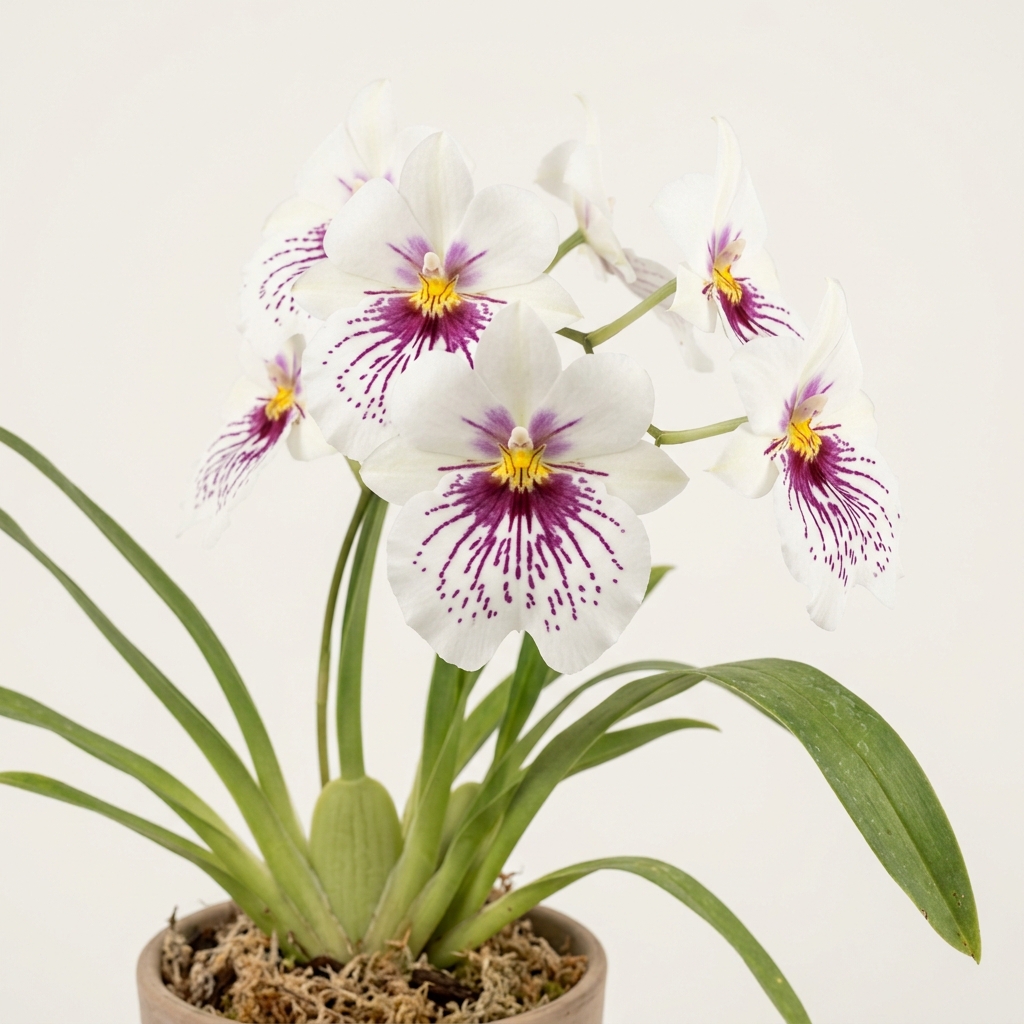
Miltoniopsis Phalaenopsis is a highly sought-after orchid species native to the humid cloud forests of Colombia, widely cherished by collectors for its striking, flat-faced blossoms that closely resemble pansies. Often referred to as a cornerstone of modern Miltoniopsis hybridization, this orchid features delicate, pale green pseudobulbs and slender, grass-like foliage that presents an elegant silhouette even when not in bloom. Its unique floral presentation and compact growth habit make it a centerpiece in intermediate-to-cool growing collections.
Growers value this orchid for its distinctive white flowers adorned with dramatic, waterfall-like patterns of purple and yellow on the expansive lip. While it has a reputation for being somewhat demanding compared to more resilient genera like Phalaenopsis, providing the correct balance of high humidity, consistent moisture, and buoyant air movement rewards the dedicated hobbyist with spectacular, long-lasting displays. Understanding its specific environmental preferences is the key to successfully cultivating this exquisite botanical treasure.
💡 Did You Know?
Miltoniopsis Phalaenopsis belongs to the Miltoniopsis orchid group, where flower presentation is often just as important as . White-flowered cultivars are especially valued indoors because their pale blooms reflect well and pair easily with many home, greenhouse, and display settings.
🌿 Botanical Overview
Miltoniopsis Phalaenopsis is a sympodial epiphytic orchid that naturally grows on moss-covered tree trunks in wet, mountainous regions. Unlike true Miltonia species, which prefer warmer conditions, Miltoniopsis species are adapted to cooler, high-altitude environments where temperatures remain moderate and humidity levels are consistently high.
The plant produces tightly clustered, flattened pseudobulbs, each topped with a single, thin, light-green leaf. The root system is notably fine and delicate, making it highly sensitive to both extreme drought and stagnant, waterlogged conditions. This delicate root structure dictates much of the plant’s cultural requirements in a home or greenhouse setting.
🌸 Flower Characteristics
The flowers of Miltoniopsis Phalaenopsis are the primary draw for enthusiasts, typically measuring two to three inches in diameter. The sepals and petals are a pristine, crystalline white, providing a stark contrast to the large, fan-shaped lip. The lip features a highly variable and intricate pattern of deep magenta, violet, or purple streaks that radiate outward, often accompanied by a bright yellow mask at the center.
Inflorescences emerge from the base of the newly matured pseudobulbs, carrying two to five flowers per spike. The blooms are held gracefully just above or within the foliage, creating a compact and visually balanced presentation that highlights the flat, face-like geometry of the individual flowers.
Fragrance & Bloom Profile
While many Miltoniopsis hybrids are celebrated for their intense, rose-like scents, the fragrance profile of the pure Miltoniopsis Phalaenopsis species is less pronounced and can vary among individual specimens. Some growers report a delicate, subtle floral scent during the warmest hours of the day, while others note that certain clones are virtually unscented.
The blooms are relatively long-lasting, often remaining pristine for four to six weeks if kept in cool, stable conditions. To maximize the lifespan of the flowers, growers should avoid getting water on the petals and maintain excellent air circulation around the blooming plant.
Parentage & Hybrid Lineage
As a distinct species rather than a man-made hybrid, Miltoniopsis Phalaenopsis represents a foundational species in orchid breeding. It has been extensively utilized by hybridizers to introduce the desirable flat-lipped, pansy-like flower shape and intricate waterfall patterns into modern Miltoniopsis grexes.
Because historical registration records can sometimes conflate species and early hybrids, tracing the exact lineage of older commercial clones can be challenging. However, its genetic legacy is clearly visible in many of today’s award-winning cool-growing orchid hybrids, which inherit its striking floral markings and compact growth habit.
🌱 Growing Conditions
Successful cultivation of Miltoniopsis Phalaenopsis requires replicating its native cloud forest environment. It thrives in bright, filtered light, similar to the light levels preferred by Paphiopedilums. Direct sunlight must be avoided, as the thin, pale leaves are highly susceptible to scorching and heat stress.
💡 Care Tip
For best results, grow Miltoniopsis Phalaenopsis in bright filtered with steady and gentle airflow. Avoid placing the plant in harsh midday sun, but do not keep it in a dark corner; weak is one of the most common reasons cultivated orchids refuse to rebloom.
Temperature management is critical; this orchid prefers cool to intermediate conditions, with daytime temperatures ideally ranging from 65°F to 75°F (18°C to 24°C) and a nighttime drop to 55°F to 60°F (13°C to 16°C). High relative humidity of 60% to 80% is essential, paired with constant, gentle air movement to prevent fungal pathogens from settling on the damp foliage.
Watering, Feeding & Potting Media
Due to its fine root system, Miltoniopsis Phalaenopsis requires a potting medium that retains moisture while remaining highly aerated. A mix of fine-grade fir bark, sphagnum moss, and perlite or tree fern fiber is highly effective. The medium should never be allowed to dry out completely, nor should it remain soggy or waterlogged.
Watering should be frequent, typically when the top layer of the medium begins to feel slightly damp but not dry. Apply a balanced, highly diluted orchid fertilizer weekly during the active growing season, flushing the pot with pure water once a month to prevent harmful mineral salt buildup, which can quickly burn the sensitive roots.
Blooming Season & Care Notes
This orchid typically initiates its blooming cycle in the spring or early summer, though healthy plants may occasionally produce a secondary flush of flowers in the autumn. The development of new pseudobulbs is a precursor to flowering, as spikes emerge from the leaf sheaths at the base of these newly matured growths.
Once the blooming cycle is complete, the old flower spikes can be cut back to the base of the pseudobulb. Repotting is best performed in the autumn when cool temperatures return and new root growth is initiated. This minimizes transplant shock and allows the fine roots to establish in fresh, well-draining media before the next warm season.
⚠️ Common Issues
⚠️ Common Mistake
The most common mistake is by calendar instead of root and potting-media condition. Miltoniopsis roots need moisture and air at the same time, so constantly wet bark or sphagnum can lead to root loss even when the leaves still look healthy.
- Accordion-style leaf folding: This is a classic sign of inconsistent watering or low humidity, causing the developing leaves to stick together as they grow.
- Root rot: Caused by overwatering, poor drainage, or decomposing potting media that suffocates the fine root system.
- Leaf tip burn: Often indicates excessive mineral salts from fertilizer or hard tap water; using pure rainwater or reverse osmosis water is highly recommended.
- Spider mites: These pests thrive in dry conditions and can quickly damage the thin foliage; maintain high humidity and treat with insecticidal soap if detected.
- Bud blast: Sudden dropping or yellowing of unopened buds, usually triggered by rapid temperature fluctuations, drafts, or low humidity.
❓ Frequently Asked Questions
Why are the leaves on my Miltoniopsis Phalaenopsis folding like an accordion?
Accordion-like folding of the leaves is a direct response to moisture stress, typically caused by low humidity or inconsistent watering. When the air is too dry or the roots do not receive steady moisture, the emerging leaves cannot slide smoothly out of the leaf sheath, causing them to crimp and fold. Increasing humidity and maintaining a consistent watering schedule will prevent this on new growth.
Can I grow Miltoniopsis Phalaenopsis under artificial LED lights?
Yes, this orchid adapts well to LED grow lights. Because it prefers moderate, filtered light, place the plant toward the edges of the light footprint or adjust the intensity to mimic bright, indirect shade. Monitor the foliage color; a healthy plant should have light, grassy-green leaves, while dark green indicates too little light and yellow or reddish tints suggest too much light.
What is the best potting mix for this orchid?
A fine-grade, moisture-retentive yet well-draining mix is ideal. A combination of fine fir bark, chopped sphagnum moss, and perlite works exceptionally well. This mixture keeps the delicate, fine roots consistently damp without cutting off the essential oxygen supply that prevents root rot.
How do I encourage my Miltoniopsis Phalaenopsis to rebloom?
Reblooming is triggered by the maturation of new pseudobulbs combined with cool nighttime temperatures. Ensure the plant receives bright, indirect light and consistent moisture throughout the growing season. A slight drop in night temperatures during the autumn and winter will naturally stimulate the development of new flower spikes for the upcoming spring.
⭐ Final Growing Notes
While Miltoniopsis Phalaenopsis demands more attention to humidity and temperature than some of its hardier orchid relatives, the reward of its flat, pansy-like blossoms is unmatched. By prioritizing consistent moisture, excellent air movement, and cool, shaded conditions, growers can successfully cultivate this exquisite species and enjoy its dramatic, waterfall-patterned blooms year after year.
⚕️ Health, Safety & Edibility
Understanding how a plant interacts with people, pets, and the surrounding environment is part of responsible cultivation. This section uses conservative, general guidance and does not replace professional medical or veterinary advice.
Human Safety: No published evidence currently identifies species-specific toxicity concerns for Miltoniopsis Phalaenopsis during normal handling. As with most ornamental plants, it should not be intentionally consumed.
Pet Safety: Published information does not indicate that this orchid commonly poses a toxicity concern for cats or dogs. However, chewing leaves, flowers, roots, or potting media may still cause mild digestive upset.
Edibility: This orchid is cultivated for ornamental display rather than food. Ornamental plants may carry fertilizers, pesticides, or other horticultural treatments that make them unsuitable for consumption.
Skin Contact: Routine handling is not generally associated with skin irritation. Gardeners with sensitive skin may prefer wearing gloves when repotting, pruning, or handling potting media.
🌱 Propagation Tip
Propagation should be approached patiently. Most home growers should wait for natural keikis or divide only mature, healthy plants when the orchid type allows it. Never remove a young growth until it has strong roots and enough leaves to support itself away from the parent plant.
⭐ Expert Advice
Repot after flowering when fresh root tips begin to appear. This timing helps the plant anchor quickly into new bark or sphagnum and reduces stress, especially for orchids grown indoors where airflow, , and drying speed can change from season to season.




Leave A Comment