
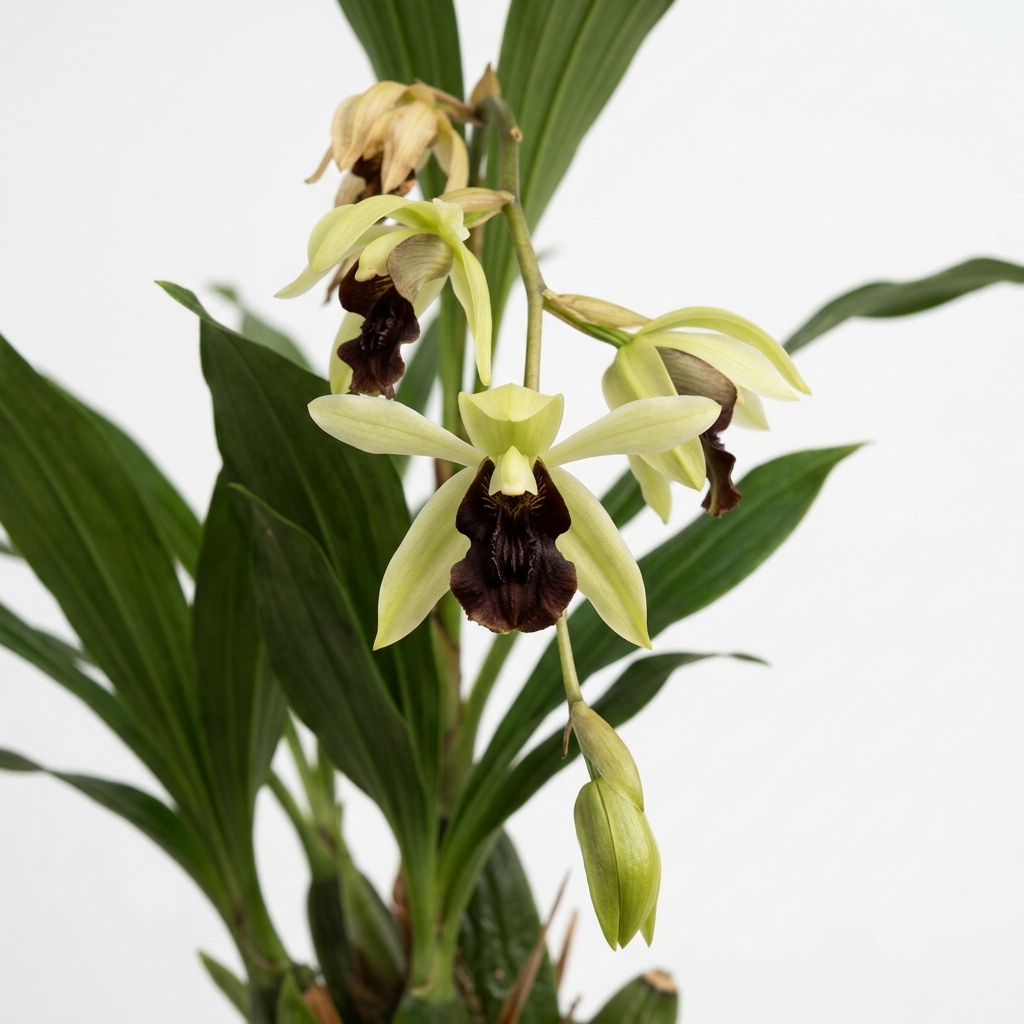
Coelogyne Usitana is a highly coveted epiphytic orchid species native to the Philippines, celebrated for its dramatic, contrasting floral display and unique sequential blooming habit. Discovered relatively recently in the early 2000s, this orchid has quickly captured the attention of collectors worldwide due to its pendulous inflorescences that produce flowers over an extended period. The striking contrast between its pale, creamy-green petals and its deep, near-black labellum makes it a standout addition to any indoor orchid collection.
As a warm-to-intermediate grower, Coelogyne Usitana thrives in humid, shaded environments that mimic its native tropical forest canopy. Unlike many orchids that bloom all at once, this species presents its flowers one after another on a single gracefully arching spike, providing growers with months of continuous interest. Understanding its specific moisture requirements and preference for undisturbed roots is key to successfully cultivating this remarkable botanical treasure.
💡 Did You Know?
Coelogyne Usitana is named after Villamor T. Usita, the president of a Philippine ecological group who discovered the species in 2001. Its unique sequential blooming habit means a single hanging flower spike can continuously produce new blossoms for up to half a year, making it one of the longest-blooming species in the entire .
🌿 Botanical Overview
Coelogyne Usitana is characterized by its clustered, somewhat pear-shaped pseudobulbs, each bearing a single, upright, lanceolate leaf with prominent veining. In its natural habitat in the humid forests of Mindanao, Philippines, it grows as an epiphyte on moss-covered tree branches, where it benefits from constant air movement and high ambient humidity. The plant relies on its pseudobulbs to store water and nutrients, helping it survive brief periods of lower moisture, though it prefers a consistently damp root zone.
The growth habit is relatively compact compared to some larger members of the genus, making it highly suitable for indoor cultivation, terrariums, or greenhouse benches. New growths emerge from the base of mature pseudobulbs, and the pendulous flower spikes develop from the center of these emerging growths. This growth cycle requires careful monitoring, as water trapped in the new, tender growths can lead to rot before the spike has a chance to fully mature.
🌸 Flower Characteristics
The flowers of Coelogyne Usitana are visually arresting, primarily due to their stark color contrast. The sepals and petals are a delicate, translucent pale yellow or greenish-white, which frames a deeply colored, highly detailed labellum. This lip ranges from a rich, dark chocolate brown to an almost pure velvety black, featuring subtle ridges and a slightly ruffled margin that guides potential pollinators.
Each flower typically measures between two to three inches in diameter. The inflorescence is distinctly pendulous, hanging downward in a graceful arch. Because it is a sequential bloomer, the spike will produce one or two flowers at a time, with new buds developing at the tip of the spike as the older flowers fade. A single inflorescence can remain active for several months, producing a dozen or more flowers over its lifespan.
Fragrance & Bloom Profile
Unlike some highly aromatic members of the Coelogyne genus, Coelogyne Usitana is not known for a strong or sweet fragrance. Most growers report that the flowers are either completely unscented or carry a very faint, earthy aroma that is only noticeable in close proximity. This lack of intense fragrance is easily overlooked given the plant’s exceptional visual appeal and prolonged blooming cycle.
The blooming profile is defined by its sequential nature. It is crucial for growers to avoid cutting the green flower spikes even after the first few flowers have fallen, as the tip of the spike will continue to produce new buds. The overall display is elegant and minimalist, with the downward-facing flowers requiring a hanging basket or a high shelf placement to be fully appreciated at eye level.
Parentage & Hybrid Lineage
Coelogyne Usitana is a naturally occurring species rather than a man-made hybrid or cultivar, though it is frequently referred to as a cultivar in commercial trade due to selected high-quality clones. It was named in honor of Villamor T. Usita, who collected the plant in the Philippines. Because of its unique dark lip and sequential blooming habit, it has become a popular parent in modern hybridization programs within the Coelogyne genus.
Hybrids derived from Coelogyne Usitana often inherit the dark lip coloration and the pendulous, sequential flowering traits. However, when purchasing this orchid, growers should verify whether they are acquiring the true species or a hybrid cross, as care requirements can vary slightly depending on the genetic background of the parent plants.
🌱 Growing Conditions
To cultivate Coelogyne Usitana successfully, growers must replicate its warm, humid forest home. It thrives in intermediate to warm temperatures, ideally ranging from 65°F to 85°F (18°C to 29°C) during the day, with a slight drop at night to stimulate healthy growth. It is sensitive to extreme cold and should be protected from temperatures dropping below 55°F (13°C).
💡 Care Tip
Position Coelogyne Usitana in a hanging basket at eye level or higher. Because the flower spikes are completely pendulous and hang straight down, growing this orchid in a standard pot on a flat shelf will prevent the gorgeous dark-lipped flowers from displaying properly and may damage the emerging buds.
Light levels should be kept moderate to low, equivalent to bright, filtered shade. Direct sunlight will quickly scorch the thin, pleated leaves, while too little light may prevent the plant from flowering. High humidity is essential, ideally maintained between 60% and 80%. Good air circulation is equally critical to prevent stagnant air from encouraging fungal pathogens on the damp foliage and roots.
Watering, Feeding & Potting Media
This orchid prefers a potting medium that retains moisture while still allowing excellent drainage and aeration. A mix of high-quality New Zealand sphagnum moss and fine fir bark works exceptionally well, as does mounting the plant on a cork slab if high humidity can be consistently maintained. Because of its pendulous spikes, growing Coelogyne Usitana in a hanging plastic or wooden basket is highly recommended.
Watering should be frequent enough to keep the medium evenly moist but never waterlogged. The pseudobulbs should remain plump; shriveling indicates that the plant is under-watered or that the roots have rotted from over-watering. Feed the plant with a diluted, balanced orchid fertilizer every two weeks during the active growing season, flushing the pot with pure water once a month to prevent salt buildup.
Blooming Season & Care Notes
While Coelogyne Usitana can bloom at almost any time of the year, its primary flowering period typically spans from spring through late summer. During this active phase, ensure the plant receives consistent moisture and humidity to support the developing flower spikes. Avoid moving the plant or changing its orientation drastically once a spike begins to form, as sudden environmental shifts can cause bud blast.
After the blooming cycle concludes and the flower spike finally turns brown and dry, it can be carefully snipped off at the base. Repotting should only be done when absolutely necessary, as this species dislikes root disturbance. The best time to repot is just as new root growth begins to emerge from the base of the newest pseudobulb, typically in the spring.
⚠️ Common Issues
⚠️ Common Mistake
A common mistake is cutting off the flower spike too early. Because Coelogyne Usitana is a sequential bloomer, the spike may look bare after the first flower drops, but new buds are actively forming at the tip. Always leave the spike intact until it turns completely brown and dry.
- Root Rot: Caused by compacted, poorly draining media or over-watering, leading to mushy roots and shriveled pseudobulbs.
- Bud Blast: Sudden dropping or drying of buds, often triggered by low humidity, drafty conditions, or rapid temperature fluctuations.
- Leaf Spotting: Fungal or bacterial spots can develop on the leaves if water is allowed to sit on the foliage overnight without adequate airflow.
- Spider Mites and Mealybugs: Common pests that hide in the crevices of the pleated leaves and pseudobulb bases; treat promptly with insecticidal soap or neem oil.
- Dehydration: Indicated by severely wrinkled pseudobulbs and accordion-like folding of new leaves, usually due to insufficient watering or low humidity.
❓ Frequently Asked Questions
How long do the flowers of Coelogyne Usitana last?
While individual flowers on Coelogyne Usitana typically last for two to three weeks, the entire blooming spike can remain active for several months. Because it is a sequential bloomer, new buds will continuously form and open at the tip of the pendulous spike as older flowers fade, providing a prolonged display.
Should I cut the flower spike after the first flower falls?
No, you should never cut the green flower spike of Coelogyne Usitana after the first flowers fade. This species blooms sequentially on the same inflorescence. Only cut the spike when it has completely dried out, turned brown, and stopped producing new buds at the tip.
Can Coelogyne Usitana be grown mounted on wood?
Yes, Coelogyne Usitana can be grown successfully mounted on cork bark or tree fern slabs. However, because it prefers consistent moisture, mounted plants require very high ambient humidity (above 70%) and daily watering, sometimes multiple times a day during hot summer weather, to prevent dehydration.
Why are the leaves on my Coelogyne Usitana turning yellow?
Yellowing leaves can indicate several issues, most commonly over-exposure to direct sunlight or root rot from over-watering. Ensure the plant is kept in bright, filtered shade and that the potting medium is airy and moist but not soggy. Inspect the roots to ensure they are firm and healthy.
⭐ Final Growing Notes
Coelogyne Usitana is a rewarding and visually spectacular orchid that brings a touch of tropical drama to any dedicated grower’s collection. By providing it with consistent warmth, high humidity, and a carefully managed watering routine that never allows the roots to dry out completely, you will be rewarded with months of its unique, dark-lipped blossoms. Its manageable size and sequential blooming habit make it an exceptional choice for those looking to expand their collection beyond more common orchid genera.
⚕️ Health, Safety & Edibility
Understanding how a plant interacts with people, pets, and the surrounding environment is part of responsible cultivation. This section uses conservative, general guidance and does not replace professional medical or veterinary advice.
Human Safety: No published evidence currently identifies species-specific toxicity concerns for Coelogyne Usitana during normal handling. As with most ornamental plants, it should not be intentionally consumed.
Pet Safety: Published information does not indicate that this orchid commonly poses a toxicity concern for cats or dogs. However, chewing leaves, flowers, roots, or potting media may still cause mild digestive upset.
Edibility: This orchid is cultivated for ornamental display rather than food. Ornamental plants may carry fertilizers, pesticides, or other horticultural treatments that make them unsuitable for consumption.
Skin Contact: Routine handling is not generally associated with skin irritation. Gardeners with sensitive skin may prefer wearing gloves when repotting, pruning, or handling potting media.
🌱 Propagation Tip
Propagate this orchid by division only when the plant has outgrown its container and has at least six to eight healthy pseudobulbs. Carefully divide the rhizome, ensuring each new division has at least three mature pseudobulbs and an active lead growth to ensure rapid recovery and successful re-establishment.
⭐ Expert Advice
To prevent rot in new growths, avoid overhead . Water can easily pool in the tender, cup-like new leaves where the flower spikes emerge, leading to fungal decay. Direct your can straight to the potting medium, or water early in the day so air movement can dry the foliage before nightfall.

Leave A Comment