
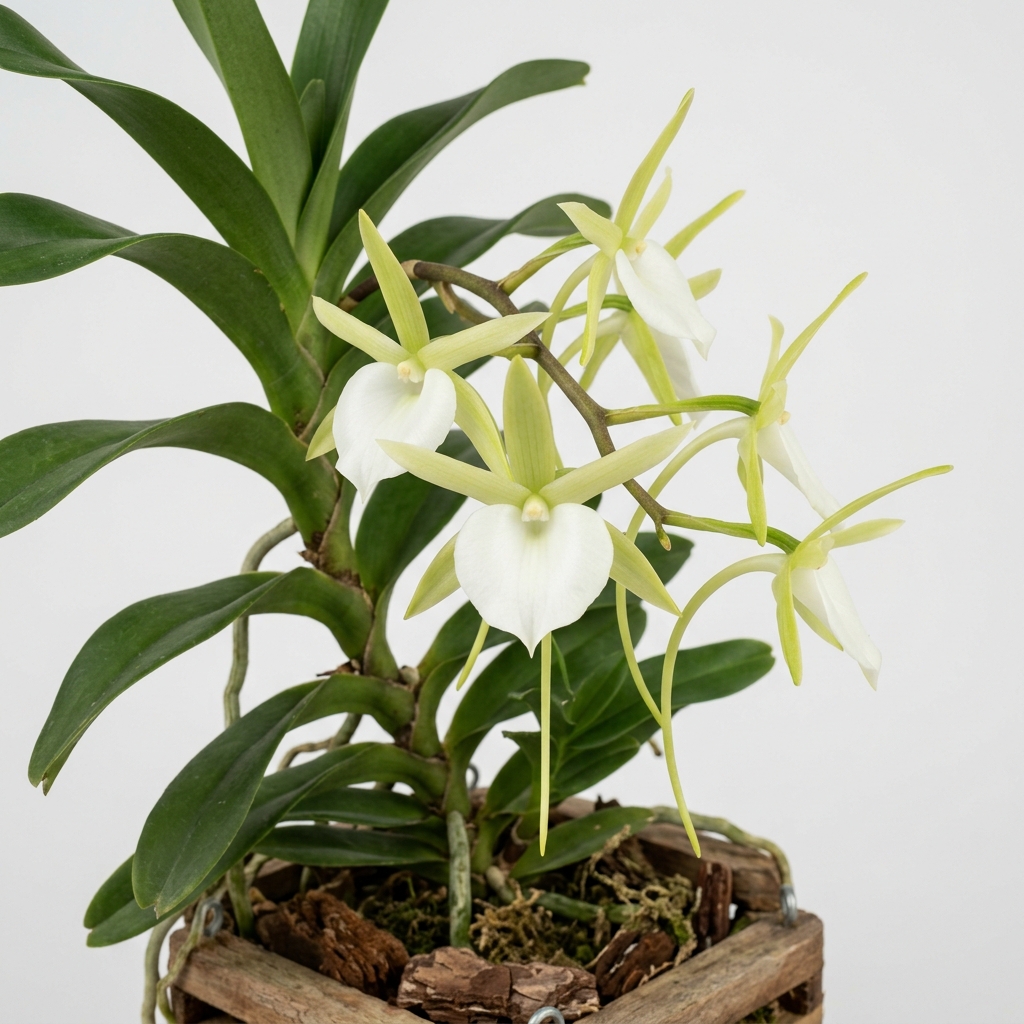
Angraecum Eichlerianum is a striking monopodial orchid species native to the tropical rainforests of West-Central Africa, highly prized by collectors for its unique growth habit and elegant, nocturnal blooms. Belonging to the renowned genus Angraecum, this orchid is celebrated for its distinctive climbing or scrambling growth form, which sets it apart from more compact, rosette-forming relatives. Growers value this plant for its architectural presence and its ability to produce highly stylized, exotic flowers that capture the essence of classic African orchid flora.
In cultivation, this orchid presents a rewarding challenge for intermediate to advanced hobbyists who can accommodate its vertical growth and specific atmospheric needs. The blossoms feature a dramatic contrast between slender, greenish-yellow sepals and a broad, pristine white labellum, accompanied by a characteristic nectar spur. When provided with warm temperatures, high humidity, and consistent moisture, Angraecum Eichlerianum develops into a magnificent specimen that brings both structural beauty and a captivating evening fragrance to the indoor greenhouse or growing space.
💡 Did You Know?
Angraecum Eichlerianum relies on a highly specialized evolutionary partnership for survival in the wild. Its flowers feature a long, narrow nectar spur that can only be accessed by specific species of nocturnal hawkmoths with exceptionally long proboscises. As the moth reaches deep into the spur for nectar, pollen is precisely deposited on its head, ensuring pollination when it visits the next flower.
🌿 Botanical Overview
Angraecum Eichlerianum is a monopodial orchid species native to the humid, low-elevation forests of tropical Africa, including regions of Cameroon, Gabon, Congo, and Angola. Unlike sympodial orchids that grow horizontally via a rhizome, this species grows vertically from a single vegetative stem. Over time, the stem can become quite elongated, taking on a scrambling or climbing habit as it seeks support from surrounding vegetation in its natural habitat.
The foliage consists of thick, leathery, strap-like leaves that are arranged alternately in a neat, flat plane along the stem. Robust, fleshy aerial roots emerge along the length of the stem, helping the plant cling to tree trunks and absorb moisture and nutrients from the humid air. This growth habit makes it an exceptionally architectural plant, even when it is not in bloom.
🌸 Flower Characteristics
The blossoms of Angraecum Eichlerianum are a masterclass in geometric elegance. Each flower typically measures between three and four inches across, featuring narrow, reflexed sepals and petals that range in color from pale green to a soft, translucent chartreuse. These greenish segments frame a large, pure white, shell-shaped lip that serves as the visual centerpiece of the bloom.
At the rear of the lip sits a long, slender, backward-pointing spur that contains nectar. The flowers are borne on short, sturdy inflorescences that emerge from the leaf axils, usually carrying one to three flowers per spike. The blooms are held clear of the foliage, presenting themselves beautifully against the dark green leaves.
Fragrance & Bloom Profile
In keeping with the evolutionary traits of the subtribe Angraecinae, Angraecum Eichlerianum is primarily pollinated by nocturnal hawkmoths. To attract these pollinators, the flowers emit a powerful, sweet, and slightly spicy fragrance that begins to release at dusk and peaks during the middle of the night. During the day, the scent is almost completely absent.
The blooming cycle typically occurs in the late summer or autumn months, though healthy plants in stable greenhouse environments may occasionally bloom at other times of the year. The individual flowers are remarkably long-lasting, often remaining pristine for four to six weeks if kept in cool, stable conditions away from direct drafts.
Parentage & Hybrid Lineage
Angraecum Eichlerianum is a naturally occurring species rather than a man-made hybrid. First described scientifically in the late 19th century, its lineage is wild and documented in botanical records of tropical African flora. Because it is a species, its characteristics are stable and passed down directly through seed propagation.
While it is occasionally used by hybridizers to introduce its climbing habit, robust growth, and large white lip to other Angraecoid crosses, it remains most popular in its pure species form. Growers appreciate the historical and botanical authenticity of cultivating a wild species that has changed very little from its native forest ancestors.
🌱 Growing Conditions
To cultivate Angraecum Eichlerianum successfully, growers should attempt to replicate its warm, humid forest canopy habitat. It thrives in moderate to bright indirect light. Direct midday sunlight must be avoided as it can easily scorch the leathery leaves, but insufficient light will result in weak, leggy growth and a lack of flowers. An east-facing window or a shaded south-facing window is usually ideal.
💡 Care Tip
Provide a sturdy cedar stake or a moss pole for your Angraecum Eichlerianum. As a climbing monopodial orchid, it needs physical support to grow upright, and its aerial roots will naturally cling to the support structure, mimicking its natural epiphytic habit.
Temperature ranges should be kept warm to intermediate. Daytime temperatures between 75°F and 85°F are preferred, with a slight drop at night to around 65°F to 70°F. High humidity is crucial for this species; aim to maintain relative humidity levels between 60% and 80%. Excellent air movement is essential at these humidity levels to prevent stagnant air from harboring fungal pathogens.
Watering, Feeding & Potting Media
During the active growing season, Angraecum Eichlerianum requires regular and thorough watering. The potting medium should be kept evenly moist but never saturated. Allow the medium to approach dryness before watering again, but do not let it dry out completely for extended periods. In the winter, watering should be reduced slightly to match the plant’s slower metabolic rate.
Feed the orchid weekly with a highly diluted, balanced orchid fertilizer during the spring and summer. Flush the potting medium with pure water once a month to prevent harmful fertilizer salts from accumulating. Because of its climbing habit and robust aerial roots, this orchid is best grown in a coarse, open medium such as large fir bark chunks, charcoal, and perlite. It can be grown in pots with sturdy stakes for support, in wooden baskets, or mounted on large cork slabs if high humidity can be guaranteed.
Blooming Season & Care Notes
As the blooming season approaches in late summer, ensure the plant receives stable temperatures and high humidity to support bud development. Avoid moving the plant or changing its orientation once buds begin to form in the leaf axils, as sudden environmental shifts can lead to bud drop. After the flowers fade, the old flower spikes can be trimmed back to the stem once they have completely dried and turned brown.
Repotting should be done with extreme caution. Angraecums are notorious for hating root disturbance and can take a year or more to recover from a rough repotting. Only repot when the potting medium has begun to break down or the plant has completely outgrown its container. The best time to repot is in the spring, just as active new root growth is observed.
⚠️ Common Issues
⚠️ Common Mistake
The most common mistake is repotting this orchid too frequently or disturbing its root system unnecessarily. Angraecum species have highly sensitive roots that react poorly to disturbance; only repot when the growing medium has completely degraded.
- Root Rot:
Occurs when the potting medium is too dense, degraded, or overwatered, leading to suffocated, mushy roots. - Leaf Spotting: Fungal or bacterial spots can develop on the leaves if humidity is high but air circulation is inadequate.
- Bud Blast:
The premature drying and dropping of flower buds, usually caused by low humidity, cold drafts, or sudden temperature swings. - Pests:
Mealybugs and scale insects can occasionally hide in the tight crevices of the leaf axils and should be treated promptly with horticultural soap or neem oil. - Dehydration:
Shriveled leaves and dry, brittle aerial roots indicate that the plant is not receiving enough water or that the ambient humidity is too low.
❓ Frequently Asked Questions
How tall does Angraecum Eichlerianum grow?
Because of its monopodial, climbing growth habit, Angraecum Eichlerianum can eventually reach heights of three to five feet or more in cultivation. It requires a sturdy stake, trellis, or totem to support its vertical stem as it grows.
Why are the buds on my Angraecum Eichlerianum falling off before opening?
This issue, known as bud blast, is typically caused by a sudden environmental shock. Common culprits include a sharp drop in humidity, exposure to cold drafts, underwatering, or moving the plant to a new location while the buds are developing.
Does Angraecum Eichlerianum require a winter rest period?
This species does not require a severe dry winter rest. However, because light levels and temperatures naturally decrease in winter, you should reduce watering frequency slightly and ease off on fertilizer until active growth resumes in the spring.
Can I grow Angraecum Eichlerianum under LED grow lights?
Yes, Angraecum Eichlerianum can be grown successfully under modern LED grow lights. Position the plant so it receives moderate to bright light, ensuring the top of the tall stem is not too close to the light source to prevent heat stress or foliage burn.
⭐ Final Growing Notes
Angraecum Eichlerianum is a magnificent orchid that rewards patient growers with its architectural form and spectacular, night-fragrant blossoms. While its vertical growth habit and sensitivity to root disturbance require a thoughtful approach to staking and repotting, its overall resilience makes it an excellent choice for those looking to expand their collection with a classic African species. By maintaining high humidity, warm temperatures, and consistent moisture, you can enjoy the exotic beauty and enchanting evening perfume of this remarkable orchid for many years to come.
⚕️ Health, Safety & Edibility
Understanding how a plant interacts with people, pets, and the surrounding environment is part of responsible cultivation. This section uses conservative, general guidance and does not replace professional medical or veterinary advice.
Human Safety: No published evidence currently identifies species-specific toxicity concerns for Angraecum Eichlerianum during normal handling. As with most ornamental plants, it should not be intentionally consumed.
Pet Safety: Published information does not indicate that this orchid commonly poses a toxicity concern for cats or dogs. However, chewing leaves, flowers, roots, or potting media may still cause mild digestive upset.
Edibility: This orchid is cultivated for ornamental display rather than food. Ornamental plants may carry fertilizers, pesticides, or other horticultural treatments that make them unsuitable for consumption.
Skin Contact: Routine handling is not generally associated with skin irritation. Gardeners with sensitive skin may prefer wearing gloves when repotting, pruning, or handling potting media.
🌱 Propagation Tip
Propagation is best achieved by waiting for the plant to naturally produce basal offsets or keikis along the stem. Allow these offsets to develop a robust system of their own aerial roots before carefully detaching them with a sterile blade and potting them up individually.
⭐ Expert Advice
To maximize bloom production, maintain a distinct but gentle drop of about 10 degrees Fahrenheit between day and night during the late summer. This natural fluctuation helps trigger the initiation of flower spikes in the leaf axils.

Leave A Comment