
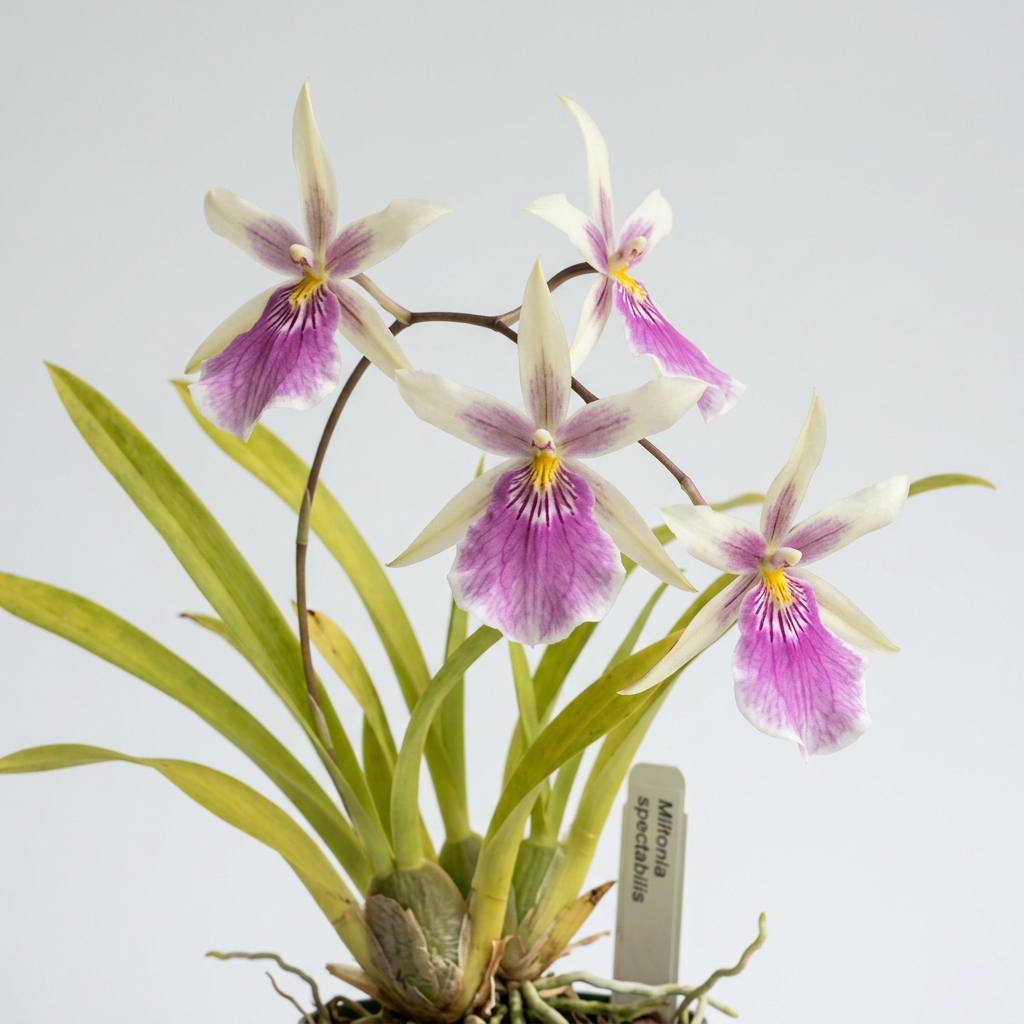
Miltonia Spectabilis is a highly prized orchid species native to the rainforests of Brazil, celebrated for its striking, flat-faced flowers and creeping growth habit. Often referred to as the outstanding Miltonia, this orchid is a favorite among collectors due to its relatively large blooms and its adaptability to intermediate growing conditions.
Unlike many other orchids that grow in tight clumps, this species spreads via elongated rhizomes, creating a beautiful, sprawling display over time. Its distinctive pale green to yellowish-yellow foliage and contrasting, vividly colored flowers make it an eye-catching addition to any indoor or greenhouse collection.
💡 Did You Know?
Miltonia Spectabilis belongs to the Miltonia orchid group, where flower presentation is often just as important as . White-flowered cultivars are especially valued indoors because their pale blooms reflect well and pair easily with many home, greenhouse, and display settings.
🌿 Botanical Overview
Miltonia Spectabilis is characterized by its unique growth habit, which sets it apart from many other popular cultivated orchids. It features flattened, egg-shaped pseudobulbs that are spaced relatively far apart along a creeping rhizome. This sprawling growth pattern means the plant quickly outgrows standard pots, often climbing over the edges or spreading across mounting plaques.
The foliage of this species is thin, strap-like, and typically displays a light yellowish-green coloration. While this pale hue might suggest a nutrient deficiency in other orchid genera, it is a perfectly normal characteristic for Miltonia Spectabilis and often indicates that the plant is receiving the bright light levels it requires to trigger blooming.
🌸 Flower Characteristics
The flowers of Miltonia Spectabilis are renowned for their dramatic, flat presentation. Each inflorescence typically carries one or occasionally two large blooms, measuring up to four inches across. The sepals and petals are narrow, pointed, and usually range from a clean white to a warm cream color, providing a stark contrast to the rest of the flower.
The defining feature of the bloom is its exceptionally large, fan-shaped lip, or labellum. This prominent structure is typically a rich, vibrant rose-purple, adorned with darker violet veins radiating from the yellow-flushed throat. The flat, open form of the flower maximizes its visual impact, making it a highly desirable specimen for exhibition.
Fragrance & Bloom Profile
This orchid produces a delightful, moderate fragrance that is most pronounced on warm, sunny mornings. The scent is commonly described as sweet and honey-like, sometimes with a subtle hint of licorice or spice. It is a pleasant addition to indoor growing spaces, adding a sensory dimension to the plant’s visual appeal.
The blooming cycle typically begins in the late summer and can extend well into the autumn months. Individual flowers are relatively long-lasting, often remaining fresh and vibrant for three to five weeks, provided the plant is kept in a stable environment free from extreme temperature fluctuations or dry drafts.
Parentage & Hybrid Lineage
Miltonia Spectabilis is a naturally occurring species native to the eastern regions of Brazil, rather than a man-made hybrid. In its native habitat, it grows as an epiphyte on tree trunks and branches in warm, humid forests. Because of its outstanding floral traits, it has been widely used by hybridizers to introduce flat flower shapes and rich purple coloration into various intergeneric orchid crosses.
While it is a true species, several distinct color forms exist in cultivation. The most famous of these is the variety moreliana, which features deep plum-purple petals and sepals with an even darker purple lip. In modern horticultural taxonomy, some authorities classify moreliana as a distinct species, but it is still widely grown and traded under the Miltonia Spectabilis umbrella.
🌱 Growing Conditions
To cultivate Miltonia Spectabilis successfully, growers should aim to replicate its native Brazilian forest environment. It thrives in bright, filtered light, similar to the conditions preferred by Cattleyas. Direct midday sun should be avoided to prevent leaf scorch, but insufficient light will result in dark green leaves and a failure to produce flowers.
💡 Care Tip
For best results, grow Miltonia Spectabilis in bright filtered with steady and gentle airflow. Avoid placing the plant in harsh midday sun, but do not keep it in a dark corner; weak is one of the most common reasons cultivated orchids refuse to rebloom.
Intermediate to warm temperatures are ideal for this species. Daytime temperatures should ideally range between 70°F and 82°F (21°C to 28°C), with a slight drop at night to stimulate healthy growth. High humidity levels of 60% to 80% are essential, coupled with strong, continuous air movement to prevent stagnant air from causing leaf or root diseases.
Watering, Feeding & Potting Media
Unlike orchids with thick, water-storing pseudobulbs, Miltonia Spectabilis has relatively thin pseudobulbs and a fine, delicate root system. Consequently, it does not tolerate drying out completely. The potting medium should be kept consistently moist but never waterlogged. Water thoroughly as soon as the medium approaches dryness.
A fine-grade fir bark mix blended with perlite and charcoal works well for potted specimens, as it retains some moisture while allowing excellent drainage. Alternatively, because of its creeping rhizome, this orchid is an useful selection for mounting on cork slabs or tree fern plaques, provided the grower can maintain high humidity and water the plant daily. Feed weakly with a balanced orchid fertilizer every second or third watering during the active growing season.
Blooming Season & Care Notes
The primary blooming season occurs in late summer and early autumn, coinciding with the completion of the current season’s pseudobulb growth. Once the flower spikes emerge from the base of the new pseudobulbs, avoid moving the plant to a different environment, as sudden changes can cause the buds to drop prematurely.
After the blooming period concludes, the orchid enters a semi-dormant phase during the cooler winter months. During this time, reduce watering frequency slightly, allowing the medium to dry out a bit more between waterings, but never to the point where the pseudobulbs begin to shrivel severely. Resume regular watering and feeding in the spring when new green shoots and root tips appear.
⚠️ Common Issues
⚠️ Common Mistake
The most common mistake is by calendar instead of root and potting-media condition. Miltonia roots need moisture and air at the same time, so constantly wet bark or sphagnum can lead to root loss even when the leaves still look healthy.
- Accordion Leaf Growth: New leaves that grow in a pleated, accordion-like fashion indicate that the plant is suffering from insufficient humidity or inconsistent watering during its active growth phase.
- Leaf Spotting: Small black or brown spots on the thin leaves are often caused by fungal or bacterial pathogens, which thrive in high-humidity environments with inadequate air circulation.
- Root Rot:
Over-watering or using a degraded, compacted potting medium will quickly suffocate and rot the fine root system, leading to a rapid decline in plant health. - Spider Mites:
These pests can target the thin foliage, especially if the surrounding air becomes too dry. Maintain high humidity and mist the undersides of the leaves to deter them.
❓ Frequently Asked Questions
Why are the leaves on my Miltonia Spectabilis turning yellow?
A light yellowish-green color is actually normal and healthy for this species, indicating that it is receiving sufficient light to bloom. However, if the leaves turn a bright, bleached yellow or develop dry white patches, the plant is receiving too much direct sunlight and should be moved to a more shaded location.
How often should I water my Miltonia Spectabilis?
There is no set schedule, but you should water just as the potting medium begins to dry out. In a typical home environment, this may mean watering two to three times a week during the warm summer months, and reducing to once a week or less during the winter rest period.
Can I grow Miltonia Spectabilis under LED grow lights?
Yes, this orchid adapts well to artificial lighting. Position the plant under full-spectrum LED grow lights, ensuring it receives moderate to high light intensity for about 12 to 14 hours a day, while keeping a close eye on leaf color to ensure it does not scorch.
When is the best time to repot this orchid?
The best time to repot is in the spring, just as new growth and fresh roots begin to emerge from the base of the pseudobulbs. This allows the plant to establish itself quickly in the new medium before the hot summer months arrive.
⭐ Final Growing Notes
Miltonia Spectabilis is a rewarding and visually spectacular orchid that brings a touch of the Brazilian rainforest into the home or greenhouse. By understanding its need for consistent moisture, bright filtered light, and excellent air movement, growers of intermediate experience can successfully cultivate this species and enjoy its magnificent, flat-faced summer blooms for many years to come.
⚕️ Health, Safety & Edibility
Understanding how a plant interacts with people, pets, and the surrounding environment is part of responsible cultivation. This section uses conservative, general guidance and does not replace professional medical or veterinary advice.
Human Safety: No published evidence currently identifies species-specific toxicity concerns for Miltonia Spectabilis during normal handling. As with most ornamental plants, it should not be intentionally consumed.
Pet Safety: Published information does not indicate that this orchid commonly poses a toxicity concern for cats or dogs. However, chewing leaves, flowers, roots, or potting media may still cause mild digestive upset.
Edibility: This orchid is cultivated for ornamental display rather than food. Ornamental plants may carry fertilizers, pesticides, or other horticultural treatments that make them unsuitable for consumption.
Skin Contact: Routine handling is not generally associated with skin irritation. Gardeners with sensitive skin may prefer wearing gloves when repotting, pruning, or handling potting media.
🌱 Propagation Tip
Propagation should be approached patiently. Most home growers should wait for natural keikis or divide only mature, healthy plants when the orchid type allows it. Never remove a young growth until it has strong roots and enough leaves to support itself away from the parent plant.
⭐ Expert Advice
Repot after flowering when fresh root tips begin to appear. This timing helps the plant anchor quickly into new bark or sphagnum and reduces stress, especially for orchids grown indoors where airflow, , and drying speed can change from season to season.

Leave A Comment