
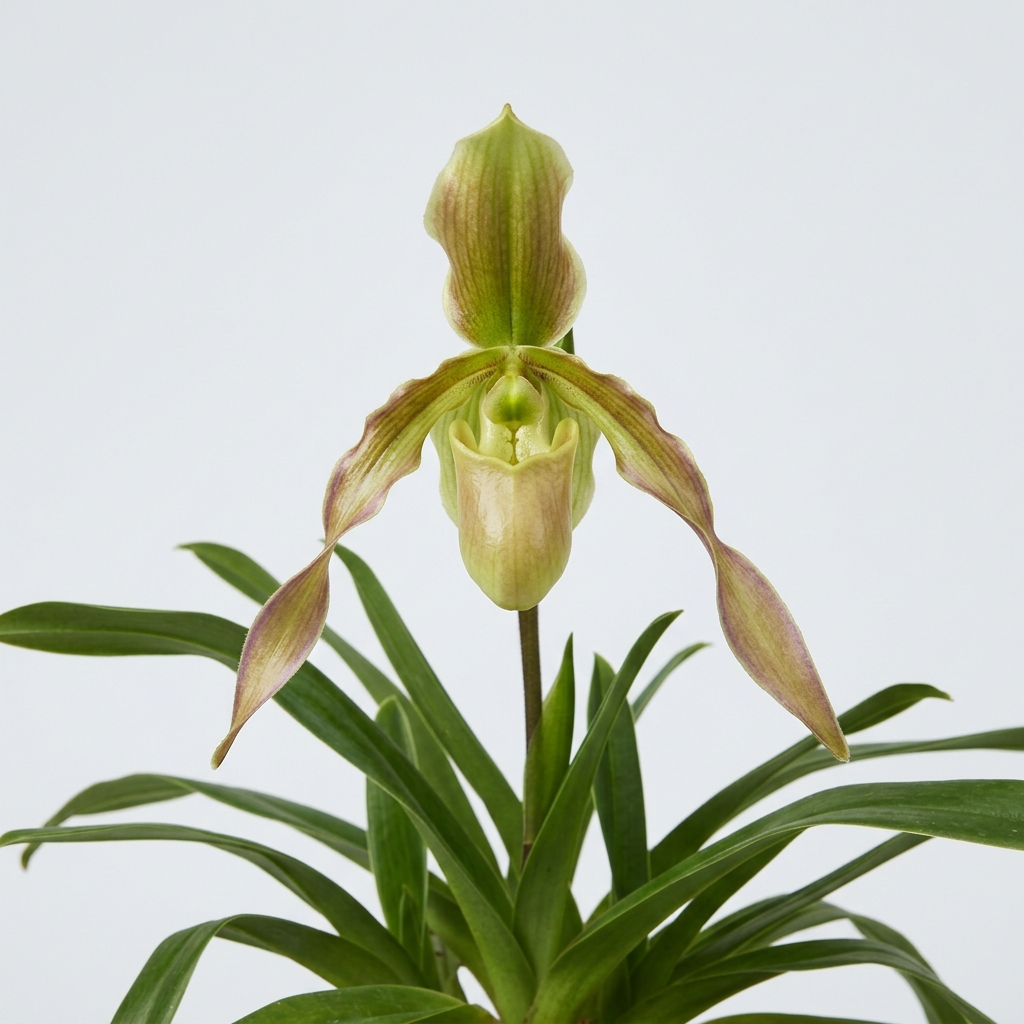
Phragmipedium Richteri is a captivating South American slipper orchid highly prized by collectors for its elegant, architectural blooms and robust growth habit. Belonging to the Cypripedioideae subfamily, this orchid showcases the classic pouch-like lip characteristic of slipper orchids, combined with gracefully elongated, twisting petals that lend a dramatic flair to any collection.
Growers value this orchid not only for its exotic, multi-tonal green and bronze flowers but also for its relatively forgiving nature compared to other delicate slipper orchids. It thrives in bright, filtered light and high-humidity environments, making it an excellent choice for intermediate to advanced hobbyists looking to expand their collection of terrestrial-style orchids.
💡 Did You Know?
Phragmipedium orchids, including the Richteri, are unique among orchids for their semi-aquatic tendencies in the wild. They are often found growing right at the water's edge, where their roots are constantly bathed in fresh, flowing water. This explains why they require much more frequent than typical epiphytic orchids like Phalaenopsis.
🌿 Botanical Overview
Phragmipedium Richteri is native to the wet, mountainous regions of South America, where it typically grows as a terrestrial or lithophytic plant. In its natural habitat, it is often found nestled in leaf litter along riverbanks or on damp rocky slopes, where its roots have constant access to moisture and excellent aeration.
The plant features a fan-shaped growth habit with long, strap-like, bright green leaves that are leathery to the touch. Unlike epiphytic orchids that store water in prominent pseudobulbs, Phragmipedium Richteri relies on its thick, fleshy root system and continuous moisture access to sustain its lush foliage and sequential blooming cycle.
🌸 Flower Characteristics
The flowers of Phragmipedium Richteri are a masterclass in structural elegance, featuring a prominent, pouch-shaped labellum that is typically pale green to yellowish-green, often adorned with delicate mahogany or purple speckling along the interior rim. The dorsal sepal is upright and slightly wavy, while the lateral petals extend outward and downward, displaying a characteristic spiral twist and fine ciliate margins.
The color palette is a sophisticated blend of soft greens, tan, and rich bronze, with subtle veining that highlights the intricate form of the bloom. Flowers are produced sequentially on a tall, erect inflorescence, meaning that as one bloom fades, another opens, extending the overall display over several weeks or even months.
Fragrance & Bloom Profile
While some slipper orchids are grown for their sweet scents, Phragmipedium Richteri is not consistently documented as having a noticeable fragrance. Most growers report that the blooms are unscented, with the primary appeal lying entirely in their complex visual geometry and striking color contrast.
The sequential blooming habit is a key feature of this orchid’s profile. A single flower spike can produce multiple buds that open one after the other, ensuring that while you may only see one or two open flowers at any given time, the plant remains in bloom for an extended period.
Parentage & Hybrid Lineage
The exact taxonomic status of Phragmipedium Richteri has been the subject of botanical discussion, with some historical references treating it as a natural hybrid and others classifying it as a distinct species. It shares close morphological affinities with Phragmipedium boissierianum and Phragmipedium pearcei, reflecting the complex evolutionary history of slipper orchids in the Andean region.
Because documentation regarding specific cultivated clones can vary, growers should approach parentage claims with cautious optimism. In the orchid trade, plants labeled as Phragmipedium Richteri represent a stable, highly desirable form that consistently shows the classic twisted petals and robust growth associated with its wild counterparts.
🌱 Growing Conditions
To cultivate Phragmipedium Richteri successfully, growers should aim to replicate its humid, montane native environment. It prefers bright, indirect light, similar to the conditions favored by Cattleya orchids, though it should be protected from harsh, direct midday sun which can easily scorch the strap-like leaves.
💡 Care Tip
Always use pure water, such as rainwater, reverse osmosis, or distilled water, for your Phragmipedium Richteri. This orchid is highly sensitive to dissolved minerals and salts found in tap water, which can quickly cause root dieback and unsightly brown leaf tips.
Temperature ranges should ideally remain in the intermediate to warm category, with daytime temperatures between 70°F and 80°F (21°C to 27°C) and a slight drop at night to stimulate healthy growth and eventual flowering. High humidity, ideally between 60% and 80%, combined with gentle, continuous airflow, is essential to prevent stagnant air and fungal issues.
Watering, Feeding & Potting Media
Unlike many other orchid genera, Phragmipedium Richteri must never be allowed to dry out completely. The potting medium should remain consistently moist, but not waterlogged or stagnant. Many successful growers use a plastic pot with a shallow tray of pure water underneath to maintain constant moisture, provided the water is flushed regularly.
The potting media should be highly retentive yet free-draining, typically consisting of a mix of fine fir bark, sphagnum moss, perlite, and charcoal. Feeding should be light but frequent, using a balanced, highly diluted orchid fertilizer at one-quarter strength every two weeks, followed by a thorough flush with pure, low-mineral water to prevent salt buildup on the sensitive roots.
Blooming Season & Care Notes
Phragmipedium Richteri can bloom at various times throughout the year, though peak flowering often occurs in the spring and autumn months. Once a flower spike emerges, it should be supported with a stake to prevent the weight of the sequential blooms from bending the stem.
After the blooming cycle is complete and the spike has naturally dried, it can be cut back to the base of the plant. Repotting is best performed annually or biennially in the spring, just as new growth begins, to ensure the potting medium remains fresh and does not break down into a suffocating, acidic slurry.
⚠️ Common Issues
⚠️ Common Mistake
A common mistake is letting the potting medium dry out completely between waterings. While most orchids prefer a wet-to-dry cycle, Phragmipedium Richteri lacks water-storing pseudobulbs and will quickly suffer root damage and leaf drop if the medium becomes bone-dry.
- Root Rot:
Caused by stagnant, poorly aerated water or decomposing potting media that suffocates the roots. - Leaf Tip Burn: Often a sign of mineral buildup from tap water or over-fertilization; use pure rainwater or distilled water to resolve.
- Bud Blast:
Sudden drops in humidity or temperature fluctuations can cause developing buds to yellow and drop before opening. - Mealybugs and Scale: These pests can hide in the tight crevices of the fan-shaped leaf bases; treat promptly with insecticidal soap or neem oil.
- Bacterial Soft Rot: Can occur if water is allowed to sit in the crown of the plant overnight, especially in cool conditions.
❓ Frequently Asked Questions
How often should I water my Phragmipedium Richteri?
You should water Phragmipedium Richteri frequently enough to keep the potting medium consistently moist. Unlike other orchids, they do not like to dry out between waterings. Many growers water them two to three times a week, or keep the pot sitting in a shallow tray of pure water.
Can I grow Phragmipedium Richteri under LED grow lights?
Yes, Phragmipedium Richteri adapts very well to LED grow lights. Position the plant so it receives moderate to bright light, but monitor the leaves closely. If the foliage begins to turn yellow or develops reddish-purple edges, the light may be too intense.
Why are the leaf tips of my orchid turning brown?
Brown leaf tips are usually caused by mineral sensitivity. Phragmipediums are highly sensitive to salts and minerals in tap water. Switching to pure rainwater, distilled water, or reverse osmosis water, and flushing the pot thoroughly during waterings, will help prevent this issue.
Is Phragmipedium Richteri suitable for beginner orchid growers?
It is best suited for intermediate growers due to its strict watering and water-quality requirements. However, beginners who are diligent about keeping the medium moist and using purified water can successfully grow and bloom this rewarding slipper orchid.
⭐ Final Growing Notes
Phragmipedium Richteri stands out as an exceptionally rewarding slipper orchid that brings a touch of prehistoric elegance to the modern home or greenhouse. By respecting its need for constant moisture, high humidity, and pure water, growers can enjoy a spectacular, sequential display of architectural blooms year after year.
⚕️ Health, Safety & Edibility
Understanding how a plant interacts with people, pets, and the surrounding environment is part of responsible cultivation. This section uses conservative, general guidance and does not replace professional medical or veterinary advice.
Human Safety: Species-specific human toxicity data for Phragmipedium Richteri is limited. Use conservative handling practices and avoid intentional consumption.
Pet Safety: Pet-specific safety information for Phragmipedium Richteri is limited, so keep it away from animals that commonly chew plants.
Edibility: Phragmipedium Richteri should not be treated as edible. Ornamental specimens may contain natural irritants or horticultural residues that make them unsuitable for consumption.
Skin Contact: Skin irritation is not well documented for this plant, but gloves are sensible when repotting, pruning, or handling potting media.
🌱 Propagation Tip
Propagation is best achieved through division during spring repotting. Ensure that each division has at least three healthy, mature fans with active root systems. Avoid dividing the plant into single fans, as smaller divisions struggle to recover and may take years to bloom again.
⭐ Expert Advice
To maximize the sequential blooming period, maintain high and stable temperatures while the spike is active. Sudden environmental shifts or dry indoor air can cause the orchid to abort its remaining buds prematurely, cutting the spectacular display short.

Leave A Comment