
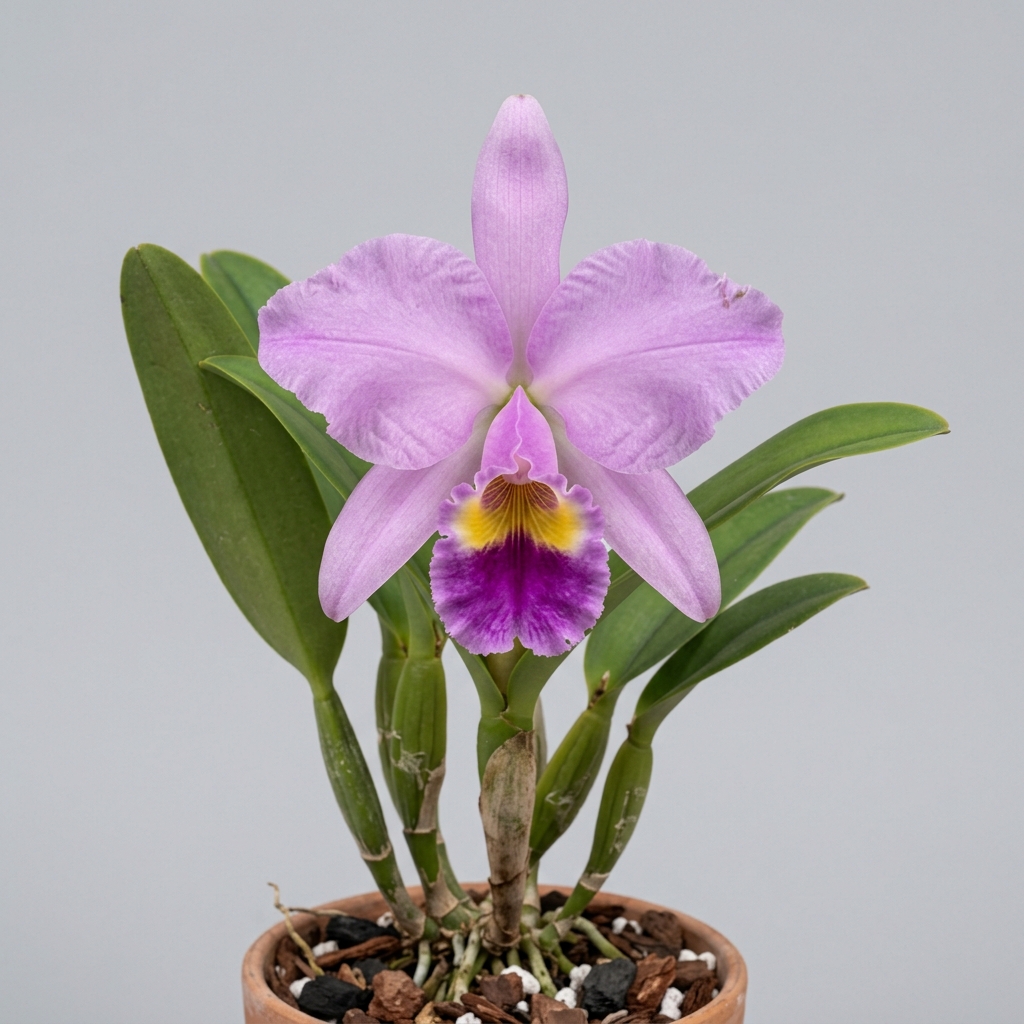
Cattleya trianae, commonly known as the Christmas orchid, is a highly revered species within the orchid family, celebrated for its large, elegant blooms and historical significance. As the national flower of Colombia, this epiphytic orchid features a classic sympodial growth habit with sturdy, club-shaped pseudobulbs that support single, thick, leathery leaves. Growers highly prize this species for its reliable winter-blooming habit and its ability to produce spectacular displays when mature.
Cultivating this classic Cattleya offers a rewarding experience for both intermediate and advanced orchid enthusiasts. Its flowers, which typically range from soft lavender-pink to pristine white, feature a beautifully contrasting lip with a yellow throat and a rich purple midlobe. By understanding its natural seasonal cycles of growth and rest, indoor and greenhouse growers can successfully coax this magnificent orchid into spectacular annual blooms.
💡 Did You Know?
Cattleya trianae is the national flower of Colombia, selected in 1936 because the colors of its lip—yellow, blue, and red—mirror the colors of the Colombian national flag. It is also known as the Christmas Orchid because its peak blooming period naturally aligns with the winter holidays in the Northern Hemisphere.
🌿 Botanical Overview
Cattleya trianae is native to the high-altitude cloud forests of Colombia, where it grows as an epiphyte on tree branches. This natural habitat exposes the plant to bright, dappled sunlight and excellent air movement, which are critical factors to replicate in a home or greenhouse environment. The plant possesses robust, club-like pseudobulbs that store water and nutrients, helping it survive seasonal dry spells.
The foliage consists of a single, rigid, oblong leaf emerging from the apex of each pseudobulb. This growth form is characteristic of unifoliate Cattleyas, which generally produce larger flowers than their bifoliate relatives. Healthy root systems are thick and covered in a white velamen layer that rapidly absorbs moisture and clings securely to potting media or mount surfaces.
🌸 Flower Characteristics
The blossoms of Cattleya trianae are renowned for their exceptional form and balance, often considered the archetype of the classic Cattleya flower. Individual blooms can reach up to seven inches in diameter, presenting a harmonious arrangement of broad petals and narrower sepals. The most striking feature is the prominent, tubular lip, or labellum, which typically shows a rich amethyst-purple apex and a warm, golden-yellow throat.
Flowers are borne on short spikes that emerge from a protective green sheath at the top of the matured pseudobulb. A single inflorescence can support two to five flowers, which are held elegantly above the foliage. The texture of the petals is often described as crystalline, catching the light beautifully during peak bloom.
Fragrance & Bloom Profile
This species is highly valued for its delightful fragrance, which is typically described as a sweet, delicate floral scent with subtle spicy undertones. The perfume is most pronounced during the morning hours when temperatures begin to rise and light levels increase. The fragrance fills the growing space without becoming overpowering, adding an extra layer of sensory appeal to its visual display.
Individual flowers are remarkably long-lasting for a Cattleya species, often remaining pristine for four to five weeks if kept in cool, dry conditions. To maximize the lifespan of the blooms, growers should avoid getting water on the petals and keep the plant away from direct drafts or sudden temperature fluctuations.
Parentage & Hybrid Lineage
As a naturally occurring species rather than a man-made hybrid, Cattleya trianae has a pure botanical lineage. However, it has played a monumental role in orchid hybridization since the nineteenth century. It is a primary ancestor of countless modern large-flowered Cattleya hybrids, valued by breeders for its excellent flower shape, reliable winter blooming time, and dominant color genes.
Within the species itself, numerous select color forms or cultivars exist, such as coerulea (blue-toned), alba (pure white), and semialba (white with a colored lip). These distinct variations are highly sought after by collectors, though their specific origins and historical award records are sometimes subject to debate among taxonomic purists.
🌱 Growing Conditions
To thrive, Cattleya trianae requires bright, indirect light. A south- or east-facing window with sheer curtains is ideal for indoor cultivation, while greenhouse growers often use 30% to 50% shade cloth. The leaves should maintain a light, grassy-green color; dark green leaves indicate insufficient light, while yellowing or reddish-purple tinting suggests excessive exposure.
💡 Care Tip
To prevent fungal spots, always water Cattleya trianae in the morning so the foliage dries completely before nightfall. Ensure your growing area has a gentle, continuous breeze from a small fan to keep air moving around the leaves.
Temperature management is crucial for bud initiation. The orchid prefers daytime temperatures between 75°F and 85°F, with a nightly drop to 60°F or 65°F. High humidity, ideally between 60% and 70%, combined with strong air circulation, prevents fungal pathogens from establishing on the leaves and roots.
Watering, Feeding & Potting Media
Watering should be frequent and thorough during the active spring and summer growing seasons. The potting medium must be allowed to dry out almost completely between waterings to prevent root rot. During the winter rest period following flowering, watering should be significantly reduced, providing just enough moisture to keep the pseudobulbs from shriveling.
A balanced, water-soluble orchid fertilizer applied at quarter-strength every two weeks during active growth supports robust pseudobulb development. Flush the pot with pure water once a month to remove accumulated salts. The ideal potting medium is a highly porous, free-draining mixture of coarse fir bark, horticultural charcoal, and large perlite, or the plant can be mounted on cork bark if high humidity can be maintained.
Blooming Season & Care Notes
Cattleya trianae typically initiates its blooming cycle in late autumn, with flowers opening from December through February. The flower buds develop slowly within the protective sheath over several months. During this critical period, avoid moving the plant or altering its environmental conditions, as sudden changes can cause the buds to yellow and drop.
Repotting is best performed in the spring, immediately after flowering concludes and as new root tips begin to emerge from the base of the newest pseudobulb. Choose a pot that allows for two years of future growth, and handle the fragile new roots with extreme care to avoid stalling the plant’s development.
⚠️ Common Issues
⚠️ Common Mistake
A frequent error is overwatering during the dark winter months. After flowering, Cattleya trianae enters a semi-dormant rest phase where its water requirements drop significantly; keeping the roots constantly wet during this time will lead to rot.
- Root rot: Caused by overwatering or compacted, decomposing potting media that retains too much moisture.
- Bud blast: The premature drying and dropping of flower buds, often triggered by low humidity, drafty conditions, or sudden temperature shifts.
- Scale and mealybugs: Common pests that hide in the paper-like sheaths surrounding the pseudobulbs; these sheaths should be gently peeled away if pests are suspected.
- Foliar spotting: Fungal or bacterial infections arising from water sitting on the leaves overnight in stagnant air.
❓ Frequently Asked Questions
How often should I water my Cattleya trianae?
Water thoroughly when the potting medium is almost completely dry, which typically translates to once a week in summer and every ten to fourteen days during the winter rest period.
Why is my Cattleya trianae not blooming?
The most common cause of non-blooming is insufficient light during the growing season, which prevents the plant from storing enough energy to produce a flower spike.
Should I remove the dried sheaths from the pseudobulbs?
Yes, once the sheaths turn dry and papery, they can be gently peeled away to eliminate hiding spots for pests like scale and mealybugs.
What is the best potting mix for this orchid?
A coarse, fast-draining mix composed primarily of medium-to-large fir bark, charcoal, and perlite works best to ensure rapid drying around the roots.
⭐ Final Growing Notes
Cattleya trianae remains a timeless masterpiece of the orchid world, offering unmatched elegance and a rich historical legacy. While it demands careful attention to light, watering cycles, and seasonal rest periods, its spectacular winter blooms make it an incredibly rewarding addition to any serious orchid collection.
🌱 Propagation Tip
Propagate mature Cattleya trianae specimens by division during spring repotting. Ensure each new division has at least three to four healthy, mature pseudobulbs with an active lead eye to guarantee successful establishment.
⭐ Expert Advice
If your Cattleya trianae produces healthy green sheaths but no buds, try increasing the night-to-day differential by ten degrees in early autumn. This natural drop mimics its native habitat and triggers robust bud development.




Leave A Comment