
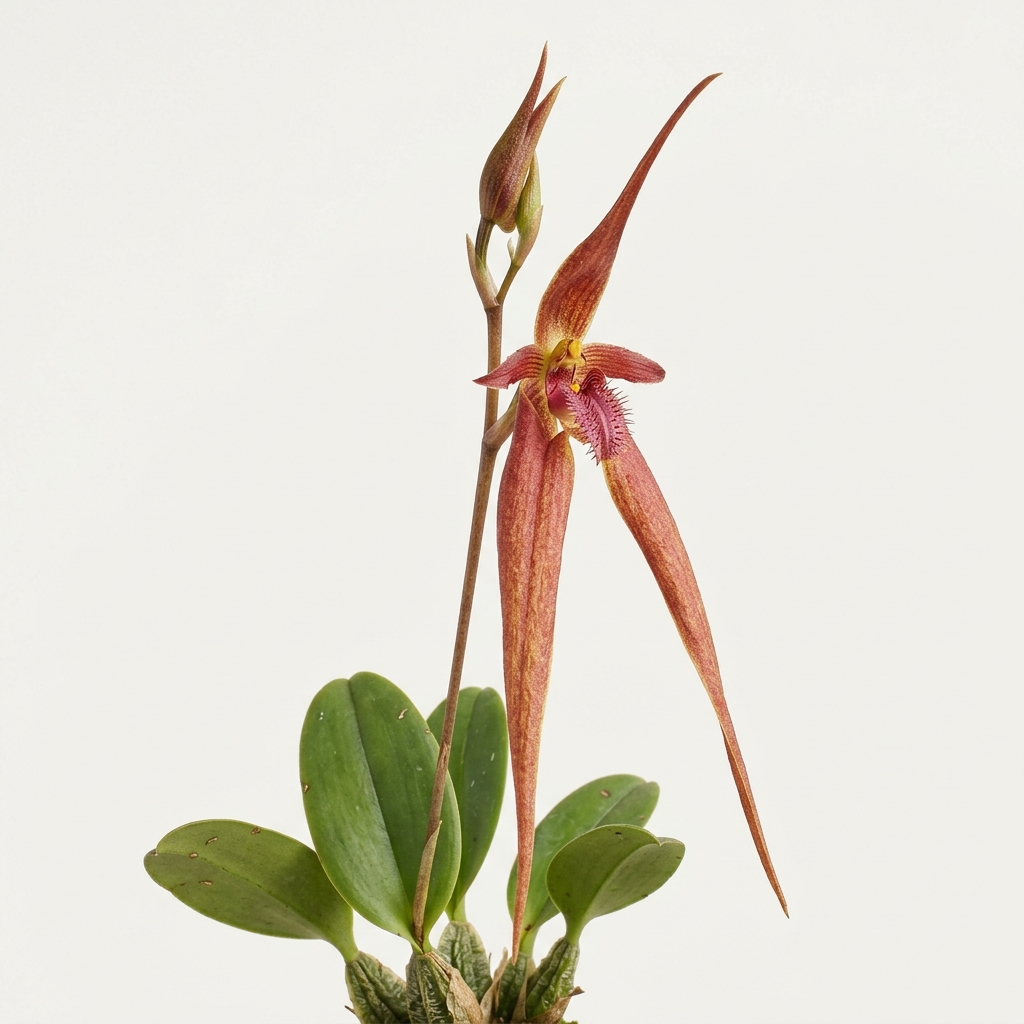
Bulbophyllum echinolabium is a remarkable epiphytic orchid species celebrated among collectors for producing some of the largest flowers in the entire Bulbophyllum genus. Native to the tropical rainforests of Sulawesi, Indonesia, this species is highly sought after for its dramatic, alien-like blooms and unique evolutionary adaptations. Growers value it as a prized specimen plant that brings an exotic, primeval aesthetic to any specialized orchid collection.
This orchid features a creeping rhizome habit with distinct pseudobulbs, each supporting a single, leathery leaf. While its vegetative growth is relatively compact, its flowering spikes produce massive, long-tailed blossoms that command attention. Cultivating this species successfully requires a commitment to high humidity and consistent moisture, making it an engaging challenge for intermediate to advanced orchid enthusiasts.
💡 Did You Know?
Bulbophyllum echinolabium boasts the largest flowers in its , with individual blooms reaching up to sixteen inches in length. Its highly mobile, hinged lip moves with the slightest breeze, mimicking the movement of insects to further entice its fly pollinators.
🌿 Botanical Overview
Bulbophyllum echinolabium is an epiphytic species that thrives in warm, humid forest environments. It is characterized by its clustered, egg-shaped pseudobulbs that grow along a creeping rhizome. Each pseudobulb produces a single, erect, oblong leaf that is thick and durable, designed to withstand the humid canopy conditions of its native habitat.
The plant’s growth habit is relatively vigorous when its environmental needs are met. New leads emerge from the base of the mature pseudobulbs, quickly establishing new roots into the surrounding media. Because of its creeping nature, it can rapidly outgrow standard pots, often making shallow baskets or mounts the preferred choice for long-term cultivation.
🌸 Flower Characteristics
The flowers of Bulbophyllum echinolabium are truly spectacular, often measuring up to twelve inches or more from the tip of the dorsal sepal to the tips of the lateral sepals. The sepals are elongated, tapering into long, slender tails that drape elegantly. The petals are much smaller, framing the center of the blossom.
The most distinctive feature is the lip, or labellum, which is hinged and highly mobile. This lip is covered in fine, fleshy projections or hairs, giving it a textured, spiky appearance that inspires its specific epithet, echinolabium (meaning “spiny lip”). The coloration typically ranges from deep coppery-red to yellowish-orange, often with darker striping or flushing.
Fragrance & Bloom Profile
While visually stunning, the fragrance of Bulbophyllum echinolabium is notoriously unpleasant. It emits a strong, pungent odor resembling decaying meat or carrion. This scent is an evolutionary strategy designed to attract carrion flies, which act as the primary pollinators in the wild.
The blooms are produced sequentially on a long, erect to arching inflorescence. While each individual flower may only last for a week to ten days, the spike can produce later buds over several weeks or even months. Growers should avoid cutting the green flower spikes until they have completely yellowed and dried, as they may continue to produce flowers.
Parentage & Hybrid Lineage
As a naturally occurring species rather than a man-made hybrid, Bulbophyllum echinolabium does not have a hybrid parentage. However, it has been widely used by orchid hybridizers to introduce large flower size, dramatic sepal tails, and intense coloration into new Bulbophyllum grexes.
Its offspring often inherit the impressive flower size and mobile lip, though the intensity of the carrion fragrance is sometimes diluted when crossed with sweeter-scented or unscented species. In common grower references, its hybrids are highly prized for their ease of bloom and striking visual presentation.
🌱 Growing Conditions
To cultivate Bulbophyllum echinolabium successfully, growers must replicate its native tropical environment. It thrives in warm to hot temperatures, ideally ranging from 75°F to 85°F (24°C to 29°C) during the day, with a slight drop at night. It does not tolerate cold temperatures well, and exposure to drafts below 60°F (15°C) should be strictly avoided.
💡 Care Tip
Maintain constant air circulation around your Bulbophyllum echinolabium, especially when keeping levels above seventy percent. Good airflow prevents fungal leaf spots and root rot while helping the plant tolerate warm summer temperatures.
Light levels should be kept in the moderate to bright indirect range. Direct sunlight will quickly scorch the leathery leaves, while too little light will inhibit flowering. High humidity is critical, ideally maintained between 70% and 90%, coupled with strong, continuous air movement to prevent fungal pathogens from settling on the damp foliage.
Watering, Feeding & Potting Media
This species requires consistent moisture and does not possess a significant pseudobulb storage capacity to survive prolonged dry spells. The potting medium should remain damp but never waterlogged. High-quality New Zealand sphagnum moss or a fine bark and tree fern fiber mix works exceptionally well to retain the necessary moisture.
For plants grown in baskets or mounted on cork slabs, daily watering may be required during the warm summer months. Feeding should be light but frequent; a balanced, diluted orchid fertilizer applied weekly at one-quarter strength during active growth will support the development of robust pseudobulbs and strong flowering spikes.
Blooming Season & Care Notes
Bulbophyllum echinolabium can bloom at various times throughout the year, though peak flowering typically occurs in the spring and summer. Because it is a sequential bloomer, patience is required as the buds develop one after another on the same spike.
Repotting is best performed in the spring when new root growth is just beginning to emerge from the base of the newest pseudobulb. Minimize root disturbance as much as possible, as Bulbophyllum species can be sensitive to repotting shock. If mounting, secure the plant firmly to the mount with monofilament or wire until the new roots attach naturally.
⚠️ Common Issues
⚠️ Common Mistake
A frequent error is allowing the potting medium to dry out completely between waterings. Unlike some orchids that prefer a dry cycle, this species lacks large water-storage organs and will quickly suffer leaf drop and root loss if left dry.
- Root Rot:
Caused by compacted, poorly draining media or overwatering in stagnant air conditions. - Leaf Spotting: Fungal or bacterial spots can develop if water sits on the leaves overnight without adequate airflow.
- Bud Blast:
Sudden changes in humidity, temperature, or water stress can cause developing buds to yellow and drop. - Dehydration:
Shriveled pseudobulbs and wrinkled leaves indicate the plant is not receiving enough water or the humidity is too low. - Pests:
Mealybugs and spider mites can occasionally hide in the crevices of the pseudobulbs and under the leaves.
❓ Frequently Asked Questions
How do I manage the unpleasant smell of Bulbophyllum echinolabium flowers?
The carrion-like fragrance is strongest during the warmest parts of the day when the flower first opens. To manage the scent, place the plant in a well-ventilated area, a dedicated greenhouse, or outdoors in a shaded spot during its blooming period.
Can Bulbophyllum echinolabium be grown under LED lights?
Yes, this species adapts well to indoor cultivation under high-quality LED grow lights. Ensure the lights are positioned to provide moderate, diffused light, and monitor the temperature and humidity closely, as indoor heating can dry out the air quickly.
Why are the pseudobulbs on my orchid shriveling?
Shriveled pseudobulbs are a sign of water stress, which can be caused by underwatering, low ambient humidity, or a compromised root system that can no longer absorb moisture. Check the roots to ensure they are healthy and adjust your watering frequency accordingly.
Should I cut the flower spike after the first bloom falls off?
No, do not cut the flower spike while it remains green. Bulbophyllum echinolabium is a sequential bloomer, meaning it will produce multiple flowers one after another from the same spike over an extended period.
⭐ Final Growing Notes
Bulbophyllum echinolabium is a rewarding and visually arresting orchid that rewards the dedicated grower with some of the most dramatic blooms in the plant kingdom. While its unique fragrance requires some accommodation, its ease of growth under warm, humid conditions makes it an unforgettable centerpiece for any serious orchid collection.
🌱 Propagation Tip
Propagate this species by division only when the plant has at least six to eight mature pseudobulbs. Ensure each division has at least three healthy pseudobulbs and an active lead, and divide during the active root-growth phase in spring.
⭐ Expert Advice
When growing this orchid indoors, place a shallow tray filled with water and pebbles beneath the pot to boost local , or use a dedicated humidifier. Keeping the high is the single most important factor for successful bud development.




Leave A Comment