
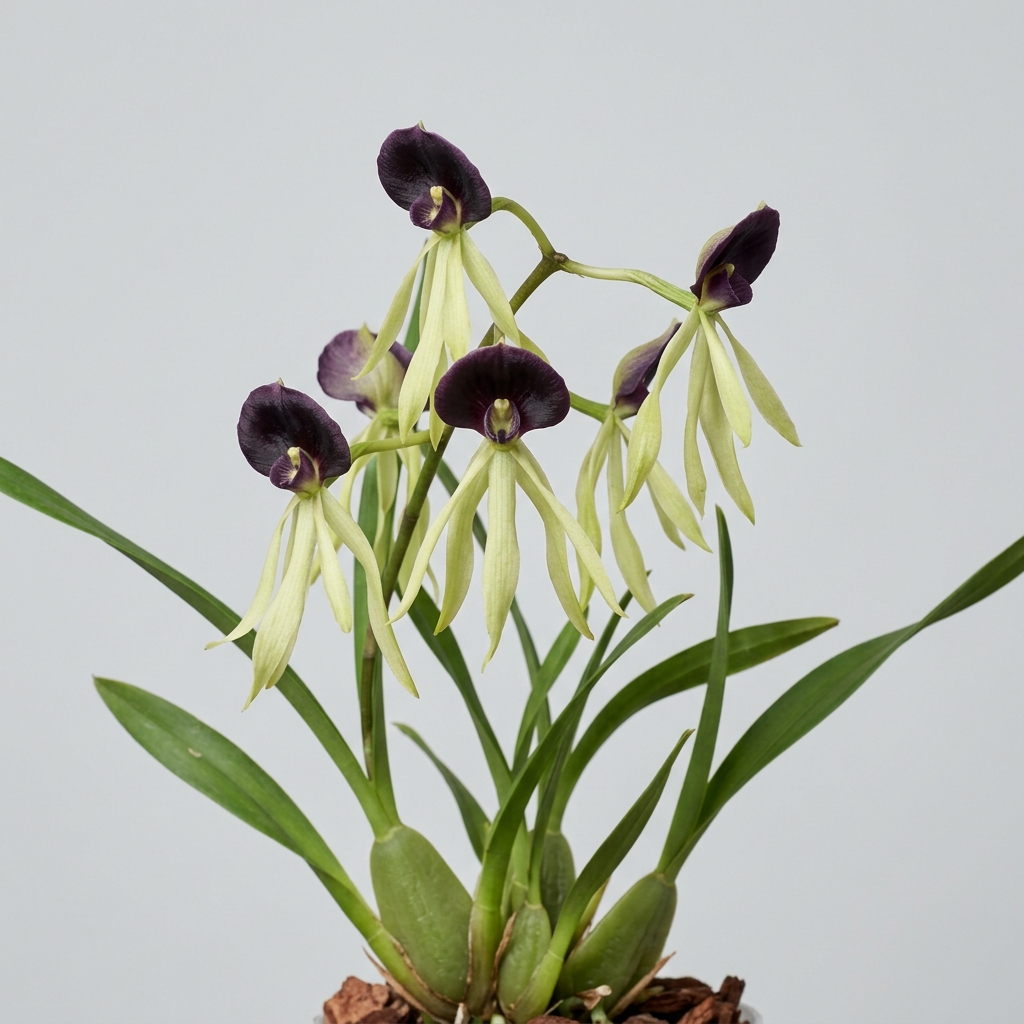
Encyclia cochleata, widely recognized as the clamshell or cockleshell orchid, is a highly popular and distinctive orchid species cherished by collectors for its unusual, squid-like flowers. Native to the tropical regions of Central America, the Caribbean, and parts of Florida, this resilient epiphyte is celebrated for its ease of culture and nearly continuous blooming habit under optimal conditions. Its pseudobulbs are notably flattened and pear-shaped, giving rise to narrow, strap-like leaves that form an elegant, architectural clump.
Growers of all experience levels value this orchid not only for its striking visual presentation but also for its forgiving nature in typical household environments. The unique flowers feature a deep purple-black, shell-shaped lip positioned uppermost on the flower, with slender, pale green sepals and petals dangling below like tentacles. This upside-down flowering habit, known as being non-resupinate, sets it apart from most other orchids and makes it a captivating focal point in any indoor collection.
💡 Did You Know?
Encyclia cochleata was one of the first tropical orchids to flower in Europe, blooming at the Royal Botanic Gardens, Kew, in the late 18th century. Its unique non-resupinate flowers, where the lip sits uppermost, have fascinated botanists and collectors for over two centuries.
🌿 Botanical Overview
Encyclia cochleata is a sympodial epiphyte that naturally grows on trees in damp, tropical forests. It features prominent, compressed pseudobulbs that store water and nutrients, allowing the plant to withstand brief periods of drought. The foliage consists of two or three lanceolate, bright green leaves that emerge from the apex of each pseudobulb, creating a lush, leafy canopy.
Taxonomically, this species has undergone several reclassifications, often being placed in the genus Prosthechea or Anacheilium by modern botanists. However, it remains widely traded and recognized under its traditional name, Encyclia cochleata, in horticultural circles. Its robust growth habit and adaptability make it an excellent subject for studying sympodial orchid development.
🌸 Flower Characteristics
The flowers of Encyclia cochleata are famous for their non-resupinate orientation, meaning the lip or labellum is situated at the top of the flower rather than the bottom. This lip is deeply cupped, heavily veined with rich purple-black coloration, and resembles a small clamshell. The remaining petals and sepals are narrow, ribbon-like, and a pale chartreuse or yellowish-green, hanging downward to create a whimsical, jellyfish-like silhouette.
Individual blooms are typically two to three inches in size and are produced sequentially on an erect, terminal inflorescence that emerges from the center of the newest pseudobulb. Because the flowers open one after another over an extended period, a single flower spike can remain active and attractive for several months, continuously presenting fresh blossoms.
Fragrance & Bloom Profile
While some growers report a subtle, sweet, or slightly citrusy fragrance from Encyclia cochleata during the warmest hours of the day, scent production is highly variable and often dependent on environmental factors. In many indoor settings, the fragrance may be faint or virtually undetectable, meaning the primary appeal of this orchid remains its exceptional visual form.
The blooming profile is remarkably persistent. Unlike orchids that produce a brief, synchronized flush of flowers, this species is a sequential bloomer. As older flowers fade, new buds develop at the tip of the spike, ensuring a steady display that can span half the year or more on a mature, healthy specimen.
Parentage & Hybrid Lineage
As a naturally occurring species rather than a man-made hybrid, Encyclia cochleata possesses a pure genetic lineage that has been utilized extensively in orchid breeding. It is a primary parent in several notable intergeneric hybrids, contributing its unique non-resupinate flower shape, dark lip coloration, and vigorous growth habit to its progeny.
In commercial cultivation, select clones and line-bred variations may exhibit larger flowers or more intense coloration, but these are selections of the species rather than complex hybrids. When purchasing, growers should note that while parentage is straightforward, individual clonal variations can influence the ultimate size and vigor of the plant.
🌱 Growing Conditions
To thrive, Encyclia cochleata requires bright, filtered light, similar to the conditions preferred by many Cattleya orchids. An east- or shaded south-facing window is ideal, providing sufficient light to encourage blooming without scorching the leaves. If the foliage turns a dark, dull green, the plant may need more light; a light green hue with slight yellow undertones often indicates optimal light levels.
💡 Care Tip
To prevent bacterial rot, always water your Encyclia cochleata in the morning so that any water splashed onto the leaves or into the crown of the pseudobulbs has ample time to evaporate before evening temperatures drop.
Temperature ranges should ideally mimic its native tropical habitat, with daytime temperatures between 75°F and 85°F, and a night drop to around 60°F to 65°F. Adequate air circulation is crucial, especially in high-humidity environments, to prevent stagnant air from encouraging fungal or bacterial pathogens on the leaves and pseudobulbs.
Watering, Feeding & Potting Media
Watering should be frequent enough to keep the potting medium lightly moist during the active growing season, but the roots must be allowed to dry slightly between applications to prevent rot. A coarse, free-draining orchid mix composed primarily of medium-grade fir bark, perlite, and charcoal works exceptionally well. Alternatively, mature plants can be mounted on cork bark if high humidity can be consistently maintained.
During the spring and summer months when new growth is active, apply a balanced, water-soluble orchid fertilizer diluted to quarter- or half-strength every two to three weeks. Flush the pot thoroughly with pure water between fertilizer applications to wash away accumulated mineral salts, which can damage the sensitive root tips.
Blooming Season & Care Notes
Encyclia cochleata does not adhere to a strict seasonal blooming schedule and can produce flower spikes at almost any time of the year, though peak activity often occurs from late spring through autumn. Once a flower spike emerges, avoid moving the plant to a location with drastically different light or temperature, as sudden environmental shifts can cause developing buds to drop.
After the blooming cycle is complete, do not cut the green flower spike until it has completely yellowed and dried, as it may continue to produce occasional buds. Repotting is best performed in the spring, just as new root growth begins to emerge from the base of the newest pseudobulb, ensuring the plant establishes quickly in its new container.
⚠️ Common Issues
⚠️ Common Mistake
A frequent mistake is cutting down the flower spike too early. Because this species is a sequential bloomer, a single green spike can continue producing new buds for several months; only cut it when it turns completely brown.
- Root rot caused by overwatering or compacted, decaying potting media that suffocates the root system.
- Leaf spotting or fungal infections resulting from poor air circulation combined with high humidity or wet foliage overnight.
- Bud blast, where developing buds turn yellow and drop prematurely, often triggered by sudden drafts, low humidity, or dry potting media.
- Pests such as scale insects, mealybugs, and spider mites, which can hide in the crevices of the pseudobulbs and under the leaves.
❓ Frequently Asked Questions
Why are the flowers on my Encyclia cochleata upside down?
This is a natural botanical characteristic known as non-resupination. Unlike most orchids which twist 180 degrees as they develop to place the lip at the bottom, Encyclia cochleata flowers do not twist, leaving the distinctive clamshell-shaped lip at the top of the bloom.
How often should I repot my Clamshell Orchid?
Typically, repotting is required every two to three years, or when the potting medium begins to break down and retain too much moisture. The best time to repot is in the spring when active new root growth is visible at the base of the newest pseudobulbs.
Can Encyclia cochleata be grown under artificial LED lights?
Yes, this species adapts exceptionally well to indoor growing under broad-spectrum LED grow lights. Position the plant so it receives moderate to high light intensity, ensuring the lights run for approximately 12 to 14 hours a day to simulate natural tropical day lengths.
What causes the pseudobulbs on my orchid to wrinkle?
Wrinkled pseudobulbs generally indicate dehydration, which can be caused by underwatering or, conversely, root loss due to overwatering. Examine the roots: if they are firm and white, increase watering frequency; if they are brown and mushy, the roots have rotted, and the plant must be repotted into fresh media.
⭐ Final Growing Notes
Encyclia cochleata remains a timeless favorite in the orchid community, offering an unmatched combination of exotic, alien-like beauty and straightforward care. By providing bright, indirect light, moderate watering, and excellent air movement, growers can enjoy a nearly continuous display of its fascinating clamshell blooms for many years.
🌱 Propagation Tip
Propagate mature specimens by division during spring repotting. Ensure each division has at least three to four healthy, mature pseudobulbs with active root systems to guarantee successful establishment in their new pots.
⭐ Expert Advice
If your Encyclia cochleata is growing vigorously but failing to bloom, try gradually increasing the intensity. A slight increase in , combined with a distinct day-to-night drop of about ten degrees, often triggers flower spike development.




Leave A Comment