
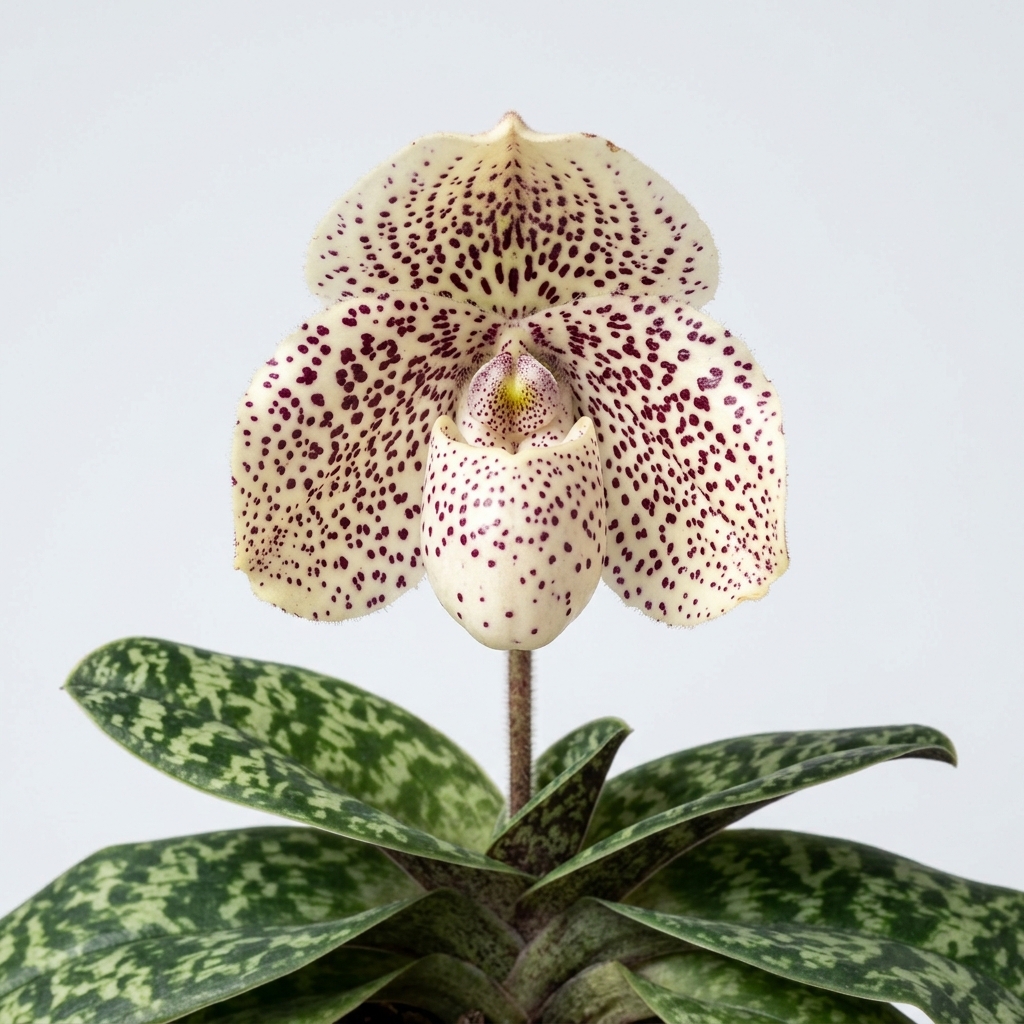
Paphiopedilum bellatulum, commonly known as the egg-in-a-nest orchid, is a highly coveted miniature slipper orchid species celebrated for its striking visual appeal and compact growth habit. Native to the limestone cliffs of Southeast Asia, this orchid is cherished by collectors for its beautifully tessellated foliage and uniquely rounded, cup-shaped flowers. Its slow-growing nature and distinct appearance make it a centerpiece in any specialized orchid collection.
Cultivators value this species not only for its dramatic floral display but also for its ornamental value when out of bloom. The thick, fleshy leaves feature a dark green and pale green marbled pattern on the upper surface, often with purple spotting underneath. When it does bloom, the large, cream-colored flowers heavily speckled with dark purple spots create a stunning contrast against the compact foliage, rewarding patient growers with a truly spectacular presentation.
💡 Did You Know?
Unlike the majority of tropical orchids that grow as epiphytes high up in tree branches, Paphiopedilum bellatulum is a lithophyte. In its native habitat, it clings directly to steep, shaded limestone cliffs, drawing nutrients from decaying leaf litter and moss washed down by seasonal rains, which is why it thrives with calcium additives in cultivation.
🌿 Botanical Overview
Paphiopedilum bellatulum belongs to the Brachypetalum section of the Paphiopedilum genus. It naturally grows as a lithophyte on shaded, mossy limestone cliffs, typically at elevations ranging from 300 to 1,000 meters. This specific natural habitat dictates much of its care requirements in cultivation, particularly its preference for calcium-rich media and excellent drainage.
The plant’s growth habit is distinctly compact, rarely exceeding a few inches in height. Its root system is relatively sparse and fragile compared to other orchid genera, consisting of thick, hairy roots that creep through leaf litter and moss on rocky surfaces. Understanding this delicate root structure is key to successful long-term cultivation.
🌸 Flower Characteristics
The flowers of Paphiopedilum bellatulum are remarkably large relative to the size of the plant, often measuring up to three inches (7.5 cm) in diameter. The petals and dorsal sepal are broad, rounded, and overlapping, giving the blossom a distinctively spherical, cup-like shape. The pouch, or labellum, is egg-shaped and tucked neatly within the surrounding petals, inspiring its common name.
Coloration is highly distinctive, featuring a base of ivory, cream, or soft white. This background is heavily patterned with large, irregular spots of deep burgundy, maroon, or dark purple. The short, sturdy inflorescence typically carries a single flower, which is held close to the foliage, creating a compact and visually balanced presentation.
Fragrance & Bloom Profile
While many slipper orchids are completely unscented, Paphiopedilum bellatulum is known to occasionally produce a faint, delicate fragrance. Growers often describe the scent as mildly sweet or floral, though its intensity can vary significantly depending on environmental factors such as temperature, humidity, and light levels.
The blooms are long-lasting, often remaining in pristine condition for four to six weeks. Because the flower spike is short, the heavy bloom rests just above the marbled leaves, making it an excellent subject for close-up display on shelves or terrariums where its intricate details can be fully appreciated.
Parentage & Hybrid Lineage
As a true species rather than a man-made hybrid, Paphiopedilum bellatulum carries a pure genetic lineage. However, it has been extensively used in orchid hybridization programs to introduce its desirable round flower shape, compact growth habit, and dramatic spotting to new grexes.
In hybrid registration records, it is a primary parent of several famous primary hybrids, such as Paphiopedilum Conco-bellatulum (a cross with Paphiopedilum concolor). When evaluating parentage in modern cultivars, growers should note that while pure species traits are highly stable, individual line-bred selections may exhibit enhanced flower size or more intense spotting.
🌱 Growing Conditions
Replicating the natural limestone cliff environment of Paphiopedilum bellatulum is essential for optimal growth. It thrives in low to moderate light conditions, similar to those preferred by Phalaenopsis orchids. Direct sunlight must be avoided, as it can easily scorch the fleshy, variegated leaves. East-facing windows or shaded under-bench areas in a greenhouse are ideal.
💡 Care Tip
Always water this orchid from the bottom or carefully around the base of the leaves. Avoid getting water trapped in the central crown or leaf joints, as stagnant moisture in these areas quickly leads to devastating crown rot, especially in cooler environments.
Temperature management is crucial for this species. It prefers intermediate to warm conditions, with daytime temperatures ranging from 75°F to 85°F (24°C to 29°C) and a distinct drop at night to around 60°F to 65°F (15°C to 18°C). This diurnal temperature fluctuation is often necessary to trigger successful bud initiation. High humidity of 60% to 80% combined with gentle, continuous air movement prevents stagnant air and fungal issues.
Watering, Feeding & Potting Media
Unlike epiphytic orchids that tolerate drying out between waterings, Paphiopedilum bellatulum prefers to remain consistently moist but never soggy. Water the plant thoroughly when the top layer of the medium begins to feel slightly dry. Use pure water, such as rainwater, distilled water, or reverse osmosis water, as this species is sensitive to mineral buildup.
The potting medium must be highly free-draining yet moisture-retentive. A mix of fine-grade fir bark, perlite, charcoal, and chopped sphagnum moss works well. Because it is a lithophyte growing on limestone, adding a small amount of calcium carbonate, such as crushed oyster shells or dolomite lime, to the potting mix helps maintain the slightly alkaline to neutral pH it prefers. Feed with a highly diluted, balanced orchid fertilizer every two to three waterings during the active growing season.
Blooming Season & Care Notes
The primary blooming season for Paphiopedilum bellatulum occurs from spring to early summer, though occasional autumn blooms can occur under optimal conditions. As the flower spike emerges from the center of the growth, avoid getting water in the crown, as this can lead to rot and cause the developing bud to blast.
After blooming has finished, the old growth will slowly decline over several years while producing new vegetative leads from the base. Repotting should be done every one to two years, ideally in the spring just after flowering concludes and as new root growth begins. Handle the fragile, hairy roots with extreme care during this process.
⚠️ Common Issues
⚠️ Common Mistake
A frequent error is allowing the potting medium to break down completely. Because this orchid requires consistent moisture, organic media like bark degrade faster. Failing to repot every one to two years leads to compacted, acidic media, which suffocates and rots the delicate roots.
- Crown Rot: Caused by water sitting in the center of the leaf fan, especially in cool or stagnant conditions.
- Bud Blast: Developing buds may yellow and die before opening due to sudden changes in humidity, temperature, or water quality.
- Root Rot: Occurs when the potting medium degrades and loses aeration, suffocating the delicate, hairy root system.
- Mealybugs and Scale: These pests often hide in the tight crevices at the base of the leaves or under the flower bracts.
- Leaf Scorch: Bleached or brown patches on the variegated foliage indicate excessive light exposure.
❓ Frequently Asked Questions
How do I encourage my Paphiopedilum bellatulum to bloom?
To trigger blooming, ensure the plant experiences a distinct temperature drop of about 10°F to 15°F (5°C to 8°C) between day and night during the autumn and winter months. Consistent humidity and appropriate low-to-medium light levels are also essential for bud development.
Why are the tips of my orchid’s leaves turning brown?
Brown leaf tips are typically caused by mineral buildup from tap water or over-fertilization. Switch to pure rainwater or distilled water, flush the potting medium thoroughly with clean water, and reduce fertilizer concentration.
Can I grow Paphiopedilum bellatulum mounted on wood?
While possible in highly controlled, high-humidity environments like a greenhouse or terrarium, it is generally not recommended for home growers. This species has delicate roots that dry out too quickly when mounted; growing in a pot with a moisture-retaining medium yields much better results.
What is the best potting mix for this specific slipper orchid?
A successful mix consists of fine-grade bark, perlite, charcoal, and a small amount of sphagnum moss. Crucially, you should incorporate a handful of crushed oyster shells or limestone chips to provide the calcium this lithophytic species craves.
⭐ Final Growing Notes
Paphiopedilum bellatulum is a rewarding species that brings a touch of exotic elegance to any indoor garden. While it requires more attention to watering, humidity, and calcium levels than common hybrid orchids, its spectacular spotted blooms and beautiful variegated foliage make the extra care well worth the effort for dedicated enthusiasts.
🌱 Propagation Tip
This species is propagated primarily by division rather than stem cuttings. Only divide healthy, mature specimens that have at least six to eight growth fans. Ensure each division retains at least three active fans and a viable portion of the root system to guarantee survival.
⭐ Expert Advice
To achieve the perfect balance of moisture and aeration, use a small clay pot rather than plastic. Clay pots allow the root zone to breathe more efficiently and help prevent the media from becoming sour, while naturally cooling the roots through evaporation.




Leave A Comment