
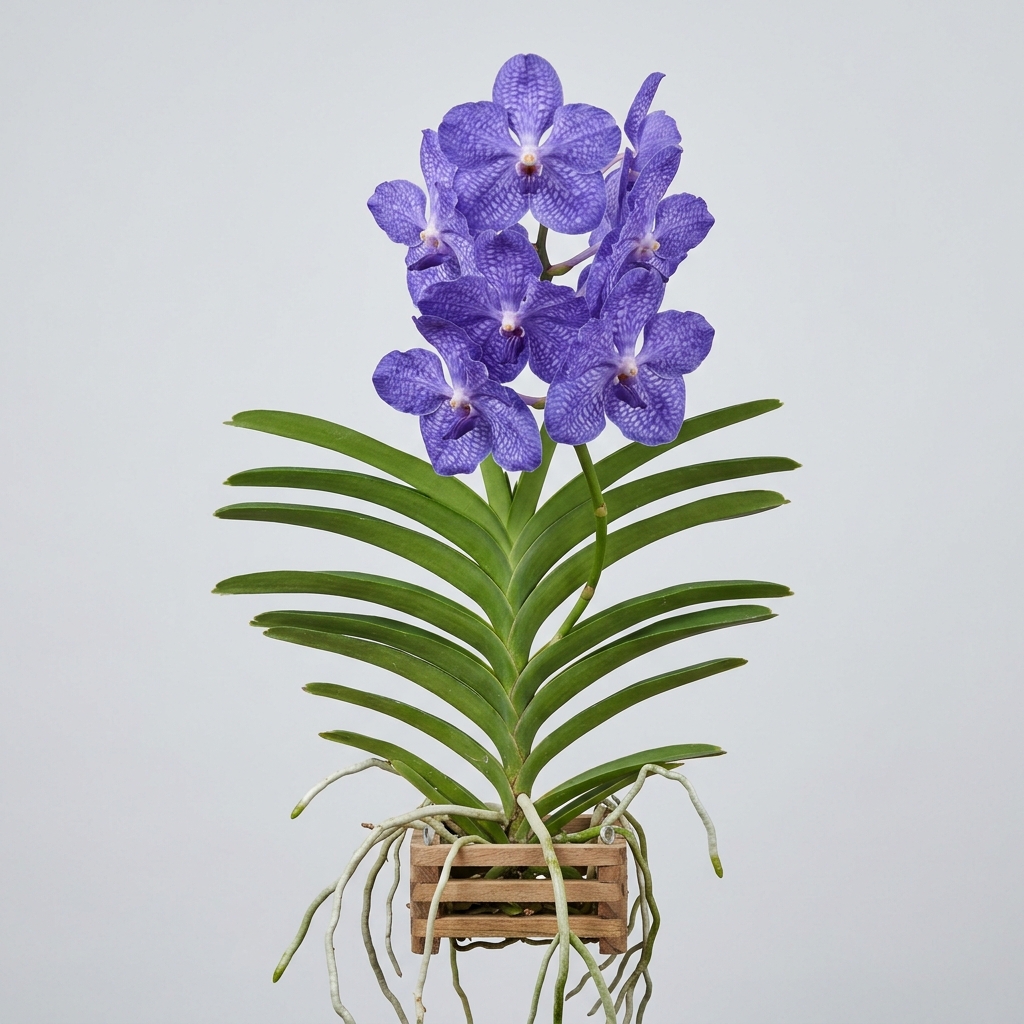
Vanda Sansai Blue is a highly celebrated evergreen epiphytic orchid cultivar famous for its striking blue-violet flowers. Known for its robust growth habit and large, tessellated blooms, this cultivar represents the classic beauty of hybrid Vandas. It is highly valued by collectors and hobbyists for its ability to bloom multiple times a year under optimal conditions, making it a centerpiece in tropical orchid collections.
Like many strap-leaved Vandas, Vanda Sansai Blue features a monopodial growth habit, producing thick, leathery leaves arranged in a neat V-shape along a central stem. Its extensive, thick aerial root system is a defining characteristic, adapted to absorb moisture and nutrients directly from the air. Growers appreciate this cultivar not only for its dramatic floral display but also for its relative resilience compared to more sensitive wild Vanda species.
💡 Did You Know?
The striking blue-violet color of Vanda Sansai Blue is inherited from Vanda coerulea, one of the very few true blue orchid species found in nature. This ancestral link not only gives the cultivar its vibrant hue but also endows it with a slightly greater tolerance for cooler night temperatures than many other tropical Vanda hybrids.
🌿 Botanical Overview
Vanda Sansai Blue is a monopodial epiphyte that showcases the classic vegetative structure of the Vanda genus. The plant grows upward from a single vegetative point, producing alternating, strap-like leaves that are deeply channeled and rigid. This growth form allows the plant to efficiently capture light and funnel rainwater toward the stem and root system in its native-style environments.
The root system of this cultivar is exceptionally robust, consisting of thick, fleshy aerial roots covered in a spongy layer of velamen. This velamen layer acts like a sponge, rapidly absorbing water and dissolved nutrients while protecting the inner root core from dehydration and intense light. Because these roots require constant airflow, traditional potting methods are often detrimental to the plant’s long-term health.
🌸 Flower Characteristics
The flowers of Vanda Sansai Blue are the primary draw for enthusiasts, typically measuring between three to four inches in diameter. The sepals and petals are broad, overlapping, and display a stunning range of violet-blue hues, often adorned with a darker, net-like pattern known as tessellation. The lip, or labellum, is usually a deeper, more saturated purple-blue, providing a striking focal point at the center of each blossom. Flowers are borne on strong, upright or slightly arched inflorescences that emerge from the leaf axils, with each spike carrying anywhere from eight to fifteen long-lasting blooms.
Fragrance & Bloom Profile
While some growers report a faint, sweet fragrance during the warmest hours of the day, the scent profile of Vanda Sansai Blue is not consistently documented as a primary feature in standard horticultural literature. The blooms are highly prized instead for their exceptional longevity, often remaining pristine on the plant for six to eight weeks. The intensity of the blue-violet coloration can vary slightly depending on light levels and temperature during bud development, with cooler temperatures sometimes intensifying the blue tones.
Parentage & Hybrid Lineage
Vanda Sansai Blue is widely recognized in grower circles as a hybrid that incorporates the genetics of Vanda coerulea, a species famous for imparting blue coloration to its progeny. While specific registration details and complete ancestral lines can sometimes vary or remain less documented in general retail references, the influence of Vanda coerulea is clearly visible in the tessellated petal patterns and cool-toned coloration of the blooms. This hybrid lineage grants the cultivar a slightly higher tolerance for cooler night temperatures than some ultra-tropical Vanda species.
🌱 Growing Conditions
To thrive, Vanda Sansai Blue requires bright, filtered light. While it enjoys high light levels, direct midday sun can scorch the foliage, so a sheer curtain or 50% shade cloth is recommended for outdoor or greenhouse cultivation. Temperatures should ideally remain warm, ranging from 70°F to 85°F (21°C to 29°C) during the day, with a slight drop at night to stimulate blooming. High humidity of 70% to 80% coupled with strong, continuous air movement is essential to prevent fungal pathogens from settling on the damp foliage.
💡 Care Tip
Always water your Vanda Sansai Blue in the morning. This allows the foliage and leaf axils to dry completely before nightfall, significantly reducing the risk of crown rot and fungal leaf spot diseases.
Watering, Feeding & Potting Media
Watering is the most critical aspect of caring for Vanda Sansai Blue. When grown bare-root in slatted wooden baskets, the roots should be thoroughly soaked or misted daily—sometimes twice daily during hot summer months—until they turn a vibrant green. Fertilization should be frequent but dilute; a balanced orchid fertilizer applied weekly at quarter-strength supports the plant’s active growth. Traditional potting soil or dense moss should be avoided, as the roots will quickly suffocate and rot without rapid drying cycles.
Blooming Season & Care Notes
This cultivar is an opportunistic bloomer, meaning it can produce flowers at almost any time of the year when environmental conditions are favorable, though spikes most commonly appear in spring, summer, or early autumn. Once a flower spike has finished blooming and naturally withered, it should be cut back close to the stem using sterilized shears. Repotting or moving the plant to a larger wooden basket is rarely necessary and should only be done when the plant has completely outgrown its support structure or the basket begins to decay.
⚠️ Common Issues
⚠️ Common Mistake
A frequent mistake is planting Vanda Sansai Blue in standard potting soil or fine orchid bark. Their thick aerial roots are highly adapted to constant airflow and will quickly suffocate, rot, and die if buried in dense, moisture-retaining media.
- Root Rot: Caused by stagnant water or planting in dense, moisture-retaining media. Roots should dry completely within a few hours of watering.
- Dehydration: Indicated by wrinkled, limp leaves and dry, silvery roots that fail to turn green when watered.
- Bud Blast: The sudden yellowing and dropping of unopened buds, often triggered by abrupt changes in temperature, drafty conditions, or low humidity.
- Leaf Spotting: Fungal or bacterial spots can develop if water sits on the leaves overnight without adequate air circulation.
- Pests: Mealybugs, scale, and thrips can occasionally hide in the leaf axils or feed on tender flower buds.
❓ Frequently Asked Questions
How do I encourage my Vanda Sansai Blue to rebloom?
To stimulate reblooming, ensure the plant receives sufficient bright, filtered light and a noticeable temperature drop of about 10°F to 15°F (5°C to 8°C) between day and night. Consistent watering and a regular, dilute feeding schedule during the active growing season are also crucial for providing the energy needed to produce new flower spikes.
Can I grow Vanda Sansai Blue indoors without a greenhouse?
Yes, Vanda Sansai Blue can be grown indoors, provided you can meet its high light and humidity requirements. Placing the plant in a bright south- or east-facing window and using a humidifier or a daily soaking routine in a sink or bucket can help replicate its preferred tropical environment.
Why are the aerial roots of my Vanda turning brown and dry?
Brown, brittle, or dry roots typically indicate chronic under-watering or insufficient ambient humidity. Healthy Vanda roots should be thick, silvery-white when dry, and turn bright green within minutes of being watered. Increase the frequency of misting or soak the roots for 15 to 20 minutes daily.
What is the best potting medium for Vanda Sansai Blue?
Vanda Sansai Blue performs best when grown entirely bare-root in open, slatted wooden or plastic baskets without any traditional potting medium. This setup allows maximum airflow around the roots. If growing in an exceptionally dry climate, a few large chunks of charcoal or coarse fir bark can be placed in the basket to help retain minimal moisture.
⭐ Final Growing Notes
Vanda Sansai Blue remains a premier choice for orchid enthusiasts seeking a reliable, show-stopping blue bloom. While its bare-root growing style and high humidity demands require a more attentive watering routine than standard potted orchids, the reward of its spectacular, long-lasting violet-blue flowers makes it an incredibly satisfying cultivar to cultivate.
🌱 Propagation Tip
Vandaceous orchids do not divide like sympodial orchids. Propagation is typically achieved by waiting for the plant to naturally produce a keiki along the main stem. Once the keiki has developed several robust roots of its own, it can be carefully detached and basketed.
⭐ Expert Advice
If you struggle to maintain high indoors, try growing your Vanda in a large, empty glass vase. The vase helps trap around the roots while still allowing to reach the plant, though you must still remove any standing water after soaking.




Leave A Comment