
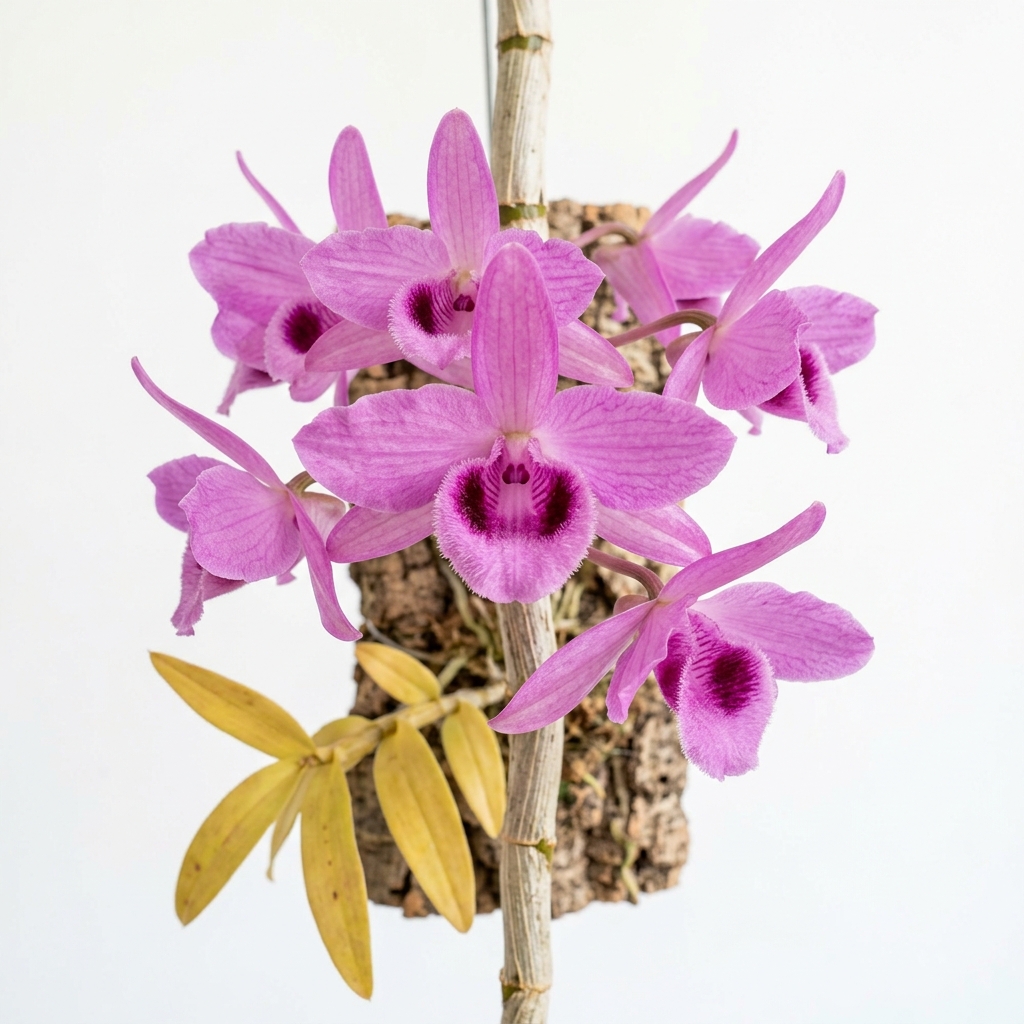
Dendrobium parishii is a highly prized deciduous epiphytic orchid species native to the seasonal forests of Southeast Asia. Renowned for its unique growth habit and striking floral display, this orchid produces thick, pendulous pseudobulbs that naturally shed their leaves during the winter dormancy period. Growers particularly value the species for its ability to burst into a spectacular show of fragrant blossoms along its seemingly lifeless canes in the spring.
Cultivating this orchid offers a rewarding challenge for indoor and greenhouse gardeners alike. Its compact to medium growth habit makes it an excellent candidate for slab mounting or hanging baskets, allowing its canes to drape naturally. With its vibrant pink-to-purple flowers and legendary sweet fragrance, it remains a staple in collections focused on classic species orchids.
💡 Did You Know?
Dendrobium parishii belongs to the Dendrobium orchid group, where flower presentation is often just as important as . White-flowered cultivars are especially valued indoors because their pale blooms reflect well and pair easily with many home, greenhouse, and display settings.
🌿 Botanical Overview
Dendrobium parishii is characterized by its short, stout, and distinctly curved or pendulous pseudobulbs, which are often referred to as canes. These canes are covered in white, papery sheaths when young and can grow up to 30 centimeters in length. The leaves are thick, leathery, and lanceolate, arranged alternately along the new growth during the spring and summer active growing season.
As a deciduous species, it undergoes a dramatic seasonal transformation. In late autumn, the leaves begin to yellow and drop, leaving the bare canes exposed. This leaf loss is a natural adaptation to its native monsoonal climate, conserving moisture during the dry winter months and preparing the plant for its spring flowering cycle.
🌸 Flower Characteristics
The flowers of Dendrobium parishii are typically 4 to 5 centimeters in diameter, appearing in clusters of two to three from the nodes of the previous year’s leafless canes. The petals and sepals are a rich rose-pink to light purple, presenting a vibrant contrast against the bare wood of the cane.
The lip, or labellum, is a defining feature of the species. It is short, downy, and kidney-shaped, featuring a pale pink or white throat flanked by two prominent, deep purple-maroon spots. The margin of the lip is often finely fringed or pubescent, adding a delicate texture to the overall floral presentation.
Fragrance & Bloom Profile
One of the most celebrated attributes of Dendrobium parishii is its intense and delightful fragrance. The blooms emit a sweet, fruity scent that is widely compared to raspberries, rhubarb, or strawberry jam. This fragrance is most potent during the warm morning hours and can easily fill a growing space.
The blooming period typically occurs in mid-to-late spring and lasts for approximately three to four weeks. Because the flowers open simultaneously along the length of the bare canes, a well-grown specimen creates a dense, colorful garland effect that is highly photogenic.
Parentage & Hybrid Lineage
Unlike complex modern hybrids, Dendrobium parishii is a naturally occurring species first described in the 19th century. While it is not a hybrid itself, it has been used extensively in breeding programs to introduce its compact, pendulous habit, rich coloration, and intense fragrance to new Dendrobium grexes.
Several color forms exist within the species, including the rare Dendrobium parishii f. album, which features pure white flowers. In the horticultural trade, growers may encounter selected cultivars or line-bred variations that exhibit larger flowers or deeper purple tones, though their primary lineage remains rooted in the wild species.
🌱 Growing Conditions
To grow Dendrobium parishii successfully, one must mimic its native seasonal environment. During the active growing season from spring to early autumn, the plant thrives in bright, indirect light, similar to the dappled canopy of its native forests. High humidity of 70% or more, coupled with strong air movement, is essential to prevent fungal issues.
💡 Care Tip
For best results, grow Dendrobium parishii in bright filtered with steady and gentle airflow. Avoid placing the plant in harsh midday sun, but do not keep it in a dark corner; weak is one of the most common reasons cultivated orchids refuse to rebloom.
Temperature requirements shift with the seasons. In summer, the orchid prefers warm conditions with daytime temperatures ranging from 24°C to 30°C (75°F to 86°F). In winter, a cooler environment is necessary to trigger bud development, with night temperatures ideally dropping to 10°C to 15°C (50°F to 59°F).
Watering, Feeding & Potting Media
Watering must be adjusted dynamically throughout the year. During the active growth phase, the orchid should be watered copiously, keeping the roots consistently moist but not waterlogged. Weekly applications of a balanced orchid fertilizer diluted to quarter-strength will support the rapid development of new canes.
Because of its pendulous growth habit, Dendrobium parishii is ideally suited for mounting on cork bark or tree fern slabs, or planted in hanging baskets using a highly draining medium such as coarse fir bark mixed with charcoal. If mounted, daily watering may be required during the heat of summer.
Blooming Season & Care Notes
The transition into the blooming season requires a strict winter rest period starting in late autumn. As day lengths shorten and temperatures drop, watering should be gradually reduced to a bare minimum, and fertilizing must stop entirely. Only occasional misting should be provided to prevent the canes from shriveling excessively.
This dry rest triggers the formation of flower buds at the nodes of the canes. Once the buds begin to swell in early spring, normal watering can slowly resume. Avoid repotting during the bud development stage, as disturbing the roots can cause bud drop; instead, wait until new green shoots emerge from the base of the plant after flowering.
⚠️ Common Issues
⚠️ Common Mistake
The most common mistake is by calendar instead of root and potting-media condition. Dendrobium roots need moisture and air at the same time, so constantly wet bark or sphagnum can lead to root loss even when the leaves still look healthy.
- Root Rot:
Caused by overwatering during the winter rest period or using compacted, poorly draining media. - Bud Blast:
Sudden temperature fluctuations, low humidity, or premature watering before buds are fully formed can cause buds to yellow and drop. - Shriveled Canes: While some wrinkling is normal during the winter rest, severe shriveling indicates extreme dehydration; light misting can alleviate this.
- Spider Mites and Mealybugs: These pests can hide in the papery sheaths of the canes, especially in dry, low-humidity environments.
- Leaf Spotting: Fungal or bacterial spots can develop on leaves during summer if air circulation is inadequate under high humidity.
❓ Frequently Asked Questions
Why are the leaves on my Dendrobium parishii turning yellow and falling off?
This is a natural deciduous process that occurs in late autumn. The orchid sheds its leaves to conserve moisture and prepare for its winter dormancy, which is essential for the later spring blooming cycle.
How dry should I keep Dendrobium parishii during its winter rest?
Watering should be severely restricted. Only mist the plant lightly every one to two weeks if the canes show signs of extreme shriveling. Do not resume regular watering until the flower buds are clearly visible in spring.
Can I grow Dendrobium parishii in a standard plastic pot?
While possible, it is not ideal due to the plant’s natural pendulous growth habit. Hanging baskets or cork mounts are highly recommended to allow the canes to drape downward naturally and to ensure rapid drainage.
What does the fragrance of Dendrobium parishii smell like?
The blooms produce a highly distinctive, sweet fragrance that is commonly described as smelling like raspberries, rhubarb, or sweet strawberry jam, which is most intense in the morning.
⭐ Final Growing Notes
Mastering the seasonal rhythm of Dendrobium parishii is the key to unlocking its full horticultural potential. By respecting its need for a warm, wet summer growing season followed by a cool, dry winter rest, growers are rewarded with an unforgettable spring display of vibrant, raspberry-scented blossoms that epitomize the classic charm of species orchids.
🌱 Propagation Tip
Propagation should be approached patiently. Most home growers should wait for natural keikis or divide only mature, healthy plants when the orchid type allows it. Never remove a young growth until it has strong roots and enough leaves to support itself away from the parent plant.
⭐ Expert Advice
Repot after flowering when fresh root tips begin to appear. This timing helps the plant anchor quickly into new bark or sphagnum and reduces stress, especially for orchids grown indoors where airflow, , and drying speed can change from season to season.




Leave A Comment