
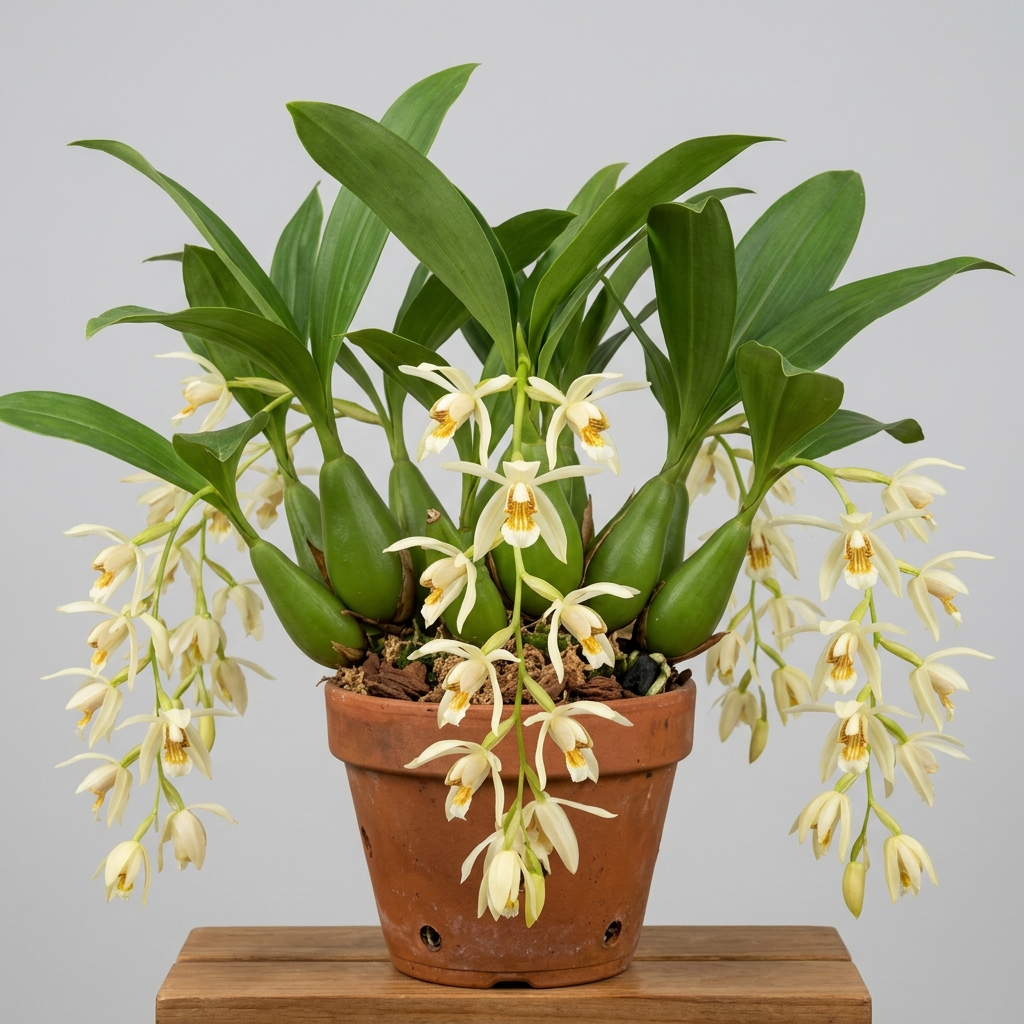
Coelogyne flaccida is a captivating epiphytic orchid species highly prized by collectors for its elegant, cascading habit and abundant spring blooms. Native to the cool-to-warm regions of the Himalayas and Southeast Asia, this resilient orchid produces pendulous inflorescences that drape gracefully over the sides of its container. Its distinctive growth form and reliable blooming nature make it a standout addition to any indoor orchid collection or temperate greenhouse.
Growers value Coelogyne flaccida not only for its striking floral display but also for its relatively forgiving nature compared to more delicate orchid species. The plant features prominent, pear-shaped pseudobulbs topped with lush, leathery leaves that remain attractive year-round. When in bloom, the contrast between the dense green foliage and the delicate, downward-reaching spikes of cream-colored flowers creates a spectacular visual effect.
💡 Did You Know?
Coelogyne flaccida is native to the montane forests of the Himalayas, where it grows as an epiphyte on mossy trees at elevations up to 1,600 meters. Its pendulous flower spikes evolved to hang downward, allowing the blooms to remain protected under the plant's canopy from heavy mountain rains while remaining highly visible to flying pollinators.
🌿 Botanical Overview
Coelogyne flaccida is characterized by its clustered, ovoid to pyriform pseudobulbs, which serve as water and nutrient storage organs. Each pseudobulb typically bears two lanceolate, plicate leaves that are rich green and durable. The plant spreads via a creeping rhizome, gradually forming dense, impressive clumps over time when grown under optimal conditions.
In its natural habitat, this species grows as an epiphyte on moss-covered tree trunks or occasionally as a lithophyte on damp rocks. This adaptation explains its preference for excellent drainage and high atmospheric humidity. Understanding its native montane environment helps growers replicate the seasonal moisture and temperature fluctuations necessary for its long-term health.
🌸 Flower Characteristics
The flowers of Coelogyne flaccida are borne on pendulous, arching racemes that emerge from the base of mature pseudobulbs. Each inflorescence can carry between 5 and 15 flowers, which open nearly simultaneously to create a dramatic cascading effect. The individual blossoms are typically 3 to 5 centimeters in diameter, featuring narrow, spreading sepals and petals of a pristine cream, ivory, or pale yellow hue.
The most intricate part of the flower is the three-lobed lip, or labellum. It features a bright yellow or golden center flanked by dark brown or reddish-brown veins and ridges. This contrasting coloration serves as a visual guide for natural pollinators, adding a sophisticated level of detail to the delicate, nodding blooms.
Fragrance & Bloom Profile
The fragrance of Coelogyne flaccida is a subject of much discussion among orchid enthusiasts. It is generally described as a distinct, sweet, and slightly musky scent that becomes more pronounced in the warmth of the midday sun. While some find the aroma pleasant and honey-like, others note a heavier, earthy undertone that is characteristic of many species within the Coelogyne genus.
The blooms are moderately long-lasting, typically remaining in prime condition for two to three weeks, depending on ambient temperatures and humidity levels. To maximize the lifespan of the flowers, growers should keep the plant in a cool, draft-free location once the buds begin to open, avoiding direct water contact on the delicate petals.
Parentage & Hybrid Lineage
As a naturally occurring species rather than a man-made hybrid, Coelogyne flaccida does not have a complex lineage of parental cultivars. It belongs to the section Flaccidae within the genus Coelogyne, a group known for its pendulous flowering habits and distinct pseudobulb morphology.
While it is primarily grown and appreciated in its pure species form, Coelogyne flaccida has occasionally been used in breeding programs to introduce its cascading flower habit and cold tolerance to new hybrids. However, documented registered hybrids utilizing this species remain relatively uncommon in mainstream commercial cultivation, making the pure species the primary choice for collectors.
🌱 Growing Conditions
To cultivate Coelogyne flaccida successfully, provide medium to bright indirect light, similar to the dappled sunlight found under a forest canopy. East- or shaded south-facing windows are ideal. Avoid direct afternoon sun, which can easily scorch the plicate leaves and cause permanent damage.
💡 Care Tip
Ensure your Coelogyne flaccida receives excellent air circulation, especially when grown in high- environments. Gentle breeze from a small fan prevents stagnant air, which significantly reduces the risk of fungal leaf spotting and helps the potting medium dry out evenly between waterings.
This orchid thrives in intermediate to cool temperature ranges. Daytime temperatures of 18 to 24 degrees Celsius (65 to 75 degrees Fahrenheit) are ideal during the growing season, with a night drop of 5 to 10 degrees to mimic montane conditions. High humidity, ideally between 50% and 70%, combined with gentle, continuous air movement, is essential to prevent fungal issues and support healthy leaf development.
Watering, Feeding & Potting Media
During the active spring and summer growing season, Coelogyne flaccida requires abundant watering. The potting medium should be kept consistently moist but never waterlogged. As the new pseudobulbs mature in autumn, gradually reduce watering to allow the plant a semi-dry winter rest, which is crucial for triggering the next spring’s bloom cycle.
Apply a balanced, diluted orchid fertilizer weekly or bi-weekly during active growth, using a “weakly, weekly” approach. Flush the pot with pure water once a month to prevent salt buildup. The ideal potting medium is a well-draining mix of medium-grade fir bark, charcoal, and perlite, or high-quality sphagnum moss. Because of its pendulous flower spikes, growing this species in a hanging basket or mounted on a cork slab is highly recommended.
Blooming Season & Care Notes
Coelogyne flaccida typically blooms in late winter or early spring, with flower spikes emerging from the base of the newest pseudobulbs. It is critical not to disturb the plant or repot it when the flower spikes are developing, as sudden environmental changes can cause the buds to blast.
Repotting should only be performed immediately after flowering has finished and as new root growth begins from the base of the pseudobulbs. Because Coelogyne species dislike root disturbance, only repot when the potting medium has degraded or the plant has completely outgrown its container. When dividing the plant, ensure each division has at least three to four healthy pseudobulbs to guarantee successful recovery.
⚠️ Common Issues
⚠️ Common Mistake
A frequent error is overwatering Coelogyne flaccida during its winter rest period. While the plant requires generous moisture during summer growth, keeping the medium wet in winter when temperatures are cool will quickly lead to root rot and can prevent the orchid from flowering in spring.
- Root rot: Caused by overwatering or compacted, poorly draining potting media that deprives roots of oxygen.
- Leaf spotting: Fungal or bacterial spots can develop if water sits on the leaves overnight or if air circulation is inadequate.
- Bud blast: Sudden drops in humidity, extreme temperature fluctuations, or moving the plant while buds are forming can cause flowers to drop prematurely.
- Dehydration: Shriveled pseudobulbs indicate insufficient watering during the active growth phase or a loss of healthy roots due to rot.
- Pests: Spider mites, mealybugs, and scale can occasionally target the undersides of the leaves and the crevices of the pseudobulbs.
❓ Frequently Asked Questions
How do I trigger blooming on my Coelogyne flaccida?
To encourage abundant blooming, provide a distinct winter rest period with reduced watering and cooler night temperatures. This seasonal shift mimics its natural habitat and triggers the development of flower spikes from the base of the pseudobulbs in late winter.
Can Coelogyne flaccida be grown mounted on cork bark?
Yes, mounting Coelogyne flaccida on cork slab or tree fern fiber is highly effective and showcases its natural pendulous blooming habit beautifully. However, mounted plants dry out much faster and require daily watering or very high ambient humidity to thrive.
Why are the pseudobulbs on my orchid shriveling?
Slight shriveling of older pseudobulbs is normal during the dry winter rest period. However, severe shriveling during the active growing season usually indicates underwatering or a damaged root system that can no longer absorb moisture.
What is the best potting container for this orchid?
Slatted wooden or plastic hanging baskets are excellent choices for Coelogyne flaccida. These containers allow the pendulous flower spikes to drape naturally over the sides without obstruction, while also ensuring superior drainage and airflow around the roots.
⭐ Final Growing Notes
Coelogyne flaccida is a rewarding and elegant orchid that brings a touch of wild montane beauty to any collection. By respecting its need for a distinct winter rest, providing bright indirect light, and choosing a container that accommodates its cascading blooms, growers can enjoy a spectacular annual display of fragrant, ivory flowers for many years to come.
🌱 Propagation Tip
When dividing Coelogyne flaccida, always keep a minimum of three to four interconnected pseudobulbs per division. Smaller divisions often struggle to establish, frequently skipping several bloom cycles as they expend energy trying to produce new vegetative growth rather than flowers.
⭐ Expert Advice
If you struggle to accommodate the cascading flower spikes in standard pots, transition the orchid into a slatted wooden basket lined with coconut coir or high-quality sphagnum moss. This allows the spikes to emerge naturally from the bottom and sides, mimicking its wild epiphytic growth habit.




Leave A Comment