
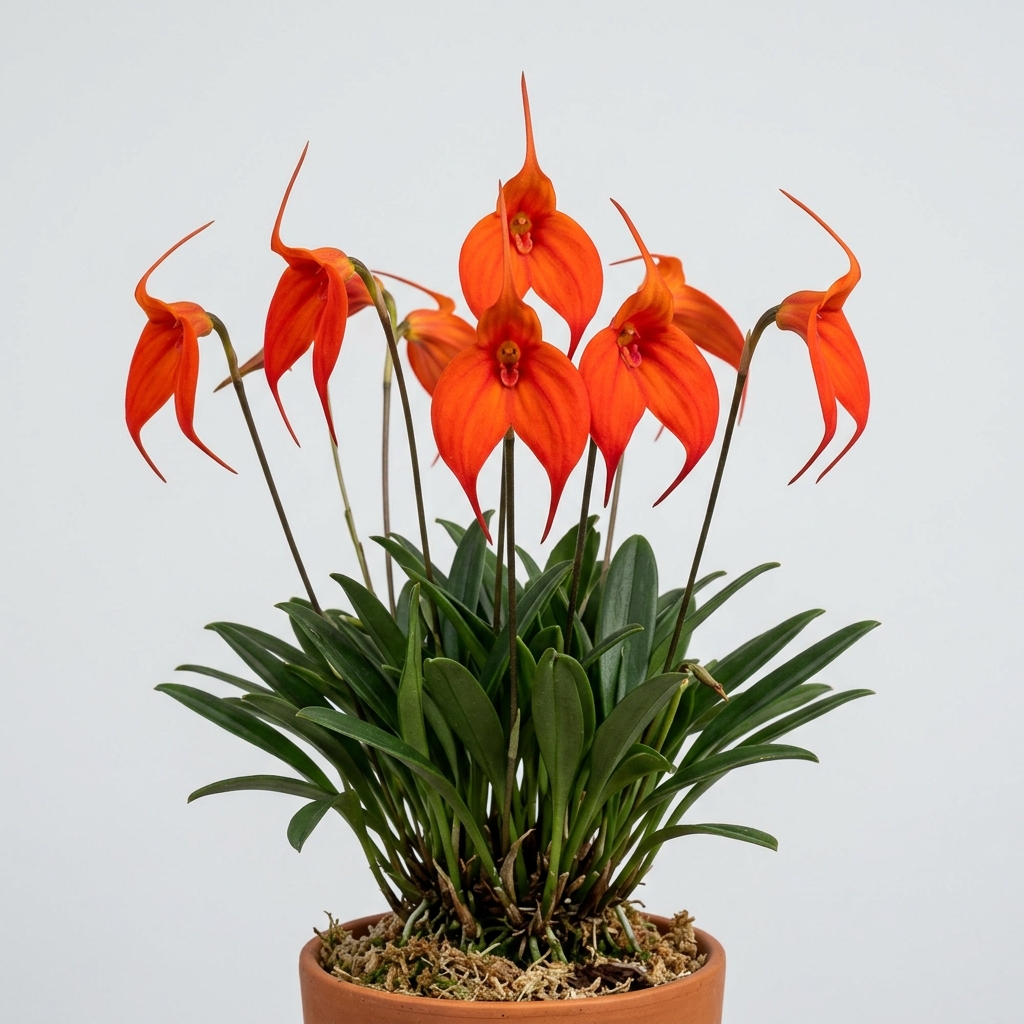
Masdevallia ignea, commonly known as the fiery Masdevallia, is a striking cool-growing orchid species highly prized by enthusiasts for its intensely vibrant, neon-orange to scarlet blooms. Native to the high-altitude cloud forests of Colombia, this compact epiphyte brings a dramatic splash of color to specialized indoor collections and cool greenhouses. Unlike many of the more common tropical orchids, this species thrives in conditions that mimic its misty, montane habitat, making it both a rewarding challenge and a crown jewel for dedicated growers.
Cultivators value Masdevallia ignea not only for its brilliant floral display but also for its neat, tufted growth habit. The plant produces slender, erect leaves that form an attractive green canopy, from which the slender flower spikes emerge to present the blossoms well above the foliage. While its environmental demands require careful attention to temperature and moisture, the sheer visual impact of its uniquely shaped, glowing flowers makes it an enduring favorite in the orchid-growing community.
💡 Did You Know?
Masdevallia ignea is part of the Masdevallia orchid group, a favorite among growers because its flowers, growth habit, and care needs make it useful for comparing cultivated orchids within the same . Observing its leaves, roots, and bloom spikes can help growers understand how this cultivar responds to indoor conditions.
🌿 Botanical Overview
Masdevallia ignea is a tufted, caespitose orchid species that lacks pseudobulbs, a characteristic common to the Pleurothallidinae subtribe. Instead, it relies on short, erect ramicauls wrapped in tubular sheaths, each bearing a single, fleshy, dark green leaf. This structural adaptation means the plant has very little water-storage capacity, making it highly dependent on consistent ambient moisture and humidity to survive.
In its native Colombian habitat, this orchid grows as an epiphyte on moss-covered tree trunks or occasionally as a lithophyte on damp rocks at elevations ranging from 2,500 to 3,200 meters. These high-altitude regions are characterized by constant cloud cover, cool breezes, and frequent mist, which dictate the specific cultural requirements needed to maintain the species successfully in cultivation.
🌸 Flower Characteristics
The flowers of Masdevallia ignea are renowned for their brilliant, almost fluorescent coloration, which ranges from fiery orange to deep scarlet, often accented by yellow or reddish-purple veins. The lateral sepals are fused together to form a broad, downward-curving hood, while the dorsal sepal is reflexed backward, ending in a slender, tail-like sepaline spur.
The actual petals and lip of the orchid are tiny and hidden deep within the sepaline tube, a common feature of the genus designed to attract specific pollinators in the wild. Each flower is borne singly on a slender, erect inflorescence that rises well above the foliage, ensuring the brilliant blooms are prominently displayed.
Fragrance & Bloom Profile
While some members of the Pleurothallidinae subtribe produce distinct scents to attract pollinators, a noticeable fragrance is not consistently documented for Masdevallia ignea. Most growers report that the flowers are virtually scentless, relying almost entirely on their intense, glowing color to attract attention.
The blooms are remarkably long-lasting, often remaining in pristine condition for several weeks if environmental conditions are kept cool and humid. A mature specimen can produce multiple spikes sequentially, extending the overall display over several months.
Parentage & Hybrid Lineage
As a distinct species rather than a man-made hybrid, Masdevallia ignea represents a pure wild lineage. However, its exceptional color and vigorous growth habit have made it a highly sought-after parent in orchid hybridization. It has been used extensively to introduce bright orange and red hues, as well as improved temperature tolerance, into modern Masdevallia hybrids.
When researching specific specimens, growers may encounter line-bred cultivars of Masdevallia ignea that have been selected for larger flower size or more intense coloration. Because registration details for individual line-bred selections can vary, parentage and specific clonal awards are not always consistently documented in general grower references.
🌱 Growing Conditions
Replicating the cool, misty cloud forest environment is the key to success with Masdevallia ignea. The plant thrives in cool to cold temperatures, ideally requiring daytime temperatures between 65°F and 72°F and a distinct nighttime drop to 50°F to 55°F. Temperatures consistently exceeding 75°F can cause rapid decline, leaf drop, and heat stress.
💡 Care Tip
For best results, grow Masdevallia ignea in bright filtered with steady and gentle airflow. Avoid placing the plant in harsh midday sun, but do not keep it in a dark corner; weak is one of the most common reasons cultivated orchids refuse to rebloom.
Light levels should be kept low to moderate, similar to those preferred by Phalaenopsis orchids. Bright, filtered light is ideal, but direct sunlight must be avoided as it can easily burn the thin leaves. High humidity of 70% to 90% is essential, coupled with constant, gentle airflow to prevent stagnant air from encouraging fungal pathogens.
Watering, Feeding & Potting Media
Because Masdevallia ignea lacks pseudobulbs to store water, the potting medium must never be allowed to dry out completely. The roots should remain evenly moist but not waterlogged. High-quality water, such as rainwater, reverse osmosis water, or distilled water, is highly recommended, as this species is extremely sensitive to dissolved salts and mineral buildup.
A potting mix of high-grade New Zealand sphagnum moss or a fine-grade bark mix works exceptionally well in maintaining the necessary moisture balance. Plastic pots are often preferred to retain moisture, though clay pots can provide beneficial evaporative cooling in warmer climates. Feeding should be done with a highly diluted, balanced orchid fertilizer applied every two to three weeks during active growth, followed by a thorough flushing with pure water to prevent salt accumulation.
Blooming Season & Care Notes
The primary blooming season for Masdevallia ignea typically spans from late winter through spring, though healthy plants can occasionally produce flowers at other times of the year. To encourage robust blooming, ensure the plant experiences a reliable drop in night temperatures during the autumn months.
Once the flowers fade, the old spikes can be cut back to the base of the leaf stem. Repotting is best done in the autumn or early spring when temperatures are cool and the plant is actively producing new root growth. Avoid repotting during the heat of summer, as the added stress can be detrimental to the orchid’s recovery.
⚠️ Common Issues
⚠️ Common Mistake
The most common mistake is by calendar instead of root and potting-media condition. Masdevallia roots need moisture and air at the same time, so constantly wet bark or sphagnum can lead to root loss even when the leaves still look healthy.
- Leaf Spotting: Often caused by high humidity combined with inadequate air movement, allowing fungal or bacterial pathogens to colonize the foliage.
- Heat Stress and Leaf Drop: Rapid loss of lower leaves is a classic sign that ambient temperatures are too high or that the root system has failed due to underwatering.
- Root Rot: Occurs when the potting media degrades and becomes compacted, suffocating the delicate, hair-like roots in stagnant water.
- Pests: Aphids and spider mites can occasionally target the tender new growth and flower buds, requiring prompt treatment with a gentle, orchid-safe insecticidal soap.
❓ Frequently Asked Questions
How do I prevent my Masdevallia ignea from dropping its leaves in summer?
Leaf drop in summer is typically caused by heat stress. To prevent this, keep the plant in the coolest room of your home, use evaporative cooling methods, or use a small fan to increase air circulation around the pot. Keeping the root zone cool with damp clay pots can also help mitigate high ambient temperatures.
What is the best potting mix for Masdevallia ignea?
A high-quality, long-fibered New Zealand sphagnum moss is highly recommended because it retains consistent moisture while allowing air to reach the roots. Alternatively, a fine-grade orchid bark mix blended with perlite and tree fern fiber can be used for growers who prefer a more free-draining medium.
Can Masdevallia ignea be grown under LED lights?
Yes, this species adapts very well to artificial LED setups. Because it requires low to moderate light, place the plant toward the periphery of the light footprint or adjust the intensity to mimic shaded forest conditions, ensuring the lights do not generate excess heat.
Why are the leaf tips of my orchid turning black?
Black leaf tips are usually a sign of mineral burn from tap water or over-fertilization. Masdevallia ignea has highly sensitive roots that cannot tolerate dissolved salts. Switch to pure rainwater, distilled water, or reverse osmosis water, and reduce fertilizer concentration to a quarter-strength or less.
⭐ Final Growing Notes
While Masdevallia ignea demands a disciplined approach to temperature control and moisture management, it remains one of the most rewarding cool-growing orchids available to hobbyists. By providing consistent humidity, pure water, and protection from summer heat, growers can enjoy the unparalleled brilliance of its fiery blooms year after year, making it a standout addition to any specialized collection.
🌱 Propagation Tip
Propagation should be approached patiently. Most home growers should wait for natural keikis or divide only mature, healthy plants when the orchid type allows it. Never remove a young growth until it has strong roots and enough leaves to support itself away from the parent plant.
⭐ Expert Advice
Repot after flowering when fresh root tips begin to appear. This timing helps the plant anchor quickly into new bark or sphagnum and reduces stress, especially for orchids grown indoors where airflow, , and drying speed can change from season to season.




Leave A Comment