
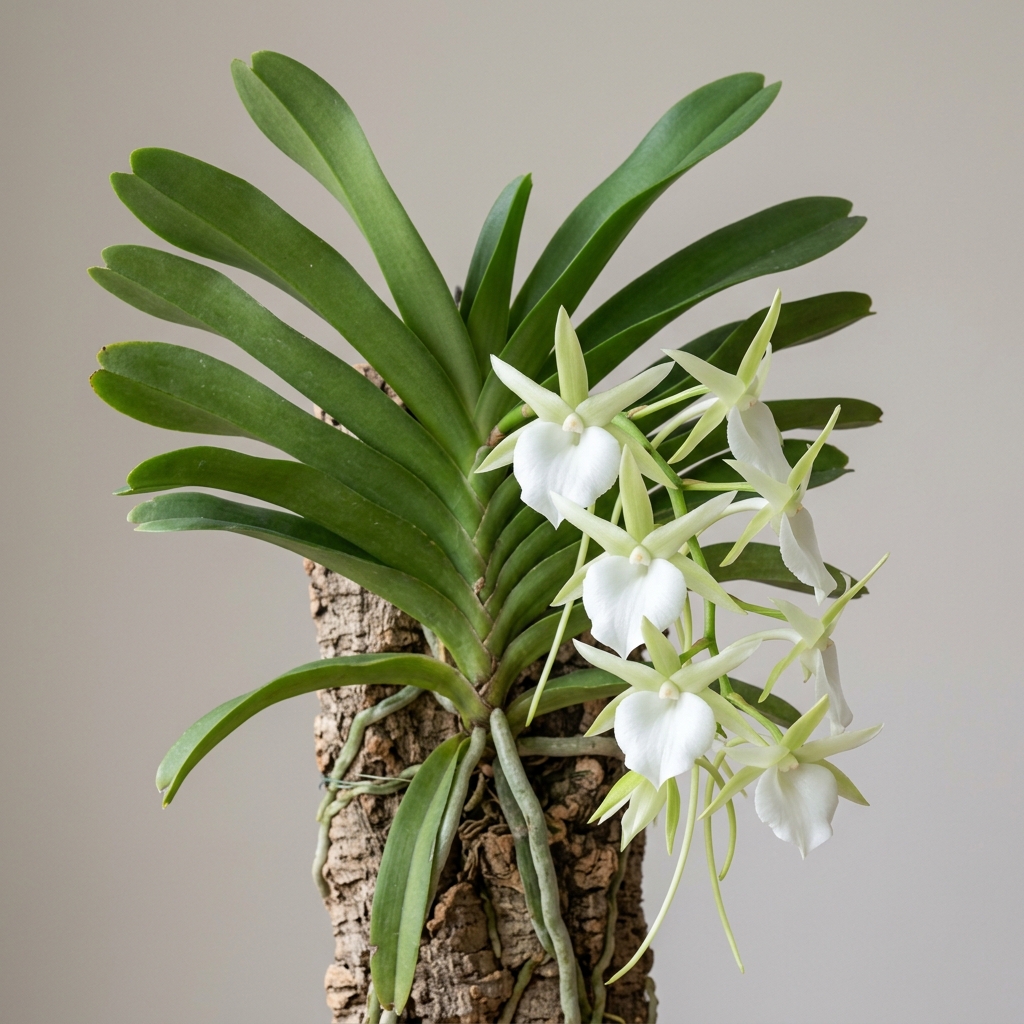
Angraecum eburneum, commonly known as the ivory-colored Angraecum, is a magnificent epiphytic orchid species celebrated for its grand stature and pristine, long-lasting blooms. Native to the tropical regions of Madagascar and neighboring islands, this robust orchid has captured the fascination of collectors for generations. Its architectural growth habit and striking floral presentation make it a highly prized centerpiece in any serious orchid collection.
Growers particularly value this species for its reliable winter-blooming habit and its enchanting nocturnal fragrance. While its large size requires dedicated growing space, its ease of culture compared to other exotic orchids makes it an exceptionally rewarding choice. The contrast between its leathery, fan-shaped foliage and its crystalline white flowers offers year-round visual appeal.
💡 Did You Know?
Angraecum eburneum relies on a highly specialized evolutionary relationship with night-flying hawkmoths. The moths use their exceptionally long proboscises to reach the nectar hidden deep inside the flower's long spur, pollinating the orchid in the process.
🌿 Botanical Overview
Angraecum eburneum is a monopodial orchid, meaning it grows upward from a single stem rather than producing pseudobulbs. In its natural habitat, it grows as an epiphyte on tree trunks or occasionally as a lithophyte on damp rocks. The plant features thick, leathery, strap-like leaves arranged in a tight, fan-shaped configuration. These leaves are deeply channeled and can reach lengths of up to two feet on mature specimens, giving the plant an impressive, sculptural presence even when not in bloom.
As the plant matures, it develops a massive root system characterized by thick, fleshy aerial roots covered in velamen. These roots are highly efficient at absorbing moisture and nutrients from the air and rain. Over time, the main stem may produce basal offsets, eventually forming a spectacular, multi-stemmed specimen. Due to its potential size, growers should plan for long-term placement where the plant can expand without frequent disturbance.
🌸 Flower Characteristics
The flowers of Angraecum eburneum are renowned for their striking, upside-down presentation, a botanical phenomenon known as non-resupination. The most prominent feature of the blossom is the large, heart-shaped or shell-shaped labellum (lip), which is a pristine ivory-white color and points upward. Surrounding the lip are narrow, lanceolate sepals and petals that typically exhibit a contrasting pale green or yellowish-green hue.
Each flower features a long, nectar-filled spur extending from the back of the lip, which can reach several inches in length. The blooms are arranged in two neat rows along a stout, arching inflorescence that emerges from the leaf axils. A single flower spike can carry anywhere from ten to thirty individual flowers, each measuring up to three to four inches across. The heavy, waxy substance of the petals ensures that the flowers remain pristine for several weeks.
Fragrance & Bloom Profile
One of the most captivating attributes of Angraecum eburneum is its intense nocturnal fragrance. During the day, the flowers are virtually scentless, saving their metabolic energy for the evening hours. As dusk approaches, the blooms release a powerful, sweet perfume that fills the growing area. This fragrance is often described as a rich blend of jasmine, gardenia, and sweet honey, specifically evolved to attract night-flying hawkmoths for pollination.
The blooming cycle typically begins in late autumn or early winter, with the flowers remaining in perfect condition for six to eight weeks. Because the waxy flowers open sequentially along the spike, the overall display can extend for up to two months. The combination of its luminous white color and powerful evening scent makes it a standout performer in any indoor or greenhouse environment.
Parentage & Hybrid Lineage
Angraecum eburneum is a naturally occurring species rather than a man-made hybrid. Within the botanical community, several subspecies and varieties are recognized, including Angraecum eburneum subsp. superbum and Angraecum eburneum subsp. xerophilum, which vary slightly in flower size and geographical origin. Because of its dominant desirable traits, this species has been used as a parent in several notable intergeneric and intrageneric hybrids.
In common grower references, its exact hybrid pedigree in modern cultivation is carefully tracked, though many plants sold today are line-bred selections of the species itself. When purchasing this orchid, growers should note that wild-collected specimens are strictly protected under conservation laws, and all cultivated plants should be sourced from reputable nurseries utilizing seed-raised or tissue-cultured propagation.
🌱 Growing Conditions
To cultivate Angraecum eburneum successfully, growers must replicate its warm, humid tropical origin. It thrives in bright, indirect light, similar to the conditions preferred by Cattleyas. While it can tolerate some morning direct sun, hot afternoon sun will scorch the thick leaves. A light level of 2,500 to 3,500 foot-candles is generally ideal for promoting robust growth and consistent winter blooming.
💡 Care Tip
Provide constant, gentle air movement around your Angraecum eburneum. Because it requires high , stagnant air can quickly lead to fungal leaf spot or crown rot, especially if water pools in the leaf axils.
Temperature: wise, this orchid prefers warm to intermediate conditions. Daytime temperatures should ideally range between 75°F and 85°F (24°C to 29°C), with a night drop to around 60°F to 65°F (15°C to 18°C). High relative humidity of 60% to 80% is critical, especially when temperatures rise. To prevent stagnant air and fungal pathogens, constant, gentle air movement must be provided around the foliage and root zone.
Watering, Feeding & Potting Media
Angraecum eburneum requires a consistent watering schedule, as it lacks pseudobulbs to store water. The potting medium should be kept evenly moist but never waterlogged. During the active growing season in spring and summer, water the plant thoroughly as soon as the medium approaches dryness. In the winter, watering should be slightly reduced, allowing the medium to dry out more between applications, but the plant should never be allowed to shrivel.
Because of its large size and sensitive roots, a coarse, fast-draining potting mix is essential. A blend of large-grade fir bark, charcoal, and coarse perlite works exceptionally well in large clay or plastic pots. Alternatively, mature specimens can be grown in wooden baskets without media, allowing the thick aerial roots to drape freely. Feed the plant weekly with a balanced, water-soluble orchid fertilizer diluted to quarter or half strength, flushing the pot with pure water once a month to prevent salt buildup.
Blooming Season & Care Notes
The primary blooming season for Angraecum eburneum spans from December through March. Flower spikes begin to emerge from the lower leaf axils in mid-autumn and develop slowly over several weeks. During this developmental phase, it is crucial to maintain stable environmental conditions, as sudden drops in humidity or temperature can cause the developing buds to blast.
Once the blooming cycle is complete, the old flower spike should be cut back close to the stem using sterilized cutting tools. Repotting should be done only when absolutely necessary, as this species resents root disturbance. The ideal time to repot is in early spring, just as new root tips begin to emerge from the base of the plant. Use extreme care to avoid breaking the thick, active roots during the transition.
⚠️ Common Issues
⚠️ Common Mistake
The most common mistake is repotting this orchid too frequently. Angraecum species have highly sensitive roots that resent disturbance, often stalling their growth or skipping a bloom cycle if repotted unnecessarily.
- Root Rot: Caused by overwatering or compacted, decaying potting media that suffocates the roots.
- Leaf Spotting: Fungal or bacterial spots can develop if water is allowed to sit in the leaf crown or axils overnight.
- Bud Blast: Premature dropping of flower buds due to sudden drafts, low humidity, or extreme temperature fluctuations.
- Dehydration: Indicated by wrinkled, leathery leaves and shriveled aerial roots, often caused by underwatering or a dead root system.
- Pests: Mealybugs and scale insects can hide in the tight crevices of the fan-shaped foliage and must be treated promptly with horticultural oil or insecticidal soap.
❓ Frequently Asked Questions
How large does Angraecum eburneum grow?
Angraecum eburneum is a large-stature orchid that can easily reach three to four feet in height and width as a mature specimen. Because of its monopodial growth habit and robust fan of thick leaves, growers should ensure they have adequate space in their greenhouse or indoor growing area before acquiring one.
Why are the buds on my Angraecum eburneum falling off before opening?
This issue, known as bud blast, is typically caused by sudden environmental stress. Common triggers include dry indoor air, cold drafts from windows or air vents, or letting the potting medium dry out completely while the flower spike is actively developing. Maintaining high humidity and stable temperatures will prevent this.
Can I grow Angraecum eburneum mounted on wood?
Yes, mounting is an excellent option for this orchid, especially when young. However, because mature plants become exceptionally heavy and large, they are usually transitioned to large wooden baskets or heavy clay pots filled with coarse bark to provide stability and support their extensive root systems.
How often should I repot this orchid?
Angraecum eburneum dislikes root disturbance and should only be repotted every three to four years, or when the potting medium has completely broken down. Always wait until you see active new root growth in the spring before attempting to repot, and handle the roots with extreme care.
⭐ Final Growing Notes
Angraecum eburneum is a magnificent testament to the diversity of the orchid family, offering a dramatic combination of architectural foliage, pristine winter blooms, and an unforgettable nocturnal fragrance. While its ultimate size requires a commitment of space, its robust nature and straightforward cultural requirements make it an achievable triumph for intermediate growers. By providing bright light, high humidity, and minimizing root disturbance, you will be rewarded with a spectacular annual display of ivory blossoms that bring tropical elegance to the winter months.
🌱 Propagation Tip
This monopodial orchid is best propagated by carefully detaching basal offsets, or keikis, once they have developed several strong roots of their own. Avoid dividing the main stem unless it has grown excessively tall and has established aerial roots.
⭐ Expert Advice
To trigger a heavy flush of winter blooms, ensure your orchid experiences a slight drop in night temperatures during early autumn, combined with bright, filtered . This environmental cue encourages the development of strong flower spikes.




Leave A Comment