
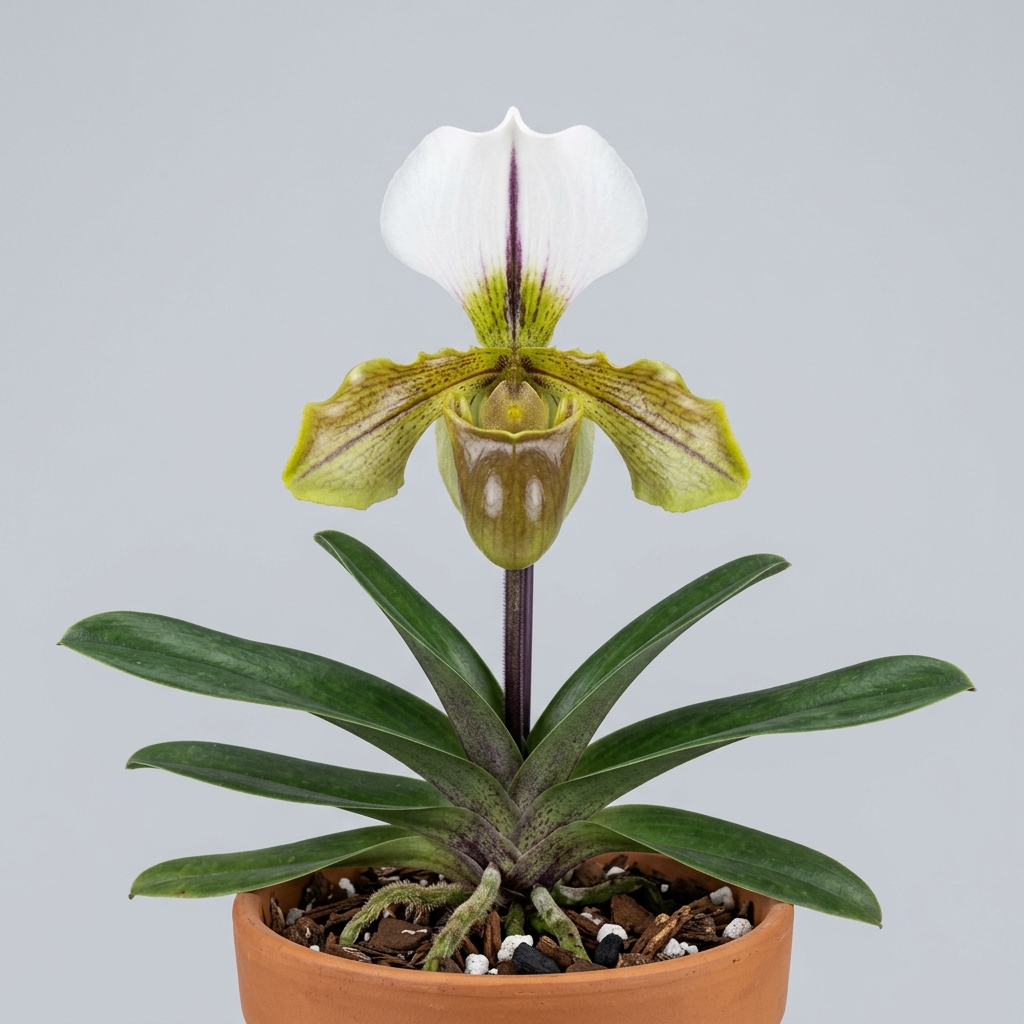
Paphiopedilum spicerianum is a captivating species of slipper orchid highly prized by collectors for its distinctive, elegant blooms and compact growth habit. Native to the cool, misty forested regions of Southeast Asia, this terrestrial or lithophytic orchid brings a touch of exotic sophistication to indoor collections. Growers particularly value its striking floral morphology, which features a prominent, pure white dorsal sepal accented by a singular, vertical purple stripe.
Beyond its visual appeal, this orchid is celebrated for its relatively manageable care requirements compared to more finicky slipper orchid species. Its moderate size makes it an excellent candidate for windowsill cultivation or under-lights growing setups. With its attractive, strap-like green foliage and long-lasting flowers, it remains a cornerstone species in both historical orchid hybridization and modern hobbyist collections.
💡 Did You Know?
The distinctive white dorsal sepal of Paphiopedilum spicerianum, with its central purple stripe, is believed to mimic a wet, glistening surface in the wild. This visual trick attracts hoverflies, its primary natural pollinators, which mistake the shiny surface for a source of food or a suitable site to lay eggs, ensuring successful pollination.
🌿 Botanical Overview
Paphiopedilum spicerianum is a small-to-medium-sized species characterized by its fan-shaped growth habit. It lacks pseudobulbs, instead producing clumps of dark green, strap-like leaves that are slightly purple-spotted at the base. In its natural habitat, it grows primarily as a lithophyte on steep, shaded limestone cliffs or as a terrestrial in rich leaf litter, where it benefits from constant moisture and excellent drainage.
The root system of this species is typical of the genus, consisting of thick, hairy roots that are sensitive to salt buildup and prolonged dryness. Because it lacks water-storing pseudobulbs, the plant relies on its fleshy leaves and consistent environmental moisture to sustain itself throughout the year.
🌸 Flower Characteristics
The flower of Paphiopedilum spicerianum is a masterpiece of natural architecture, typically measuring 5 to 7 centimeters across. The most striking feature is the broad, obovate dorsal sepal, which is pristine white with reflexed margins and a bold, vertical crimson-purple stripe running down the center. The lateral petals are narrow, wavy along the margins, and colored a greenish-yellow with fine reddish-brown speckling and a central brown line.
The pouch, or labellum, is deeply cupped and helmet-shaped, displaying a glossy, brownish-green hue. Each single-flowered inflorescence arises from the center of the leaf fan on a slender, purple-brown scape that can reach up to 20 to 30 centimeters in height, presenting the bloom well above the foliage.
Fragrance & Bloom Profile
While some slipper orchids possess subtle scents, a distinct fragrance is not consistently documented for Paphiopedilum spicerianum. Most growers report that the blooms are entirely unscented, relying instead on their striking visual contrast to attract natural pollinators.
The lack of fragrance is amply compensated for by the exceptional longevity of the flowers. A single bloom can remain pristine on the plant for six to eight weeks, or even longer when kept in cool, stable indoor conditions.
Parentage & Hybrid Lineage
As a true species rather than a man-made hybrid, Paphiopedilum spicerianum has a rich history in orchid breeding. It was first introduced to European horticulture in the late 19th century and quickly became a foundational parent in slipper orchid hybridization.
It has been used to introduce its characteristic white dorsal sepal and compact growth habit to countless classic grexes. Because it is a species, plants sold under this name are typically propagated via sibling crosses or selfing to preserve the pure, wild-type characteristics of the taxon.
🌱 Growing Conditions
To cultivate Paphiopedilum spicerianum successfully, growers should aim to replicate its native cool-to-intermediate forest habitat. It thrives in low to moderate indirect light, similar to the conditions preferred by African violets. Direct sunlight should be avoided, as it can easily scorch the thin, non-succulent leaves.
💡 Care Tip
Place your Paphiopedilum spicerianum in a location with gentle, indirect , such as an east-facing window. If the leaves begin to turn a pale, yellowish-green, the plant is receiving too much and should be moved further back from the window or shielded with a sheer curtain.
Temperature ranges should ideally span from 15°C to 18°C (59°F to 64°F) at night, with daytime temperatures reaching 21°C to 26°C (70°F to 79°F). A distinct drop in night temperatures during the autumn months is often reported as a key trigger for initiating flower spikes. Relative humidity should ideally be maintained between 50% and 70%, supported by gentle, continuous airflow to prevent stagnant air.
Watering, Feeding & Potting Media
Unlike epiphytic orchids with large pseudobulbs, Paphiopedilum spicerianum does not tolerate drying out completely. The potting medium should remain evenly moist but never soggy. Watering frequency depends on environmental conditions, but typically ranges from once to twice a week.
A well-draining, moisture-retentive potting mix is essential. A classic blend consists of fine-grade fir bark, perlite, charcoal, and a small amount of chopped sphagnum moss. Feeding should be light and consistent; use a balanced, highly diluted orchid fertilizer and flush the pot with pure water once a month to prevent harmful mineral salt accumulation.
Blooming Season & Care Notes
The primary blooming season for Paphiopedilum spicerianum occurs from autumn through early winter. As the days shorten and temperatures cool, the emerging flower bud can be seen nestled in the center of the leaf fan. Once the spike begins to elongate, avoid changing the plant’s orientation to the light source to ensure the flower develops a straight, symmetrical presentation.
After the bloom fades, cut the flower spike down to the base of the foliage. Repotting is best performed in the spring, just as new vegetative growth begins. This species generally prefers to be repotted every one to two years to refresh the decomposing media and maintain optimal root health.
⚠️ Common Issues
While relatively resilient, Paphiopedilum spicerianum can encounter several common cultivation challenges:
⚠️ Common Mistake
A frequent error is allowing the potting medium to dry out completely between waterings. Unlike many epiphytic orchids, Paphiopedilum spicerianum lacks water-storing pseudobulbs and relies on constant, moisture. Allowing the roots to dry out entirely will quickly lead to leaf dehydration, bud drop, and root loss.
- Root rot: Caused by overwatering or compacted, decomposing potting media that suffocates the roots.
- Mealybugs and scale: These pests frequently hide in the tight crevices at the base of the leaf fans.
- Bud blast: Sudden changes in temperature, low humidity, or drafts can cause developing flower buds to wither and die before opening.
- Leaf scorch: Bleached or yellowed patches on the foliage indicate that the light levels are too high.
❓ Frequently Asked Questions
How often should I water my Paphiopedilum spicerianum?
Water your orchid when the top half-inch of the potting medium feels slightly dry to the touch. It should never dry out completely, but the roots must not sit in standing water.
Can I grow Paphiopedilum spicerianum under artificial LED lights?
Yes, this species adapts exceptionally well to artificial lighting. Place the plant under moderate-intensity LED grow lights, ensuring the foliage does not get too warm from the fixtures.
Why are the leaf tips of my slipper orchid turning brown?
Brown leaf tips are commonly caused by mineral salt buildup from tap water or fertilizer. Use distilled, reverse osmosis, or rainwater, and flush the pot regularly with pure water.
Is Paphiopedilum spicerianum suitable for beginner orchid growers?
Yes, it is widely considered one of the more forgiving slipper orchids, making it an excellent choice for beginners who can maintain consistent moisture and moderate humidity.
⭐ Final Growing Notes
Paphiopedilum spicerianum remains an enduring favorite for a reason: its unique, architectural blooms and compact growth make it a rewarding addition to any collection. By providing consistent moisture, moderate indirect light, and cool-to-intermediate temperatures, growers can enjoy the elegant, long-lasting flowers of this classic slipper orchid year after year.
🌱 Propagation Tip
Slipper orchids like Paphiopedilum spicerianum cannot be propagated by leaf or stem cuttings. Instead, propagation is achieved by carefully dividing mature, multi-fan specimens during repotting. Ensure each division has at least three healthy, mature fans and a well-developed root system to support successful establishment.
⭐ Expert Advice
To trigger reliable autumn blooming, expose your Paphiopedilum spicerianum to a slight drop in night temperatures during the late summer and early autumn. A differential of about five to eight degrees Fahrenheit between day and night for a few weeks will stimulate the plant to initiate its flower spikes.




Leave A Comment