
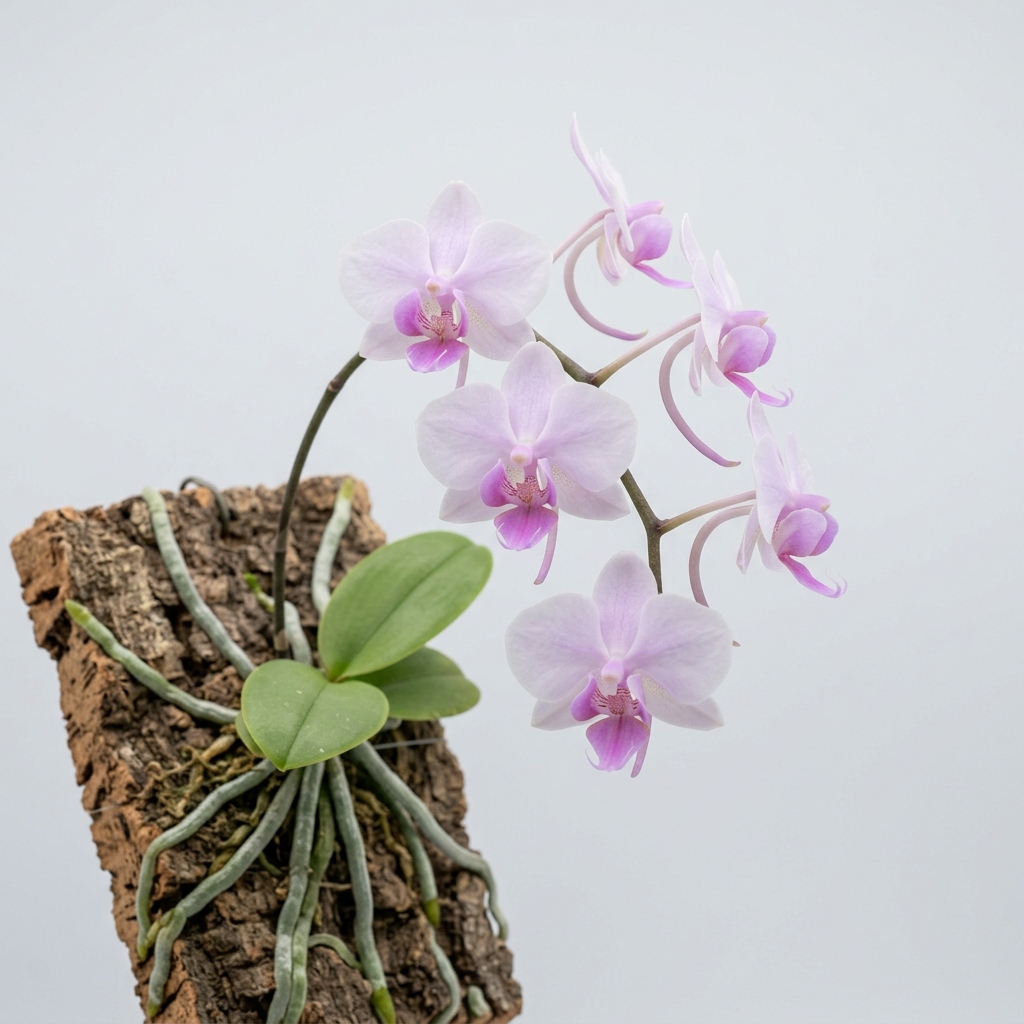
Phalaenopsis lowii is a highly sought-after miniature orchid species celebrated for its distinctive floral structure and unusual growth habit. Native to the limestone cliffs of Southeast Asia, particularly Myanmar and Thailand, this epiphytic or lithophytic orchid stands out due to its ability to drop its leaves during dry periods. Collectors highly value it for its delicate, pale pink to lavender-white blooms and its historical significance as one of the more unique members of the genus Phalaenopsis.
Unlike many of its evergreen relatives, this species has adapted to seasonal monsoons and dry spells, making its cultivation a rewarding challenge for experienced growers. Its flowers feature an exceptionally long, curved column that resembles the beak of a bird, earning it a special place in botanical collections. When grown under the right conditions, it rewards the patient horticulturist with a graceful display of long-lasting, elegant blossoms.
💡 Did You Know?
Phalaenopsis lowii possesses an extraordinary evolutionary adaptation that allows it to behave as a deciduous plant. In its native limestone habitats of Myanmar, it drops its leaves during the severe winter dry season to conserve moisture, relying entirely on its photosynthetic roots to survive until the monsoon rains return.
🌿 Botanical Overview
Phalaenopsis lowii is a miniature epiphyte or lithophyte native to the seasonally dry tropical forests of Myanmar and western Thailand. In its natural habitat, it is frequently found clinging to steep limestone cliffs or growing on the bark of deciduous trees. This environment subjects the orchid to dramatic seasonal shifts, characterized by heavy monsoon rains in the summer followed by a prolonged, dry winter season.
To survive these harsh seasonal transitions, the species has evolved a semi-deciduous to fully deciduous growth habit. During the dry season, the plant may shed its small, fleshy, elliptic leaves entirely to conserve moisture, relying on its extensive, flattened root system to perform photosynthesis. In home cultivation, however, if high humidity and moderate moisture are maintained year-round, the plant may remain semi-evergreen, retaining one or two leaves throughout the winter.
🌸 Flower Characteristics
The blossoms of Phalaenopsis lowii are celebrated for their delicate, ethereal beauty and unique anatomical structure. The flowers typically measure around one and a half to two inches in diameter and are presented on a slender, arching inflorescence that can carry several blooms simultaneously. The petals and sepals are typically a soft, translucent white or pale pink, often flushed with a deeper lavender or rose-purple hue toward the tips.
The most striking feature of the flower is its lip and column. The lip is three-lobed, with a deep violet-magenta mid-lobe that provides a vivid contrast to the pale petals. The column is exceptionally long, slender, and curved forward, terminating in a prominent, beak-like rostellum. This distinct shape, which closely resembles the head and beak of a bird, is a key identifying feature of the species and serves as a specialized evolutionary adaptation for specific insect pollinators.
Fragrance & Bloom Profile
While some growers report a very faint, sweet scent under warm, humid conditions, a distinct fragrance is not consistently documented for Phalaenopsis lowii in common grower references. The primary appeal of this orchid lies in its visual presentation rather than its scent. The blooms are remarkably long-lasting, often remaining fresh on the spike for several weeks, provided the ambient humidity is kept high and temperatures remain stable.
The blooming cycle typically occurs in the late summer and autumn, aligning with the end of the active growing season. The slender spikes emerge from the base of the plant and should be handled with care, as they are delicate and prone to physical damage. Once the blooming cycle is complete, the plant naturally prepares for its cooler, drier winter rest phase.
Parentage & Hybrid Lineage
As a true, naturally occurring species, Phalaenopsis lowii does not have a hybrid parentage. It was first described in the mid-19th century and named in honor of the prominent British horticulturalist and collector Hugh Low. Because of its unique floral morphology and compact size, it has been used by orchid hybridizers to introduce miniature growth habits and intense lip coloration into primary and complex Phalaenopsis hybrids.
In hybrid registration records, its lineage is relatively limited compared to more common species like Phalaenopsis equestris or Phalaenopsis amabilis, largely due to its historically rare status in cultivation. However, primary hybrids involving Phalaenopsis lowii are highly prized by collectors for their intermediate growth habits and unusual, bird-beak column structures.
🌱 Growing Conditions
Replicating the natural habitat of Phalaenopsis lowii is the key to successful cultivation. It thrives in medium to bright filtered light, similar to the dappled shade found under a forest canopy. Direct, midday sunlight must be avoided, as it will quickly scorch the thin leaves of this miniature species. Under artificial LED setups, place the plant in a moderate light zone with excellent diffusion.
💡 Care Tip
To mimic its natural habitat, mount Phalaenopsis lowii on a cork slab with a small pad of sphagnum moss. This allows the roots to dry rapidly after , preventing the crown rot to which this miniature species is highly susceptible.
Temperature requirements are warm to intermediate. During the active summer growing season, daytime temperatures should ideally range between 75 and 85 degrees Fahrenheit, with a slight drop at night. In the winter, cooler nighttime temperatures down to 60 degrees Fahrenheit are beneficial, as this temperature drop, combined with reduced watering, helps trigger the natural resting phase and later blooming cycle.
Watering, Feeding & Potting Media
Watering practices must be adjusted dynamically according to the season. During the active spring and summer growth periods, Phalaenopsis lowii requires frequent watering and high humidity, ideally between 60% and 80%. The roots should be allowed to dry slightly between waterings but never remain bone-dry for extended periods. Apply a highly diluted, balanced orchid fertilizer weekly during this active phase.
In late autumn and winter, watering must be significantly reduced to mimic the natural dry season. If the plant sheds its leaves, water only sparingly—just enough to prevent the roots from shriveling completely. Mounted culture on cork slabs or tree fern fiber is highly recommended for this species, as it allows the roots to dry rapidly and prevents the crown rot that often occurs in traditional pots. If potted, use a very open, fast-draining medium such as fine fir bark mixed with perlite and charcoal.
Blooming Season & Care Notes
The primary blooming season for Phalaenopsis lowii spans from late summer through autumn. As the flower spike develops, maintain stable environmental conditions, as sudden drops in humidity or drafts can cause the developing buds to blast. Do not cut the green flower spike after the blooms fade, as it can occasionally produce secondary branches or even adventitious keikis if left intact.
Repotting or remounting should only be performed when the plant is actively producing new root tips, which typically occurs in the early spring as the orchid emerges from its winter rest. Minimize disturbance to the root system during this process, as Phalaenopsis lowii can be sensitive to root damage and may take some time to re-establish itself on a new mount.
⚠️ Common Issues
⚠️ Common Mistake
The most frequent mistake growers make is overwatering Phalaenopsis lowii during its winter rest period. Keeping the medium constantly wet when the plant is semi-deciduous or dormant will quickly rot the root system and kill the orchid.
- Winter Root Rot: Caused by overwatering during the cool winter rest period when the plant is semi-dormant.
- Leaf Drop (Pathological): While natural leaf drop occurs in winter, sudden yellowing and dropping of leaves during summer indicates crown rot or excessive moisture.
- Bud Blast:
Occurs when dry indoor air or sudden temperature fluctuations cause developing flower buds to dry up and fall off. - Dehydration:
If mounted plants do not receive adequate daily misting during the hot summer months, the roots will shrivel and turn silver-grey. - Pests:
Mealybugs and spider mites can occasionally hide in the crevices of the small leaves and must be treated promptly with horticultural soap.
❓ Frequently Asked Questions
Why is my Phalaenopsis lowii losing its leaves in the winter?
This is a natural adaptation for this species. In the wild, Phalaenopsis lowii drops its leaves during the dry winter season to conserve moisture. If your plant is kept slightly drier and cooler in winter, leaf loss is normal, and new leaves will emerge in the spring.
Can I grow Phalaenopsis lowii in a standard plastic pot?
While possible, it is highly discouraged. This species is highly susceptible to root rot. It performs exceptionally well when mounted on cork bark or tree fern slabs, which allows the root system to dry quickly and receive maximum aeration.
How often should I water my mounted Phalaenopsis lowii in summer?
During the hot summer months, mounted plants may need to be misted or soaked daily, depending on your home’s ambient humidity. The goal is to provide ample moisture while allowing the roots to dry completely by nightfall.
Does Phalaenopsis lowii require a strict winter rest?
Yes. To encourage blooming and prevent rot, you must reduce watering significantly in the winter. Stop fertilizing entirely and only mist the roots occasionally to keep them from desiccating completely until new growth appears in spring.
⭐ Final Growing Notes
Phalaenopsis lowii is an exquisite jewel of the orchid world, offering a unique glimpse into the diverse survival strategies of the genus Phalaenopsis. While its deciduous nature and specific moisture requirements demand a more attentive grower, the reward of its delicate, bird-like blossoms makes it a crown jewel for any serious miniature orchid collection. By respecting its seasonal rhythm of summer wet and winter dry, you will enjoy this fascinating species for many years.
🌱 Propagation Tip
Propagation of Phalaenopsis lowii is typically achieved through backbulb division or the occasional production of adventitious offsets, known as keikis, on old flower spikes. Because it is a delicate species, division should only be attempted on robust, multi-growth specimens during active spring growth.
⭐ Expert Advice
When cultivating this species under artificial LED lights, position it in a zone that receives moderate, diffused rather than intense, direct exposure. Ensure that levels remain above sixty percent, especially if the plant is mounted, to prevent the roots from desiccating.




Leave A Comment