
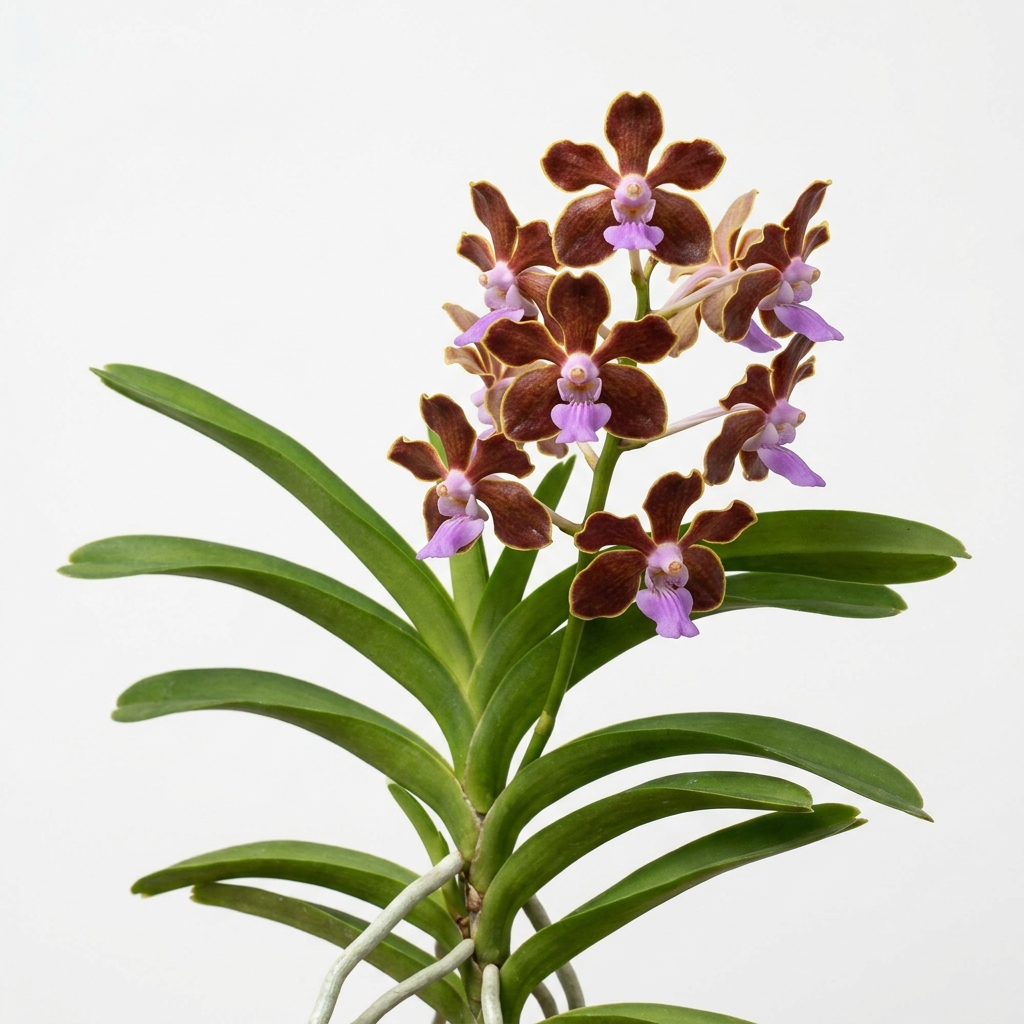
Vanda Limbata is a highly valued monopodial epiphytic orchid species native to Southeast Asia, particularly Java and the Lesser Sunda Islands. Highlighted by its distinctive, richly colored flowers and its reputation among orchid enthusiasts, this species is celebrated for its compact to medium growth habit and striking floral presentation.
Growers prize Vanda Limbata for its intense, sweet fragrance and its resilience in warm, high-light environments. Unlike some larger Vanda species, it offers a manageable size for greenhouse or indoor growers who can provide the necessary humidity and air movement, making it a rewarding addition to any tropical orchid collection.
💡 Did You Know?
The intense, cinnamon-like of Vanda Limbata is an evolutionary adaptation designed to attract specific native pollinators in its tropical Southeast Asian habitats. Unlike many orchids that only release scent at night, this species is most fragrant during the warm, bright hours of the day, maximizing its chances of successful pollination when its insect partners are most active.
🌿 Botanical Overview
Vanda Limbata is a monopodial epiphyte characterized by its upright, single-stemmed growth habit. The thick, leathery, strap-shaped leaves are arranged in a V-shaped channel along the stem, typical of the Vanda genus. These leaves are adapted to conserve moisture in environments that experience distinct wet and dry seasons.
The root system of this species is exceptionally robust, producing thick, fleshy aerial roots covered in a spongy layer of velamen. This velamen layer rapidly absorbs moisture and nutrients from the air and rain. In its native habitat, the plant clings to tree branches where it is exposed to constant air movement and bright, filtered sunlight.
🌸 Flower Characteristics
The inflorescence of Vanda Limbata is an axillary raceme that emerges from the leaf axils, typically carrying several moderately sized flowers. Each bloom features sepals and petals that are generally obovate, displaying a rich, glossy brownish-red or ochre coloration, often highlighted by a distinct, pale yellow or greenish-yellow margin.
The most striking feature of the flower is the prominent, three-lobed lip or labellum. The mid-lobe of the lip is typically a vibrant lilac, pink, or light purple, creating a beautiful contrast against the darker sepals and petals. The flowers are long-lasting, maintaining their structural integrity and color for several weeks under optimal conditions.
Fragrance & Bloom Profile
One of the primary reasons growers seek out Vanda Limbata is its intense and highly pleasant fragrance. The scent is commonly described as sweet, spicy, and reminiscent of cinnamon or cloves, becoming most pronounced during the warm daylight hours when pollinators are active.
The blooming cycle is highly dependent on environmental cues, particularly light intensity and temperature fluctuations. While individual flowers can last up to a month, maintaining high humidity and avoiding water contact on the petals will help preserve the blooms and prevent premature spotting or decay.
Parentage & Hybrid Lineage
As a naturally occurring species rather than a man-made hybrid, Vanda Limbata possesses a distinct genetic profile that has been utilized in orchid breeding. It has been used as a parent in various intergeneric and intrageneric hybrids to introduce its desirable traits, such as its compact growth habit, rich coloration, and exceptional fragrance.
When researching specimens, growers should note that while wild-type characteristics are relatively stable, line-bred cultivars may exhibit enhanced flower size or more intense coloration. It is important to purchase from reputable nurseries to ensure the plant is a true species or a verified hybrid rather than an undocumented cross.
🌱 Growing Conditions
To cultivate Vanda Limbata successfully, growers must replicate its warm, tropical native habitat. It requires bright, filtered light to thrive and bloom; a slight yellow-green tint to the leaves indicates optimal light levels, whereas dark green leaves suggest insufficient light. Direct midday sun should be shaded to prevent leaf scorch.
💡 Care Tip
When your Vanda Limbata, ensure the thick aerial roots are thoroughly soaked until they turn from a silvery-white to a vibrant green. This color change indicates that the velamen layer has fully absorbed moisture, which is crucial for the plant's hydration and nutrient uptake.
Temperatures should remain warm year-round, ideally ranging between 75°F and 90°F (24°C to 32°C) during the day, with a night drop to no lower than 60°F to 65°F (15°C to 18°C). High humidity of 70% to 80% is essential, coupled with strong, continuous air movement to prevent fungal pathogens from settling on the wet foliage.
Watering, Feeding & Potting Media
Like most Vandas, Vanda Limbata is best grown bare-root in wooden slat baskets or mounted on cork plaques. This allows the extensive aerial root system to dry rapidly after watering, which is critical for preventing root rot. If grown in pots, a highly porous medium consisting of large-grade charcoal, coarse fir bark, or volcanic rock must be used.
Watering should be frequent and thorough. During the active growing season in spring and summer, the roots should be misted or soaked daily—sometimes twice daily in hot, dry weather—allowing them to turn green and then dry completely. Feed the plant weekly with a balanced, water-soluble orchid fertilizer diluted to quarter or half strength, flushing the roots with pure water periodically to prevent salt buildup.
Blooming Season & Care Notes
The primary blooming season for Vanda Limbata typically occurs in the summer and early autumn, though well-established plants under optimal greenhouse conditions may bloom at other times of the year. As the flower spike begins to emerge from the leaf axils, avoid changing the plant’s orientation to the light source, as this can cause the buds to twist or develop unevenly.
Once blooming is complete, the old flower spike should be cut back close to the stem using sterilized cutting tools. Repotting or basket maintenance is best performed in the spring when new root tips are actively growing, minimizing transplant shock and allowing the plant to quickly anchor itself to its new support.
⚠️ Common Issues
⚠️ Common Mistake
A frequent error is growing Vanda Limbata in standard, dense orchid potting soil or fine bark. This species requires rapid wet-dry cycles and maximum root aeration; packing the roots into tight media suffocates them, leading to rapid root rot and the eventual decline of the entire plant.
- Root rot: Caused by stagnant water or compacted potting media that prevents the roots from drying quickly.
- Leaf spotting: Fungal or bacterial infections arising from high humidity combined with poor air circulation.
- Bud blast: Premature dropping of flower buds, often triggered by sudden temperature drops, low humidity, or drafts.
- Dehydration: Shriveled leaves and dry, brittle roots resulting from insufficient watering or extremely low humidity.
- Pests: Susceptible to scale, mealybugs, and spider mites, which should be treated promptly with insecticidal soap or horticultural oil.
❓ Frequently Asked Questions
How do I encourage my Vanda Limbata to bloom?
Blooming is primarily triggered by high light levels and consistent warmth. Ensure your plant receives bright, filtered sunlight where leaves maintain a light yellow-green hue, and provide a slight temperature drop at night to stimulate spike development.
Can Vanda Limbata be grown indoors without a greenhouse?
Yes, but it requires careful attention to humidity and light. Growing near a bright south- or east-facing window with a humidifier and an oscillating fan to maintain air movement can yield excellent results.
Why are the aerial roots of my Vanda Limbata turning brown and dry?
This is typically a sign of low humidity or underwatering. Healthy roots should be silvery-white when dry and turn bright green when watered. Increase watering frequency and mist the roots daily.
What is the best potting medium for Vanda Limbata?
This orchid thrives best with no traditional potting medium at all. Growing it bare-root in a wooden teak basket or mounted on a cork slab allows the roots to receive the high level of aeration they require.
⭐ Final Growing Notes
Vanda Limbata remains a highly rewarding species for intermediate to advanced orchid growers who can accommodate its specific light, watering, and humidity demands. Its manageable growth habit, striking brownish-red flowers with contrasting lilac lips, and exceptional fragrance make it a standout specimen that brings a genuine touch of the tropical rainforest into any collection.
⚕️ Health, Safety & Edibility
Understanding how a plant interacts with people, pets, and the surrounding environment is part of responsible cultivation. This section uses conservative, general guidance and does not replace professional medical or veterinary advice.
Human Safety: Vanda Limbata is generally considered non-toxic to humans.
Pet Safety: No significant reports of toxicity to domestic pets exist.
Edibility: This ornamental orchid is not intended for consumption.
Skin Contact: Safe to handle, though sensitive individuals may experience mild contact irritation.
Eye Contact: Avoid contact with eyes.
Allergy Information: Orchid pollen may cause mild respiratory sensitivity.
Handling Advice: Always use sterile.
🌱 Propagation Tip
Propagation of Vanda Limbata is typically achieved through the separation of offshoots, known as keikis, which occasionally develop along the main stem. Wait until the keiki has produced at least three robust aerial roots of its own, each several inches long, before carefully detaching it with a sterile blade and mounting it independently.
⭐ Expert Advice
To optimize blooming and overall vigor, maintain a consistent weekly feeding schedule during the active spring and summer growth phases. Use a balanced orchid fertilizer diluted to quarter strength, and always flush the root system with pure, unfertilized water once a month to prevent harmful mineral salts from accumulating on the sensitive velamen.


Leave A Comment