
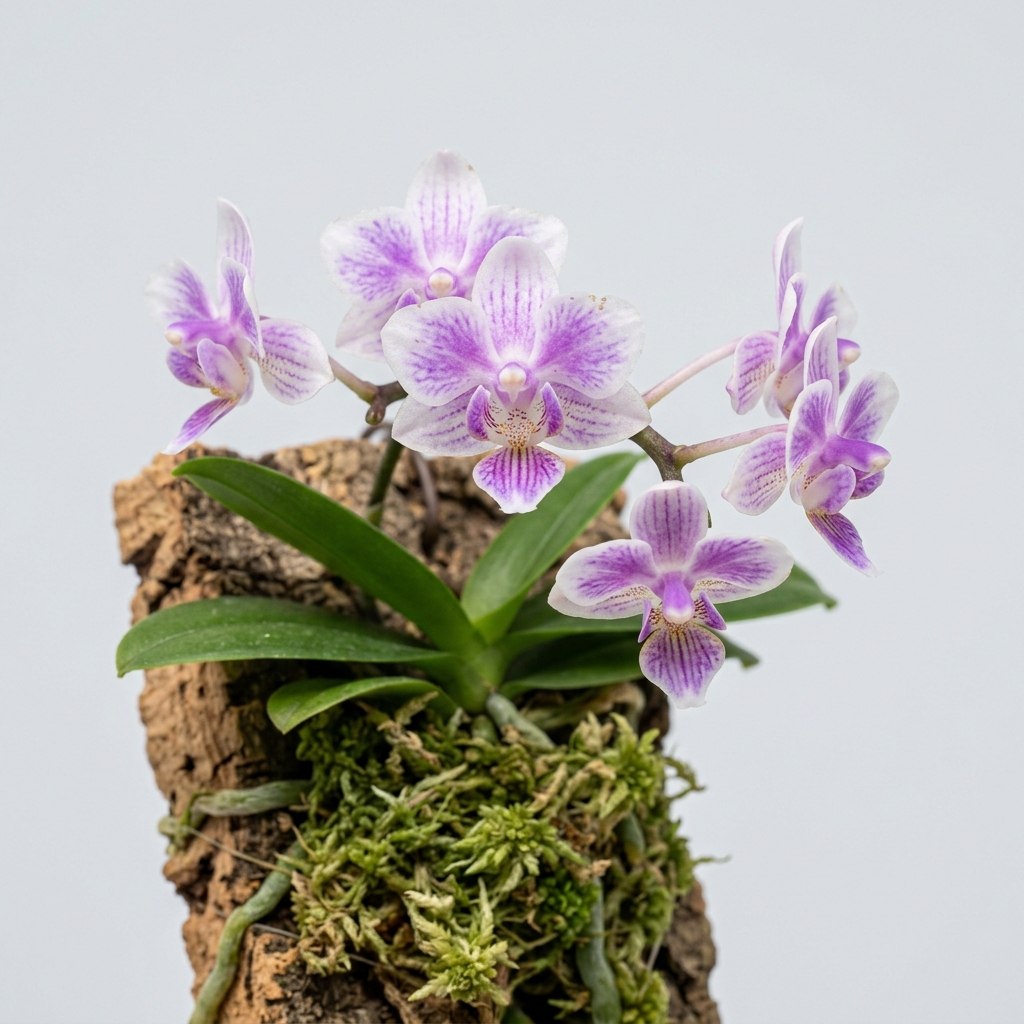
Phalaenopsis Appendiculata is a highly coveted miniature orchid species cherished by collectors for its diminutive size and exquisitely detailed blossoms. Belonging to the genus Phalaenopsis, this charming epiphyte produces small, delicate flowers that feature intricate patterns of violet, pink, and white. Orchid enthusiasts value this species for its compact growth habit, making it an ideal candidate for terrariums, vivariums, or specialized indoor growing spaces where space is at a premium.
Unlike its larger, mass-market hybrid relatives, this miniature orchid demands a more attentive approach to care, thriving under specific humidity and moisture regimes. Its unique botanical features, particularly the distinct appendages on the lip of the flower, make it a fascinating subject for close-up study and a rewarding challenge for intermediate to advanced growers.
💡 Did You Know?
Phalaenopsis Appendiculata gets its specific epithet from the unique, tooth-like appendages on its floral lip. These microscopic structures are specialized evolutionary adaptations designed to assist specific insect pollinators in navigating the tiny blossom, a fascinating example of ecological specialization in miniature orchids.
🌿 Botanical Overview
Phalaenopsis Appendiculata is native to the humid, shaded forests of Malaysia, particularly Johor and parts of Borneo. In its natural habitat, it grows as an epiphyte on moss-covered tree trunks and branches, where it is shielded from direct sunlight by the dense forest canopy. This environment provides the plant with constant air movement, high ambient humidity, and frequent rainfall.
The plant itself is remarkably small, typically featuring a short stem clad in a few fleshy, elliptic leaves that rarely exceed three to four inches in length. Its root system is relatively fine and adapted to clinging tightly to damp bark or mossy substrates. Because of its miniature stature and pendulous flowering habit, it is most naturally grown mounted on cork bark or tree fern plaques.
🌸 Flower Characteristics
The blossoms of Phalaenopsis Appendiculata are tiny, usually measuring less than an inch in diameter, yet they exhibit a remarkable level of complexity. The sepals and petals are typically white or pale cream, adorned with striking horizontal bars or spots of deep violet, magenta, or pink. These vivid markings create a beautiful contrast against the lighter background of the flower.
The defining feature of this species is its lip, or labellum, which features distinct, hair-like or tooth-like appendages near the apex. This intricate structure is designed to attract specific pollinators in the wild. The flowers are borne on short, sometimes branched inflorescences that emerge from the base of the leaves, presenting the blooms in a downward or slightly nodding fashion.
Fragrance & Bloom Profile
While some growers report a very faint, sweet fragrance from Phalaenopsis Appendiculata under warm, humid conditions, a distinct scent profile is not consistently documented across all specimens. Any fragrance produced is typically subtle and most noticeable during the peak daylight hours when temperatures rise.
The blooms generally open sequentially or a few at a time, extending the overall flowering period over several weeks. Individual flowers are relatively long-lasting for a miniature species, provided the ambient humidity remains high and the plant is not subjected to sudden environmental stress or drafts.
Parentage & Hybrid Lineage
Phalaenopsis Appendiculata is a naturally occurring species rather than a man-made hybrid or cultivar. In the orchid world, it is classified within the subgenus Parishianae, a group known for its miniature members with unique lip structures. Because of its distinct markings and compact size, hybridizers have occasionally used it in breeding programs to create novel miniature hybrids, though such crosses remain relatively rare in the commercial market.
When researching this plant, growers should note that its wild origin means its genetic makeup is adapted to a stable, tropical rainforest environment. Consequently, it does not possess the hybrid vigor or broad environmental tolerance found in common grocery store Phalaenopsis hybrids, requiring growers to replicate its native conditions more closely.
🌱 Growing Conditions
Replicating the native habitat of Phalaenopsis Appendiculata is key to successful cultivation. It thrives in low to medium indirect light, similar to the light levels preferred by jewel orchids or ferns. Direct sunlight must be strictly avoided, as the thin, delicate leaves are highly susceptible to scorching and heat stress.
💡 Care Tip
If you choose to grow this miniature orchid mounted on cork bark, wrap a small pad of high-quality sphagnum moss around the roots. This helps retain a critical buffer of moisture, preventing the fine roots from desiccating too quickly in typical indoor home environments.
Temperature ranges should ideally be kept warm to intermediate, with daytime temperatures between 75°F and 85°F (24°C to 29°C) and a slight drop at night to around 65°F to 70°F (18°C to 21°C). High humidity is critical for this species; maintaining levels between 70% and 85% is highly recommended. To prevent stagnant air from causing fungal issues in such high humidity, gentle but continuous air movement must be provided by a small fan.
Watering, Feeding & Potting Media
Unlike larger Phalaenopsis species that tolerate drying out between waterings, Phalaenopsis Appendiculata prefers to remain consistently moist but never waterlogged. If grown mounted on cork or wood, it may require daily misting or watering, sometimes twice a day during hot summer months. If potted, a highly draining medium such as high-quality New Zealand sphagnum moss or a mix of fine fir bark and perlite is essential.
Fertilization should be approached with caution, as miniature orchids can be sensitive to salt buildup. Apply a balanced, water-soluble orchid fertilizer diluted to one-quarter or one-eighth strength every second or third watering. Flush the growing medium with pure, distilled, or reverse-osmosis water periodically to wash away any accumulated fertilizer salts.
Blooming Season & Care Notes
The primary blooming season for Phalaenopsis Appendiculata typically occurs from late summer through autumn, though cultivated plants may bloom at other times of the year if stable conditions are maintained. The flower spikes should not be cut back while they are still green, as they can occasionally produce additional buds or secondary spikes.
Repotting or remounting should be performed only when necessary, ideally just as new root growth is observed, which usually coincides with the end of the flowering cycle or the start of spring. Because of its delicate root system, minimize disturbance to the healthy roots as much as possible during this process.
⚠️ Common Issues
⚠️ Common Mistake
A frequent error is treating this miniature species like a standard hybrid Phalaenopsis. Allowing Phalaenopsis Appendiculata to dry out completely for extended periods, or placing it in low- rooms, will rapidly lead to leaf shriveling, root loss, and eventual decline.
- Root Rot:
Caused by overwatering in poorly draining media or lack of adequate air circulation around the root zone. - Dehydration:
Shriveled leaves and dry, brittle roots indicate insufficient watering or critically low humidity levels. - Bud Blast:
Sudden drops in humidity, temperature fluctuations, or drafts can cause developing flower buds to yellow and drop before opening. - Leaf Spotting: Fungal or bacterial pathogens can attack the leaves if water is allowed to sit on the foliage overnight without sufficient airflow.
- Pests:
Spider mites, mealybugs, and scale can occasionally target the tender leaves; treat promptly with insecticidal soap or neem oil.
❓ Frequently Asked Questions
Can Phalaenopsis Appendiculata be grown in a standard plastic pot?
While it can be grown in a small, highly ventilated plastic pot with New Zealand sphagnum moss, it is generally much easier to manage and healthier when mounted on cork bark or tree fern. Mounting allows the roots to dry quickly and receive the high level of aeration they require.
How do I prevent bud blast on my Phalaenopsis Appendiculata?
To prevent bud blast, maintain highly stable environmental conditions once flower spikes begin to emerge. Avoid moving the plant, protect it from cold drafts or heating vents, and ensure the ambient humidity remains consistently above 70%.
Is Phalaenopsis Appendiculata suitable for a terrarium?
Yes, its miniature size and high humidity requirements make it an excellent candidate for a terrarium or vivarium. However, you must ensure there is adequate internal air circulation, such as a small computer fan, to prevent stagnant air and later rot.
What should I do if the leaves start to turn yellow?
Yellowing leaves can indicate several issues, including overwatering, underwatering, or excessive light. Check the root system first; if the roots are mushy and brown, reduce watering and improve drainage. If the roots are healthy, the plant may be receiving too much direct light.
⭐ Final Growing Notes
Phalaenopsis Appendiculata is a true gem of the orchid world, offering a rewarding challenge for those willing to accommodate its specific environmental needs. By providing high humidity, gentle air movement, and consistent moisture, growers can enjoy the intricate beauty of its miniature, violet-striped blooms year after year.
⚕️ Health, Safety & Edibility
Understanding how a plant interacts with people, pets, and the surrounding environment is part of responsible cultivation. This section uses conservative, general guidance and does not replace professional medical or veterinary advice.
Human Safety: No published evidence currently identifies species-specific toxicity concerns for Phalaenopsis Appendiculata during normal handling. As with most ornamental plants, it should not be intentionally consumed.
Pet Safety: Published information does not indicate that this orchid commonly poses a toxicity concern for cats or dogs. However, chewing leaves, flowers, roots, or potting media may still cause mild digestive upset.
Edibility: This orchid is cultivated for ornamental display rather than food. Ornamental plants may carry fertilizers, pesticides, or other horticultural treatments that make them unsuitable for consumption.
Skin Contact: Routine handling is not generally associated with skin irritation. Gardeners with sensitive skin may prefer wearing gloves when repotting, pruning, or handling potting media.
🌱 Propagation Tip
Propagation of this species is typically limited to the occasional production of basal keikis or offsets. If a keiki forms, allow it to develop several healthy roots at least an inch long before carefully detaching it with a sterile blade and mounting it independently.
⭐ Expert Advice
For optimal health, water this orchid using pure rainwater, distilled water, or reverse-osmosis water. Its fine roots are highly sensitive to the dissolved minerals and chlorine found in typical tap water, which can cause root tip dieback over time.




Leave A Comment