
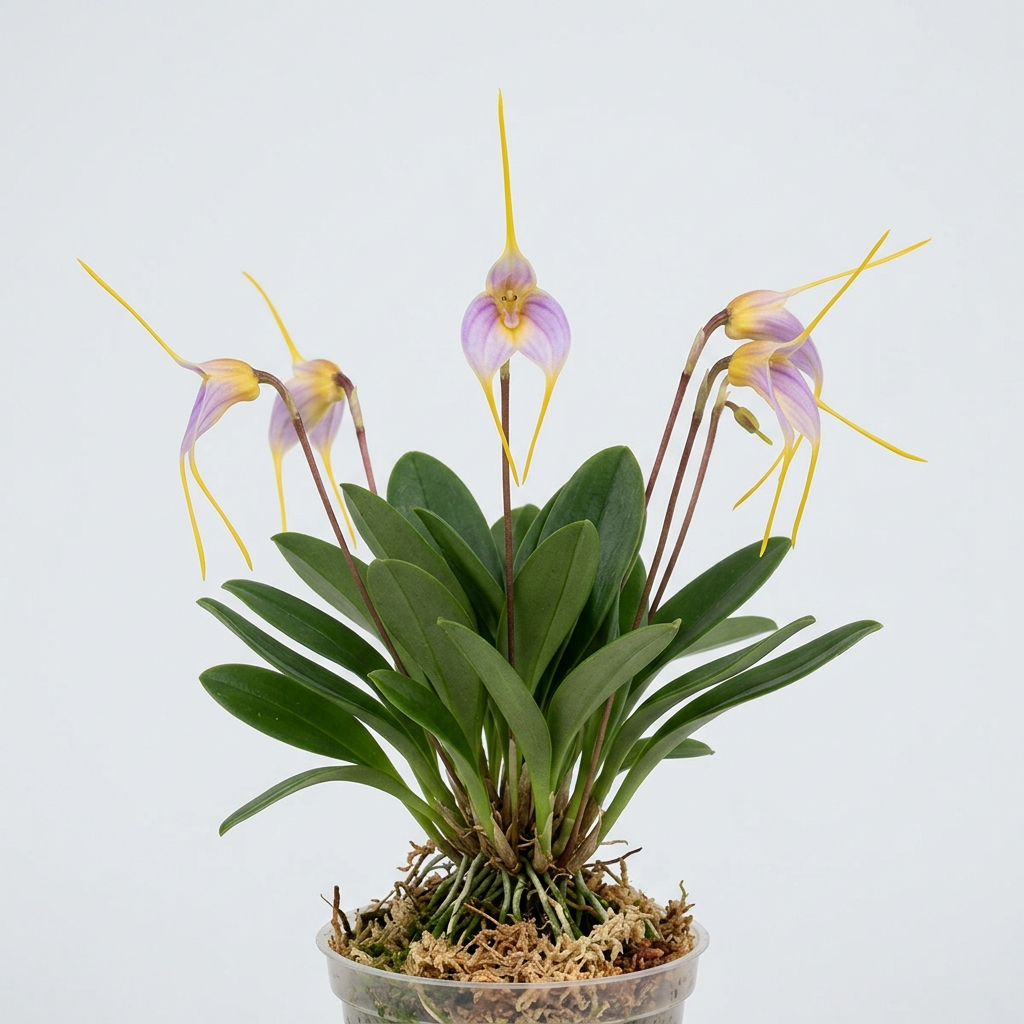
Masdevallia Estradae is a captivating miniature orchid prized by collectors for its delicate, whimsical flowers and compact growth habit. Belonging to the diverse Pleurothallidinae subtribe, this cool-growing epiphyte is celebrated for its unique floral structure, featuring prominent sepaline tails that flutter in the slightest breeze.
While it requires specific environmental conditions to thrive—namely high humidity, cool temperatures, and consistent moisture—growers find the reward of its elegant blooms well worth the effort. Its compact size makes it an excellent candidate for specialized terrariums, Wardian cases, or dedicated cool-grow areas.
💡 Did You Know?
Unlike many common orchids that store water in thick, bulbous stems called pseudobulbs, Masdevallia Estradae lacks these structures entirely. This means the plant has no water reserves to fall back on during dry spells, making consistent and moisture absolutely vital for its survival in both the wild and the home greenhouse.
🌿 Botanical Overview
Masdevallia Estradae is a miniature, tufted, epiphytic orchid native to the cool, cloud forests of Colombia. Unlike many other popular orchid genera, members of the genus Masdevallia lack pseudobulbs—the water-storing organs common to orchids like Cattleya or Oncidium. Instead, they rely on short, erect ramicauls that bear single, fleshy, oblanceolate leaves to manage their moisture and nutrient reserves.
Because they lack pseudobulbs, these plants have very little tolerance for drought. In their native habitat, they grow on moss-covered tree trunks and branches where they are constantly bathed in mist, high humidity, and gentle air currents. This evolutionary adaptation dictates their strict care requirements in cultivation, demanding attentive moisture management.
🌸 Flower Characteristics
The flowers of Masdevallia Estradae are a marvel of specialized evolution. The most striking feature of the bloom is the fusion of the three sepals, which form a shallow cup or tube before extending outward into long, slender, thread-like tails known as caudae. These tails are often a contrasting yellow or orange hue, while the main body of the sepals displays soft shades of lavender, pale purple, or white.
The actual petals and the lip (labellum) are extremely small and hidden deep within the sepaline tube, playing a secondary visual role to the showy sepals. Each flower is produced singly on a slender, erect to sub-erect inflorescence that rises just above or level with the foliage, presenting the blooms beautifully against the dark green leaves.
Fragrance & Bloom Profile
Fragrance is not a primary characteristic of Masdevallia Estradae, and it is generally considered to be unscented or to possess a very faint, nondescript aroma that is not easily detected by the human nose. The primary evolutionary driver for these flowers is visual attraction, specifically targeting specialized insect pollinators in their native cloud forest environments.
Despite the lack of scent, the visual display is highly dynamic. The long sepaline tails react to the slightest air movement, giving the plant an active, dancing appearance when grouped in a collection. Individual flowers can remain in pristine condition for several weeks if cool temperatures and high humidity are consistently maintained.
Parentage & Hybrid Lineage
Masdevallia Estradae is recognized as a distinct species rather than a man-made hybrid. In the orchid world, species like this serve as the foundational genetic building blocks for creating complex hybrids. Hybridizers value the genus for its compact growth habit, unique flower shapes, and vibrant color variations, though Masdevallia Estradae itself is most frequently grown in its pure, species form by dedicated collectors.
While some hybrid offspring exist within the Masdevallia registry, the exact parentage and hybrid lineage of specific crosses involving this species are not always consistently documented in general grower references. Collectors typically seek out the pure species to appreciate its natural, wild form as it would appear in the high-altitude forests of South America.
🌱 Growing Conditions
Replicating the cool cloud forest environment is the key to success with Masdevallia Estradae. It thrives in cool to intermediate temperatures, ideally ranging from 50°F to 60°F (10°C to 15°C) at night, and not exceeding 75°F (24°C) during the day. Prolonged exposure to high temperatures can cause rapid decline, leaf drop, and vulnerability to pests.
💡 Care Tip
To keep your orchid cool during warm summer days, place the pot on a tray filled with wet pebbles or use a clay pot, which cools the root zone through evaporation. Ensure a small fan provides continuous, gentle air movement around the foliage to prevent fungal pathogens from taking hold in the damp air.
Light should be kept low to moderate, similar to the dappled shade found under a dense forest canopy. East-facing windows or shaded grow lights work well. High humidity is absolutely critical, ideally maintained between 70% and 90%. To prevent fungal issues in such damp conditions, constant, gentle air movement must be provided by a small fan.
Watering, Feeding & Potting Media
Because Masdevallia Estradae lacks pseudobulbs, the potting medium must never be allowed to dry out completely. The roots should remain consistently damp but never waterlogged or stagnant. High-quality sphagnum moss or a fine-grade bark mix containing perlite and tree fern fiber are excellent choices for retaining moisture while allowing essential oxygen to reach the root zone.
Watering should be done with pure water, such as rainwater, distilled water, or reverse osmosis water, as these orchids are highly sensitive to dissolved mineral salts. Fertilizing should be approached with extreme caution; use a balanced, urea-free orchid fertilizer diluted to one-quarter or one-eighth of the recommended strength, applied every two to three weeks during active growth, followed by a flush of pure water.
Blooming Season & Care Notes
The primary blooming season for Masdevallia Estradae typically occurs in the spring and early summer, though healthy plants can occasionally produce flowers opportunistically at other times of the year. As the flower spikes emerge from the base of the leaves, ensure that humidity remains high to prevent the developing buds from blasting or drying out before they can open.
Once the blooming cycle is complete, the old flower spikes can be cut back to the base of the plant, as they will not rebloom from the same stem. Repotting is best done in the autumn or early spring when temperatures are cool and the plant is entering a period of active root growth. Minimize root disturbance during this process to avoid transplant shock.
⚠️ Common Issues
Cultivating this delicate orchid can present several challenges, particularly for growers new to cool-growing species. Watch for these common issues:
⚠️ Common Mistake
The most common mistake growers make is letting the potting medium dry out completely between waterings. While many orchids prefer a wet-to-dry cycle, this species requires constant, even moisture. Allowing the roots to dry out even once can cause immediate leaf drop and severe root damage.
- Leaf Spotting and Drop: Often caused by excessively high temperatures, poor air circulation, or fungal pathogens thriving in stagnant, humid air.
- Root Rot:
Occurs when the potting medium becomes compacted, broken down, or waterlogged, suffocating the delicate, fine roots. - Bud Blast:
The premature drying and dropping of flower buds, usually triggered by sudden drops in humidity or drafts of dry air. - Pests:
Aphids, spider mites, and mealybugs can occasionally target the tender new growth; treat promptly with gentle, orchid-safe insecticidal soap.
❓ Frequently Asked Questions
Can Masdevallia Estradae be grown in a standard home environment?
Growing this species in a typical home can be challenging due to its strict requirements for high humidity and cool temperatures. However, it can thrive in a climate-controlled terrarium, a specialized orchid case, or a dedicated grow room equipped with humidifiers and cooling fans.
What type of water is best for Masdevallia Estradae?
This orchid is highly sensitive to minerals and salts found in tap water. It is strongly recommended to use rainwater, distilled water, or reverse osmosis water. Accumulation of salts in the potting medium will quickly burn the delicate roots and lead to leaf tip dieback.
How do I know if my orchid is getting too much light?
If the leaves of your plant begin to turn yellow, develop bleached patches, or show red or purple tinting, it is likely receiving too much light. Healthy leaves should be a uniform, medium grass-green color. Move the plant to a more shaded location immediately.
How often should I repot Masdevallia Estradae?
It is generally best to repot every one to two years, or when the potting medium begins to break down and retain too much water. Always repot during the cooler months of autumn or early spring to allow the root system to recover without the stress of summer heat.
⭐ Final Growing Notes
While Masdevallia Estradae demands a disciplined approach to temperature and moisture management, it remains one of the most rewarding miniature orchids for the dedicated hobbyist. By carefully mimicking its native cloud forest habitat with cool temperatures, high humidity, pure water, and gentle air movement, you can enjoy the whimsical, dancing blooms of this exquisite Colombian species for many years to come.
⚕️ Health, Safety & Edibility
Understanding how a plant interacts with people, pets, and the surrounding environment is part of responsible cultivation. This section uses conservative, general guidance and does not replace professional medical or veterinary advice.
Human Safety: No published evidence currently identifies species-specific toxicity concerns for Masdevallia Estradae during normal handling. As with most ornamental plants, it should not be intentionally consumed.
Pet Safety: Published information does not indicate that this orchid commonly poses a toxicity concern for cats or dogs. However, chewing leaves, flowers, roots, or potting media may still cause mild digestive upset.
Edibility: This orchid is cultivated for ornamental display rather than food. Ornamental plants may carry fertilizers, pesticides, or other horticultural treatments that make them unsuitable for consumption.
Skin Contact: Routine handling is not generally associated with skin irritation. Gardeners with sensitive skin may prefer wearing gloves when repotting, pruning, or handling potting media.
🌱 Propagation Tip
Propagation is typically achieved through careful division of mature, healthy clumps during the repotting process in spring or autumn. Ensure that each division has at least five to eight healthy leaves and a robust root system, as smaller divisions can struggle to recover due to the lack of pseudobulbs.
⭐ Expert Advice
When growing in warm climates, consider using an evaporative cooler or placing the orchid in an air-conditioned room near an east-facing window. Monitoring the differential between day and night is crucial; a drop of 10 to 15 degrees Fahrenheit at night is highly beneficial for the plant's overall vigor and blooming potential.




Leave A Comment