
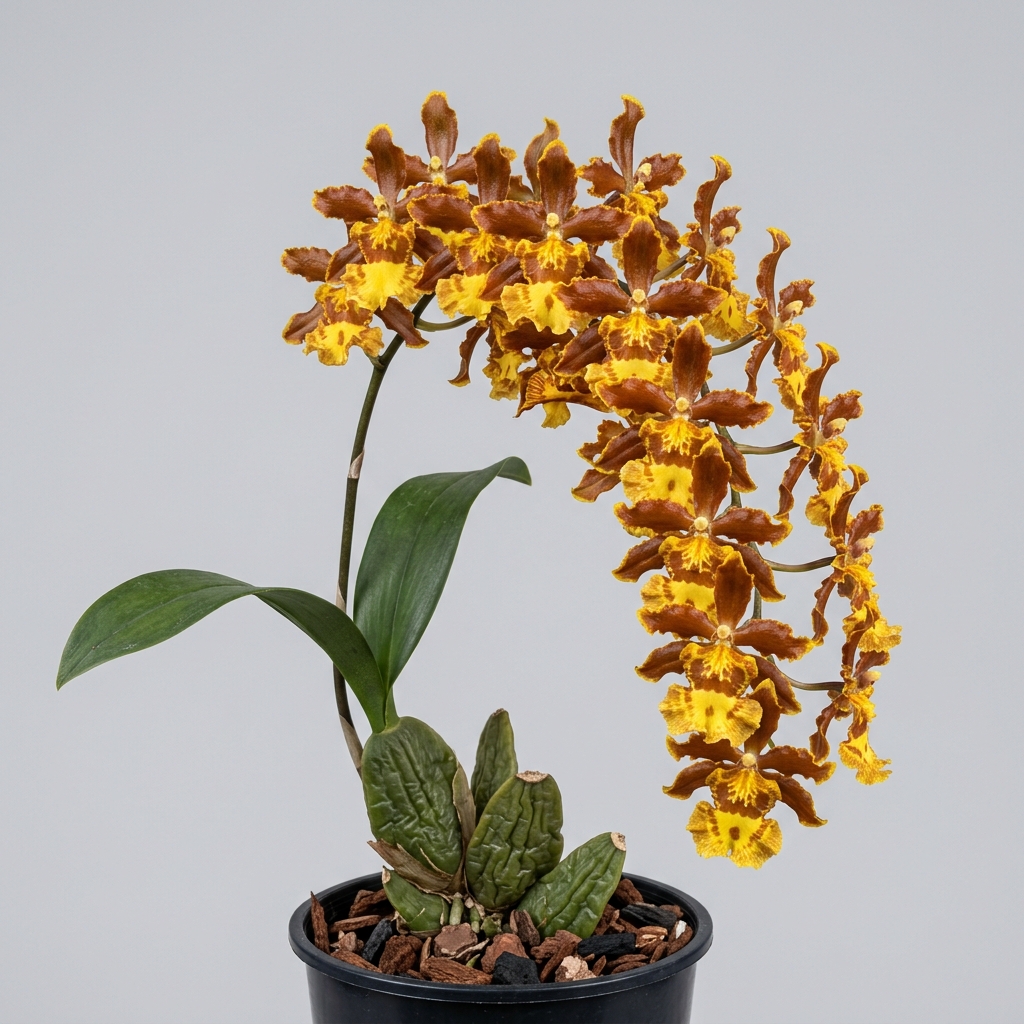
Oncidium Crispum is a highly distinguished orchid celebrated among collectors for its dramatic, richly colored blossoms and distinctive ruffled petals. Originating from the cool, humid mountainous regions of Brazil, this epiphytic species has played a foundational role in orchid hybridization, lending its robust growth habit and striking floral presentation to numerous modern crosses. Growers particularly prize this orchid for its arching inflorescences that carry a dense display of copper-brown and golden-yellow flowers.
Cultivating this orchid successfully requires an understanding of its native cloud forest habitat, where it experiences bright light, constant air movement, and distinct seasonal shifts. While it demands slightly more attention to temperature and humidity than common mass-market hybrids, the reward of its spectacular, long-lasting autumn blooms makes it an exceptionally satisfying addition to any intermediate orchid collection.
💡 Did You Know?
Oncidium Crispum is native to the high-elevation Organ Mountains of Brazil, where it grows as an epiphyte on moss-covered trees. This specific habitat exposes the orchid to constant mountain mists and cool evening breezes, which explains why it thrives in cooler, more humid conditions than many other lowland Oncidium species.
🌿 Botanical Overview
Oncidium Crispum is characterized by its clustered, flattened, and somewhat wrinkled pseudobulbs, which typically bear two leathery, dark green leaves at their apex. These pseudobulbs serve as vital water and nutrient storage organs, allowing the plant to withstand brief periods of dryness in its native canopy environment. The root system is relatively fine and fibrous, adapted for clinging to rough tree bark and rapidly absorbing moisture from passing rain and heavy mountain mists.
In its native habitat within the Brazilian rainforests, this orchid grows at moderate to high elevations, where it is exposed to constant air movement and dappled sunlight. This evolutionary background dictates its preference for cooler temperatures and higher humidity levels than many of the warm-growing lowland Oncidium hybrids commonly found in retail nurseries.
🌸 Flower Characteristics
The defining feature of Oncidium Crispum is its magnificent floral display. The flowers are relatively large for the genus, often measuring up to three inches across, and are produced on stout, arching, or sometimes branched inflorescences that can carry dozens of blooms. The petals and sepals exhibit a rich, glossy chestnut or copper-brown hue, accented by dramatically ruffled or “crisped” margins that give the flower its specific epithet.
The prominent lip, or labellum, is a focal point of the blossom, featuring a bright yellow or golden-yellow callus at its center, surrounded by a broad band of warm brown. This contrasting color pattern is designed to attract specific pollinators in the wild, while providing a stunning visual contrast that makes the orchid a standout specimen in any greenhouse or growing space.
Fragrance & Bloom Profile
The fragrance of Oncidium Crispum is a subject of some variation among growers. While some individual specimens produce a delicate, faintly sweet scent that is most noticeable during the warm morning hours, others may have no discernible fragrance at all. This variability suggests that fragrance intensity is highly dependent on clonal variation, ambient temperature, and light levels during the blooming cycle.
The blooms are exceptionally long-lasting, often remaining fresh on the spike for six to eight weeks under optimal environmental conditions. To maximize the lifespan of the flowers, growers should avoid wetting the blossoms directly and maintain stable, cool temperatures once the buds begin to open.
Parentage & Hybrid Lineage
As a distinct species within the crispum group of Oncidiums, this plant has a well-documented history in classical orchid breeding. It has been widely utilized by hybridizers to introduce large flower size, ruffled petal margins, and rich bronze-brown coloration into modern intergeneric hybrids.
Because of taxonomic revisions over the years, some older references may list this orchid under different sectional names, but its identity as a cornerstone of the Oncidium genus remains secure. When purchasing this plant, growers should look for reputable nurseries that can verify the clonal line, as select cultivars may exhibit superior flower form or more robust growth habits than wild-type imports.
🌱 Growing Conditions
To cultivate Oncidium Crispum successfully, growers must replicate its montane forest environment. It thrives in bright, filtered light, similar to the levels required by Cattleyas. Direct midday sun should be avoided to prevent leaf scorch, but insufficient light will result in weak, floppy foliage and a failure to initiate flower spikes. A light green leaf color is generally a good indicator of appropriate light levels.
💡 Care Tip
Ensure your Oncidium Crispum receives excellent air movement at all times. Constant, gentle air circulation mimics its native mountain canopy habitat, helping to dry wet foliage quickly and preventing the fungal leaf spots to which this species can be susceptible.
Temperature management is crucial for this cool-to-intermediate grower. It prefers daytime temperatures between 70°F and 75°F, with a distinct drop at night to around 55°F to 60°F. This nocturnal temperature drop is essential for triggering the blooming cycle. High humidity, ideally between 60% and 80%, must be maintained alongside excellent air circulation to prevent stagnant air from encouraging fungal pathogens.
Watering, Feeding & Potting Media
Watering should be frequent and thorough during the active growing season, which typically spans from spring through late summer. The potting medium should be allowed to dry out slightly, but never completely, between waterings. When the pseudobulbs begin to mature in late summer, watering frequency should be gradually reduced to accommodate the plant’s natural semi-dormant period.
A high-quality, free-draining potting mix is essential to prevent root rot. A medium-grade fir bark mixed with perlite, charcoal, and a small amount of sphagnum moss works well in plastic or clay pots. Alternatively, experienced growers often mount this species on cork bark or tree fern plaques, which allows the fine roots to dry rapidly after watering, mimicking their natural epiphytic growth habit. Feed with a balanced, diluted orchid fertilizer every second or third watering during active growth, flushing the pot with pure water periodically to prevent salt buildup.
Blooming Season & Care Notes
Oncidium Crispum typically initiates its flower spikes in the late summer or early autumn, with blooms opening in the fall and lasting into the winter months. Once the flower spike begins to emerge from the base of the newest mature pseudobulb, it should be carefully staked to support the weight of the developing buds.
After the blooming cycle is complete, the old flower spike can be cut back to the base of the pseudobulb. Repotting is best performed in the spring, just as new vegetative growth and fresh root tips begin to emerge. Avoid disturbing the root system unless the potting medium has begun to decompose, as this species can be sensitive to root disturbance and may take a season to recover if repotted prematurely.
⚠️ Common Issues
⚠️ Common Mistake
A frequent mistake is keeping Oncidium Crispum too wet during its winter rest period. Excessive moisture when the plant is not actively growing can quickly lead to root rot, which destroys the fine root system and causes the pseudobulbs to shrivel severely.
- Root Rot:
Caused by overwatering or compacted, poorly draining potting media. Ensure the mix remains airy and fresh. - Leaf Spotting: Fungal or bacterial spots can develop if water is allowed to sit on the foliage overnight, especially in cool, stagnant air.
- Bud Blast:
Sudden drops in humidity, drafts, or extreme temperature fluctuations can cause developing flower buds to yellow and drop before opening. - Pseudobulb Shriveling: A sign of dehydration, which can be caused either by underwatering or by root loss due to overwatering. Inspect the roots to determine the cause.
- Pests:
Scale, mealybugs, and spider mites can occasionally target the tender new growth and flower spikes. Treat promptly with insecticidal soap or neem oil.
❓ Frequently Asked Questions
How often should I water my Oncidium Crispum?
Watering frequency depends heavily on your growing environment and potting medium. During the active spring and summer growth phase, water thoroughly when the top inch of the medium feels dry. In winter, reduce watering significantly, allowing the medium to dry out almost completely between light waterings to respect the plant’s natural rest period.
Why are the pseudobulbs on my orchid shriveling?
Shriveled pseudobulbs indicate that the orchid is not absorbing enough water. This can be due to underwatering, or ironically, overwatering, which rots the root system and leaves the plant unable to take up moisture. Slip the plant out of its pot to inspect the roots; healthy roots are firm and white, while rotted roots are mushy and brown.
Can I grow Oncidium Crispum mounted on wood?
Yes, mounting Oncidium Crispum on cork bark or tree fern plaques is highly successful if you can maintain high humidity. Mounted plants dry out much faster than potted ones, so they may require daily watering or misting during the warm summer months to prevent dehydration.
What causes the leaves of this orchid to turn yellow?
Yellowing leaves can be caused by several factors, including natural aging of older foliage, excessive direct sunlight, or root rot. If the yellowing is concentrated on the oldest pseudobulbs, it is likely natural shedding. If new leaves are yellowing, check for pests, reduce light intensity, and evaluate your watering schedule.
⭐ Final Growing Notes
While Oncidium Crispum requires a bit more environmental precision than standard hybrid orchids, its spectacular autumn display of ruffled, copper-toned blossoms makes it a highly rewarding species for dedicated growers. By providing bright, filtered light, cool night temperatures, and maintaining a careful balance of moisture and airflow, you can enjoy the dramatic elegance of this classic Brazilian orchid for many years to complete your collection.
⚕️ Health, Safety & Edibility
Understanding how a plant interacts with people, pets, and the surrounding environment is part of responsible cultivation. This section uses conservative, general guidance and does not replace professional medical or veterinary advice.
Human Safety: No published evidence currently identifies species-specific toxicity concerns for Oncidium Crispum during normal handling. As with most ornamental plants, it should not be intentionally consumed.
Pet Safety: Published information does not indicate that this orchid commonly poses a toxicity concern for cats or dogs. However, chewing leaves, flowers, roots, or potting media may still cause mild digestive upset.
Edibility: This orchid is cultivated for ornamental display rather than food. Ornamental plants may carry fertilizers, pesticides, or other horticultural treatments that make them unsuitable for consumption.
Skin Contact: Routine handling is not generally associated with skin irritation. Gardeners with sensitive skin may prefer wearing gloves when repotting, pruning, or handling potting media.
🌱 Propagation Tip
This orchid is best propagated by division during spring repotting. Ensure that each division contains at least three to four healthy, mature pseudobulbs with active root leads to give the new plants the energy required to establish successfully without stalling.
⭐ Expert Advice
To trigger reliable blooming, provide a distinct drop of 10 to 15 degrees Fahrenheit between day and night during the late summer. This natural cooling cue mimics the autumn transition in its native habitat and is essential for initiating strong, healthy flower spikes.




Leave A Comment