
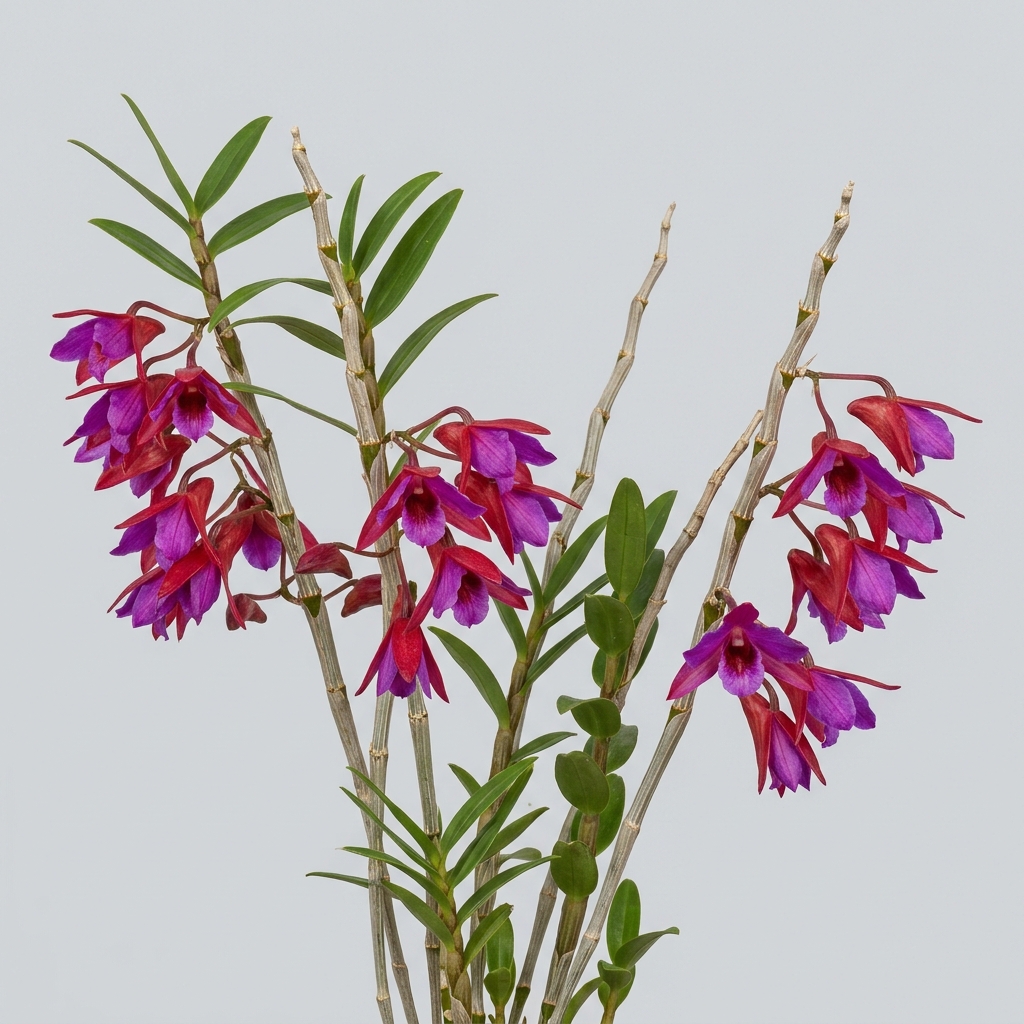
Dendrobium Lawesii is a highly sought-after epiphytic orchid species native to the mossy montane forests of Papua New Guinea and the Solomon Islands. Revered by collectors for its unique pendulous growth habit and vibrant, bell-shaped blossoms, this orchid brings a dramatic, cascading aesthetic to indoor growing spaces. Unlike many upright dendrobiums, its slender, cane-like pseudobulbs naturally drape downward, making it an useful selection for hanging baskets or mounted displays.
The primary appeal of Dendrobium Lawesii lies in its remarkably colorful and long-lasting flowers, which emerge in clusters directly from the nodes of both leafy and mature, leafless canes. Available in a striking spectrum of colors, ranging from deep red and brilliant purple to bicolor variations, these waxy blooms can persist for several weeks. For growers seeking an orchid that departs from standard upright growth forms while offering reliable, vivid floral displays, this species represents a rewarding addition to intermediate and warm greenhouse collections.
💡 Did You Know?
Dendrobium Lawesii belongs to a specialized group of orchids that bloom directly from older, completely leafless canes. While many growers mistake these bare stems for dead wood and trim them away, keeping them intact is essential, as a single leafless cane can produce vibrant clusters of bell-shaped flowers repeatedly for several years.
🌿 Botanical Overview
Dendrobium Lawesii is a distinct epiphytic species belonging to the section Calyptrochilus of the vast Dendrobium genus. In its native habitat, it grows on moss-covered tree trunks and branches in humid, montane forests at elevations ranging from sea level up to approximately 1,200 meters. This natural environment provides the plant with constant air movement, high humidity, and frequent rainfall, which are critical factors to replicate in a home or greenhouse setting.
The growth habit of this orchid is characterized by slender, semi-pendulous to fully pendulous pseudobulbs that can reach up to 12 to 18 inches in length. These canes are covered with small, lanceolate leaves arranged in two ranks along the stem. Over time, the leaves naturally yellow and drop from older canes, leaving bare, segmented stems that remain capable of producing flowers for several years. This pendulous nature dictates that the plant is best grown in a way that allows the canes to hang freely.
🌸 Flower Characteristics
The flowers of Dendrobium Lawesii are highly distinctive, featuring a tubular, bell-like shape with a waxy, heavy substance that contributes to their longevity. The sepals and petals are closely aligned, forming a protective hood over the small, tucked-away lip. Individual blooms typically measure about one inch in length and are produced in tight, hanging clusters of two to six flowers from the nodes of the canes.
Coloration is exceptionally diverse within the species. While deep red and magenta-purple are the most common color forms, growers also prize orange, yellow, and striking bicolor specimens where the tips of the petals contrast sharply with the base. Because the flowers emerge from both leafy and leafless canes, a mature specimen can present a stunning contrast of bright blossoms against bare, sculptural stems and lush green foliage.
Fragrance & Bloom Profile
Unlike many other members of the Dendrobium genus, Dendrobium Lawesii is not primarily grown for its scent. Fragrance is generally considered to be absent or, at most, extremely faint and sweet, detectable only under warm, humid conditions during the peak of the day. The lack of a strong scent is amply compensated for by the visual impact and durability of the blossoms.
The bloom profile is characterized by remarkable endurance. Individual flowers can remain fresh and vibrant for up to two months, provided the plant is kept in a stable environment. Furthermore, because the species does not follow a strict, singular blooming season, healthy plants can produce flowers multiple times throughout the year, with the heaviest flushes typically occurring in late winter and spring.
Parentage & Hybrid Lineage
Dendrobium Lawesii is a naturally occurring species rather than a man-made hybrid. Consequently, it does not have a complex lineage of parental cultivars. In the orchid trade, it is primarily propagated from seed or tissue culture to preserve its species characteristics, though select color forms are sometimes line-bred to intensify specific hues like deep red or bicolor patterns.
In hybridizing programs, Dendrobium Lawesii has occasionally been used to introduce its pendulous growth habit, vibrant coloration, and long-lasting flower substance to new crosses. However, because its offspring often inherit the specific cultural requirements of the parent species, these hybrids remain relatively specialized and are most frequently found in the collections of dedicated orchid enthusiasts rather than mass-market nurseries.
🌱 Growing Conditions
To cultivate Dendrobium Lawesii successfully, growers must provide conditions that mimic its native montane forest habitat. It thrives in moderate to bright indirect light, similar to the light levels preferred by Cattleya orchids. Direct, intense sunlight should be avoided, as it can easily scorch the thin foliage, while excessive shade will result in weak, spindly canes and poor flowering.
💡 Care Tip
To maintain the high this species craves without risking root rot, mount the orchid on a cork slab with a small pad of sphagnum moss around the roots, and hang it in a location with continuous, gentle fan-driven air movement.
Temperature management is crucial for this species. It is best classified as an intermediate to warm grower, preferring daytime temperatures between 70°F and 85°F, with a night drop to around 60°F to 65°F. High humidity is essential, ideally maintained between 60% and 80%. To prevent fungal and bacterial issues in such a humid environment, continuous, gentle air movement must be provided around the foliage and root system.
Watering, Feeding & Potting Media
Dendrobium Lawesii does not possess large pseudobulbs for water storage, meaning it has a lower tolerance for prolonged drought than some of its relatives. The root system should be kept consistently moist but never waterlogged. During the active growing season in spring and summer, water the plant thoroughly as soon as the media approaches dryness. In the winter, watering should be reduced slightly, allowing the medium to dry out a bit more between waterings, but the canes should never be allowed to shrivel severely.
Because of its pendulous growth habit, mounting this orchid on cork bark or tree fern slabs is highly recommended, provided high humidity can be maintained. If pot culture is preferred, use hanging baskets or net pots filled with a well-draining medium such as high-quality sphagnum moss or a fine fir bark mix. Feed the plant weekly with a highly diluted, balanced orchid fertilizer during the active growth phase, flushing the medium with pure water once a month to prevent salt buildup.
Blooming Season & Care Notes
While Dendrobium Lawesii can bloom at almost any time of the year, the most prolific flowering typically occurs from late winter through late spring. To encourage robust blooming, ensure the plant receives a slight drop in night temperatures during the autumn months. Do not cut back old, leafless canes unless they are completely dry, brown, and hollow, as these mature stems will continue to produce flowers from dormant nodes for several seasons.
Repotting or remounting should be performed only when necessary, ideally in the spring just as new root growth begins to emerge from the base of the current season’s canes. This species dislikes root disturbance, so select a container or mount that can accommodate at least two to three years of growth. When remounting, secure the plant firmly to prevent movement, which can damage tender new root tips.
⚠️ Common Issues
⚠️ Common Mistake
A frequent mistake is cutting off bare, leafless canes under the assumption that they are dead. These mature stems serve as vital energy reservoirs and are the primary source of future blooms, so they should only be removed if they become completely dry, brown, and brittle.
- Root Rot:
Caused by overwatering or compacted, poorly draining potting media that deprives the roots of oxygen. - Bud Blast:
Sudden drops in humidity, drafts, or extreme temperature fluctuations can cause developing buds to yellow and drop before opening. - Shriveled Canes: A sign of dehydration, which can stem from underwatering or, paradoxically, root loss due to rot.
- Pests:
Spider mites, mealybugs, and scale can occasionally infest the undersides of leaves and the crevices of the canes; treat promptly with insecticidal soap or neem oil. - Leaf Spotting: Fungal or bacterial spots may develop if water is allowed to sit on the foliage overnight in stagnant air.
❓ Frequently Asked Questions
How do I encourage my Dendrobium Lawesii to bloom?
To stimulate blooming, provide bright indirect light and ensure a distinct temperature drop of 10 to 15 degrees Fahrenheit between day and night during the autumn. Additionally, avoid cutting back older, leafless canes, as these are the primary sites for future flower clusters.
Can I grow Dendrobium Lawesii in a standard plastic pot?
While possible, standard plastic pots are not ideal due to the plant’s natural pendulous growth habit. If you must use a pot, choose a hanging plastic net pot or clay pot with excellent drainage, and allow the canes to drape naturally over the sides.
Why are the leaves on my orchid turning yellow and falling off?
It is natural for older canes of Dendrobium Lawesii to shed their leaves as they mature. However, if leaves on new, developing canes are turning yellow, it may indicate overwatering, insufficient light, or root damage.
How often should I water a mounted Dendrobium Lawesii?
Mounted orchids dry out much faster than potted ones. In typical home or greenhouse conditions, a mounted Dendrobium Lawesii may require daily watering or misting during the hot summer months, reducing to every two to three days in winter.
⭐ Final Growing Notes
Dendrobium Lawesii is a rewarding species that offers a delightful departure from conventional upright orchids. By accommodating its pendulous growth habit with a mount or hanging basket, maintaining high humidity, and respecting its need for consistent moisture, growers can enjoy a spectacular, cascading display of colorful, waxy blossoms that endure for months. Its unique form and vibrant presence make it a true highlight in any specialized orchid collection.
⚕️ Health, Safety & Edibility
Understanding how a plant interacts with people, pets, and the surrounding environment is part of responsible cultivation. This section uses conservative, general guidance and does not replace professional medical or veterinary advice.
Human Safety: No published evidence currently identifies species-specific toxicity concerns for Dendrobium Lawesii during normal handling. As with most ornamental plants, it should not be intentionally consumed.
Pet Safety: Published information does not indicate that this orchid commonly poses a toxicity concern for cats or dogs. However, chewing leaves, flowers, roots, or potting media may still cause mild digestive upset.
Edibility: This orchid is cultivated for ornamental display rather than food. Ornamental plants may carry fertilizers, pesticides, or other horticultural treatments that make them unsuitable for consumption.
Skin Contact: Routine handling is not generally associated with skin irritation. Gardeners with sensitive skin may prefer wearing gloves when repotting, pruning, or handling potting media.
🌱 Propagation Tip
Propagation is most safely achieved by dividing mature clumps during repotting, ensuring each division has at least three to four healthy canes. Occasionally, the plant may produce adventitious offsets, known as keikis, along the canes, which can be removed once they develop independent root systems.
⭐ Expert Advice
If you struggle to keep your mounted orchid sufficiently moist in a home environment, try growing it in a wooden slat basket filled with loose, high-quality New Zealand sphagnum moss. This setup accommodates the pendulous growth habit while retaining moisture longer than a bare mount.




Leave A Comment