
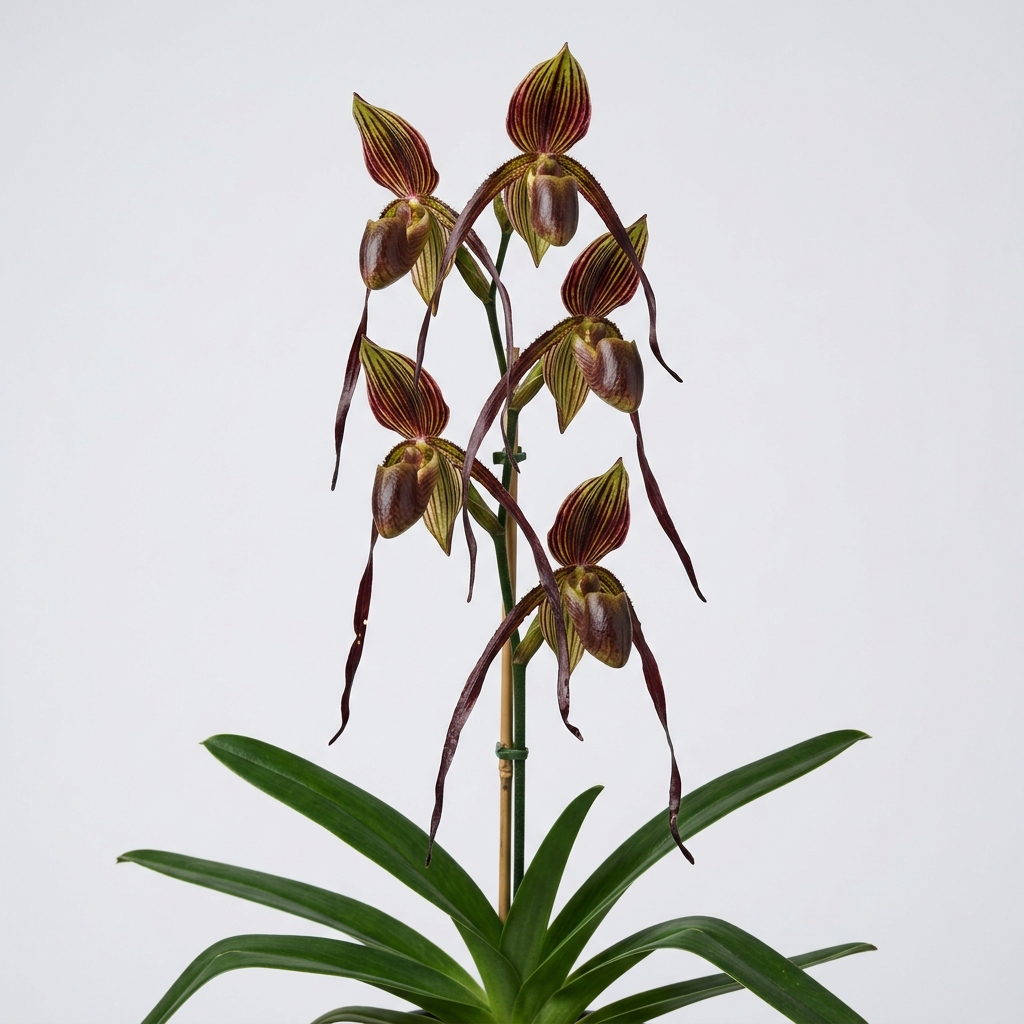
Paphiopedilum Adductum is a highly prized, striking multifloral slipper orchid native to the mountainous regions of the Philippines. Highlighted by its distinctive, dramatic appearance, this species is characterized by long, ribbon-like, dark-colored petals that drape elegantly from the flowering spike. Growers and collectors value this orchid for its architectural form and the exotic, almost gothic aesthetic it brings to a curated collection.
Cultivating this orchid requires patience and a nuanced understanding of its environmental preferences, as it is notoriously slow-growing compared to other slipper orchids. However, the reward of its multi-flowered display makes it a crown jewel for intermediate and advanced hobbyists. By replicating its natural humid, forest-understory habitat, growers can successfully maintain this remarkable species and enjoy its long-lasting blooms.
💡 Did You Know?
Paphiopedilum Adductum is highly sought after by hybridizers because of its ability to pass down its intense, near-black coloration and dramatically elongated, downward-sweeping petals to its offspring. This makes it a foundational species for creating some of the most striking and dark-flowered multifloral slipper orchid hybrids in cultivation today.
Quick Facts
| Property | Details |
|---|---|
| Paphiopedilum Adductum | |
| Slipper Orchids (Multifloral) | |
| Paphiopedilum | |
| Orchidaceae | |
| Dark maroon, reddish-brown, yellow, and green stripes | |
| Not consistently documented / Non-fragrant | |
| Typically late spring to summer | |
| Medium to bright indirect light | |
| Warm to intermediate (65°F to 85°F / 18°C to 29°C) | |
| High (60% to 80%) | |
| Consistently moist, never waterlogged | |
| Fine to medium fir bark, perlite, charcoal, and chopped sphagnum moss | |
| Moderate to Advanced | |
| Generally considered non-toxic to pets and humans |
🌿 Botanical Overview
Paphiopedilum Adductum is a terrestrial or lithophytic species native to the island of Mindanao in the Philippines, where it grows in humus-rich pockets on limestone cliffs or steep slopes. It typically inhabits elevations ranging from 1,200 to 1,500 meters, experiencing a climate that is consistently humid and moderately warm throughout the year.
The plant features a compact growth habit with strap-shaped, leathery, dark green leaves that lack the mottled patterning found in some other Paphiopedilum species. The foliage grows in a tight, fan-shaped arrangement, from which a single, erect, dark purple inflorescence emerges, bearing multiple flowers that open sequentially or simultaneously.
🌸 Flower Characteristics
The flowers of Paphiopedilum Adductum are renowned for their dramatic, downward-pointing petals that can reach several inches in length. These petals are typically narrow, slightly twisted, and colored a deep, dark reddish-brown or near-black, creating a stark contrast against the rest of the bloom.
The dorsal sepal is relatively small, pointed, and decorated with vertical stripes of dark maroon and pale yellow or cream. The pouch, or labellum, is helmet-shaped, brownish-yellow with darker veins, and projects forward. A single flower spike can carry two to five flowers, presenting an imposing and elegant vertical display.
Fragrance & Bloom Profile
This species is not recognized for its scent, and fragrance is not consistently documented in horticultural literature. The primary appeal of Paphiopedilum Adductum lies entirely in its visual complexity and the structural elegance of its long, hanging petals.
The blooms are exceptionally long-lasting, often remaining in pristine condition for six to eight weeks. Because the flowers open over a period of several days, the overall blooming display can extend for up to two months, provided the plant is kept in stable, cool-to-intermediate conditions during the flowering cycle.
Parentage & Hybrid Lineage
As a distinct species rather than a man-made hybrid, Paphiopedilum Adductum represents a pure genetic line within the subgenus Polyantha. It is closely related to other multifloral species such as Paphiopedilum anitum, which some taxonomists have historically treated as a variety of adductum.
In hybridizing, Paphiopedilum Adductum is highly valued for passing on its dark, intense coloration and elongated, downward-sweeping petals to its progeny. When crossed with larger multiflorals like Paphiopedilum rothschildianum, it produces striking primary hybrids that exhibit exceptional dark tones and dramatic floral architecture.
🌱 Growing Conditions
To cultivate Paphiopedilum Adductum successfully, growers must provide intermediate to warm temperatures, ideally ranging from 70°F to 85°F (21°C to 29°C) during the day, with a slight drop of 10°F (5°C to 6°C) at night to stimulate healthy growth and eventual blooming.
💡 Care Tip
To keep the high without risking root rot, place your orchid on a tray filled with pebbles and water, ensuring the bottom of the pot does not touch the water. Pair this with a small oscillating fan nearby to maintain gentle, continuous air movement around the foliage.
Light levels should be moderate to bright but strictly indirect. Direct sunlight will quickly scorch the solid green leaves. High humidity of 60% to 80% is essential, coupled with continuous, gentle air movement to prevent stagnant air pockets, which can invite fungal pathogens to settle on the foliage.
Watering, Feeding & Potting Media
Unlike some orchids that require a dry rest period, Paphiopedilum Adductum prefers to remain evenly moist throughout the year. The potting medium should never be allowed to dry out completely, nor should it remain soggy, as stagnant water around the roots will rapidly cause root rot.
A well-draining mix composed of fine to medium fir bark, perlite, horticultural charcoal, and a small amount of chopped sphagnum moss works best. Feed the plant weekly with a highly diluted, balanced orchid fertilizer, flushing the pot with pure water once a month to prevent harmful mineral salt buildup.
Blooming Season & Care Notes
The typical blooming season for Paphiopedilum Adductum occurs in late spring and throughout the summer months. The development of the flower spike is a slow process that requires patience; growers should avoid moving the plant or changing its environmental conditions once the spike begins to emerge to prevent bud blast.
After the flowers fade, cut the spike down to the base of the foliage using a sterile cutting tool. Repotting is best performed every one to two years in the spring, just as new root growth begins, ensuring the plant is snug in its pot, as over-potting can lead to excess moisture retention.
⚠️ Common Issues
⚠️ Common Mistake
A frequent error is allowing the potting medium to dry out completely between waterings. Unlike many epiphytic orchids, this terrestrial-leaning species lacks pseudobulbs for water storage and requires a consistently damp, though highly aerated, root zone to prevent dehydration and leaf drop.
- Root Rot:
Caused by overwatering or compacted potting media that prevents oxygen from reaching the roots. - Bud Blast:
Sudden drops in humidity, temperature fluctuations, or moving the plant while the spike is developing can cause buds to yellow and drop. - Mealybugs and Scale: These pests often hide in the tight crevices at the base of the fan-shaped leaves; treat promptly with insecticidal soap or neem oil.
- Leaf Tip Burn: Often a sign of excessive fertilizer salt accumulation in the medium or low humidity levels.
- Fungal Leaf Spotting: Occurs when water sits on the leaves overnight in cool conditions with inadequate air circulation.
❓ Frequently Asked Questions
How often should I water my Paphiopedilum Adductum?
Water when the top half-inch of the potting medium begins to feel slightly dry, typically every 5 to 7 days depending on your home’s humidity and temperature. Never let the roots dry out completely.
Can Paphiopedilum Adductum be grown under LED lights?
Yes, this orchid adapts well to artificial lighting. Position the plant under moderate-intensity LED grow lights, ensuring the leaves do not warm up too much, and maintain a consistent 12-to-14-hour photoperiod.
Why are the leaf tips on my orchid turning brown?
Brown leaf tips are usually caused by low ambient humidity or a buildup of fertilizer salts in the potting mix. Flush the pot thoroughly with pure rainwater or distilled water and increase local humidity.
Is Paphiopedilum Adductum suitable for beginner orchid growers?
Due to its slow growth rate, specific humidity demands, and sensitivity to root rot, this species is generally recommended for intermediate to advanced growers who can maintain stable environmental conditions.
⭐ Final Growing Notes
Though Paphiopedilum Adductum demands a disciplined care routine and a fair share of patience, the reward of its dark, dramatic, and cascading blooms is unmatched. By maintaining high humidity, consistent moisture, and gentle air movement, you can successfully cultivate this exquisite Philippine treasure and enjoy its architectural elegance for years to come.
⚕️ Health, Safety & Edibility
Understanding how a plant interacts with people, pets, and the surrounding environment is part of responsible cultivation. This section uses conservative, general guidance and does not replace professional medical or veterinary advice.
Human Safety: No published evidence currently identifies species-specific toxicity concerns for Paphiopedilum Adductum during normal handling. As with most ornamental plants, it should not be intentionally consumed.
Pet Safety: Published information does not indicate that this orchid commonly poses a toxicity concern for cats or dogs. However, chewing leaves, flowers, roots, or potting media may still cause mild digestive upset.
Edibility: This orchid is cultivated for ornamental display rather than food. Ornamental plants may carry fertilizers, pesticides, or other horticultural treatments that make them unsuitable for consumption.
Skin Contact: Routine handling is not generally associated with skin irritation. Gardeners with sensitive skin may prefer wearing gloves when repotting, pruning, or handling potting media.
🌱 Propagation Tip
This orchid is best propagated by division during repotting, but only when the plant has grown into a large clump with multiple mature fans. Ensure each division has at least two or three healthy, leafy fans and an active root system to guarantee successful establishment.
⭐ Expert Advice
When a new flower spike begins to emerge, avoid rotating or moving the pot. Slipper orchids are highly sensitive to changes in direction during spike development, and altering the plant's orientation can cause the developing stem to twist awkwardly or trigger bud blast.




Leave A Comment