
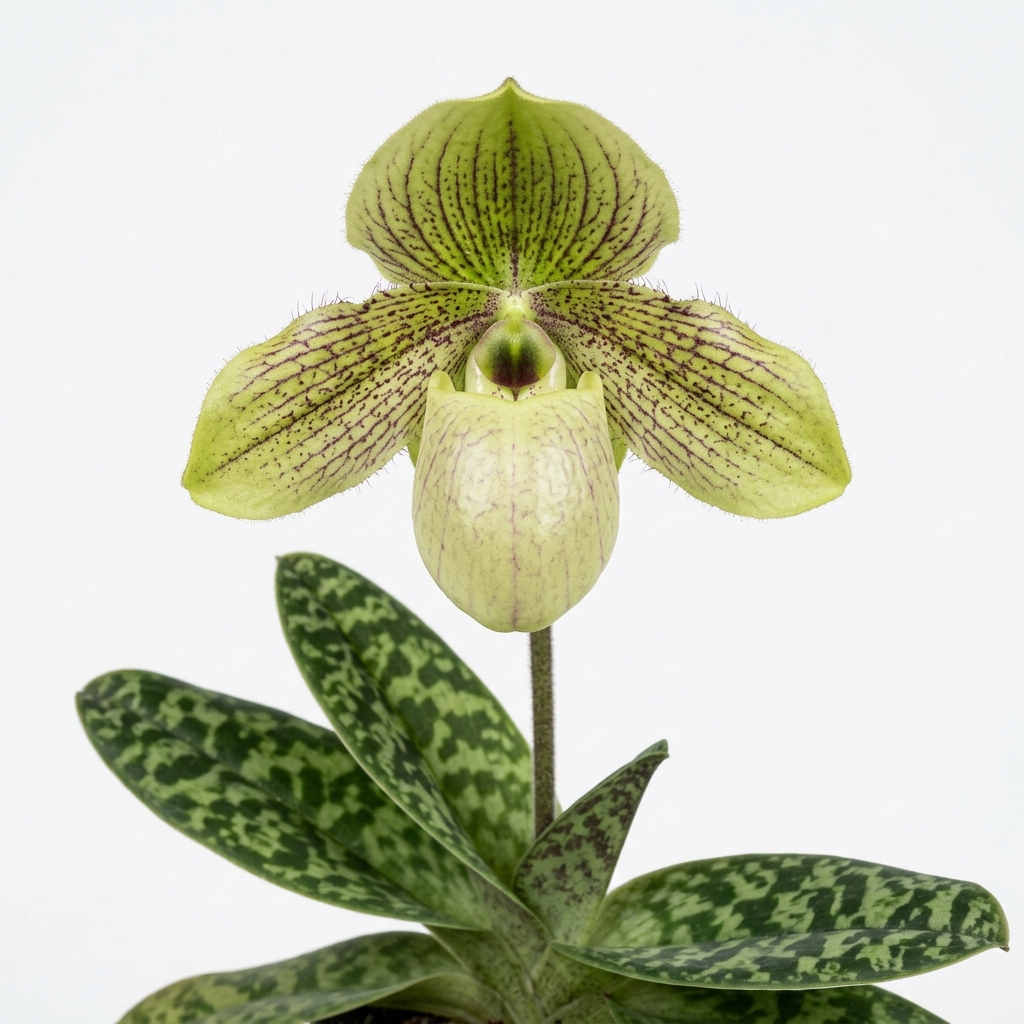
Paphiopedilum Malipoense, commonly known as the jade slipper orchid, is a highly prized species within the slipper orchid family. Renowned for its striking, apple-green blossoms and beautifully mottled foliage, this terrestrial orchid brings a unique architectural elegance to any indoor collection. Growers particularly value its distinctive flower form, which features a large, pouch-like labellum and delicate purple veining.
Native to the limestone karst regions of southern China and northern Vietnam, this orchid has adapted to specific environmental niches. While it requires a bit more patience than standard commercial hybrids due to its slow growth rate, the reward of its long-lasting, fragrant blooms makes it a coveted addition for dedicated orchid enthusiasts.
💡 Did You Know?
Paphiopedilum Malipoense is part of the Paphiopedilum orchid group, a favorite among growers because its flowers, growth habit, and care needs make it useful for comparing cultivated orchids within the same . Observing its leaves, roots, and bloom spikes can help growers understand how this cultivar responds to indoor conditions.
🌿 Botanical Overview
Paphiopedilum Malipoense belongs to the subgenus Parvisepalum, a group of slipper orchids celebrated for their distinctive pouch shapes and attractive foliage. In its natural habitat, it grows primarily as a lithophyte or terrestrial in pockets of humus accumulated on steep limestone cliffs. This evolutionary background dictates many of its cultivation requirements, particularly its preference for calcium-rich growing media.
The vegetative growth of this species is highly ornamental even when the plant is not in bloom. The leaves are tessellated, featuring a striking dark and light green mottled pattern on the upper surface, with deep purple spotting on the undersides. Each growth produces a single, upright inflorescence that can reach impressive heights, often towering well above the compact foliage.
🌸 Flower Characteristics
The flower of Paphiopedilum Malipoense is a masterpiece of natural geometry. The dominant feature is the large, inflated pouch (labellum), which is typically a soft, translucent green. The dorsal sepal and petals are similarly colored, decorated with fine, intricate veins of purple, brown, or dark green. A distinctive staminode at the center of the blossom displays a bold, dark purple or maroon coloration, serving as a visual focal point. The flowers are remarkably large relative to the size of the plant, often measuring up to ten centimeters in diameter, and are supported by a tall, pubescent spike.
Fragrance & Bloom Profile
Unlike many slipper orchids, which are completely scentless, Paphiopedilum Malipoense is famous for its pleasant fragrance. The scent is commonly described by growers as reminiscent of fresh apples, anise, or raspberries. This fragrance is typically most pronounced during the morning hours when temperatures begin to rise. A single flower is produced per spike, and due to its heavy, waxy substance, the blossom can remain in pristine condition for six to eight weeks, providing an extended period of sensory enjoyment.
Parentage & Hybrid Lineage
As a naturally occurring species rather than a man-made hybrid, Paphiopedilum Malipoense carries a pure genetic line. It was first described scientifically in the mid-1980s and quickly became a cornerstone in slipper orchid hybridizing. Breeders value it for introducing green coloration, large pouch size, and fragrance to its offspring. When crossed with other members of the Parvisepalum subgenus, it has produced famous primary hybrids such as Paphiopedilum Harold Koopowitz (malipoense crossed with rothschildianum) and Paphiopedilum Norito Hasegawa (malipoense crossed with concolor).
🌱 Growing Conditions
To cultivate Paphiopedilum Malipoense successfully, growers should mimic its native forest understory habitat. It thrives in low to moderate indirect light, similar to the requirements of Phalaenopsis orchids; direct sunlight will quickly scorch the delicate mottled leaves. Temperature-wise, it prefers intermediate to cool conditions, with daytime temperatures ranging from twenty to twenty-six degrees Celsius, and a distinct drop at night to stimulate blooming. High humidity of sixty to eighty percent, coupled with gentle, continuous air movement, is essential to prevent fungal pathogens.
💡 Care Tip
For best results, grow Paphiopedilum Malipoense in bright filtered with steady and gentle airflow. Avoid placing the plant in harsh midday sun, but do not keep it in a dark corner; weak is one of the most common reasons cultivated orchids refuse to rebloom.
Watering, Feeding & Potting Media
Slipper orchids lack pseudobulbs for water storage, meaning they must never be allowed to dry out completely. The potting medium should remain consistently damp but never waterlogged. A mix composed of fine-grade fir bark, perlite, charcoal, and chopped sphagnum moss works exceptionally well. Because of its lithophytic nature on limestone, adding a small amount of oyster shells or dolomite lime to the medium helps maintain the slightly alkaline to neutral pH it prefers. Feed the plant weekly with a highly diluted, balanced orchid fertilizer, flushing the pot with pure water once a month to prevent salt buildup.
Blooming Season & Care Notes
The primary blooming season for Paphiopedilum Malipoense occurs between late winter and late spring. The development of the flower spike is an exceptionally slow process, often taking several months from the first appearance of the bud in the leaf axil to the fully opened flower. Patience is critical during this phase, as sudden changes in temperature or moisture can cause the bud to blast. After the bloom fades, cut the spike down to the base of the growth. Repotting is best performed every one to two years in the spring, just as new root growth initiates from the base of the lead fan.
⚠️ Common Issues
⚠️ Common Mistake
The most common mistake is by calendar instead of root and potting-media condition. Paphiopedilum roots need moisture and air at the same time, so constantly wet bark or sphagnum can lead to root loss even when the leaves still look healthy.
- Root Rot:
Caused by overwatering or compacted, poorly draining potting media. - Bud Blast:
The premature drying and dropping of flower buds, usually triggered by sudden drafts, low humidity, or water stress. - Erwinia Soft Rot: A bacterial infection that presents as wet, sunken patches on the leaves, often spreading rapidly in stagnant air.
- Mealybugs and Scale: Common pests that hide in the tight crevices of the leaf bases and under the flower pouch.
- Leaf Tip Burn: Often indicates excessive fertilizer salts in the medium or irrigation water with high mineral content.
❓ Frequently Asked Questions
How long does it take for a Paphiopedilum Malipoense bud to open?
The budding process for this species is notoriously slow. It typically takes three to five months from the moment the flower spike emerges from the center of the growth to the actual opening of the blossom. Maintaining stable environmental conditions during this period is essential.
Does Paphiopedilum Malipoense require calcium in its soil?
Yes, as a natural lithophyte found on limestone cliffs, this orchid benefits from calcium. Adding dolomite lime, crushed oyster shells, or calcium chips to the potting mix helps replicate its native habitat and supports healthy leaf and root development.
Why are the tips of my orchid’s leaves turning brown?
Brown leaf tips are usually a sign of salt accumulation in the potting medium from tap water or over-fertilizing. Slipper orchids are sensitive to dissolved minerals. Use rainwater, distilled water, or reverse osmosis water, and flush the pot thoroughly between fertilizer applications.
Can I grow Paphiopedilum Malipoense under LED lights?
Yes, this orchid adapts very well to indoor cultivation under LED grow lights. Position the plant so it receives moderate, diffused light, ensuring the leaves do not feel warm to the touch, which could indicate the light source is too close.
⭐ Final Growing Notes
While Paphiopedilum Malipoense demands a disciplined approach to watering and a patient outlook during its long budding cycle, it remains one of the most rewarding slipper orchids to cultivate. Its exquisite mottled foliage provides year-round visual interest, and the eventual emergence of its large, fragrant, apple-green bloom is a true milestone for any orchid grower. By providing consistent moisture, moderate humidity, and a calcium-rich medium, you can enjoy this botanical treasure for many years.
⚕️ Health, Safety & Edibility
Understanding how a plant interacts with people, pets, and the surrounding environment is part of responsible cultivation. This section uses conservative, general guidance and does not replace professional medical or veterinary advice.
Human Safety: No published evidence currently identifies species-specific toxicity concerns for Paphiopedilum Malipoense during normal handling. As with most ornamental plants, it should not be intentionally consumed.
Pet Safety: Published information does not indicate that this orchid commonly poses a toxicity concern for cats or dogs. However, chewing leaves, flowers, roots, or potting media may still cause mild digestive upset.
Edibility: This orchid is cultivated for ornamental display rather than food. Ornamental plants may carry fertilizers, pesticides, or other horticultural treatments that make them unsuitable for consumption.
Skin Contact: Routine handling is not generally associated with skin irritation. Gardeners with sensitive skin may prefer wearing gloves when repotting, pruning, or handling potting media.
🌱 Propagation Tip
Propagation should be approached patiently. Most home growers should wait for natural keikis or divide only mature, healthy plants when the orchid type allows it. Never remove a young growth until it has strong roots and enough leaves to support itself away from the parent plant.
⭐ Expert Advice
Repot after flowering when fresh root tips begin to appear. This timing helps the plant anchor quickly into new bark or sphagnum and reduces stress, especially for orchids grown indoors where airflow, , and drying speed can change from season to season.




Leave A Comment