
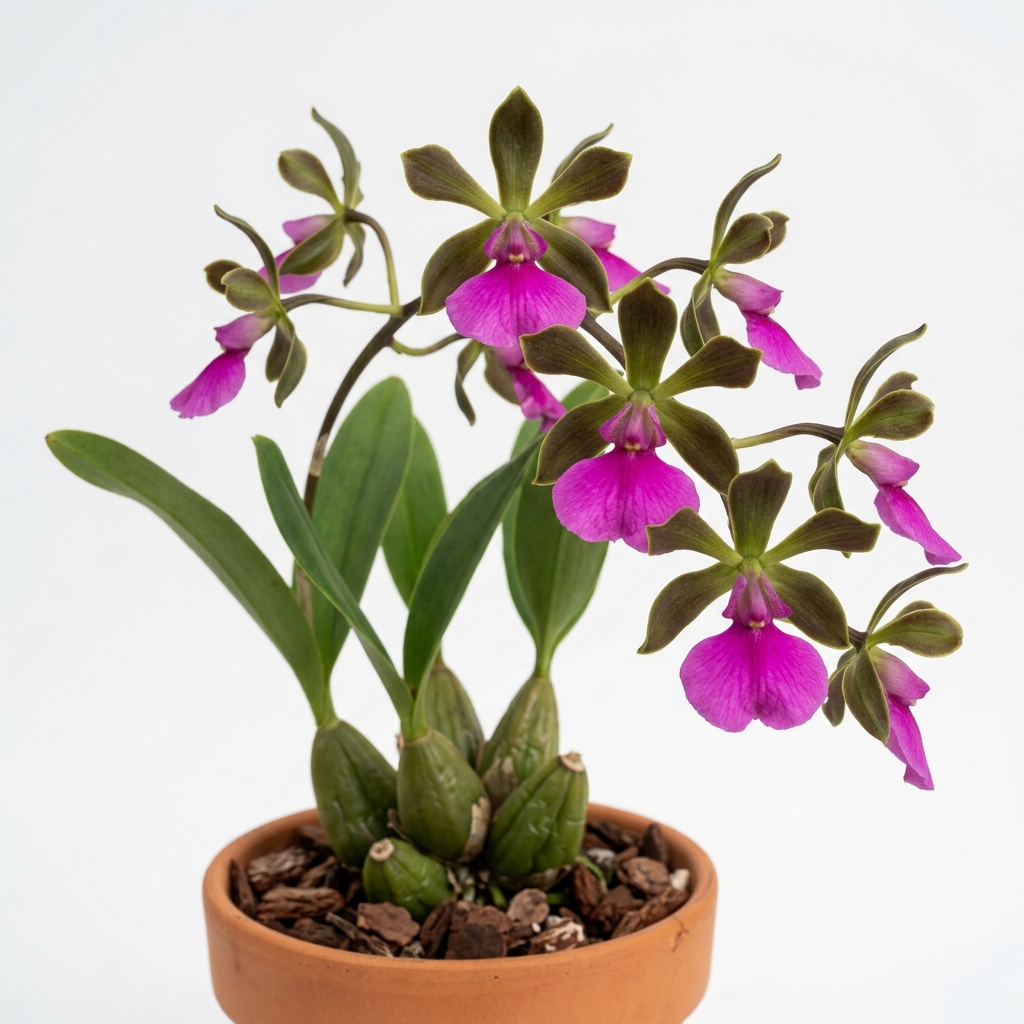
Encyclia Cordigera is a highly prized orchid species celebrated by collectors for its striking floral display and exceptionally rich fragrance. Native to the seasonally dry forests of Central America and northern South America, this sympodial epiphyte produces robust, onion-shaped pseudobulbs topped with leathery, strap-like leaves. Its growth habit is compact yet vigorous, making it an excellent choice for both greenhouse cultivation and indoor windowsill growing.
Growers particularly value this orchid for its long-lasting blooms, which emerge on upright or arching inflorescences during the spring months. The flowers feature a dramatic contrast between their dark, greenish-brown tepals and a broad, brightly colored labellum that ranges from pure white with purple veins to solid, vivid magenta. Its adaptability to intermediate temperatures and moderate humidity levels has secured its status as a staple in diverse orchid collections worldwide.
💡 Did You Know?
The intense chocolate-honey scent of Encyclia Cordigera is an evolutionary adaptation designed to attract specific native bees in its wild habitat. Unlike many orchids that rely on visual mimicry alone, this species uses its powerful morning emission to guide pollinators directly to its nectar-free flowers over long distances.
🌿 Botanical Overview
Encyclia Cordigera is characterized by its tightly clustered, egg-shaped or conical pseudobulbs, which can reach the size of a small tennis ball under optimal conditions. These pseudobulbs act as water storage organs, helping the plant survive dry seasons in its native habitat. Each pseudobulb typically bears two to three narrow, rigid, dark green leaves that can grow up to a foot in length.
In nature, this species grows epiphytically on tree trunks and large branches, where it is exposed to bright sunlight and excellent air movement. The root system is robust, with thick, fleshy roots covered in velamen to rapidly absorb moisture and nutrients during brief rain showers. Understanding this natural epiphytic habit is key to successful cultivation in home and greenhouse environments.
🌸 Flower Characteristics
The inflorescence of Encyclia Cordigera is terminal, arising from the apex of the mature pseudobulb, and can bear anywhere from 5 to 15 flowers on a single spike. The flowers are relatively large for the genus, often measuring 2 to 3 inches in diameter. The sepals and petals are typically incurved, displaying shades of olive green, bronze, or deep purplish-brown.
The defining feature of the bloom is the large, spreading, three-lobed lip. Depending on the specific variety or cultivar, the lip may be a striking magenta-pink or a pristine white marked with central purple striations. This broad, heart-shaped lip serves as a highly visible landing platform for natural pollinators.
Fragrance & Bloom Profile
One of the most compelling reasons to grow Encyclia Cordigera is its intense, captivating fragrance. The blooms release a heavy, sweet scent that is commonly described as a blend of chocolate, vanilla, and honey. This fragrance is most pronounced during the morning and early afternoon hours when temperatures rise and light levels increase.
The flowers are remarkably long-lasting, often remaining fresh and fragrant on the plant for six to eight weeks. To maximize the duration of the bloom cycle, growers should keep the plant in a slightly cooler, stable environment once the flowers have fully opened, avoiding drafty areas or direct midday sun.
Parentage & Hybrid Lineage
As a distinct species rather than a complex artificial hybrid, Encyclia Cordigera carries a pure genetic lineage that has been widely used in orchid hybridization. It is a primary parent in many intergeneric crosses within the Laeliinae subtribe, contributing its robust growth habit, intense fragrance, and prominent lip to its offspring.
While several distinct color forms exist in nature—such as Encyclia Cordigera var. rosea and var. semi-alba—these are naturally occurring variations rather than registered man-made cultivars. When purchasing, growers should note that individual plants may exhibit slight variations in flower size, color intensity, and fragrance profile depending on their specific seed-grown origin.
🌱 Growing Conditions
To thrive, Encyclia Cordigera requires bright, indirect light, similar to the conditions preferred by Cattleyas. A south- or east-facing window with sheer filtering is ideal for indoor growers. The leaves should be a light olive-green color; dark green leaves indicate insufficient light, while yellowing or reddish-purple speckling suggests the light is too intense.
💡 Care Tip
Always prioritize air movement around your Encyclia Cordigera. Placing a small, gentle fan nearby helps dry the foliage and quickly after , which mimics its natural breezy canopy environment and significantly reduces the risk of fungal infections.
Temperature ranges should mimic intermediate to warm tropical climates. Daytime temperatures between 75°F and 85°F are optimal, with a nighttime drop to 60°F or 65°F to encourage healthy growth and trigger seasonal blooming. Good air circulation is absolutely critical for this species to prevent stagnant moisture around the roots and foliage.
Watering, Feeding & Potting Media
This orchid prefers a distinct wet-to-dry watering cycle. Water the plant thoroughly, allowing water to run freely through the pot, and then allow the medium to dry out almost completely before watering again. During the active growing season in spring and summer, watering frequency should be increased, while a drier rest period should be observed in winter.
A coarse, fast-draining potting mix is essential. A blend of medium-to-large fir bark, horticultural charcoal, and perlite works exceptionally well in clay or plastic pots with ample drainage holes. Alternatively, Encyclia Cordigera can be mounted on cork bark or tree fern plaques, provided the grower can maintain high humidity and water the plant daily during hot weather. Feed weekly with a weak solution of balanced orchid fertilizer during active growth.
Blooming Season & Care Notes
The primary blooming season for Encyclia Cordigera is spring, typically from March through May, though variations can occur based on local growing conditions. The flower spikes develop slowly over several weeks from the top of the newly matured pseudobulbs. During this developmental phase, avoid moving the plant or changing its orientation to the light source, as this can cause the buds to twist or fail to open properly.
Once the blooming cycle is complete, cut the spent flower spike near the base of the pseudobulb using sterilized cutting tools. Repotting should only be performed when new root growth is visible at the base of the newest pseudobulb, which usually occurs shortly after the flowering cycle ends.
⚠️ Common Issues
⚠️ Common Mistake
A frequent error is keeping the potting medium constantly wet. Unlike terrestrial orchids, this epiphyte requires its roots to dry out rapidly between waterings. Keeping the roots continuously damp will quickly lead to root rot and the eventual decline of the plant.
- Root rot: Caused by overwatering or compacted, decaying potting media that retains too much moisture.
- Bud blast: Sudden dropping or drying of flower buds, often triggered by rapid changes in temperature, low humidity, or drafts.
- Scale and mealybugs: Common pests that hide in the dry sheaths of the pseudobulbs or on the undersides of leaves.
- Dehydration: Indicated by severely shriveled pseudobulbs and wrinkled leaves, usually due to underwatering or a compromised root system.
❓ Frequently Asked Questions
How do I trigger my Encyclia Cordigera to bloom?
To encourage blooming, ensure the plant receives bright, indirect light throughout the year and experience a distinct temperature drop of 10 to 15 degrees Fahrenheit at night during the autumn and winter months, accompanied by a reduction in watering.
Why are the pseudobulbs on my orchid shriveling?
Slight shriveling of older pseudobulbs is normal during the winter dry rest or when a new growth is developing. However, severe shriveling indicates dehydration, which can be caused by underwatering or root loss due to overwatering.
Can I grow Encyclia Cordigera mounted on wood?
Yes, this species excels when mounted on cork bark or tree fern mounts because its roots dry quickly. Mounted plants require high ambient humidity and daily watering during the warm summer months.
How often should I fertilize this orchid?
Fertilize weekly at one-quarter to one-half strength using a balanced orchid fertilizer during the active spring and summer growth phases. Flush the pot with pure water once a month to prevent harmful fertilizer salt buildup.
⭐ Final Growing Notes
Encyclia Cordigera remains a highly rewarding orchid for growers of all experience levels, offering a spectacular sensory return for relatively straightforward care. By providing bright light, a well-draining medium, and respecting its seasonal wet-to-dry cycle, you will be rewarded with a stunning, chocolate-scented spring display that elevates any indoor or greenhouse collection.
⚕️ Health, Safety & Edibility
Understanding how a plant interacts with people, pets, and the surrounding environment is part of responsible cultivation. This section uses conservative, general guidance and does not replace professional medical or veterinary advice.
Human Safety: No published evidence currently identifies species-specific toxicity concerns for Encyclia Cordigera during normal handling. As with most ornamental plants, it should not be intentionally consumed.
Pet Safety: Published information does not indicate that this orchid commonly poses a toxicity concern for cats or dogs. However, chewing leaves, flowers, roots, or potting media may still cause mild digestive upset.
Edibility: This orchid is cultivated for ornamental display rather than food. Ornamental plants may carry fertilizers, pesticides, or other horticultural treatments that make them unsuitable for consumption.
Skin Contact: Routine handling is not generally associated with skin irritation. Gardeners with sensitive skin may prefer wearing gloves when repotting, pruning, or handling potting media.
🌱 Propagation Tip
Propagation is best achieved by dividing mature plants during repotting. Ensure each division has at least three to four healthy, mature pseudobulbs with active root initials. Avoid dividing small plants, as larger specimens produce far more robust flower spikes.
⭐ Expert Advice
To achieve specimen-sized plants with multiple flower spikes, grow this orchid in a clay pot with coarse bark or mount it on a large cork slab. Minimize repotting to once every three years, as Encyclia Cordigera resents root disturbance and blooms best when established.




Leave A Comment