
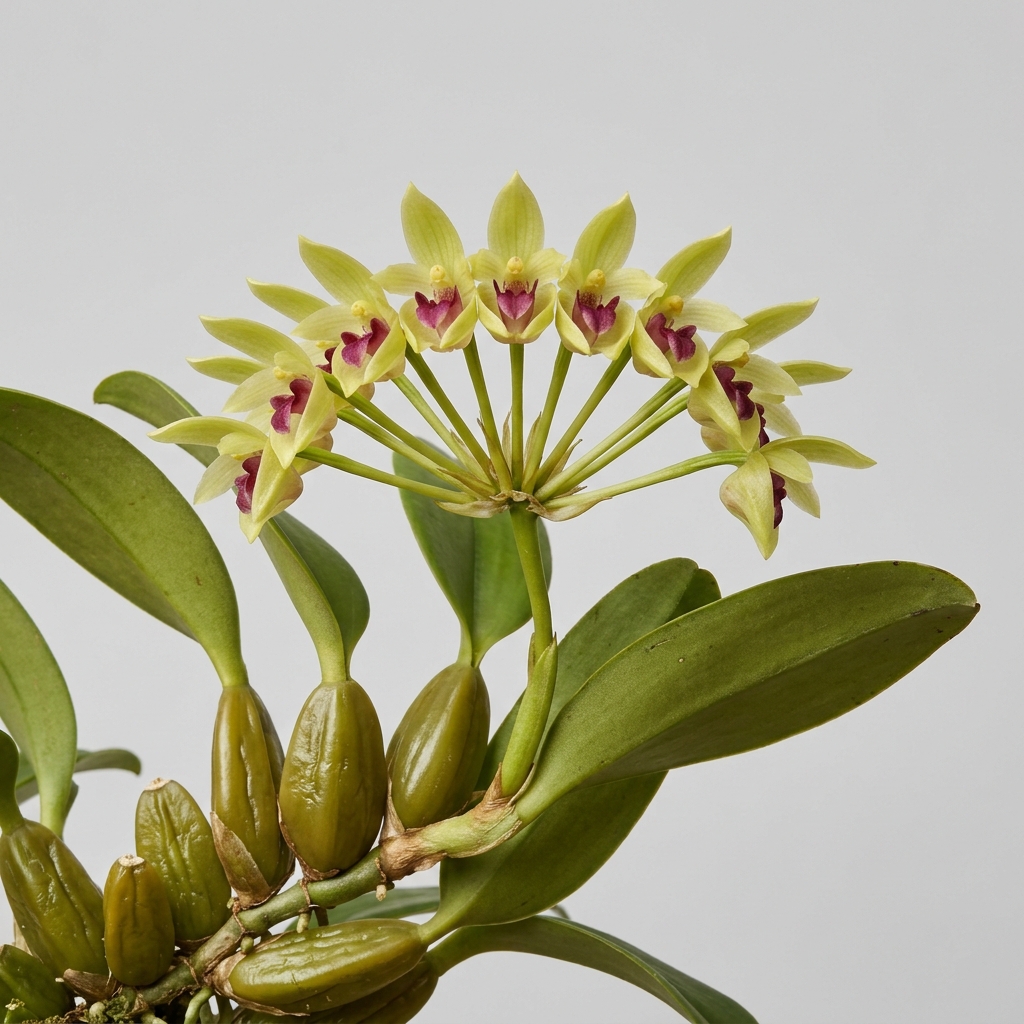
Bulbophyllum Graveolens is a striking and highly sought-after orchid species native to New Guinea and surrounding islands, celebrated for its spectacular, fan-like clusters of flowers. As one of the larger members of the diverse Bulbophyllum genus, this epiphytic orchid produces robust pseudobulbs and expansive foliage that command attention even when not in bloom. Growers prize the species for its dramatic botanical presence and the architectural beauty of its circular flower arrangements.
Cultivating this remarkable orchid requires an understanding of its tropical rainforest origins, where high humidity and consistent moisture are key to its success. While its unique floral display is a triumph for any collector, its intense fragrance is famously polarizing, making it a true conversation piece in the greenhouse. For dedicated orchid enthusiasts, mastering the care of this species offers a rewarding glimpse into the specialized world of tropical Old World epiphytes.
💡 Did You Know?
The specific epithet graveolens literally translates to heavy-scented or strong-smelling in Latin. This refers to the orchid's potent, carrion-like aroma, an evolutionary adaptation designed to attract carrion flies as pollinators in its native New Guinea rainforest canopy.
🌿 Botanical Overview
Bulbophyllum Graveolens is characterized by its large, glossy, olive-green pseudobulbs that grow sequentially along a creeping rhizome. Each pseudobulb supports a single, thick, leathery leaf that can reach impressive lengths, often exceeding twelve inches under optimal conditions. This growth habit allows the plant to store moisture and nutrients, helping it survive brief periods of dryness in its natural canopy habitat.
In the wild, this epiphyte clings to the mossy branches of trees in warm, humid lowland forests. Its extensive root system is designed to quickly absorb water and dissolved organic matter from the surrounding air and bark. Understanding this growth habit is essential for selecting the appropriate potting or mounting method in cultivation.
🌸 Flower Characteristics
The inflorescence of Bulbophyllum Graveolens is a spectacular umbel-like cluster, where up to a dozen or more flowers radiate outward from a central point, forming a semi-circular fan. The individual flowers are relatively large for the genus, dominated by elongated, pointed lateral sepals that drape downward. The primary coloration is typically a pale yellowish-green or chartreuse, which contrasts sharply with a vibrant, hinged lip.
The lip, or labellum, is often a deep reddish-purple or orange-brown and is delicately balanced on a flexible joint. This mobile lip moves with the slightest breeze or insect activity, a specialized evolutionary adaptation designed to facilitate pollination. The overall presentation of the blooming spike is architectural, dramatic, and highly distinct from typical orchid shapes.
Fragrance & Bloom Profile
The fragrance of Bulbophyllum Graveolens is one of its most notable—and notorious—features. True to its specific epithet graveolens, which translates to “strong-smelling” or “heavy-scented,” the flowers emit a potent, carrion-like odor. This scent is designed to attract blowflies and other carrion-seeking insects, which serve as its primary pollinators in the wild.
While the odor can be intense, particularly during the warmest hours of the day in enclosed spaces, it is a fascinating demonstration of evolutionary biology. The blooms typically last for two to three weeks, during which the fragrance remains consistently strong. Growers often choose to display the plant in well-ventilated areas or outdoor growing spaces during its blooming cycle to mitigate the scent.
Parentage & Hybrid Lineage
Bulbophyllum Graveolens is a naturally occurring species rather than a man-made hybrid. While it has been used as a parent in some specialized Bulbophyllum hybridization programs to introduce flower size and the fan-like cluster habit, its primary representation in collections is as the pure species.
Because registration records for older or less common Bulbophyllum hybrids can sometimes be incomplete, growers should verify the lineage of any labeled crosses with reputable orchid registries. The species itself remains highly prized by purists who appreciate its wild, unaltered botanical characteristics.
🌱 Growing Conditions
To thrive, Bulbophyllum Graveolens requires warm to intermediate temperatures, ideally ranging from 70°F to 85°F during the day, with a slight drop at night to stimulate healthy growth. It prefers moderate to bright filtered light, similar to the dappled sunlight found in the middle canopy of a rainforest. Direct, intense sunlight should be avoided, as it can easily scorch the large, leathery leaves.
💡 Care Tip
To keep the extensive, shallow root system of this orchid healthy, use a shallow bulb pan or a wide, flat basket rather than a deep pot. This prevents the potting medium at the bottom from staying too wet and souring.
High humidity is critical for this species, with target levels maintained between 60% and 80%. Excellent air movement is equally important to prevent stagnant air pockets, which can encourage fungal pathogens on the foliage and roots. Many growers find success cultivating this orchid in a dedicated greenhouse or a highly controlled indoor grow space with humidifiers and fans.
Watering, Feeding & Potting Media
This orchid prefers to remain consistently moist but never waterlogged. Because it lacks a deep soil root system, the potting medium must be highly free-draining while retaining adequate moisture. A mix of medium-grade New Zealand sphagnum moss and fine fir bark, or tree fern fiber, works exceptionally well. Alternatively, larger specimens can be mounted on cork slabs or tree fern plaques if high humidity can be maintained.
Watering frequency should be adjusted based on the season and drying rate of the medium, ensuring the roots do not dry out completely for extended periods. During the active growing season, apply a balanced, highly diluted orchid fertilizer weekly. Flushing the medium with pure water between fertilizations helps prevent harmful salt buildup, which can damage the sensitive root tips.
Blooming Season & Care Notes
Bulbophyllum Graveolens typically blooms in the late spring or summer months, though flowering can occasionally occur at other times of the year depending on local growing conditions. The flower spikes emerge from the base of the mature pseudobulbs and develop relatively quickly. Once the buds begin to swell, avoid changing the plant’s orientation or environmental conditions to prevent bud drop.
After the blooming cycle is complete, the old flower spikes can be cut back to the base of the pseudobulb. Repotting or remounting is best done in the spring, just as new root growth begins to emerge from the base of the newest pseudobulb. This minimizes transplant shock and allows the plant to establish itself quickly in its fresh medium.
⚠️ Common Issues
⚠️ Common Mistake
A common mistake is allowing the potting medium to dry out completely between waterings. Unlike some orchids with thick pseudobulbs, this species prefers consistent moisture and can suffer severe root loss if left dry for too long.
- Root Rot:
Caused by overwatering or compacted, poorly draining potting media that suffocates the roots. - Leaf Scorch: Appears as bleached or blackened patches on the leaves, resulting from exposure to direct, unfiltered sunlight.
- Bud Blast:
The premature drying and dropping of flower buds, often triggered by sudden drops in humidity or drafts. - Pests:
Mealybugs and spider mites can occasionally target the undersides of the large leaves or hide within the rhizome sheath. - Fungal Spotting: Dark spots on the foliage can develop if humidity is high but air circulation is inadequate.
❓ Frequently Asked Questions
How do I manage the strong odor of Bulbophyllum Graveolens when it blooms?
To manage the potent, carrion-like fragrance, place the blooming plant in a highly ventilated area, such as near an open window, or move it to a sheltered outdoor patio or greenhouse. Increasing airflow helps disperse the scent, making it less concentrated in living spaces.
Can Bulbophyllum Graveolens be grown successfully on a mount?
Yes, mounting on cork bark or tree fern plaques is highly successful, provided you can maintain consistently high humidity (above 70%) and water the plant daily. Mounted plants dry out much faster than potted ones, mimicking their natural epiphytic habitat.
Why are the leaves on my orchid turning yellow and dropping?
Yellowing leaves can indicate overwatering, poor drainage, or natural aging of older pseudobulbs. If the newest leaves are yellowing, check the roots immediately for signs of rot, and ensure the potting medium has not broken down and compacted.
How much light does Bulbophyllum Graveolens need to flower?
This species requires moderate to bright, indirect light (about 1500 to 2500 foot-candles). If the light is too low, the plant may grow healthy green leaves but fail to produce flower spikes. Avoid direct afternoon sun, which will burn the foliage.
⭐ Final Growing Notes
Bulbophyllum Graveolens is an extraordinary orchid that rewards the patient grower with one of the most spectacular floral displays in the botanical world. While its unique fragrance requires some accommodation, its architectural beauty and fascinating pollination mechanics make it an invaluable addition to any serious tropical plant collection. By providing warm temperatures, high humidity, and consistent moisture, you can enjoy the dramatic presence of this New Guinea treasure for many years to come.
⚕️ Health, Safety & Edibility
Understanding how a plant interacts with people, pets, and the surrounding environment is part of responsible cultivation. This section uses conservative, general guidance and does not replace professional medical or veterinary advice.
Human Safety: No published evidence currently identifies species-specific toxicity concerns for Bulbophyllum Graveolens during normal handling. As with most ornamental plants, it should not be intentionally consumed.
Pet Safety: Published information does not indicate that this orchid commonly poses a toxicity concern for cats or dogs. However, chewing leaves, flowers, roots, or potting media may still cause mild digestive upset.
Edibility: This orchid is cultivated for ornamental display rather than food. Ornamental plants may carry fertilizers, pesticides, or other horticultural treatments that make them unsuitable for consumption.
Skin Contact: Routine handling is not generally associated with skin irritation. Gardeners with sensitive skin may prefer wearing gloves when repotting, pruning, or handling potting media.
🌱 Propagation Tip
Propagate this species by division during the spring repotting cycle. Ensure each division has at least three to four healthy, mature pseudobulbs and an active lead growth to guarantee successful establishment.
⭐ Expert Advice
If growing indoors, use a small oscillating fan near your growing area. Constant, gentle air movement is the secret to preventing fungal leaf spot and root rot in high- environments required by this species.




Leave A Comment