
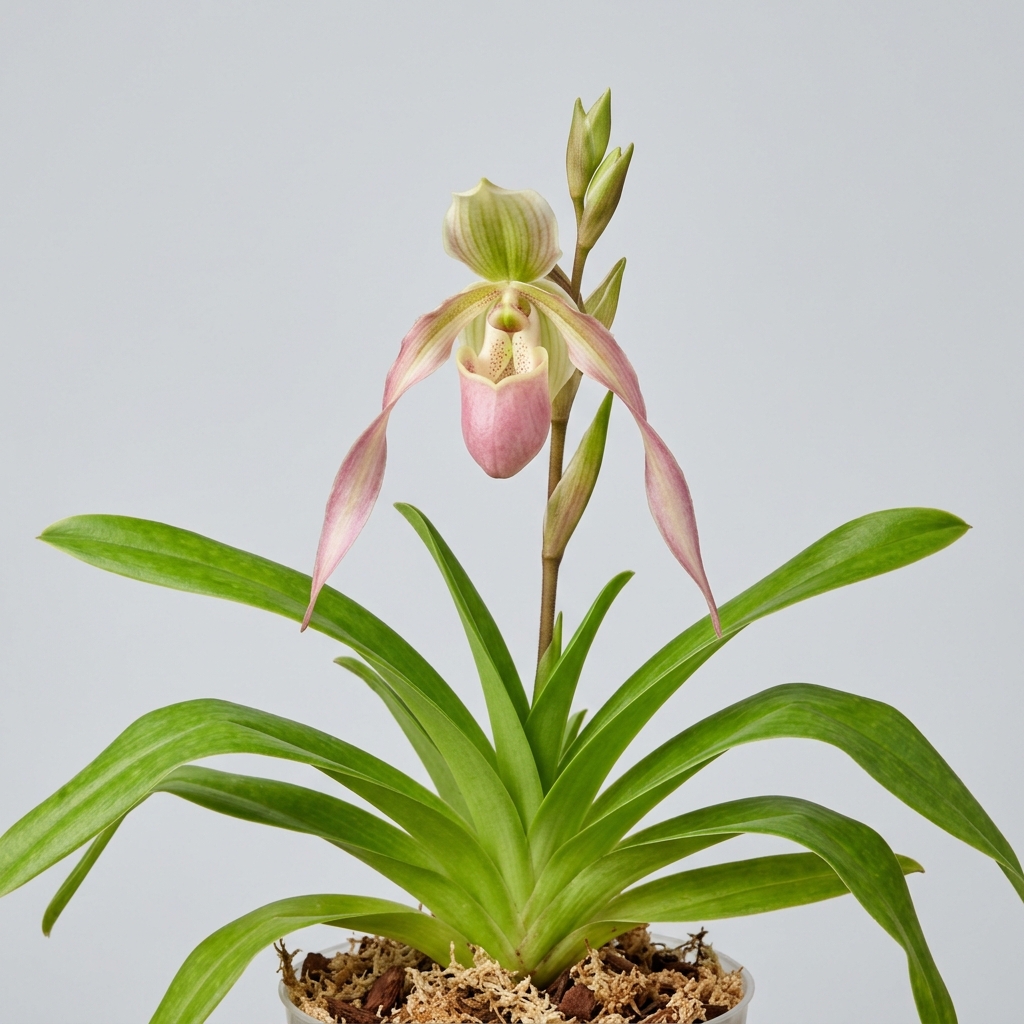
Phragmipedium Schroderae is a highly revered slipper orchid hybrid that has captivated collectors for generations with its elegant form and soft, pastel coloration. Belonging to the South American lady’s slipper group, this orchid is celebrated for its stately growth habit and the graceful, cascading petals that drape from its pouch-like blooms. Growers particularly value this cultivar for its sequential blooming habit, which allows a single flower spike to produce a succession of exquisite blossoms over an extended period.
As a terrestrial or semi-lithophytic orchid, Phragmipedium Schroderae shows a robust growth pattern with fan-shaped arrangements of bright green, strap-like leaves. Unlike many delicate orchid varieties, it possesses a relatively resilient constitution when its specific moisture and light requirements are met. This makes it an excellent choice for intermediate growers looking to transition from common houseplants to the rewarding world of slipper orchid cultivation.
💡 Did You Know?
Phragmipedium Schroderae inherits its long, ribbon-like lateral petals from its parent species, Phragmipedium caudatum. In the wild, these elongated petals can grow exceptionally long, serving as a natural ladder for crawling insect pollinators to reach the slipper-shaped pouch.
🌿 Botanical Overview
Phragmipedium Schroderae is a classic hybrid within the genus Phragmipedium, which is native to the moist, humid regions of Central and South America. These orchids are primarily terrestrial or lithophytic, growing in leaf litter, mossy crevices, or near riverbanks where their roots have access to constant moisture. The growth habit of this cultivar is characterized by a clustering fan of arching, leathery leaves that lack pseudobulbs, meaning the plant relies on its root system and foliage to store water.
The vegetative structure is robust, with mature specimens forming impressive clumps over time. The root system is thick, fleshy, and covered in fine root hairs designed to absorb water and nutrients rapidly from the surrounding organic debris. Understanding this natural growth habit is key to successful cultivation, as it dictates the plant’s preference for high humidity and consistent moisture.
🌸 Flower Characteristics
The flowers of Phragmipedium Schroderae are a masterclass in orchid architecture, showcasing a delicate balance of pastel pinks, soft rose, and cream undertones. The most striking feature is the deeply pouch-shaped lip, or labellum, which is characteristic of slipper orchids. This pouch is often adorned with fine spotting or darker rose veins along the interior rim, serving as a visual guide for potential pollinators in their natural habitats.
Flanking the pouch are the lateral petals, which are elongated, slightly twisted, and drape downward with a graceful, ribbon-like appearance. The dorsal sepal is typically upright, displaying soft green or cream coloration with subtle pink striping. The flowers are borne sequentially on a tall, sturdy inflorescence, meaning that as one flower begins to fade, another bud opens further up the spike, extending the overall display for several months.
Fragrance & Bloom Profile
While some slipper orchids possess subtle aromas, Phragmipedium Schroderae is not consistently documented as having a noticeable fragrance. Most growers report that the blooms are unscented, focusing their appeal entirely on their visual elegance. The lack of fragrance does not diminish its popularity, as the sheer longevity of the sequential blooming cycle more than compensates for the absence of scent.
A single flower spike can remain active for twelve weeks or more, with individual blossoms lasting for several weeks before dropping cleanly to make room for the next bud. This continuous display makes it a highly rewarding centerpiece in a greenhouse or indoor growing area during its active blooming cycle.
Parentage & Hybrid Lineage
Phragmipedium Schroderae is a historic hybrid with a well-regarded lineage in orchid breeding. It is generally recognized as a cross between Phragmipedium Sedenii and Phragmipedium caudatum. Because Phragmipedium Sedenii is itself a primary hybrid of Phragmipedium schlimii and Phragmipedium longifolium, Schroderae inherits a complex genetic makeup that blends the best traits of three distinct species.
From Phragmipedium caudatum, it inherits the elongated, gracefully draping petals and stately flower size. From Phragmipedium schlimii, it receives the soft pink and rose coloration, while Phragmipedium longifolium contributes vigor, sequential blooming habits, and a tolerance for wet root conditions. This combination of traits results in a hybrid that is often more robust and easier to grow than its individual parent species.
🌱 Growing Conditions
To cultivate Phragmipedium Schroderae successfully, growers should aim to replicate the bright, humid, and temperate environments of its ancestral South American habitats. It thrives in bright, filtered, indirect light, similar to the conditions preferred by Phalaenopsis orchids but slightly brighter. Direct afternoon sunlight must be avoided, as it can easily scorch the tender, non-succulent foliage.
💡 Care Tip
Always use rainwater, distilled water, or reverse osmosis water for this orchid. Phragmipediums are highly sensitive to dissolved minerals and chlorine found in tap water, which can quickly cause root dieback and unsightly brown leaf tips.
Temperature ranges should be kept in the intermediate to warm category, ideally between 65°F and 80°F during the day, with a slight drop of 5°F to 10°F at night to encourage bloom initiation. High humidity is crucial for this cultivar; maintaining levels between 60% and 80% will prevent leaf tip dieback and support healthy root development. Good air movement is equally important to prevent stagnant air from causing fungal or bacterial issues in high-humidity environments.
Watering, Feeding & Potting Media
Unlike many epiphytic orchids that require a distinct wet-and-dry cycle, Phragmipedium Schroderae prefers to remain consistently moist. The potting medium should never be allowed to dry out completely. Growers often use a highly water-retentive yet free-draining mix, typically composed of fine fir bark, chopped sphagnum moss, perlite, and charcoal. Some growers even keep the bottom of the pot sitting in a shallow tray of pure water, though this requires high-quality, clean water to prevent salt buildup.
Feeding should be done with a highly diluted, balanced orchid fertilizer applied weekly during the active growing season. Because Phragmipediums are highly sensitive to mineral salts and impurities in water, it is strongly recommended to use rainwater, distilled water, or reverse osmosis water for both watering and fertilizing. Flushing the pot thoroughly with pure water between fertilizer applications helps prevent root burn.
Blooming Season & Care Notes
The primary blooming season for Phragmipedium Schroderae typically spans from autumn through spring, though well-grown plants can bloom at various times of the year. Once a flower spike emerges from the center of a mature leaf fan, it should be staked gently to support the weight of the developing buds. Avoid cutting the spike until it has completely turned brown and dry, as new buds can continue to form sequentially over many months.
Repotting is best performed annually or biennially, immediately after the blooming cycle has concluded and new growth is visible at the base of the plant. Because these orchids prefer constant moisture, the potting media can degrade more rapidly than in drier setups. Fresh media ensures proper aeration for the roots and prevents the mix from becoming sour or compacted.
⚠️ Common Issues
⚠️ Common Mistake
A frequent error is letting the potting medium dry out completely between waterings. Unlike Cattleyas or Dendrobiums, Phragmipediums lack water-storing pseudobulbs and require constant, even moisture to prevent immediate root damage and bud drop.
- Root Rot:
Although they love moisture, stagnant or compacted media can suffocate roots, leading to rot. Ensure the mix remains airy. - Leaf Tip Burn: This is often caused by mineral buildup from tap water or over-fertilizing. Always use pure water sources.
- Bud Blast:
Sudden changes in humidity, temperature, or drafty conditions can cause developing buds to yellow and drop before opening. - Pests:
Mealybugs and spider mites can occasionally hide in the tight crevices of the leaf fans. Treat promptly with insecticidal soap or neem oil. - Bacterial Soft Rot: Water standing in the crown of the plant can lead to rapid rot. Avoid watering from above and ensure good airflow.
❓ Frequently Asked Questions
How often should I water my Phragmipedium Schroderae?
Watering frequency depends on your home environment, but the potting medium should remain consistently moist. Typically, this means watering two to three times a week, ensuring the mix never dries out completely.
Can I grow Phragmipedium Schroderae under LED grow lights?
Yes, this orchid adapts very well to artificial lighting. Place the plant under intermediate-strength LED grow lights for 12 to 14 hours a day, keeping it far enough away to avoid heat stress or leaf scorch.
Why are the tips of my orchid’s leaves turning brown?
Brown leaf tips are usually a sign of low humidity or mineral buildup in the potting media from tap water. Switch to rainwater or distilled water and increase local humidity to resolve this issue.
Is Phragmipedium Schroderae suitable for beginners?
While it requires more attention to watering and water quality than a standard Phalaenopsis, its robust hybrid vigor makes it highly manageable for intermediate beginners who can commit to keeping the medium moist.
⭐ Final Growing Notes
Phragmipedium Schroderae remains a crowning achievement of historical orchid hybridization, offering a spectacular return on investment for the patient grower. By respecting its need for pure water, consistent moisture, and high humidity, you can enjoy a continuous parade of elegant, slipper-shaped blooms that bring a touch of cloud-forest mystique into your home.
⚕️ Health, Safety & Edibility
Understanding how a plant interacts with people, pets, and the surrounding environment is part of responsible cultivation. This section uses conservative, general guidance and does not replace professional medical or veterinary advice.
Human Safety: Species-specific human toxicity data for Phragmipedium Schroderae is limited. Use conservative handling practices and avoid intentional consumption.
Pet Safety: Pet-specific safety information for Phragmipedium Schroderae is limited, so keep it away from animals that commonly chew plants.
Edibility: Phragmipedium Schroderae should not be treated as edible. Ornamental specimens may contain natural irritants or horticultural residues that make them unsuitable for consumption.
Skin Contact: Skin irritation is not well documented for this plant, but gloves are sensible when repotting, pruning, or handling potting media.
🌱 Propagation Tip
This orchid is best propagated by division during repotting. Ensure that each division has at least two or three healthy, mature leaf fans with an active root system to guarantee successful establishment in its new pot.
⭐ Expert Advice
To maximize the sequential blooming period, maintain high and stable temperatures while the spike is active. Sudden environmental shifts or dry drafts can trigger bud blast, cutting your spectacular flowering display short.




Leave A Comment