
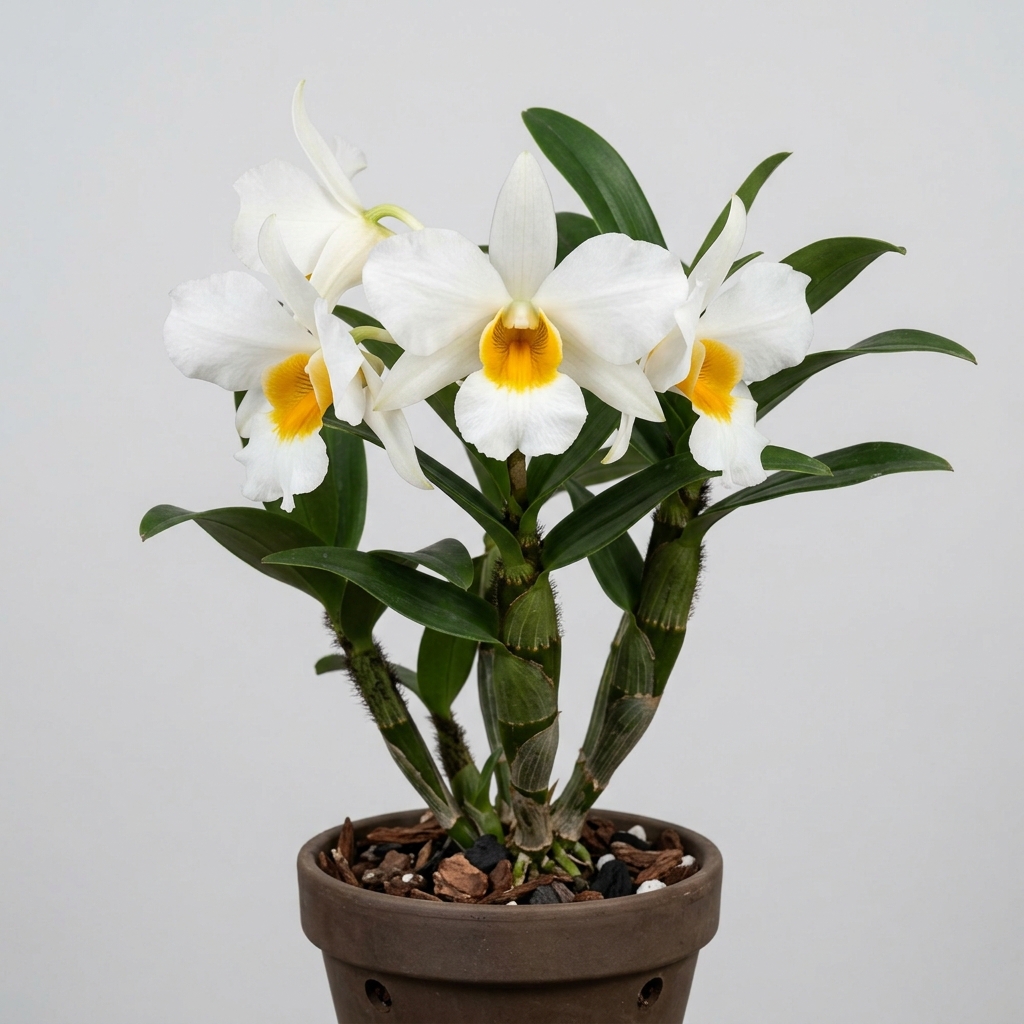
Dendrobium Formosum is a highly prized orchid species belonging to the Dendrobium genus, celebrated for its exceptionally large, pristine white blossoms and striking yellow-orange throats. Native to the mountainous regions of Southeast Asia, this epiphytic orchid is a member of the Formosae section, characterized by the fine, dark hairs that cover its pseudobulbs. Orchid enthusiasts and collectors value this plant for its robust growth habit and the dramatic visual contrast between its dark green foliage and luminous, long-lasting flowers.
In cultivation, Dendrobium Formosum presents a rewarding challenge for intermediate growers who can replicate its seasonal monsoon cycle. The species typically produces flowers from the upper nodes of mature pseudobulbs, creating a spectacular display that can last for several weeks. By understanding its specific light, temperature, and moisture requirements, indoor and greenhouse growers can successfully cultivate this classic orchid and enjoy its elegant, pristine blooms year after year.
💡 Did You Know?
The fine black hairs covering the pseudobulbs of Dendrobium Formosum are a unique evolutionary adaptation characteristic of the Formosae section. These tiny structures, known as trichomes, are believed to help harvest moisture from heavy mountain mists and dew in their native canopy habitats, assisting the plant during dry spells.
🌿 Botanical Overview
Dendrobium Formosum is an epiphytic or occasionally lithophytic orchid native to a broad range spanning from the eastern Himalayas through Myanmar, Thailand, and into Vietnam. In its natural habitat, it grows on tree trunks and branches in open forests, where it is exposed to bright, filtered sunlight and excellent air circulation. The plant features stout, cane-like pseudobulbs that can reach up to 18 inches in height, covered in small, black, hair-like structures that are a defining characteristic of its botanical section.
The leaves are ovate to oblong, leathery, and arranged alternately along the upper portion of the pseudobulbs. These leaves persist for several seasons before shedding, at which point the bare canes continue to support the plant’s overall energy reserves. The root system is vigorous but sensitive to stagnant moisture, requiring a highly porous substrate to thrive in artificial environments.
🌸 Flower Characteristics
The flowers of Dendrobium Formosum are among the largest in the genus, often measuring between three and five inches in diameter. They are borne in short, terminal or subterminal racemes, usually carrying two to five flowers per inflorescence. The sepals and petals are a clean, brilliant white, with wide, overlapping petals that give the bloom a full, rounded appearance.
The most prominent feature of the flower is its large, trilobed lip, which features a vibrant yellow to deep orange patch in the center of the throat. This throat coloration serves as a natural guide for pollinators in the wild. The substance of the flowers is remarkably thick and waxy, which contributes to their exceptional longevity on the plant, often remaining fresh for up to six weeks under ideal conditions.
Fragrance & Bloom Profile
While some growers report a mild, sweet, or citrus-like scent from Dendrobium Formosum, fragrance levels are highly variable and cultivar-dependent. The scent is typically most noticeable during the warmest hours of midday when humidity is high. For many collectors, however, the primary appeal lies in the visual impact and longevity of the blooms rather than their olfactory qualities.
The blooming cycle generally occurs in the autumn or early winter, triggered by the natural drop in night temperatures and a reduction in day length. The flowers open nearly simultaneously on the spike, creating an immediate and dramatic display. Because the flowers are long-lasting, they are highly valued for exhibition and as focal points in seasonal orchid displays.
Parentage & Hybrid Lineage
As a distinct botanical species rather than a man-made hybrid, Dendrobium Formosum possesses a pure genetic lineage shaped by natural selection. It has, however, been used extensively in hybridization programs to introduce flower size, white coloration, and substance to modern Dendrobium hybrids. Its progeny often inherit the characteristic dark hairs on the pseudobulbs and the bright yellow throat.
Because registration records for older orchid crosses can sometimes be incomplete or inconsistent in historical grower references, modern DNA sequencing and taxonomic reviews continue to clarify its relationships within the Formosae section. When purchasing this orchid, growers should ensure they are buying from reputable nurseries to guarantee species authenticity.
🌱 Growing Conditions
To grow Dendrobium Formosum successfully, intermediate to warm conditions are essential. Daytime temperatures should ideally range between 75°F and 85°F (24°C to 29°C), with a nighttime drop to 60°F or 65°F (15°C to 18°C). High humidity of 60% to 80% is critical, especially during the active summer growth phase, to prevent the developing pseudobulbs from shriveling.
💡 Care Tip
Always water Dendrobium Formosum early in the morning. This practice ensures that any water trapped in the leaf axils or around the new growth has ample time to evaporate during the day, significantly reducing the risk of bacterial rot and fungal infections.
Light levels must be bright but filtered; direct midday sun will quickly scorch the foliage, while insufficient light will result in weak, elongated canes that fail to bloom. Strong, continuous air movement is vital to mimic the breezy canopy of its native habitat, helping to dry the foliage quickly and prevent fungal pathogens from taking hold.
Watering, Feeding & Potting Media
During the active spring and summer growing season, Dendrobium Formosum requires copious watering and regular feeding. The potting medium should be kept consistently damp but never waterlogged. A balanced, water-soluble orchid fertilizer diluted to quarter or half strength should be applied weekly or bi-weekly.
As an epiphyte, this orchid demands a highly open, free-draining medium. A mix of coarse fir bark, horticultural charcoal, and perlite works exceptionally well in clay pots, which allow the roots to breathe. Alternatively, the plant can be mounted on cork bark or tree fern slabs if high humidity can be maintained. In the winter, watering must be significantly reduced to allow the plant a semi-dry rest period, which is crucial for initiating the next season’s flower buds.
Blooming Season & Care Notes
The primary blooming season for Dendrobium Formosum spans from late summer through winter. Once the new pseudobulbs have fully matured in late summer, growers should begin to taper off fertilizer and reduce watering frequency. This cooler, drier rest period mimics the natural dry season of its native habitat and is the primary catalyst for bud development.
After flowering has concluded, the old flower spikes can be cut back to the cane, but the canes themselves should never be removed unless they are completely dry, yellow, and shriveled. These old canes store water and nutrients that support new growth in the spring. Repotting should only be done when new root growth is visible at the base of the new leads, typically in early spring.
⚠️ Common Issues
⚠️ Common Mistake
A frequent error is continuing to water and fertilize heavily throughout the winter months. Without a distinct, drier winter rest period, Dendrobium Formosum will often produce vegetative growth or keikis instead of the highly anticipated flower buds, or worse, suffer from devastating root rot.
- Root Rot:
Caused by overwatering or a decomposing, compacted potting medium that suffocates the roots. - Bud Blast:
Premature dropping of flower buds, often triggered by sudden temperature fluctuations, low humidity, or drafts. - Leaf Spotting: Fungal or bacterial spots arising from poor air circulation combined with wet foliage overnight.
- Spider Mites and Mealybugs: Common pests that hide in the leaf axils and under the protective sheaths of the pseudobulbs.
- Shriveled Canes: A sign of dehydration, which can be caused by either underwatering or a loss of roots due to rot.
❓ Frequently Asked Questions
How do I trigger blooming in Dendrobium Formosum?
To trigger blooming, provide a distinct cooling and drying period in the late autumn. Reduce watering significantly, stop fertilizing, and allow night temperatures to drop to around 60°F (15°C) for several weeks. This environmental shift mimics its natural habitat and encourages bud initiation.
Why are the leaves on my orchid turning yellow and dropping?
Yellowing leaves can be a natural part of the aging process for older canes. However, if leaves on new canes are dropping, it may indicate overwatering, root rot, or insufficient light. Inspect the roots immediately to ensure they are firm, white, and healthy.
What are the black hairs on the stems of my Dendrobium Formosum?
The fine, black, hair-like structures on the pseudobulbs are a completely natural botanical feature of the Formosae section of Dendrobium. They are not a sign of pest infestation or disease and should not be scrubbed off, as they help identify the species group.
Can I grow Dendrobium Formosum under LED grow lights?
Yes, this orchid can be successfully grown under high-intensity LED grow lights. Position the plant close enough to the light source to receive bright, filtered light (around 2,000 to 3,000 foot-candles), but monitor the leaves closely for any signs of heat stress or bleaching.
⭐ Final Growing Notes
Dendrobium Formosum remains a cornerstone species for orchid collectors who appreciate classic, large-flowered epiphytes. While it demands careful attention to seasonal watering cycles and high humidity, its spectacular, long-lasting white and yellow blooms are a magnificent reward. By providing bright light, excellent air movement, and a proper winter rest, growers can enjoy the timeless elegance of this outstanding Southeast Asian orchid for many years.
⚕️ Health, Safety & Edibility
Understanding how a plant interacts with people, pets, and the surrounding environment is part of responsible cultivation. This section uses conservative, general guidance and does not replace professional medical or veterinary advice.
Human Safety: No published evidence currently identifies species-specific toxicity concerns for Dendrobium Formosum during normal handling. As with most ornamental plants, it should not be intentionally consumed.
Pet Safety: Published information does not indicate that this orchid commonly poses a toxicity concern for cats or dogs. However, chewing leaves, flowers, roots, or potting media may still cause mild digestive upset.
Edibility: This orchid is cultivated for ornamental display rather than food. Ornamental plants may carry fertilizers, pesticides, or other horticultural treatments that make them unsuitable for consumption.
Skin Contact: Routine handling is not generally associated with skin irritation. Gardeners with sensitive skin may prefer wearing gloves when repotting, pruning, or handling potting media.
🌱 Propagation Tip
While division of mature clumps with at least three to four healthy canes is the most reliable propagation method, this species occasionally produces adventitious offsets called keikis along the upper nodes of older canes. Wait until the keiki has developed several roots at least two inches long before carefully detaching and potting it.
⭐ Expert Advice
When repotting, choose the smallest pot that will comfortably accommodate the root mass for the next two years. Dendrobium Formosum prefers to be slightly root-bound, and excess holds too much moisture, which can quickly lead to root decline.

Leave A Comment