
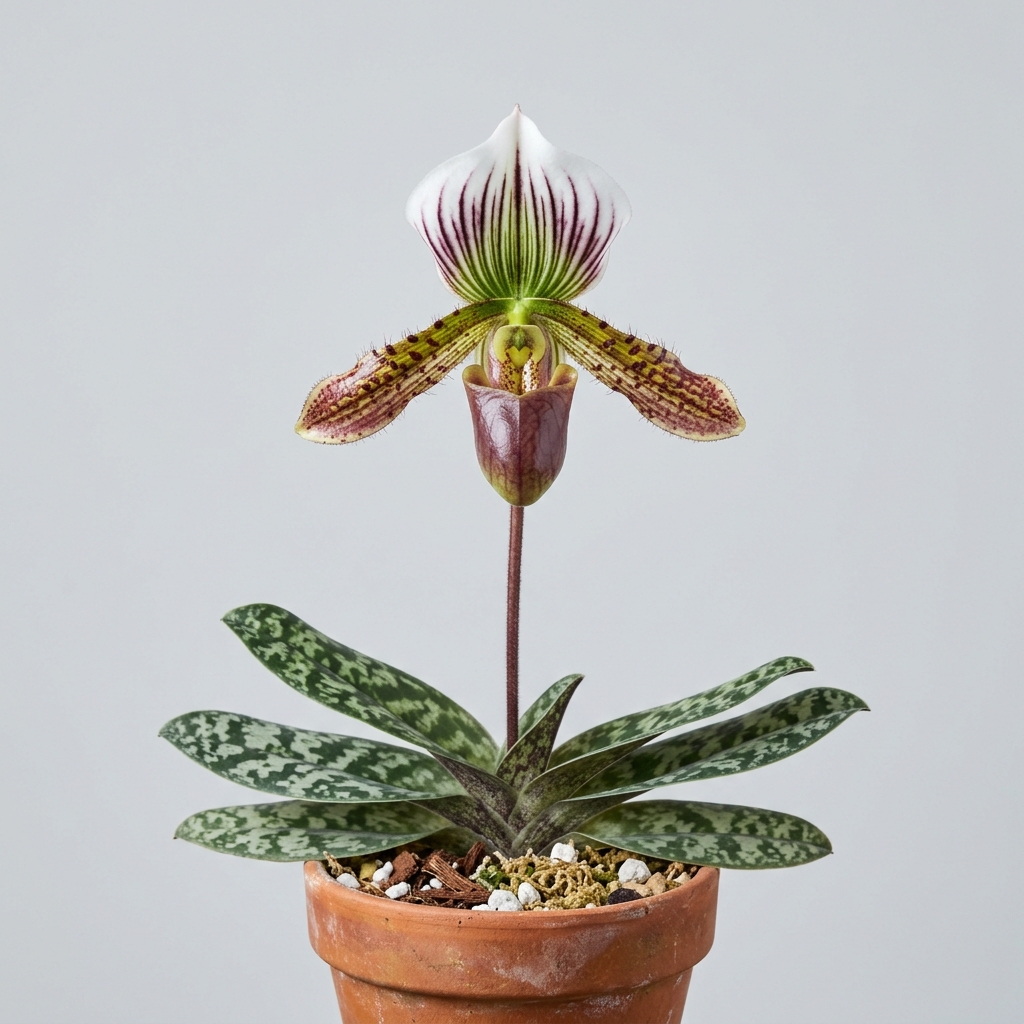
Paphiopedilum Rungsuriyanum is a highly coveted miniature slipper orchid that has captivated collectors since its relatively recent discovery in Southeast Asia. Renowned for its remarkably compact growth habit and beautifully tessellated foliage, this species proves that exceptional orchid presentation does not require vast growing space. Orchid enthusiasts particularly prize the striking contrast between its mottled, dark-green leaves and its proportionately large, intricately detailed flowers.
As a lithophytic or terrestrial species native to limestone habitats, this miniature Paphiopedilum demands specific cultural attention but rewards diligent growers with long-lasting blooms. Its unique botanical features and slow-growing nature make it a true crown jewel for indoor light carts, terrariums, or dedicated greenhouse benches. Understanding its natural environment is key to successfully cultivating this rare and exquisite slipper orchid.
💡 Did You Know?
Paphiopedilum Rungsuriyanum was only formally described by botanists in 2014, making it one of the most recently discovered species in the . Its discovery in the steep limestone cliffs of Northern Laos caused a sensation among orchid enthusiasts worldwide due to its incredibly tiny vegetative size paired with a disproportionately large, striking flower.
🌿 Botanical Overview
Paphiopedilum Rungsuriyanum is a miniature herbaceous perennial belonging to the subgenus Parvisepalum. It is characterized by its fan-shaped growth habit, with each growth consisting of several tightly clustered, fleshy leaves. The upper surface of the foliage displays a striking dark green and pale green marbled pattern, while the undersides often exhibit deep purple spotting, a common adaptation for absorbing filtered light in shaded forest understories.
In its native habitat of Northern Laos, this species typically grows in pockets of organic debris on steep limestone cliffs or mossy rock faces. This lithophytic lifestyle dictates its preference for excellent drainage combined with constant, gentle moisture. Because of its miniature stature, individual growths rarely exceed a few inches in span, making it an ideal candidate for space-conscious collectors.
🌸 Flower Characteristics
The flower of Paphiopedilum Rungsuriyanum is remarkably large relative to the overall size of the plant, often spanning nearly the width of the leaf fan itself. The dorsal sepal is typically broad and rounded, featuring a clean white or cream background adorned with bold, vertical purple-brown stripes. The petals extend horizontally or slightly downward, showcasing a rich purplish-brown coloration with fine hairs along the margins.
The most prominent feature is the pouch-like labellum, or slipper, which is deeply cupped and varies from yellow-green to a glossy purplish-brown. This complex structure is supported by a short, upright inflorescence that emerges from the center of the mature leaf fan. The single-flowered spike is covered in fine, dark hairs, adding to the tactile and visual complexity of the bloom.
Fragrance & Bloom Profile
Unlike some of its relatives in the orchid family, Paphiopedilum Rungsuriyanum is not widely recognized for having a strong or distinct scent. Most growers report that the flowers are completely fragrance-free, focusing their evolutionary energy instead on visual mimicry to attract specific insect pollinators.
What the blooms lack in scent, they more than make up for in longevity. A single flower can remain pristine on the plant for six to eight weeks, or even longer under optimal, cool-to-intermediate conditions. The slow development of the bud and the later long-lasting bloom cycle provide growers with months of visual interest.
Parentage & Hybrid Lineage
Paphiopedilum Rungsuriyanum is a distinct, naturally occurring species rather than an artificial hybrid or cultivar. It was formally described in the early 21st century, making it a relatively new addition to the horticultural world. Because of its unique miniature size and striking floral patterns, hybridizers have begun utilizing it in breeding programs to introduce compact growth habits and bold striping to new Paphiopedilum grexes.
When purchasing this orchid, growers should ensure they are acquiring plants from reputable nurseries that practice ethical, laboratory-propagated seed raising. Due to its rarity and protected status under international conservation agreements, wild-collected specimens are strictly prohibited, and maintaining clean, nursery-grown lineages is vital for the preservation of the species.
🌱 Growing Conditions
To cultivate Paphiopedilum Rungsuriyanum successfully, one must replicate the dappled light of its native forest canopies. It thrives in low to medium light conditions, typical of those provided for African violets or other mottled-leaf slipper orchids. Direct sunlight must be avoided, as it can quickly scorch the delicate foliage and bleach the vibrant marbling.
💡 Care Tip
Always water this orchid from the bottom or carefully around the base of the leaves. Avoid getting water trapped in the central crown of the leaf fan, as stagnant moisture in this tight area is a primary cause of bacterial crown rot, which can quickly destroy a miniature plant.
Temperature: wise, this species prefers intermediate to warm conditions. Daytime temperatures ranging from 70 to 80 degrees Fahrenheit (21 to 27 degrees Celsius) are ideal, with a slight drop of 10 degrees at night to encourage healthy growth and eventual budding. High relative humidity, ideally between 60% and 80%, combined with gentle, continuous air movement, is essential to prevent stagnant air and fungal pathogens.
Watering, Feeding & Potting Media
Watering is perhaps the most critical aspect of Paphiopedilum Rungsuriyanum care. The potting medium should remain consistently damp but never waterlogged. Because they lack pseudobulbs to store water, these orchids cannot tolerate prolonged dry spells. Water thoroughly with pure water, such as rainwater, distilled water, or reverse osmosis water, as they are sensitive to dissolved mineral salts.
A well-draining, fine-grade potting mix is essential. A combination of fine fir bark, perlite, chopped sphagnum moss, and a small amount of calcium-rich additives like oyster shells or limestone chips mimics their natural lithophytic environment. Feed the plant with a highly diluted, balanced orchid fertilizer every two to three weeks during the active growing season, flushing the pot with pure water between applications to prevent salt buildup.
Blooming Season & Care Notes
The primary blooming season for Paphiopedilum Rungsuriyanum typically occurs in the spring or early summer, following a slight winter rest period where watering is marginally reduced and temperatures are kept on the cooler side of their range. The emergence of a new leaf fan signals the start of the growth cycle, which eventually culminates in a terminal flower spike from the center of the mature fan.
Once the flower fades, the spike should be cut back close to the base of the fan. Slipper orchids only bloom once per growth, so future flowers will arise from new vegetative leads that develop at the base of the old fan. Repotting is best performed every one to two years in the spring, just as new root growth begins, ensuring the delicate, hairy roots are handled with extreme care.
⚠️ Common Issues
⚠️ Common Mistake
A frequent error is potting this miniature orchid in coarse, large-grade bark. Because of its small root system and lack of water-storing pseudobulbs, it will dry out too quickly in coarse media. Use a fine-grade mix that retains uniform moisture while still allowing excellent airflow to the roots.
- Root Rot:
Caused by overwatering, poor drainage, or decomposing potting media that suffocates the roots. - Bacterial Soft Rot: Rapidly spreading wet rot on leaves, often triggered by water sitting in the crown of the plant overnight.
- Bud Blast:
Premature drying and dropping of flower buds, usually due to sudden drops in humidity, drafts, or water stress. - Pests:
Mealybugs and scale insects that hide in the tight crevices of the leaf fans and under the flower bracts. - Leaf Scorch: Bleached or brown patches on the foliage caused by exposure to excessive or direct sunlight.
❓ Frequently Asked Questions
How often should I water my Paphiopedilum Rungsuriyanum?
Watering frequency depends on your home environment, but generally, this orchid should be watered every 5 to 7 days. The goal is to keep the potting medium evenly moist, like a wrung-out sponge, without letting it dry out completely or sit in standing water.
Does this miniature orchid require a winter rest to bloom?
While it does not require a severe dry rest, Paphiopedilum Rungsuriyanum benefits from a subtle winter cooling. Reducing night temperatures slightly and spacing out watering during the shorter days of winter helps stimulate the development of flower buds for the spring.
What is the best potting mix for Paphiopedilum Rungsuriyanum?
A fine-grade mix consisting of small fir bark, tree fern fiber, perlite, and a small amount of chopped sphagnum moss works best. Adding a pinch of horticultural limestone or crushed oyster shells helps maintain the slightly alkaline to neutral pH that this limestone-loving species prefers.
Can I grow Paphiopedilum Rungsuriyanum under artificial LED lights?
Yes, this miniature species is exceptionally well-suited for artificial light cultivation. Place the plant under low-to-moderate intensity LED grow lights for 12 to 14 hours a day, ensuring the leaves remain cool to the touch and do not show signs of yellowing or bleaching.
⭐ Final Growing Notes
Paphiopedilum Rungsuriyanum represents the pinnacle of miniature orchid elegance. While its specific moisture and humidity requirements demand an attentive hand, its compact footprint and spectacular, long-lasting blooms make it an incredibly rewarding species to master. By providing consistent intermediate temperatures, pure water, and a free-draining, calcium-enriched medium, you can enjoy the exquisite beauty of this rare Southeast Asian treasure for many years to come.
⚕️ Health, Safety & Edibility
Understanding how a plant interacts with people, pets, and the surrounding environment is part of responsible cultivation. This section uses conservative, general guidance and does not replace professional medical or veterinary advice.
Human Safety: No published evidence currently identifies species-specific toxicity concerns for Paphiopedilum Rungsuriyanum during normal handling. As with most ornamental plants, it should not be intentionally consumed.
Pet Safety: Published information does not indicate that this orchid commonly poses a toxicity concern for cats or dogs. However, chewing leaves, flowers, roots, or potting media may still cause mild digestive upset.
Edibility: This orchid is cultivated for ornamental display rather than food. Ornamental plants may carry fertilizers, pesticides, or other horticultural treatments that make them unsuitable for consumption.
Skin Contact: Routine handling is not generally associated with skin irritation. Gardeners with sensitive skin may prefer wearing gloves when repotting, pruning, or handling potting media.
🌱 Propagation Tip
Unlike sympodial orchids with prominent pseudobulbs, Paphiopedilum Rungsuriyanum cannot be propagated by backbulbs. Propagation is achieved by carefully dividing mature, multi-growth clumps during repotting, ensuring each division has at least two or three healthy leaf fans and an established root system to survive.
⭐ Expert Advice
To mimic its natural limestone cliff habitat, top-dress the potting medium with a small pinch of crushed oyster shells or agricultural limestone once a year. This slowly buffers the potting mix, preventing it from becoming too acidic as the bark decomposes, which keeps the delicate roots healthy.




Leave A Comment