
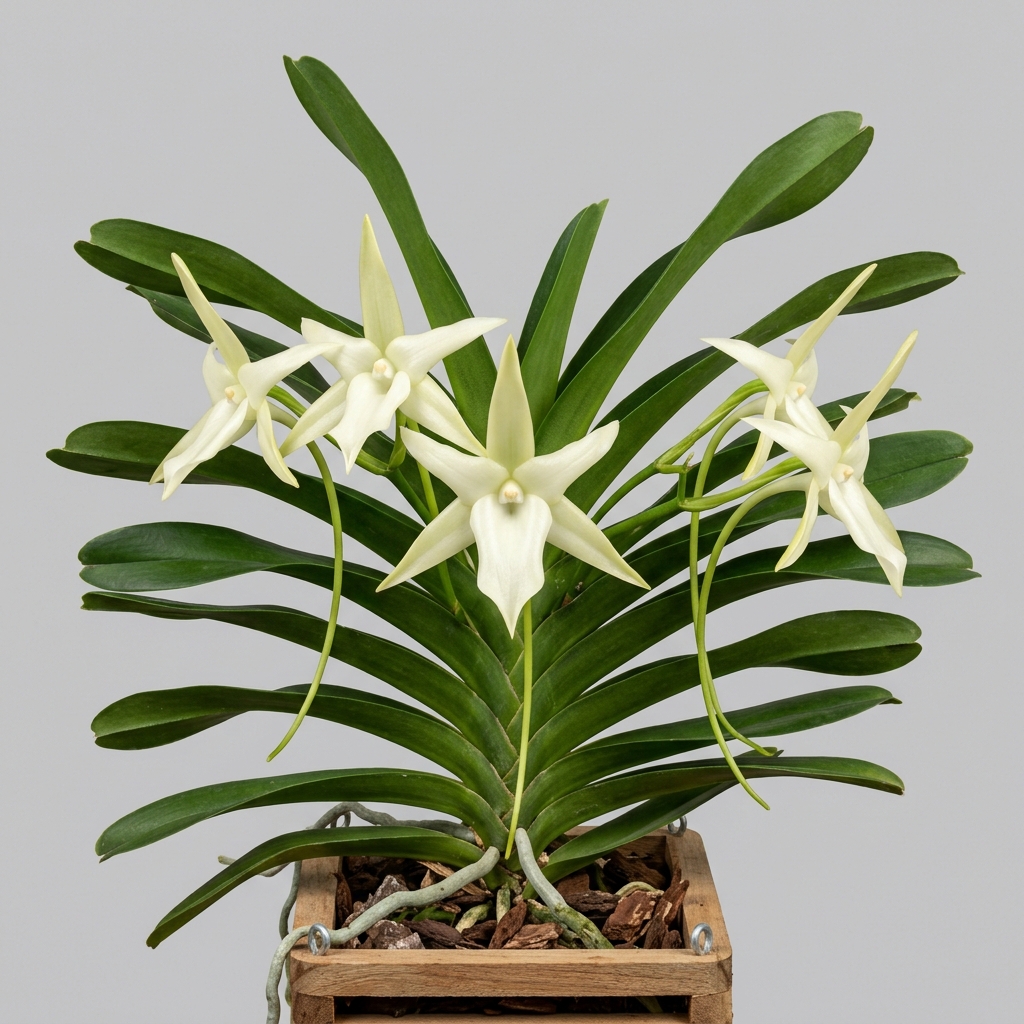
Angraecum sesquipedale, famously known as Darwin’s orchid or the Christmas orchid, is a magnificent monopodial epiphytic orchid native to the tropical coastal forests of Madagascar. Highly prized by advanced collectors and orchid enthusiasts alike, this species is celebrated for its large, star-shaped, waxy ivory-white flowers and its legendary place in the history of evolutionary biology. Its robust growth habit and dramatic presentation make it a commanding centerpiece in any serious orchid collection.
Growers value this species not only for its historical significance but also for its striking architectural form. The plant features thick, leathery, strap-like leaves arranged in a neat, fan-shaped monopodial habit, resembling a large Vanda. When in bloom, the contrast between the dark green foliage and the luminous, long-spurred blossoms creates an unforgettable visual display that is accompanied by a powerful, sweet nocturnal fragrance.
💡 Did You Know?
Charles Darwin famously predicted the existence of a moth with a foot-long proboscis capable of pollinating this orchid after examining its long nectar spur in 1862. His prediction was vindicated decades later when the giant sphinx moth, Xanthopan morganii praedicta, was discovered in Madagascar, proving his theory of coevolution.
🌿 Botanical Overview
Angraecum sesquipedale is native to the lowlands of Madagascar, where it grows as an epiphyte on the trunks and branches of trees close to the coast. In its natural habitat, it is exposed to warm temperatures, high humidity, and frequent rainfall throughout the year, followed by a slightly drier, cooler winter period. This environment shapes its robust, moisture-loving botanical characteristics.
The plant grows monopodially, meaning it grows upward from a single stem rather than producing pseudobulbs. It develops a thick, woody stem over time, supported by a massive system of fleshy, silver-gray aerial roots. These roots are highly efficient at absorbing moisture and nutrients from the humid air and rain. The leaves are leathery, oblong, and arranged in two opposing rows, forming a beautiful, symmetrical fan.
🌸 Flower Characteristics
The flowers of Angraecum sesquipedale are truly spectacular, measuring up to six to eight inches across. They are star-shaped, with thick, waxy petals and sepals that open with a light greenish hue before maturing into a striking ivory-white or pale cream color. The lip, or labellum, is broad and tapers to a point, adding to the star-like appearance of the bloom.
The most defining feature of the flower is its extraordinary green nectar spur, which projects backward from the base of the lip. This spur can reach an astonishing length of twelve to fourteen inches (30 to 35 cm). The flowers are produced on short, sturdy spikes that emerge from the leaf axils, typically carrying one to four blooms per spike, positioned to face outward for maximum visibility.
Fragrance & Bloom Profile
This species is famous for its intense nocturnal fragrance. During the daylight hours, the flowers are virtually odorless, conserving energy. As dusk approaches, they begin to emit a powerful, sweet, and slightly spicy scent reminiscent of jasmine, gardenia, and vanilla. This scent is designed to attract its specific night-flying pollinator in the wild.
The blooms are exceptionally long-lasting due to their heavy, waxy substance. Individual flowers can remain in pristine condition for six to eight weeks, provided they are kept in a stable environment free from excessive heat or physical disturbance. The blooming cycle typically occurs once a year, concentrated during the winter months.
Parentage & Hybrid Lineage
Angraecum sesquipedale is a naturally occurring species rather than a man-made hybrid. In the horticultural trade, select cultivars have been developed through line breeding to enhance desirable traits such as flatter flower form, larger bloom size, and more compact plant habits. These select cultivars are highly sought after by collectors.
While it is a species, it has been used as a parent in several notable primary hybrids within the Angraecoid group. The most famous of these is Angraecum Veitchii, a cross between Angraecum sesquipedale and Angraecum eburneum. These hybrids often inherit the impressive flower size and fragrance of sesquipedale while exhibiting increased vigor and ease of culture.
🌱 Growing Conditions
To grow Angraecum sesquipedale successfully, you must replicate its warm, humid coastal habitat. It thrives in bright, indirect light, similar to the levels required by Cattleyas. While it can tolerate some morning sun, direct midday sunlight will quickly scorch the thick, leathery leaves. High-quality LED grow lights are an excellent option for indoor growers.
💡 Care Tip
Provide this orchid with excellent air circulation at all times. High combined with stagnant air is a recipe for bacterial leaf spot and crown rot, especially in the tight leaf axils of its monopodial growth.
Temperature management is crucial. This orchid prefers warm daytime temperatures between 75°F and 85°F (24°C to 29°C), with a moderate drop at night to around 60°F to 65°F (15°C to 18°C). It requires high relative humidity, ideally maintained between 60% and 80%. Excellent, continuous air movement is mandatory to prevent fungal infections in these humid conditions.
Watering, Feeding & Potting Media
During the active spring and summer growing season, Angraecum sesquipedale requires copious watering. The potting medium should be allowed to approach dryness but never dry out completely. In the winter, watering should be reduced, allowing the plant to experience a drier resting phase, though the aerial roots should still be misted occasionally to prevent shriveling.
Because the roots are thick and require abundant oxygen, the potting medium must be extremely coarse and free-draining. A mix of large-grade fir bark, charcoal, and coarse perlite works well. Many growers prefer to cultivate this species in open wooden baskets or clay pots with extra drainage holes. Feed weekly with a highly diluted, balanced orchid fertilizer during the active growing season.
Blooming Season & Care Notes
The primary blooming season is winter, often coinciding with the holiday season, earning it the common name Christmas orchid. Flower spikes begin to emerge from the leaf axils in late autumn. During spike development, maintain stable environmental conditions, as sudden changes in temperature or humidity can lead to bud loss.
Once the blooming cycle is complete, allow the flower spikes to dry naturally before cutting them back. Repotting should be done with extreme caution and only when the potting medium has completely broken down. This species resents root disturbance and can take a year or more to recover and resume blooming after being repotted.
⚠️ Common Issues
⚠️ Common Mistake
The most common mistake is repotting too frequently or using fine . This orchid has thick, fleshy roots that require rapid drainage and abundant oxygen. Disturbed roots can cause the plant to stop growing and skip blooming cycles for several seasons.
- Root Rot:
Occurs when the potting medium degrades, becomes compacted, and retains too much moisture around the sensitive roots. - Leaf Spotting: Fungal or bacterial spots can develop on the foliage if water is allowed to sit in the leaf axils or if air circulation is inadequate.
- Bud Blast:
The yellowing and dropping of undeveloped buds, usually triggered by sudden drafts, low humidity, or underwatering. - Scale and Mealybugs: Pests that tend to hide in the tight crevices of the fan-shaped leaf bases and under the flower bracts.
❓ Frequently Asked Questions
How long does it take for Angraecum sesquipedale to bloom from a seedling?
This species is notoriously slow-growing. From a seedling in a flask, it typically takes seven to ten years of careful cultivation to reach blooming size. Purchasing a mature, near-blooming-size plant is highly recommended for impatient growers.
Why are the lower leaves of my orchid turning yellow and dropping?
While the occasional loss of the oldest bottom leaf is a natural part of the aging process, multiple yellowing leaves usually indicate root distress, severe underwatering, or a lack of adequate humidity.
Can I grow this orchid mounted on wood or cork?
Yes, Angraecum sesquipedale can be grown successfully on large mounts or in open wooden baskets. However, because it lacks pseudobulbs to store water, mounted plants require daily watering and exceptionally high humidity to thrive.
Does Angraecum sesquipedale require a winter rest to bloom?
It does not require a severe dry rest, but it benefits from a slight reduction in watering and a modest drop in nighttime temperatures during the autumn. This environmental cue helps stimulate the initiation of winter flower spikes.
⭐ Final Growing Notes
Angraecum sesquipedale is a true crown jewel of the orchid world, offering a unique blend of botanical history, architectural beauty, and mesmerizing nocturnal fragrance. While its slow growth rate and sensitivity to root disturbance require a patient and attentive hand, the reward of witnessing its magnificent, star-shaped ivory blooms and experiencing their sweet evening perfume makes it one of the most satisfying orchids any grower can cultivate.
🌱 Propagation Tip
Propagation of this species is challenging for home growers. It rarely produces keikis or basal offsets unless the main growing tip is damaged. Division is generally not possible, so propagation is primarily achieved through professional flasking and seed sowing.
⭐ Expert Advice
To initiate robust winter blooming, ensure the orchid experiences a slight drop in nighttime temperatures during the autumn months, along with a modest reduction in . This seasonal cue mimics its natural Malagasy habitat and encourages strong spike development.




Leave A Comment