
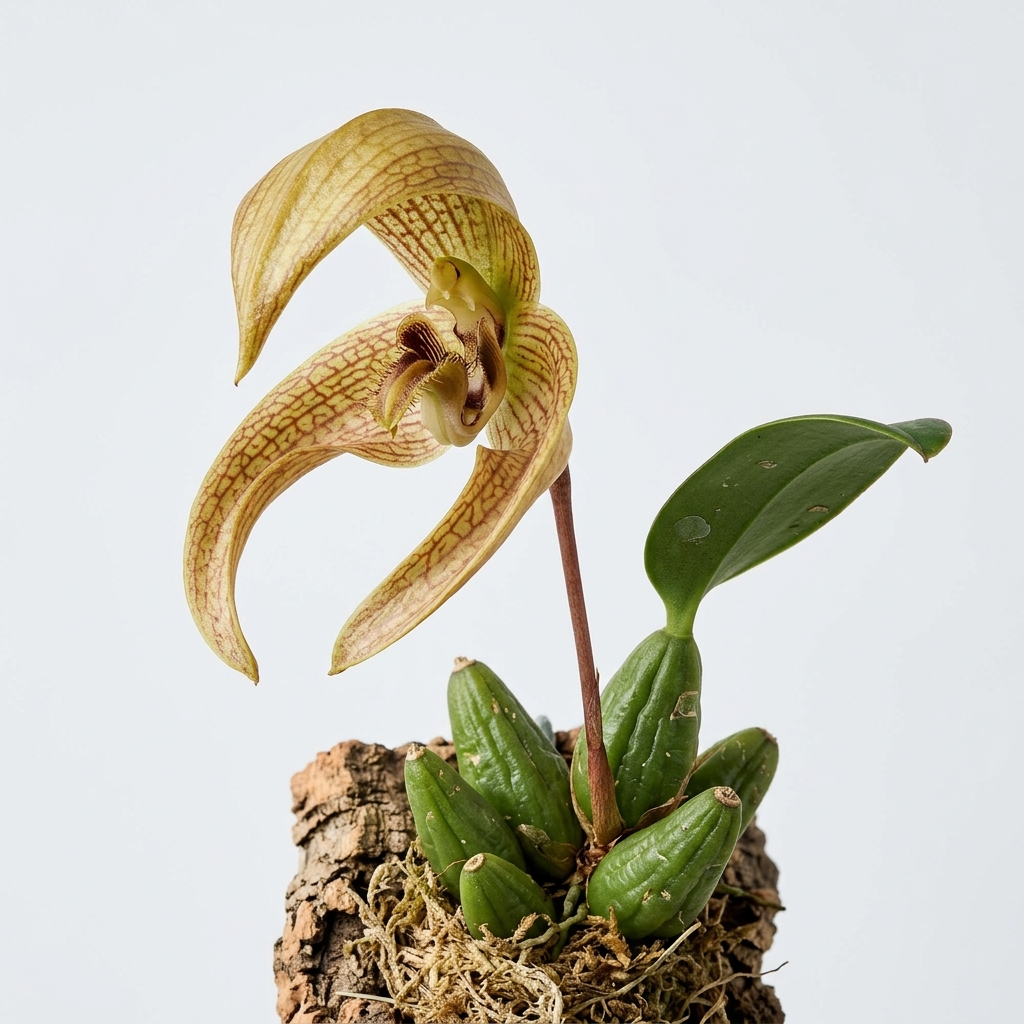
Bulbophyllum Grandiflorum, commonly known as the large-flowered Bulbophyllum, is a fascinating epiphytic orchid species native to the tropical rainforests of New Guinea and surrounding islands. Highly prized by orchid collectors for its bizarre, alien-like floral morphology, this species represents one of the more dramatic examples of the genus Bulbophyllum. Its creeping growth habit, characterized by distinct pseudobulbs spaced along a rhizome, allows it to quickly scramble across mounting plaques or shallow baskets in cultivation.
Growers are drawn to Bulbophyllum Grandiflorum primarily for its solitary, hooded flowers that feature elongated sepals curving forward to resemble a claw or a helmet. While its cultivation requires specific attention to high humidity and consistent moisture, the reward of its striking, translucent-veined blooms makes it a centerpiece in any tropical orchid collection. Understanding its natural habitat is key to successfully managing this unique orchid in a home or greenhouse environment.
💡 Did You Know?
The hinged lip of Bulbophyllum Grandiflorum is an evolutionary marvel designed for pollination. When a small insect lands on the lip, its weight causes the structure to tip backward, gently trapping the insect against the column. This mechanism ensures the transfer of pollen before the insect is released, showcasing the intricate relationship between this orchid and its natural pollinators.
🌿 Botanical Overview
Bulbophyllum Grandiflorum is a sympodial epiphyte that naturally grows on moss-covered tree trunks and branches in warm, humid lowland forests. It features egg-shaped, four-angled pseudobulbs that are spaced roughly two to four inches apart along a creeping rhizome. Each pseudobulb produces a single, leathery, dark green leaf that can reach up to eight inches in length, providing a robust green backdrop for the unusual flowers.
In the wild, this species relies on its creeping habit to colonize large areas of tree bark, absorbing moisture and nutrients from the surrounding humid air and organic debris. In cultivation, this growth habit dictates how the plant must be housed, as standard deep pots quickly restrict its horizontal expansion.
🌸 Flower Characteristics
The flowers of Bulbophyllum Grandiflorum are truly remarkable, often measuring up to four to six inches in length. The most prominent feature is the large, hooded dorsal sepal that arches over the rest of the flower parts, decorated with intricate, translucent windows or tessellated patterns of pale green, yellow, and reddish-brown. The lateral sepals are elongated and twist downward, creating a pendulous, claw-like silhouette.
The lip, or labellum, is relatively small and hinged, a classic trait of the genus Bulbophyllum. This hinged lip moves freely with the slightest breeze or movement, an evolutionary adaptation designed to assist insect pollinators by physically tipping them into the column of the flower.
Fragrance & Bloom Profile
Unlike some members of the genus Bulbophyllum that emit strong, unpleasant odors to attract carrion flies, Bulbophyllum Grandiflorum is generally reported to have a relatively mild fragrance. Growers often describe the scent as faintly musty, earthy, or slightly sweet, though some individual clones may produce virtually no detectable odor.
The single-flowered inflorescence emerges from the base of the mature pseudobulb, rising on a slender, upright peduncle. While the individual blooms are short-lived compared to some other orchid genera—typically lasting between one and two weeks—their dramatic visual impact more than compensates for their brief duration.
Parentage & Hybrid Lineage
Bulbophyllum Grandiflorum is a naturally occurring species rather than a man-made hybrid. In orchid taxonomy, it belongs to the section Sestochilos, a group known for producing large, solitary flowers with prominent dorsal sepals.
While it is primarily grown as a species by collectors, it has occasionally been used in hybridizing programs to introduce large flower size, hooded shapes, and intricate tessellation to new Bulbophyllum grexes. However, documented registered hybrids remain relatively uncommon in mainstream commercial cultivation, and most plants available on the market are species propagated from seed or division.
🌱 Growing Conditions
To successfully cultivate Bulbophyllum Grandiflorum, growers must replicate its warm, humid forest canopy habitat. It thrives in low to medium indirect light, similar to the light levels preferred by Phalaenopsis orchids. Direct sunlight should be strictly avoided, as it will quickly scorch the thin leaves and dehydrate the pseudobulbs.
💡 Care Tip
To maintain the high this orchid craves without rotting the roots, consider mounting it on a cork plaque with a generous pad of sphagnum moss. This allows the roots to dry slightly between daily mistings while keeping the surrounding air highly humid.
Temperatures should remain warm year-round, ideally ranging from 75°F to 85°F during the day, with a slight drop to 65°F to 70°F at night. High humidity is critical; levels should ideally be maintained between 70% and 90%. Excellent air movement is essential at these high humidity levels to prevent fungal pathogens from establishing on the foliage.
Watering, Feeding & Potting Media
This species does not possess large water-storing pseudobulbs compared to some other orchid genera, meaning it has a very low tolerance for drying out. The potting medium should be kept consistently moist but never waterlogged. High-quality New Zealand sphagnum moss or a mix of fine tree fern fiber and bark works exceptionally well to retain the necessary moisture.
Because of its creeping rhizome, Bulbophyllum Grandiflorum is an ideal candidate for mounting on cork bark or tree fern plaques, provided the grower can maintain high humidity. If potted, shallow, wide containers or net baskets are highly recommended. Fertilize weakly weekly with a balanced, diluted orchid fertilizer during the active growing season, flushing the medium regularly with pure water to prevent salt buildup.
Blooming Season & Care Notes
Blooming typically occurs in the late summer, autumn, or early winter, though healthy plants can occasionally surprise growers with blooms at other times of the year. The emergence of new growth is usually followed by the development of flower spikes from the base of the newly matured pseudobulbs.
During the blooming cycle, avoid moving the plant or changing its environmental conditions, as sudden drops in humidity can cause the developing buds to blast. Once flowering is complete, continue with regular watering and warmth, as this species does not require a pronounced winter rest period, though watering can be slightly reduced during the darkest winter months.
⚠️ Common Issues
⚠️ Common Mistake
A frequent mistake is allowing the potting medium to dry out completely between waterings. Unlike Cattleyas, this species lacks large water-storing structures and will quickly suffer leaf drop and pseudobulb shriveling if left dry for even a short period.
- Pseudobulb Shriveling: Often a sign of underwatering or low humidity, indicating the plant is drawing on its water reserves.
- Leaf Spotting: Fungal or bacterial spots can develop if air circulation is inadequate in high-humidity environments.
- Root Rot: Occurs when the potting medium degrades, becomes compacted, and deprives the roots of oxygen.
- Bud Blast: The sudden drying or dropping of flower buds, usually triggered by a sudden drop in humidity or drafty conditions.
- Pests: Mealybugs and spider mites can occasionally hide under the leaves or around the base of the pseudobulbs.
❓ Frequently Asked Questions
Can Bulbophyllum Grandiflorum be grown indoors without a greenhouse?
Yes, it can be grown indoors, but it requires dedicated effort to maintain the necessary 70% to 90% humidity. Utilizing a humidifying tray, a room humidifier, or growing the plant inside a glass terrarium or Wardian case are excellent ways to achieve success in a home environment.
Why are the pseudobulbs on my orchid shriveling?
Shriveled pseudobulbs typically indicate dehydration. This can be caused by underwatering, low ambient humidity, or a damaged root system that can no longer absorb water. Check the roots; if they are healthy, increase your watering frequency and humidity levels.
How often should I repot or remount this orchid?
Bulbophyllum Grandiflorum dislikes root disturbance and should only be repotted or remounted when the potting medium begins to break down, usually every two to three years. The best time to repot is in the spring when new root growth is just beginning to emerge from the base of the newest pseudobulb.
Does Bulbophyllum Grandiflorum require a winter rest period?
No, this species does not require a dry winter rest. Because it originates from equatorial rainforests, it prefers consistent warmth, moisture, and humidity year-round. You may slightly reduce watering during the darkest winter months when growth slows, but never allow the medium to dry out completely.
⭐ Final Growing Notes
Bulbophyllum Grandiflorum is a rewarding and visually spectacular orchid that brings a touch of prehistoric wonder to any collection. While its high humidity and moisture requirements demand a disciplined care routine, its bizarre, hooded flowers and fascinating creeping habit make it an unforgettable species to cultivate. By providing consistent warmth, filtered light, and constant moisture, growers can enjoy the dramatic display of this exceptional tropical treasure for years to come.
⚕️ Health, Safety & Edibility
Understanding how a plant interacts with people, pets, and the surrounding environment is part of responsible cultivation. This section uses conservative, general guidance and does not replace professional medical or veterinary advice.
Human Safety: No published evidence currently identifies species-specific toxicity concerns for Bulbophyllum Grandiflorum during normal handling. As with most ornamental plants, it should not be intentionally consumed.
Pet Safety: Published information does not indicate that this orchid commonly poses a toxicity concern for cats or dogs. However, chewing leaves, flowers, roots, or potting media may still cause mild digestive upset.
Edibility: This orchid is cultivated for ornamental display rather than food. Ornamental plants may carry fertilizers, pesticides, or other horticultural treatments that make them unsuitable for consumption.
Skin Contact: Routine handling is not generally associated with skin irritation. Gardeners with sensitive skin may prefer wearing gloves when repotting, pruning, or handling potting media.
🌱 Propagation Tip
Propagate this species by division during the spring repotting cycle. Ensure each division has at least three to four healthy pseudobulbs and an active lead growth. Use a sharp, sterilized blade to cut the rhizome, and keep the new divisions in slightly higher until new roots establish.
⭐ Expert Advice
If you struggle to keep this orchid wet enough in a home environment, try growing it in a shallow plastic saucer filled with sphagnum moss rather than a traditional pot. This mimics the shallow, horizontal spreading of its natural creeping habit while retaining consistent moisture.

Leave A Comment