
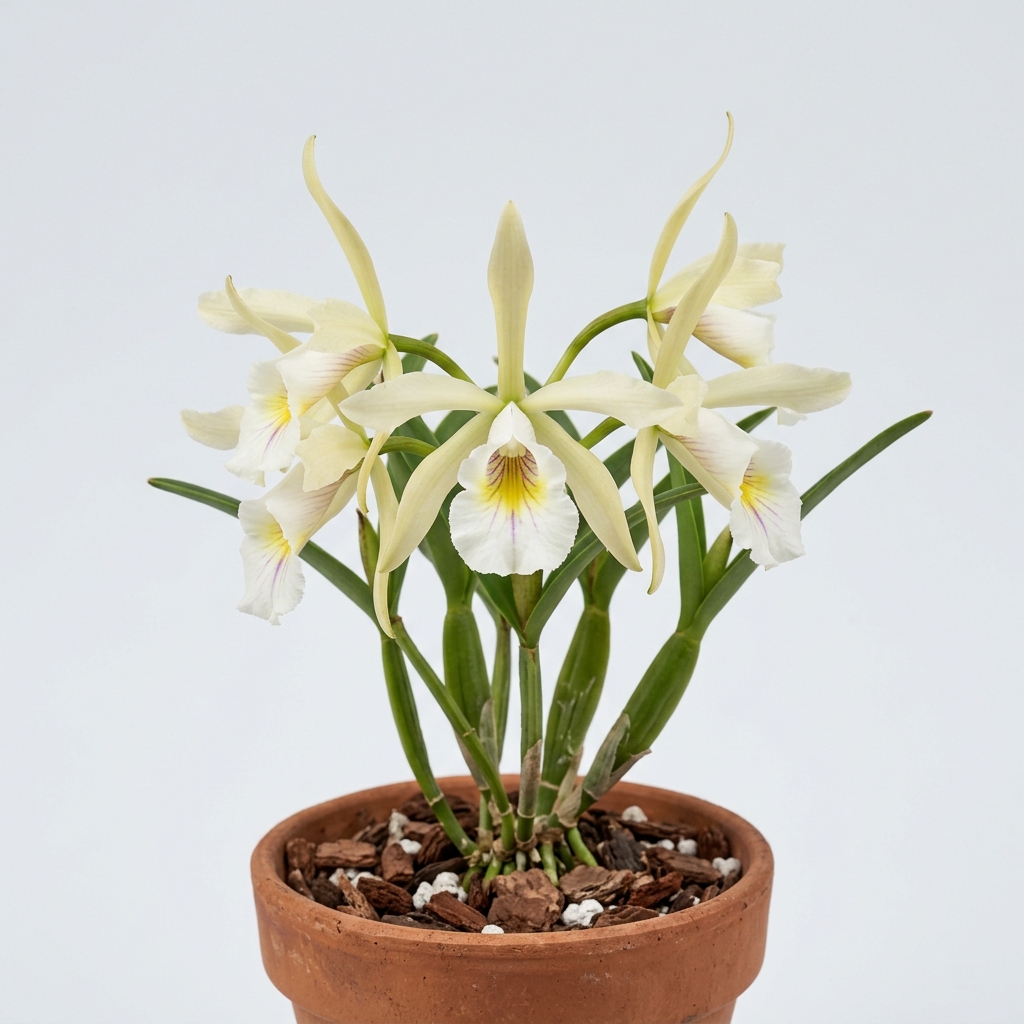
Cattleya Iricolor is a highly prized and historically significant orchid, celebrated among collectors for its elegant, slender form and exceptionally distinct floral presentation. Originating from the humid montane forests of South America, this unifoliate Cattleya species stands out due to its narrow, pale petals and a beautifully marked, trumpet-shaped lip. Growers value it not only for its unique botanical aesthetic but also for its legendary fragrance, which can easily fill an entire greenhouse or growing space.
While it was once considered exceedingly rare in cultivation, modern micropropagation and dedicated breeding efforts have made Cattleya Iricolor more accessible to dedicated hobbyists. It possesses a growth habit characterized by slender, club-shaped pseudobulbs topped by a single, leathery leaf. This orchid rewards attentive care with delicate, creamy-white to pale-yellow blooms that exhibit a striking contrast of yellow and purple veins deep within the throat of the labellum.
💡 Did You Know?
Cattleya Iricolor was lost to cultivation for nearly a century after its initial discovery in the mid-1800s. It was considered a mythical species by orchid enthusiasts until it was rediscovered in the wild in the late 20th century, sparking a major revival of interest among modern collectors.
🌿 Botanical Overview
Cattleya Iricolor is a distinct epiphytic species native to the wet, tropical forests of Ecuador and Peru, where it typically grows on tree branches at moderate elevations. Structurally, the plant features slender, elongated pseudobulbs that can reach up to ten inches in height, each topped by a single, rigid, dark green leaf. This unifoliate growth habit is characteristic of many classic Cattleya species, though Iricolor displays a more delicate and graceful silhouette than its larger-flowered relatives.
The root system is robust but highly sensitive to stagnant moisture, requiring a constant supply of fresh air and rapid drainage. In its native habitat, the plant experiences high humidity year-round, accompanied by frequent rainfall and gentle breezes. Understanding these natural conditions is key to successfully maintaining the orchid in a domestic greenhouse or indoor growing setup.
🌸 Flower Characteristics
The blossoms of Cattleya Iricolor are a masterclass in delicate botanical architecture. Each inflorescence typically carries two to five flowers, which emerge from a green sheath at the apex of the pseudobulb. The sepals and petals are narrow, elegant, and range in color from a soft, translucent cream to a pale, greenish-yellow. They frame a highly prominent, trumpet-shaped lip that serves as the visual centerpiece of the bloom.
The interior of the labellum features intricate, radiating veins of rich purple or magenta, contrasted against a bright yellow throat. The lip margins are gently ruffled and pristine white, creating a striking three-dimensional contrast. Individually, the flowers measure approximately three to four inches across, presenting a starry, wild appearance rather than the round, heavy form seen in modern Cattleya hybrids.
Fragrance & Bloom Profile
The fragrance of Cattleya Iricolor is widely regarded as one of the most intense and complex in the entire orchid family. Often described as a sweet blend of honey, vanilla, and spring lilies, the scent is strongest during the morning hours when temperatures begin to rise. A single blooming plant can easily perfume a large room, making it a favorite for growers who appreciate olfactory appeal alongside visual beauty.
The blooms typically last between three to four weeks, depending on environmental conditions such as temperature and humidity. Cooler temperatures and shaded conditions during the blooming cycle can help prolong the life of the delicate flowers, while excessive heat or dry air may cause them to fade prematurely.
Parentage & Hybrid Lineage
Unlike many complex modern cultivars, Cattleya Iricolor is a distinct, naturally occurring species rather than an artificial hybrid. It was first described in the late nineteenth century, and for decades, it remained a legendary rarity in botanical collections. Because of its unique color pattern, narrow floral segments, and powerful fragrance, it has been used selectively by hybridizers to introduce scent and elegant form into new Cattleya grexes.
When researching its lineage, growers should note that historical records occasionally refer to it under various synonyms or minor regional variations. However, modern taxonomic databases consistently recognize it as a valid species within the genus Cattleya. Its genetic contribution to hybrids often manifests as an elongated lip and a highly pronounced, sweet fragrance in its offspring.
🌱 Growing Conditions
To cultivate Cattleya Iricolor successfully, growers must replicate its native intermediate-to-warm tropical environment. Bright, filtered light is essential for robust growth and consistent blooming. The orchid thrives under light levels of approximately 2,000 to 3,000 foot-candles, which translates to a bright east-facing window or a shaded south-facing window. Direct, unfiltered midday sun should be avoided, as it can easily scorch the narrow leaves.
💡 Care Tip
Ensure your growing area has active air circulation. Using a small, oscillating fan near your Cattleya Iricolor helps dry the foliage quickly after , preventing fungal leaf spots and mimicking the gentle breezes of its native montane habitat.
Temperature management is equally critical. Ideal daytime temperatures range from 75°F to 85°F, with a nighttime drop to 60°F or 65°F. This diurnal temperature fluctuation is vital for triggering the development of flower buds. High humidity levels of 60% to 80% should be maintained, supported by active air movement from a small fan to prevent fungal pathogens from settling on the foliage.
Watering, Feeding & Potting Media
Watering Cattleya Iricolor requires a balanced approach that respects its epiphytic nature. The plant should be watered thoroughly, allowing water to run freely through the pot, and then allowed to dry out substantially before the next application. During the active growing season in spring and summer, watering frequency should be increased, while in the cooler winter months, the plant requires a slight dry rest with reduced watering.
A highly porous, free-draining potting medium is non-negotiable. A mixture of medium-to-coarse fir bark, horticultural charcoal, and perlite works exceptionally well in clay or plastic pots with ample drainage holes. Alternatively, experienced growers often mount this species on cork bark or tree fern slabs, provided they can maintain the necessary high humidity and water the plant daily. Feed with a balanced, diluted orchid fertilizer at one-quarter strength every second or third watering during active growth.
Blooming Season & Care Notes
Cattleya Iricolor typically initiates its blooming cycle in the spring or early summer, shortly after the new pseudobulbs have fully matured. As the new growth completes, a green sheath will appear at the leaf base, from which the flower buds will slowly emerge over several weeks. During this critical period, avoid moving the plant or changing its orientation to the light source, as sudden environmental shifts can cause bud blast.
After the flowers fade, the spent spike should be carefully cut back near the base of the sheath using sterilized cutting tools. Repotting should only be performed when new root tips begin to emerge from the base of the newest pseudobulb, which usually occurs shortly after the blooming cycle concludes. This timing ensures the plant establishes itself quickly in its new medium with minimal transplant shock.
⚠️ Common Issues
⚠️ Common Mistake
A frequent mistake is repotting this orchid at the wrong time of year. Avoid repotting during the winter rest or when the plant is actively blooming. Instead, wait until you see fresh, green root tips emerging from the base of the newest pseudobulb.
- Root Rot: Caused by overwatering or compacted, decaying potting media that deprives roots of oxygen.
- Bud Blast: Premature dropping of flower buds due to sudden temperature drops, low humidity, or drafts.
- Leaf Scorch: Yellow or brown patches on the foliage resulting from exposure to direct, intense sunlight.
- Scale and Mealybugs: Common pests that hide in the dry sheaths of pseudobulbs and under leaves; treat promptly with insecticidal soap or horticultural oil.
- Fungal Leaf Spotting: Dark spots on leaves caused by high humidity combined with stagnant, stagnant air.
❓ Frequently Asked Questions
How often should I water my Cattleya Iricolor?
Watering frequency depends heavily on your growing environment and potting media. Generally, water thoroughly once or twice a week during the active spring and summer growing season, allowing the medium to dry out almost completely between waterings. Reduce watering significantly during the winter rest period.
Why is my Cattleya Iricolor not blooming?
The most common reason for a lack of blooms is insufficient light. If the leaves are a dark, dull green, the plant likely needs brighter, filtered light. Additionally, ensure the orchid experiences a distinct 10 to 15 degree temperature drop between day and night to stimulate bud initiation.
Can I grow Cattleya Iricolor mounted on cork bark?
Yes, this species thrives when mounted on cork bark or tree fern slabs because it mimics its natural epiphytic growth habit. However, mounted plants dry out very quickly and typically require daily watering and high ambient humidity to prevent dehydration.
What is the best potting mix for this orchid?
A coarse, well-draining mix is essential. A combination of medium-grade fir bark, charcoal, and perlite provides the necessary aeration and drainage. Avoid heavy, soil-like mixes or dense sphagnum moss setups that retain moisture for too long around the roots.
⭐ Final Growing Notes
Cattleya Iricolor remains a captivating choice for intermediate orchid enthusiasts seeking a species with historical allure, striking structural elegance, and an unmatched fragrance profile. While it demands careful attention to watering cycles, high humidity, and bright, filtered light, its rewarding spring display of delicate, trumpet-lipped flowers makes it a standout addition to any collection. By respecting its natural epiphytic rhythm and providing excellent root aeration, growers can enjoy this South American treasure for many years.
⚕️ Health, Safety & Edibility
Understanding how a plant interacts with people, pets, and the surrounding environment is part of responsible cultivation. This section uses conservative, general guidance and does not replace professional medical or veterinary advice.
Human Safety: No published evidence currently identifies species-specific toxicity concerns for Cattleya Iricolor during normal handling. As with most ornamental plants, it should not be intentionally consumed.
Pet Safety: Published information does not indicate that this orchid commonly poses a toxicity concern for cats or dogs. However, chewing leaves, flowers, roots, or potting media may still cause mild digestive upset.
Edibility: This orchid is cultivated for ornamental display rather than food. Ornamental plants may carry fertilizers, pesticides, or other horticultural treatments that make them unsuitable for consumption.
Skin Contact: Routine handling is not generally associated with skin irritation. Gardeners with sensitive skin may prefer wearing gloves when repotting, pruning, or handling potting media.
🌱 Propagation Tip
Propagate Cattleya Iricolor by division only when the plant has outgrown its container and possesses at least six healthy pseudobulbs. Carefully divide the rhizome using a sterile blade, ensuring each new division has at least three mature pseudobulbs and active root growth.
⭐ Expert Advice
To maximize the intensity of the legendary , keep the orchid in a slightly warmer, humid environment during the morning hours when the blooms first open. This encourages the essential oils within the petals to volatilize, filling your space with its sweet scent.

Leave A Comment