

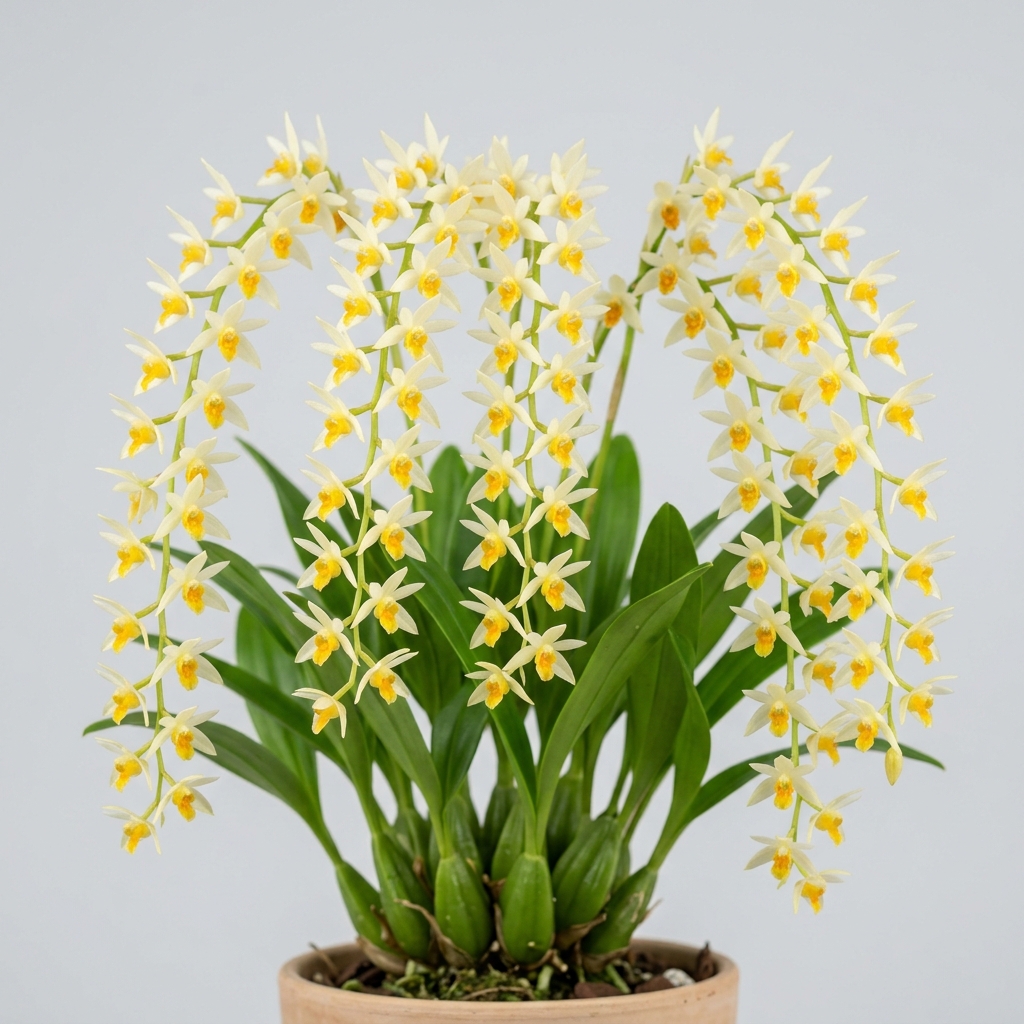
Cymbidium Parishii is a legendary orchid species highly revered by collectors and hybridizers for its elegant growth habit and striking floral display. Native to the montane forests of Myanmar, this epiphytic orchid features elongated pseudobulbs and arching, strap-like green foliage that provides year-round visual interest. It is particularly celebrated for its historical contribution to modern standard Cymbidium hybrids, lending its pristine coloration and excellent flower substance to generations of award-winning cultivars.
Growers value Cymbidium Parishii not only for its historical significance in orchid breeding but also for its rewarding, albeit specific, cultural requirements. When provided with the cool nights and bright, filtered light it enjoys in its native habitat, this orchid produces magnificent, long-lasting blooms that emit a delightful fragrance. While it requires more patience than some mass-market hybrids, the reward of its pristine white petals contrasted against a dramatically patterned lip makes it a crown jewel in any serious orchid collection.
💡 Did You Know?
Cymbidium Parishii is highly prized by orchid breeders because it possesses a dominant genetic trait for pristine white petals and sepals. This single species is responsible for introducing the clean white coloration and highly defined, colorful lip patterns seen in many of today's most popular standard commercial Cymbidium hybrids.
🌿 Botanical Overview
Cymbidium Parishii is a medium-sized orchid species characterized by its tufted growth habit and prominent, fleshy pseudobulbs. These pseudobulbs act as storage organs, conserving water and nutrients to help the plant survive seasonal fluctuations in its natural environment. From the base of these pseudobulbs arise several arching, linear-lanceolate leaves that are leathery, dark green, and can reach up to two feet in length.
In the wild, this species typically grows as an epiphyte on moss-covered tree branches or occasionally as a lithophyte on damp, shaded rocks. This natural environment exposes the root system to constant air movement and rapid drainage, characteristics that must be replicated in cultivation. Understanding its montane origin is key to successfully managing its growth cycle and encouraging annual flowering.
🌸 Flower Characteristics
The blossoms of Cymbidium Parishii are a masterclass in natural contrast. Each arching inflorescence can bear several medium-to-large flowers, typically measuring three to four inches in diameter. The sepals and petals are a clean, glistening white or pale cream, providing a neutral backdrop that accentuates the orchid's most famous feature: its lip.
The labellum, or lip, is heavily trilobed and adorned with striking, velvety markings of deep crimson, magenta, or purple. These intricate spots and bands run along the margins and center of the lip, serving as a visual guide for natural pollinators. The flowers possess a heavy, waxy substance, which contributes to their exceptional longevity, often remaining fresh on the spike for six to eight weeks.
Fragrance & Bloom Profile
One of the most alluring traits of Cymbidium Parishii is its intense, sweet fragrance. The scent is typically described as a rich, clean floral perfume with subtle citrus or warm undertones, which becomes most pronounced during the morning hours when temperatures begin to rise. This powerful aroma can easily fill an entire greenhouse or growing room.
The blooming cycle begins in late winter as the flower spikes emerge from the base of the mature pseudobulbs. The spikes slowly develop over several weeks before opening in early to mid-spring. Because the flowers open sequentially or nearly simultaneously along the spike, the plant presents a highly coordinated and visually impactful display that lasts for up to two months under optimal conditions.
Parentage & Hybrid Lineage
As a true species, Cymbidium Parishii does not have parentage in the sense of a hybrid, but its genetic legacy is monumental. It is widely recognized as one of the primary ancestors of modern white standard Cymbidium hybrids. Hybridizers in the twentieth century utilized this species extensively to introduce pure white tepals and highly defined, colorful lip patterns into commercial lines.
Some historical confusion exists in botanical literature regarding its relationship with Cymbidium sanderae, with some taxonomists grouping them together or treating parishii as a variety. In the horticultural trade, however, plants labeled as Cymbidium Parishii (or specific select cultivars derived from it, such as 'Emma Menninger') are highly sought after for their distinct, high-contrast floral markings and reliable growth habits.
🌱 Growing Conditions
To cultivate Cymbidium Parishii successfully, growers must mimic its native montane environment. It thrives in bright, filtered light, similar to the dappled sunlight found under a forest canopy. While it can tolerate some direct morning sun, harsh afternoon sunlight will scorch the foliage. Leaves should ideally be a light, grassy green; dark green leaves indicate insufficient light, while yellowing leaves suggest excess exposure.
💡 Care Tip
Ensure your orchid experiences a distinct drop of 10 to 15 degrees Fahrenheit at night during the autumn months. This natural chill is the primary environmental trigger that signals the plant to initiate its spring flower spikes.
Temperature management is critical for this species. It prefers cool to intermediate conditions, with daytime temperatures ranging between 70°F and 75°F (21°C to 24°C) and a significant drop at night to around 50°F to 55°F (10°C to 13°C). This nocturnal temperature drop, particularly in the autumn, is the primary environmental trigger required to initiate flower spike development.
Watering, Feeding & Potting Media
During the active spring and summer growing season, Cymbidium Parishii requires frequent watering to keep the potting medium evenly moist but never waterlogged. The pseudobulbs should remain plump; shriveling indicates underwatering or root loss due to overwatering. In the winter, watering should be reduced significantly, allowing the medium to dry out slightly between waterings while maintaining moderate ambient humidity.
Feeding should be consistent during the active growth phase. A balanced orchid fertilizer applied at quarter-strength every two weeks supports robust pseudobulb development. A potting medium consisting of medium-grade fir bark mixed with perlite, charcoal, and a small amount of sphagnum moss provides the ideal balance of moisture retention, aeration, and rapid drainage.
Blooming Season & Care Notes
The primary blooming season occurs in the spring. Once the flower spikes begin to emerge from the base of the pseudobulbs in late winter, it is crucial to keep the plant stable. Avoid moving the orchid to a location with drastically different light or temperature levels, as sudden environmental shifts can cause the developing buds to yellow and drop—a phenomenon known as bud blast.
After the flowers have faded, cut the spike down to the base using a sterile cutting tool. This is also the ideal window for repotting, which should be done every two to three years as the potting medium begins to break down. Repotting should only be performed when new root growth is visible at the base of the emerging pseudobulbs to ensure rapid establishment.
⚠️ Common Issues
⚠️ Common Mistake
Avoid using heavy, moisture-retaining potting soil or allowing the orchid to sit in standing water. Excess moisture suffocates the roots, rapidly leading to root rot, shriveled pseudobulbs, and the eventual decline of the entire plant.
- Root Rot:
Caused by overwatering or compacted potting media that prevents oxygen from reaching the roots. - Bud Blast:
The premature dropping of flower buds, often triggered by sudden temperature fluctuations, drafts, or low humidity. - Spider Mites:
Tiny pests that thrive in dry, warm conditions, leaving fine webbing on the undersides of the leaves. - Leaf Scorch: Bleached or brown patches on the foliage resulting from direct, intense afternoon sunlight.
- Pseudobulb Shriveling: A sign of dehydration, which can be caused by either underwatering or a loss of roots from overwatering.
❓ Frequently Asked Questions
How do I trigger blooming in Cymbidium Parishii?
To trigger blooming, ensure the orchid experiences a distinct drop in night temperatures during the autumn months, ideally down to 50°F to 55°F (10°C to 13°C), combined with bright, filtered light. This cooling period is essential for initiating the flower spikes that will open the following spring.
What is the best potting mix for this orchid?
The ideal potting mix is a well-draining, coarse medium such as medium-grade fir bark blended with perlite and horticultural charcoal. This combination ensures excellent aeration around the roots while retaining just enough moisture to keep the pseudobulbs plump.
Why are the leaves on my Cymbidium Parishii turning dark green?
Dark green leaves typically indicate that the orchid is not receiving enough light. For optimal growth and flowering, the foliage should be a healthy, light grassy green. Gradually move the plant to a brighter location with filtered sunlight.
Can Cymbidium Parishii be grown indoors?
Yes, it can be grown indoors if placed near a bright window, such as an east- or south-facing window with sheer curtains. However, providing the necessary cool night temperatures in autumn can be challenging indoors, so placing it outdoors in a shaded spot during summer and fall is highly recommended.
⭐ Final Growing Notes
Cymbidium Parishii remains an iconic species that rewards dedicated orchid enthusiasts with some of the most elegant and fragrant blooms in the genus. By respecting its preference for cool nights, bright filtered light, and a well-aerated root zone, growers can enjoy its spectacular spring display year after year. It stands as a testament to the timeless beauty of wild orchid species and continues to hold a revered place in both historical lineages and modern collections.
⚕️ Health, Safety & Edibility
Understanding how a plant interacts with people, pets, and the surrounding environment is part of responsible cultivation. This section uses conservative, general guidance and does not replace professional medical or veterinary advice.
Human Safety: No published evidence currently identifies species-specific toxicity concerns for Cymbidium Parishii during normal handling. As with most ornamental plants, it should not be intentionally consumed.
Pet Safety: Published information does not indicate that this orchid commonly poses a toxicity concern for cats or dogs. However, chewing leaves, flowers, roots, or potting media may still cause mild digestive upset.
Edibility: This orchid is cultivated for ornamental display rather than food. Ornamental plants may carry fertilizers, pesticides, or other horticultural treatments that make them unsuitable for consumption.
Skin Contact: Routine handling is not generally associated with skin irritation. Gardeners with sensitive skin may prefer wearing gloves when repotting, pruning, or handling potting media.
🌱 Propagation Tip
Propagate this orchid by division during the spring repotting cycle, only after the flowering period has ended. Ensure each division contains at least three healthy, mature pseudobulbs with active root systems to guarantee successful establishment.
⭐ Expert Advice
Keep a close eye on leaf color to gauge levels. If the leaves turn a deep, dark green, the orchid is not receiving enough to bloom. Aim for a , grassy-green hue to ensure successful flower development.

Leave A Comment