
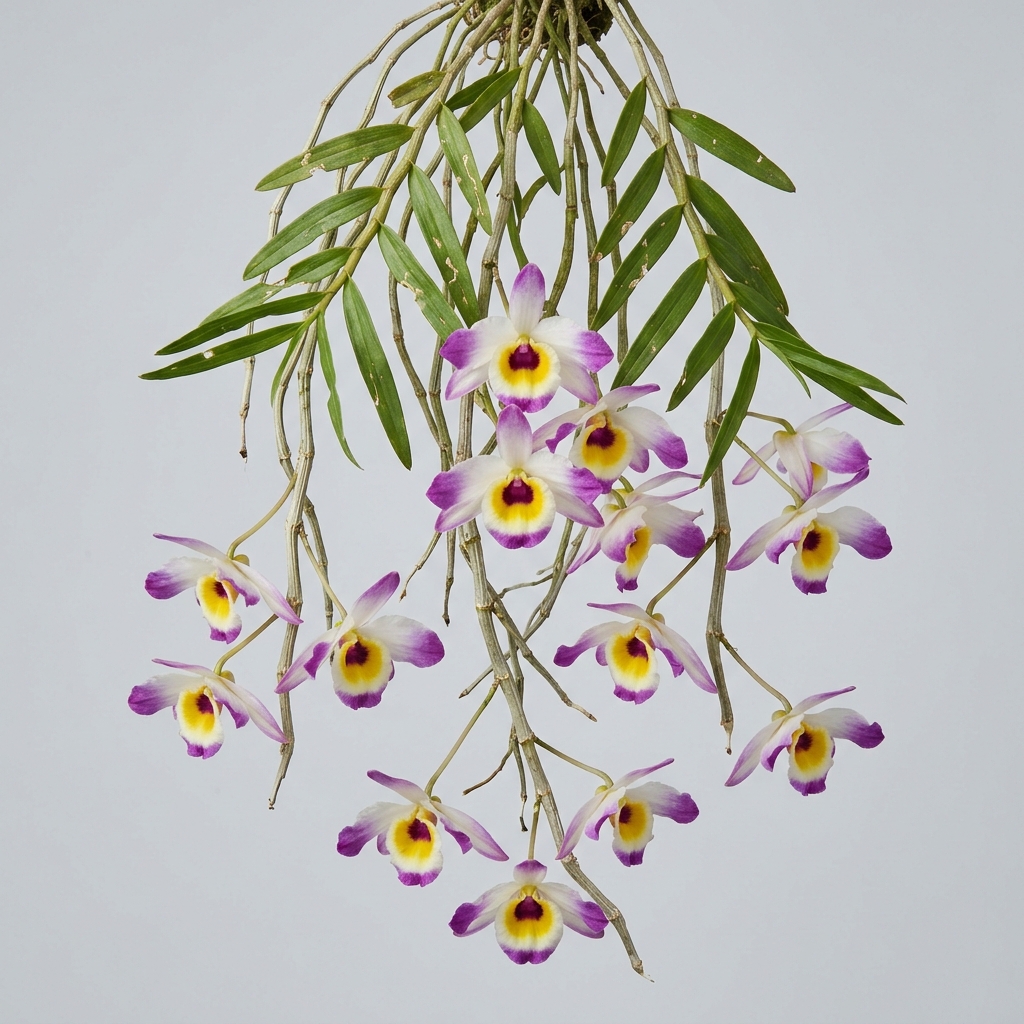
Dendrobium Falconeri is a highly sought-after orchid species prized for its delicate, pendulous growth habit and strikingly colorful blooms. Often referred to as Falconer’s Dendrobium, this epiphyte features slender, branching pseudobulbs that create a cascading, grass-like appearance, making it an exceptional choice for mounted cultivation or hanging baskets.
Orchid enthusiasts value this taxon for its dramatic floral display, where large, contrastingly colored blossoms emerge from the thin, knobby stems. While its specific cultural requirements—particularly a distinct winter rest—make it more suited for intermediate to experienced growers, the reward of its vibrant, multi-colored flowers makes the extra attention highly worthwhile.
💡 Did You Know?
The thin, branching pseudobulbs of Dendrobium Falconeri are often described as beaded or chain-like due to their swollen nodes. In its native Himalayan habitats, this unique growth habit allows the orchid to drape elegantly from tree branches, catching moisture and nutrients from the air while remaining suspended safely above the forest floor.
🌿 Botanical Overview
Dendrobium Falconeri is native to the montane forests of the Himalayas, India, Myanmar, Thailand, China, and Taiwan. In these high-altitude environments, it grows epiphytically on moss-covered trees, where it is exposed to high humidity, cool air currents, and distinct seasonal moisture variations. This evolutionary background dictates its specific care requirements in cultivation.
The vegetative structure of this orchid is highly distinctive. The pseudobulbs are exceptionally slender, branching, and characterized by swollen nodes that give them a beaded or chain-like appearance. This pendulous growth habit means the plant naturally hangs downward, draping elegantly over its mounting surface. The leaves are linear, grass-like, and deciduous, often shedding before or during the blooming cycle.
🌸 Flower Characteristics
The flowers of Dendrobium Falconeri are relatively large, often measuring 5 to 8 centimeters across, which contrasts beautifully with the thin, delicate stems. The sepals and petals are typically white or pale rose-pink, tipped with a vibrant amethyst or magenta-purple. This striking color combination gives the blossoms a luminous, painted appearance.
The lip, or labellum, is the most dramatic feature of the flower. It displays a large, rounded form with a bright yellow or orange throat and a striking, deep purple-black blotch at the center. This creates a high-contrast, multi-colored target pattern that is highly prized by collectors and judges alike. The flowers emerge individually or in small clusters from the nodes of the pseudobulbs.
Fragrance & Bloom Profile
The fragrance of Dendrobium Falconeri is generally described as delicate, sweet, and reminiscent of honey, though its intensity can vary based on environmental conditions such as temperature and light. The scent is most noticeable during the morning hours when the ambient temperature begins to rise.
Blooms typically open in the spring and can last for several weeks if kept in cool, stable conditions. Because the flowers emerge from the nodes of both leafy and leafless older pseudobulbs, a mature specimen can produce a spectacular, cloud-like display of blossoms that completely obscures the delicate stems beneath.
Parentage & Hybrid Lineage
Dendrobium Falconeri is a distinct species rather than a complex artificial hybrid, first described in the 19th century. While it has been used occasionally in hybridizing programs to introduce its striking lip coloration and pendulous habit to new grexes, it is most commonly grown and appreciated in its true species form.
As with many wild orchid species, exact horticultural selections or line-bred cultivars may exist, but their specific registration details and parentage lines are not always consistently documented in general grower registries. Cultivators generally focus on sourcing high-quality species specimens from reputable nurseries.
🌱 Growing Conditions
This orchid thrives in cool to intermediate temperatures, mimicking its native high-altitude forest habitats. Ideal daytime temperatures range from 65 to 75 degrees Fahrenheit, with a distinct drop at night. It requires bright, filtered light but must be protected from direct, scorching midday sun, which can easily burn the thin foliage and delicate stems.
💡 Care Tip
To achieve the best blooming results, ensure your orchid experiences a distinct drop in night temperatures during the autumn and winter months, ideally down to 50 to 55 degrees Fahrenheit, combined with a significant reduction in .
High humidity, ideally between 60% and 80%, and excellent, continuous air movement are critical to prevent stagnant moisture from causing rot. It is highly suited for greenhouse cultivation or dedicated indoor growing setups with humidifiers and fans. Proper ventilation is essential, especially when humidity levels are high.
Watering, Feeding & Potting Media
During the active spring and summer growing season, Dendrobium Falconeri requires frequent watering and high humidity. The potting medium should never be allowed to dry out completely during this active phase. Weekly applications of a diluted, balanced orchid fertilizer support the rapid development of new pseudobulbs.
Due to its pendulous, branching growth habit, mounting this orchid on cork bark, tree fern plaques, or tree branches is highly recommended. If pot cultivation is attempted, a highly draining, open medium such as fine fir bark mixed with perlite and charcoal should be used in a hanging basket to allow the stems to cascade naturally.
Blooming Season & Care Notes
The blooming cycle is heavily dependent on a cool, dry winter rest period. Starting in late autumn, watering should be significantly reduced, and fertilizer should be withheld entirely. The plant should experience cooler night temperatures, ideally dropping to 50 to 55 degrees Fahrenheit, to trigger bud initiation.
Only occasional misting should be provided during winter to prevent the pseudobulbs from shriveling excessively. Once buds begin to appear at the nodes in early spring, normal watering and feeding can gradually resume. Repotting or remounting is best done in late spring, immediately after flowering, as new root growth begins.
⚠️ Common Issues
⚠️ Common Mistake
Overwatering during the winter rest period is a frequent mistake that can lead to rapid root rot and prevent the orchid from blooming. Resist the urge to water heavily when the plant appears dormant and leafless.
- Root rot: Occurs if the growing medium remains soggy or lacks adequate aeration, particularly during the winter rest.
- Shriveling pseudobulbs: While some shriveling is normal during the dry winter rest, excessive dehydration can weaken the plant.
- Bud blast: Sudden changes in temperature, low humidity, or drafts can cause developing flower buds to yellow and drop before opening.
- Pests: Spider mites and scale insects can occasionally target the thin leaves and nodes; regular inspection is recommended.
❓ Frequently Asked Questions
Why is my Dendrobium Falconeri not blooming?
The most common reason for a lack of blooms is the absence of a proper winter rest. This species requires a distinct period of cool temperatures and dry conditions in late autumn and winter to trigger bud initiation. Without this seasonal cue, the plant will continue vegetative growth instead of flowering.
Can I grow Dendrobium Falconeri in a standard plastic pot?
While possible, it is not recommended. The pendulous, cascading growth habit of this species makes it difficult to manage in a standard pot. Mounting the plant on cork or tree fern, or growing it in a hanging basket, allows the stems to drape naturally and ensures the rapid drainage its roots require.
How much shriveling is normal during the winter rest?
Minor wrinkling of the thin, slender pseudobulbs is completely normal and expected during the dry winter rest. However, if the stems become severely shriveled, dry, or brittle, you should provide a light misting in the morning to prevent extreme dehydration.
What type of light does this orchid prefer?
Dendrobium Falconeri prefers bright, filtered indirect light. In an indoor setting, an east-facing window or a shaded south-facing window is ideal. Avoid direct afternoon sun, which can easily scorch the delicate leaves and thin stems.
⭐ Final Growing Notes
Dendrobium Falconeri is a rewarding species that showcases the elegant diversity of the orchid family. By mimicking its natural seasonal cycle of wet, warm summers and cool, dry winters, growers can enjoy a breathtaking annual display of contrastingly colored, delicate blossoms that cascade beautifully from its unique, chain-like stems.
⚕️ Health, Safety & Edibility
Understanding how a plant interacts with people, pets, and the surrounding environment is part of responsible cultivation. This section uses conservative, general guidance and does not replace professional medical or veterinary advice.
Human Safety: No published evidence currently identifies species-specific toxicity concerns for Dendrobium Falconeri during normal handling. As with most ornamental plants, it should not be intentionally consumed.
Pet Safety: Published information does not indicate that this orchid commonly poses a toxicity concern for cats or dogs. However, chewing leaves, flowers, roots, or potting media may still cause mild digestive upset.
Edibility: This orchid is cultivated for ornamental display rather than food. Ornamental plants may carry fertilizers, pesticides, or other horticultural treatments that make them unsuitable for consumption.
Skin Contact: Routine handling is not generally associated with skin irritation. Gardeners with sensitive skin may prefer wearing gloves when repotting, pruning, or handling potting media.
🌱 Propagation Tip
This species occasionally produces keikis along the nodes of older pseudobulbs. Allow these offsets to develop a robust system of roots at least two inches long before carefully detaching and mounting them individually.
⭐ Expert Advice
Mounting Dendrobium Falconeri on a high-quality tree fern plaque or cork slab is highly recommended over potting. This mimics its natural epiphytic habit, ensures rapid drainage, and allows the pendulous stems to cascade freely without restriction.

Leave A Comment