
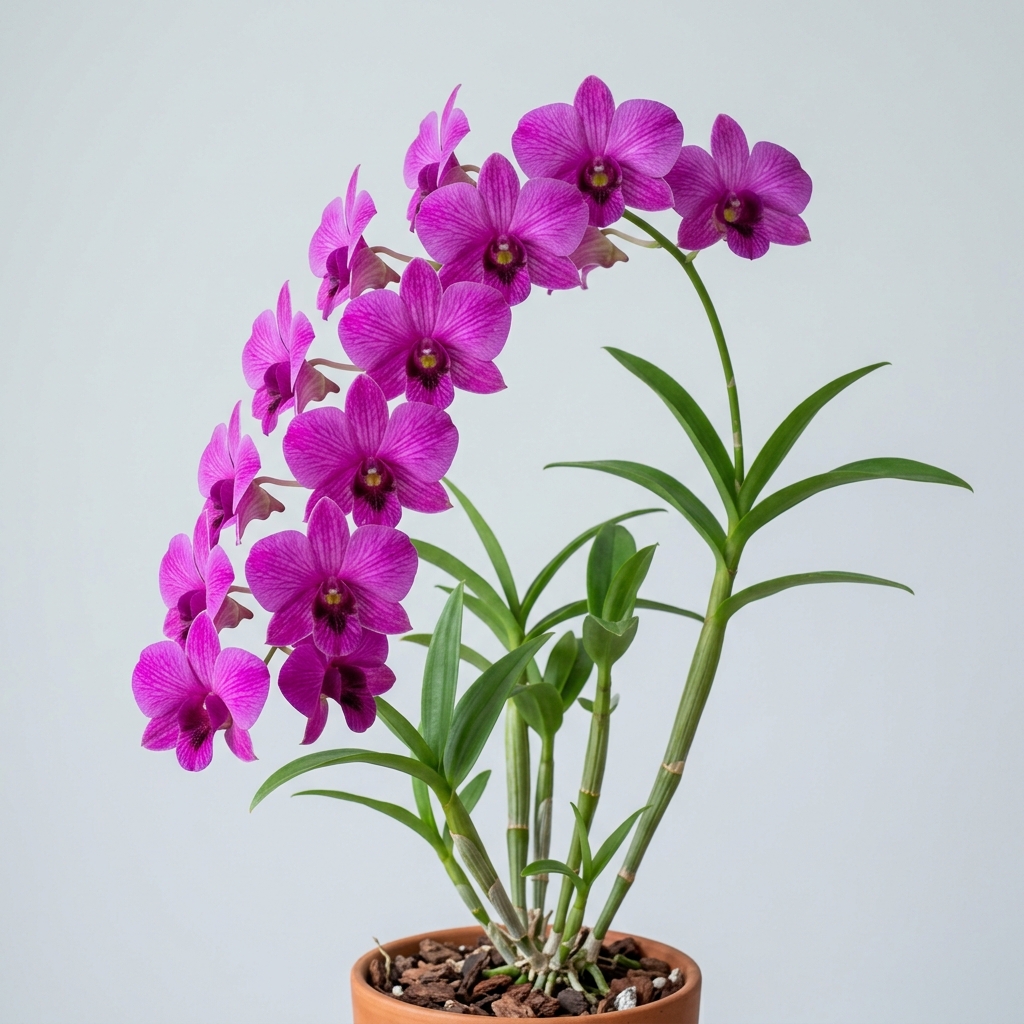
Dendrobium phalaenopsis is a highly celebrated orchid cultivar group within the genus Dendrobium, cherished by indoor gardeners and commercial growers alike for its striking, moth-like blooms that closely resemble those of the Phalaenopsis genus. This evergreen epiphyte is renowned for its tall, cane-like pseudobulbs and its ability to produce long-lasting, arching sprays of vibrant flowers. Cultivated extensively for both cut-flower production and home display, this orchid is highly valued for its robust growth habit and relatively straightforward care requirements.
Its elegant presentation and reliable blooming cycle make it an essential addition to any diverse orchid collection, offering a dramatic splash of color when in full bloom. Because of its adaptability to indoor environments, it serves as an excellent transitional plant for growers looking to expand their collection beyond standard house plants into the rewarding world of sympodial orchids.
💡 Did You Know?
Despite its name, Dendrobium phalaenopsis is not a member of the Phalaenopsis . The specific epithet was chosen because the flat, rounded flowers bear a striking resemblance to moth orchids, offering growers the aesthetic appeal of a Phalaenopsis combined with the robust, cane-like growth habit of a classic Dendrobium.
🌿 Botanical Overview
Dendrobium phalaenopsis shows a classic sympodial growth habit, characterized by slender, upright, cane-like pseudobulbs that can reach impressive heights under optimal conditions. These canes are leafy along the upper portion, bearing narrow, lanceolate, leathery green leaves that persist for several seasons before naturally shedding as the canes mature. The structural integrity of these canes allows the plant to store water and nutrients, helping it withstand short periods of drought in its native-style environments.
The root system is typically fine, wiry, and highly adapted to clinging to tree bark or rocky substrates. New growth emerges from the base of older pseudobulbs, developing rapidly during the warm, wet spring and summer months to form the next generation of flowering canes. Healthy roots are covered in a silvery velamen layer that absorbs moisture and nutrients efficiently from the surrounding air and media.
🌸 Flower Characteristics
The flowers of this cultivar are famously flat and round, mimicking the shape of moth orchids. They are arranged on long, arching racemes that emerge from the upper nodes of both new and mature canes. Each spike can carry anywhere from ten to over twenty individual blooms, creating a dense, cascading display that stands out in any setting.
The petals and sepals are typically broad and overlapping, surrounding a prominent, three-lobed lip or labellum that often features a deeper, contrasting throat color. While rich shades of magenta and purple are most common, white and bicolor variations are also highly sought after by collectors. The flowers are presented elegantly away from the foliage, maximizing their visual impact and pollinator appeal.
Fragrance & Bloom Profile
Unlike some of its highly fragrant relatives in the Dendrobium genus, Dendrobium phalaenopsis is generally considered to be unscented or to possess only a very faint, clean aroma that is barely perceptible. This lack of strong fragrance is often viewed as an advantage for indoor growers who prefer allergy-friendly plants or wish to display them in dining areas where strong scents might be intrusive.
The true appeal of this cultivar lies in the exceptional longevity of its flowers. Individual blooms can remain pristine on the plant for six to ten weeks, and the overall flowering display can extend for several months as buds open sequentially along the spike. This makes them exceptionally popular as high-end cut flowers and decorative houseplants.
Parentage & Hybrid Lineage
The taxonomic status and hybrid lineage of Dendrobium phalaenopsis are subject to ongoing discussion among botanists and orchid societies. In horticultural circles, the name is frequently used to describe a specific group of evergreen, warm-growing hybrids derived primarily from Dendrobium bigibbum and closely related species native to northern Australia and New Guinea.
Because many commercial varieties have been bred over decades for the cut-flower industry, the exact parentage of individual plants sold under this name is often not consistently documented in common grower references. Growers typically treat them as a cohesive cultural group rather than a single, isolated wild species, focusing on their shared care requirements and growth habits.
🌱 Growing Conditions
To thrive, this orchid requires bright, filtered light, significantly stronger than what is typically recommended for standard Phalaenopsis orchids. An east- or shaded south-facing window is ideal, where the plant can receive morning sun without being scorched by intense afternoon rays. Healthy leaves should be a medium grass-green color; dark green leaves suggest insufficient light, while yellowing or red-tinted leaves indicate excess exposure.
💡 Care Tip
Place your orchid in a location with excellent air movement, such as near a gentle fan. Good ventilation is essential for preventing fungal leaf spot and helping the coarse potting medium dry out efficiently between waterings.
Temperature ranges should remain warm to intermediate, ideally between 65°F and 85°F (18°C to 29°C) during the day, with a slight drop at night to stimulate bud development. Adequate air circulation is crucial to prevent stagnant air pockets, which can encourage fungal pathogens in high-humidity environments. Aim for a relative humidity level of 50% to 70% to keep the foliage and aerial roots plump.
Watering, Feeding & Potting Media
During the active spring and summer growing season, Dendrobium phalaenopsis requires frequent and thorough watering. The potting medium should be allowed to approach dryness but not dry out completely between waterings. A balanced, water-soluble orchid fertilizer applied at quarter-strength weekly is highly beneficial during this period of rapid growth to support the development of strong new canes.
The ideal potting medium is a highly porous, free-draining mixture consisting primarily of medium-grade fir bark, horticultural charcoal, and perlite. This ensures that the roots receive plenty of oxygen and dry rapidly. Repotting should only be performed when the potting medium begins to break down or when the plant completely outgrows its container, preferably just as new root growth begins in the spring.
Blooming Season & Care Notes
The primary blooming season typically occurs in autumn and early winter, though healthy plants can occasionally produce spikes at other times of the year. Once the flowers fade, the old flower spike should be cut back close to the cane, taking care not to damage the cane itself, as old canes can bloom again from different nodes in later years.
As winter approaches, the orchid enters a semi-dormant phase. During this cooler period, watering should be significantly reduced, and fertilizing should be suspended entirely until new green growth emerges from the base of the canes in spring. This winter rest is essential for the long-term health and vigor of the plant.
⚠️ Common Issues
⚠️ Common Mistake
A frequent error is cutting down old, leafless canes. Even without leaves, these pseudobulbs store vital moisture and nutrients that support new growth, and they can occasionally produce additional flower spikes from previously unbloomed nodes.
- Bud blast: Sudden dropping of unopened buds, often caused by rapid temperature fluctuations, cold drafts, or low humidity.
- Root rot: Mushy, brown roots resulting from overwatering or a compacted potting medium that retains too much moisture.
- Dehydration: Shriveled pseudobulbs and wrinkled leaves, indicating insufficient watering or a compromised root system unable to absorb moisture.
- Pests: Infestations of mealybugs, scale, or spider mites, which typically cluster in the leaf axils or on the undersides of leaves.
❓ Frequently Asked Questions
How do I encourage my Dendrobium phalaenopsis to rebloom?
To stimulate reblooming, ensure the plant receives bright, indirect light and a slight drop in nighttime temperatures during the late summer. Reducing water slightly as the new canes mature also helps signal the plant to initiate flower spikes.
Why are the leaves on my orchid turning yellow and falling off?
Yellowing leaves on older canes can be a natural part of the plant’s aging cycle. However, if leaves on new canes are yellowing rapidly, it may indicate overwatering, poor drainage, or a lack of adequate light.
Should I cut down the old canes after they finish flowering?
No, you should not cut down healthy green canes, even if they have lost their leaves. These canes store essential water and nutrients for the plant and can produce new flower spikes or keikis from unused nodes in future seasons.
What should I do if my orchid produces a baby plant on a cane?
These baby plants, known as keikis, can be allowed to grow until they develop several healthy roots that are at least two to three inches long. At that point, you can carefully detach the keiki and pot it up individually in a small container with fine bark.
⭐ Final Growing Notes
With its striking, long-lasting floral displays and resilient nature, Dendrobium phalaenopsis remains a cornerstone of the orchid-growing hobby. By providing bright light, a distinct seasonal watering routine, and maintaining excellent air movement, growers of all experience levels can enjoy the elegant, moth-like blooms of this classic cultivar for many years to come.
🌱 Propagation Tip
This cultivar occasionally produces adventitious baby plants, called keikis, along the nodes of older canes. Wait until the keiki has developed several roots at least two inches long before gently twisting it off and potting it in a small container.
⭐ Expert Advice
To maximize bloom production, keep the plant slightly root-bound in a relatively small pot. Dendrobiums tend to grow more vigorously and flower more reliably when their root systems are snug rather than swimming in excess .




Leave A Comment