

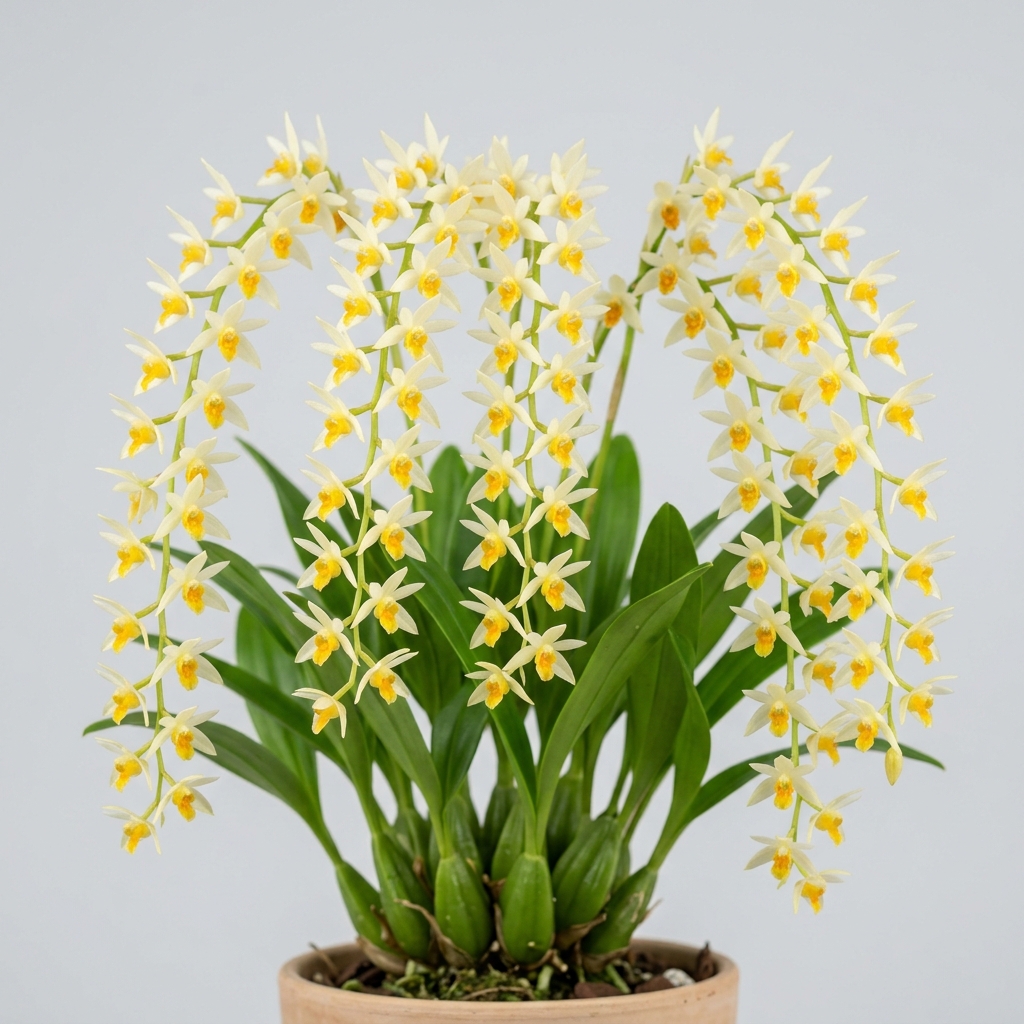
Dendrobium Polyanthum is a captivating epiphytic orchid species native to the seasonal forests of Southeast Asia, highly prized by collectors for its spectacular pendulous growth habit and abundance of delicate blossoms. Often referred to in historical texts by various synonyms, this orchid produces gracefully cascading canes that shed their leaves in the winter to prepare for a dramatic spring display. When in bloom, the bare canes become adorned with numerous pastel-hued flowers, creating a striking contrast that makes it a standout addition to any orchid collection.
Cultivating this species successfully requires an understanding of its distinct seasonal growth cycle, which transitions from a warm, wet summer growing period to a cool, dry winter rest. While it may present a slight challenge to absolute beginners due to these strict seasonal requirements, intermediate growers will find its predictable rhythm and rewarding floral display highly satisfying. When mounted or grown in hanging baskets, Dendrobium Polyanthum showcases its natural cascading form to its fullest potential, mimicking its wild habitat on tree trunks and branches.
💡 Did You Know?
Unlike many evergreen orchids, Dendrobium Polyanthum relies on a dramatic seasonal transformation to survive and bloom. By shedding all of its leaves in the winter, the plant conserves vital moisture during the dry season, directing its remaining energy into producing a spectacular burst of fragrant flowers along its bare canes when spring arrives.
🌿 Botanical Overview
Dendrobium Polyanthum is characterized by its pendulous, cylindrical pseudobulbs, commonly referred to as canes, which can grow up to thirty to sixty centimeters in length. These canes are initially covered in light green leaves arranged in two ranks along the stem. As an adaptation to its native monsoon climate, the species is deciduous, shedding its foliage during the dry autumn and winter months to conserve moisture and energy for the upcoming flowering season.
The root system is relatively fine and fibrous, adapted for clinging to the bark of host trees in open forests. In its natural habitat, it experiences high light levels and rapid drying after rainfall. Understanding this epiphytic nature is fundamental to selecting the proper growing container and substrate, as the roots require constant access to oxygen and must never remain saturated for extended periods.
🌸 Flower Characteristics
The blossoms of Dendrobium Polyanthum are typically two to five centimeters in diameter, emerging individually or in small clusters from the nodes along the mature, leafless canes. The sepals and petals are generally lanceolate, presenting a soft white to pale rose-pink coloration. The most prominent feature of the flower is its broad, trumpet-shaped lip, or labellum, which features a finely fringed margin and a soft yellow or cream-colored throat, often marked with subtle purple or reddish veins.
Because the flowers develop along the entire length of the pendulous canes, a well-grown specimen can produce dozens of blooms simultaneously. The floral substance is relatively delicate, meaning the blooms are sensitive to physical damage and high humidity levels during the flowering period, though they remain highly attractive for several weeks under optimal conditions.
Fragrance & Bloom Profile
This species is widely celebrated for its sweet, pleasant fragrance, which many growers liken to the scent of primroses, honey, or soft citrus. The scent is typically most pronounced during the morning hours as temperatures rise, filling the growing space with a delicate perfume. The blooms open sequentially or nearly simultaneously along the canes, lasting approximately two to four weeks depending on ambient temperatures and humidity.
While fragrance intensity can vary slightly between individual specimens and environmental conditions, it remains a defining characteristic of the species. To maximize the lifespan of the flowers, growers should avoid getting water on the petals and maintain moderate, stable temperatures during the blooming cycle.
Parentage & Hybrid Lineage
As a naturally occurring species rather than a man-made hybrid, Dendrobium Polyanthum possesses a distinct genetic identity shaped by its wild evolutionary history. In taxonomic circles, there has been historical confusion regarding its nomenclature, with some older references grouping or confusing it with Dendrobium cretaceum or Dendrobium primulinum. However, modern botanical databases recognize it as a distinct species.
In orchid hybridization, Dendrobium Polyanthum has been utilized to introduce its pendulous growth habit, floriferous nature, and sweet fragrance into various hybrid lines. When crossed with other members of the Dendrobium genus, it frequently passes on its deciduous tendencies and lateral flowering habit, contributing to the development of unique cascading hybrids.
🌱 Growing Conditions
To cultivate Dendrobium Polyanthum successfully, growers must replicate the seasonal variations of its native habitat. During the active spring and summer growing season, the plant thrives in bright, filtered light, similar to that required by Cattleyas. A light level of 2,500 to 3,500 foot-candles is ideal, though direct midday sun should be avoided to prevent foliage scorch. High humidity of sixty to eighty percent, accompanied by strong air movement, is essential during this period.
💡 Care Tip
During the active summer growing season, ensure your orchid receives strong air movement. High combined with stagnant air can lead to fungal issues on the lush new foliage. Placing a small fan nearby to maintain a gentle breeze will mimic its natural canopy environment and promote healthy, robust cane growth.
Temperature requirements also shift seasonally. In the summer, the orchid prefers warm conditions, with daytime temperatures ranging from twenty-four to thirty degrees Celsius and a slight drop at night. In the winter, during its dormant phase, the plant requires significantly cooler temperatures, ideally dropping to ten to fifteen degrees Celsius at night. This cool period, combined with high light, is the primary trigger for bud initiation.
Watering, Feeding & Potting Media
Watering practices must be strictly adjusted according to the plant’s growth phase. From late spring through early autumn, when new canes are actively growing, the orchid should be watered copiously, keeping the root zone consistently moist but not waterlogged. Weekly applications of a balanced orchid fertilizer, diluted to quarter- or half-strength, will support robust cane development.
As autumn approaches and the terminal leaves at the tips of the canes mature, watering must be gradually reduced, and fertilizing should cease entirely. During the winter rest, water should be provided only sparingly—just enough to prevent the canes from shriveling excessively. A light misting every one to two weeks is often sufficient.
Because of its pendulous habit, Dendrobium Polyanthum is best grown mounted on cork bark or tree fern plaques, or planted in hanging wooden baskets. If potted, a highly porous, fast-draining medium such as medium-grade fir bark mixed with perlite and charcoal is necessary to ensure rapid drying.
Blooming Season & Care Notes
The primary blooming season for Dendrobium Polyanthum occurs in late winter to early spring, shortly after the winter rest period concludes. As the cool, dry winter ends, small buds will begin to emerge from the nodes opposite the fallen leaves. Once these buds are visible, growers can gradually increase watering, though heavy watering should be withheld until the flowers open and new vegetative growth begins at the base of the canes.
After flowering is complete, the orchid will initiate new growth from the base of the old canes. This is the ideal time to repot or remount the plant if the medium has degraded. Repotting should be done carefully to avoid damaging the tender new roots that quickly emerge from the base of the new shoots.
⚠️ Common Issues
⚠️ Common Mistake
The most common mistake is continuing to water and fertilize normally during the autumn and winter months. Failing to provide a distinct dry and cool rest period will prevent the orchid from setting flower buds, often resulting in vegetative keikis instead of blossoms, or causing the root system to rot in cold, wet media.
- Root Rot:
Caused by overwatering during the winter dormant period or using a degraded, water-retentive potting medium. - Bud Blast:
Occurs when developing buds are subjected to sudden temperature drops, drafts, or low humidity. - Cane Shriveling: While slight shriveling is normal during the winter rest, excessive shriveling indicates severe dehydration and requires a light watering or misting.
- Pest Infestations: Spider mites and mealybugs can target the tender new growth and the undersides of leaves during dry conditions.
- Lack of Blooms: Usually the result of failing to provide a sufficiently cool and dry winter rest period, or inadequate light during the summer.
❓ Frequently Asked Questions
Why is my Dendrobium Polyanthum losing its leaves?
It is completely natural for this species to shed its leaves in the autumn and winter. Dendrobium Polyanthum is a deciduous orchid, and leaf drop is a normal part of its annual cycle, signaling the start of its winter rest period which is necessary for blooming.
How do I know when to start watering after the winter rest?
You should begin to increase watering gradually once you see flower buds clearly developing along the canes. However, avoid heavy watering until the flowers have fully opened and you observe new green shoots emerging from the base of the plant.
Can I grow Dendrobium Polyanthum in a standard plastic pot?
While it is possible, it is not recommended due to the orchid’s pendulous growth habit. The long, cascading canes will easily tip a standard pot over. Growing it in a hanging basket or mounted on cork bark allows the canes to hang naturally and ensures excellent drainage.
What should I do if the canes shrivel during winter?
A minor amount of shriveling is normal and expected during the dry winter rest. If the canes become severely shriveled or wrinkled, provide a light watering or mist the roots in the morning, but do not return to a regular watering schedule until buds appear.
⭐ Final Growing Notes
Dendrobium Polyanthum is a highly rewarding species that brings a touch of natural elegance to any collection. By respecting its seasonal requirements—offering abundant water and warmth in summer, followed by a cool, dry rest in winter—growers can enjoy a spectacular annual display of fragrant, delicate blossoms. Its unique cascading form makes it a perfect candidate for mounting, allowing enthusiasts to appreciate this orchid in a manner that closely mirrors its wild epiphytic lifestyle.
⚕️ Health, Safety & Edibility
Understanding how a plant interacts with people, pets, and the surrounding environment is part of responsible cultivation. This section uses conservative, general guidance and does not replace professional medical or veterinary advice.
Human Safety: No published evidence currently identifies species-specific toxicity concerns for Dendrobium Polyanthum during normal handling. As with most ornamental plants, it should not be intentionally consumed.
Pet Safety: Published information does not indicate that this orchid commonly poses a toxicity concern for cats or dogs. However, chewing leaves, flowers, roots, or potting media may still cause mild digestive upset.
Edibility: This orchid is cultivated for ornamental display rather than food. Ornamental plants may carry fertilizers, pesticides, or other horticultural treatments that make them unsuitable for consumption.
Skin Contact: Routine handling is not generally associated with skin irritation. Gardeners with sensitive skin may prefer wearing gloves when repotting, pruning, or handling potting media.
🌱 Propagation Tip
This species occasionally produces adventitious offsets, known as keikis, along the nodes of older canes. Allow these plantlets to develop a robust root system of at least two to three inches in length before carefully detaching them. Once removed, they can be mounted or potted individually to establish new, independent plants.
⭐ Expert Advice
For the most natural and visually stunning display, mount this orchid on a slab of cork bark or tree fern. This allows the canes to cascade downward as they would in the wild, preventing water from pooling in the crown of new growths and showcasing the floral display at eye level.

Leave A Comment