
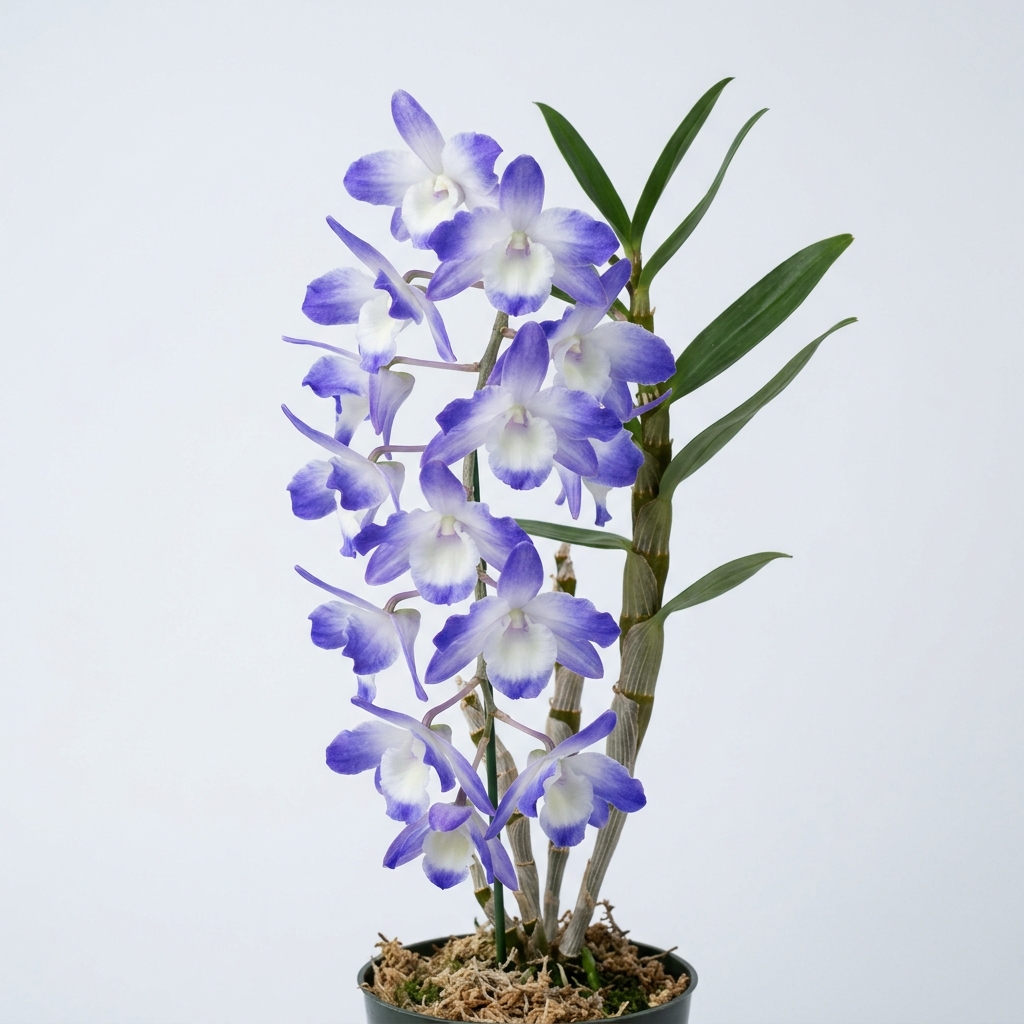
Dendrobium Victoriae-Reginae, commonly known as the Queen Victoria Dendrobium, is a highly coveted orchid species native to the high-altitude montane forests of the Philippines. Renowned for its rare and striking blue-violet to cobalt-colored blossoms, this pendulous epiphytic orchid offers a unique aesthetic that contrasts beautifully with the typical pink, yellow, and white hues of the orchid world.
Cultivating this species successfully requires replicating its cool, humid, and misty native cloud forest environment. While it has a reputation for being somewhat demanding compared to lowland Dendrobiums, dedicated growers are rewarded with spectacular, clustered blooms that emerge directly from both old and new pseudobulbs. Understanding its specific moisture and temperature preferences is key to unlocking its full blooming potential.
💡 Did You Know?
The specific epithet victoriae-reginae honors Queen Victoria of the United Kingdom. This orchid is highly prized among collectors because true blue is one of the rarest colors in the orchid , and its cool-growing requirements make it a unique addition to specialized greenhouse collections.
🌿 Botanical Overview
Dendrobium Victoriae-Reginae is a medium-sized epiphyte characterized by its pendulous, branching, and cane-like pseudobulbs. In its native habitat on the islands of Luzon and Mindanao in the Philippines, it grows on moss-covered trees at elevations ranging from 1,200 to 2,400 meters. This high-altitude provenance dictates its preference for cooler temperatures and constant air movement.
The leaves are lanceolate, dark green, and deciduous, often dropping from older canes before flowering. The pendulous growth habit means that the canes naturally drape downward, making this species exceptionally well-suited for hanging baskets or mounted culture where the stems can cascade freely.
🌸 Flower Characteristics
The flowers of Dendrobium Victoriae-Reginae are celebrated for their unusual color palette, which transitions from a translucent white at the center to a deep violet-blue or cobalt at the tips of the petals and sepals. Each bloom typically measures between 3 to 5 centimeters in diameter. The flowers are produced in short, dense racemes of two to several blossoms, emerging from the nodes of both leafy and leafless canes.
The lip, or labellum, is similarly colored, featuring dark blue or purple veining that guides pollinators toward the column. Unlike many other orchids, the flowers do not open completely flat, maintaining a slightly cup-like or bell-like shape that adds to their delicate appearance.
Fragrance & Bloom Profile
While some growers report a very faint, subtle sweet scent under warm, humid conditions, the fragrance of Dendrobium Victoriae-Reginae is not consistently documented or prominent. The primary appeal of this orchid lies entirely in its visual presentation. The blooms are remarkably long-lasting, often remaining fresh on the plant for several weeks to a month, provided the humidity remains high and temperatures are kept cool.
Parentage & Hybrid Lineage
As a naturally occurring species rather than a man-made hybrid, Dendrobium Victoriae-Reginae does not have a complex pedigree of parent cultivars. It belongs to the section Pedilonum within the genus Dendrobium. It has been used occasionally in hybridization programs to introduce its rare blue coloration to other Dendrobium lines, though such hybrids are relatively uncommon and can be challenging to stabilize.
🌱 Growing Conditions
To thrive, this orchid demands cool to intermediate conditions, mimicking its montane cloud forest origin. Ideal daytime temperatures range from 20 to 24 degrees Celsius, with a distinct drop at night to around 12 to 15 degrees Celsius. It requires bright, filtered light but must be shielded from direct midday sun, which can easily scorch the thin foliage.
💡 Care Tip
Always maintain high and constant, gentle air movement around this orchid. If growing indoors, placing a small fan nearby and using a tray can help replicate the misty, breezy conditions of its native Philippine cloud forests.
High humidity is critical, ideally maintained between 70% and 85% year-round. Excellent air circulation is mandatory to prevent stagnant air from encouraging fungal pathogens, especially given the high humidity levels required.
Watering, Feeding & Potting Media
Unlike many Dendrobiums that require a dry winter rest, Dendrobium Victoriae-Reginae prefers to remain consistently moist throughout the year. It should never be allowed to dry out completely. Water thoroughly with pure water, such as rainwater or reverse osmosis water, as the fine roots are sensitive to salt buildup.
During the active growing season, apply a highly diluted, balanced orchid fertilizer weekly. Potting media should retain moisture while allowing excellent drainage; a high-quality New Zealand sphagnum moss or a fine fir bark mix works well. Alternatively, mounting the orchid on a tree fern slab with a pad of moss allows for natural pendulous growth, though this requires daily watering in most home environments.
Blooming Season & Care Notes
This species is known for its opportunistic blooming habit, often flowering multiple times a year, with peaks typically occurring in the spring and autumn. Because flowers develop on older, leafless canes, growers must resist the urge to cut back bare pseudobulbs unless they are completely dry, brown, and hollow. Repotting should be done only when necessary, preferably in early spring when new root growth is initiated, as this species dislikes root disturbance.
⚠️ Common Issues
⚠️ Common Mistake
A frequent error is treating this species like a typical warm-growing Dendrobium by allowing it to dry out completely or subjecting it to hot summer temperatures. This will quickly lead to root loss, dehydration, and a failure to bloom.
- Root rot: Caused by compacted, poorly draining media or overwatering in stagnant air.
- Bud blast: Sudden drops in humidity or temperature fluctuations can cause developing buds to yellow and drop.
- Leaf drop: While older leaves naturally fall, premature leaf drop on young canes indicates underwatering or heat stress.
- Pests: Spider mites and mealybugs can occasionally target the thin foliage, particularly if the humidity drops too low.
❓ Frequently Asked Questions
Why are the leaves falling off my Dendrobium Victoriae-Reginae?
It is natural for this species to shed leaves from older, mature canes before or during the blooming cycle. However, if leaves are dropping rapidly from new, active growth, it is usually a sign of environmental stress, such as insufficient watering, low humidity, or excessively high temperatures.
How do I encourage my orchid to produce its signature blue flowers?
The intensity of the blue-violet coloration is highly dependent on temperature and light. Growing the orchid in cooler conditions, especially during the bud development phase, tends to intensify the blue pigment. Brighter, filtered light also supports vibrant color development, whereas low light may result in paler, washed-out blooms.
Can I grow this orchid mounted instead of in a pot?
Yes, mounting Dendrobium Victoriae-Reginae on a tree fern or cork slab is highly recommended because of its natural pendulous growth habit. However, mounted orchids dry out much faster than potted ones, so you must be prepared to mist or water the plant daily to maintain the necessary moisture levels.
Does this species require a dry winter rest period?
No, unlike many other deciduous Dendrobium species, Dendrobium Victoriae-Reginae does not require a strict dry winter rest. It should be kept moist year-round, though watering can be slightly reduced during the darkest winter months when growth naturally slows down.
⭐ Final Growing Notes
Dendrobium Victoriae-Reginae is a rewarding challenge for the intermediate to advanced orchid enthusiast. By prioritizing cool temperatures, high humidity, and consistent moisture, growers can successfully cultivate this botanical treasure and enjoy its rare, captivating blue-violet blossoms for years to come.
⚕️ Health, Safety & Edibility
Understanding how a plant interacts with people, pets, and the surrounding environment is part of responsible cultivation. This section uses conservative, general guidance and does not replace professional medical or veterinary advice.
Human Safety: No published evidence currently identifies species-specific toxicity concerns for Dendrobium Victoriae-Reginae during normal handling. As with most ornamental plants, it should not be intentionally consumed.
Pet Safety: Published information does not indicate that this orchid commonly poses a toxicity concern for cats or dogs. However, chewing leaves, flowers, roots, or potting media may still cause mild digestive upset.
Edibility: This orchid is cultivated for ornamental display rather than food. Ornamental plants may carry fertilizers, pesticides, or other horticultural treatments that make them unsuitable for consumption.
Skin Contact: Routine handling is not generally associated with skin irritation. Gardeners with sensitive skin may prefer wearing gloves when repotting, pruning, or handling potting media.
🌱 Propagation Tip
This species can occasionally produce keikis along the nodes of older canes. Allow the keiki to develop a robust root system of at least two inches in length before carefully detaching it and potting it in a fine, moisture-retentive medium.
⭐ Expert Advice
To maximize the blue intensity of the flowers, ensure your growing area experiences a significant drop at night during the autumn and winter. Cooler night temperatures stimulate the production of the deep violet-blue pigments in the developing buds.

Leave A Comment