
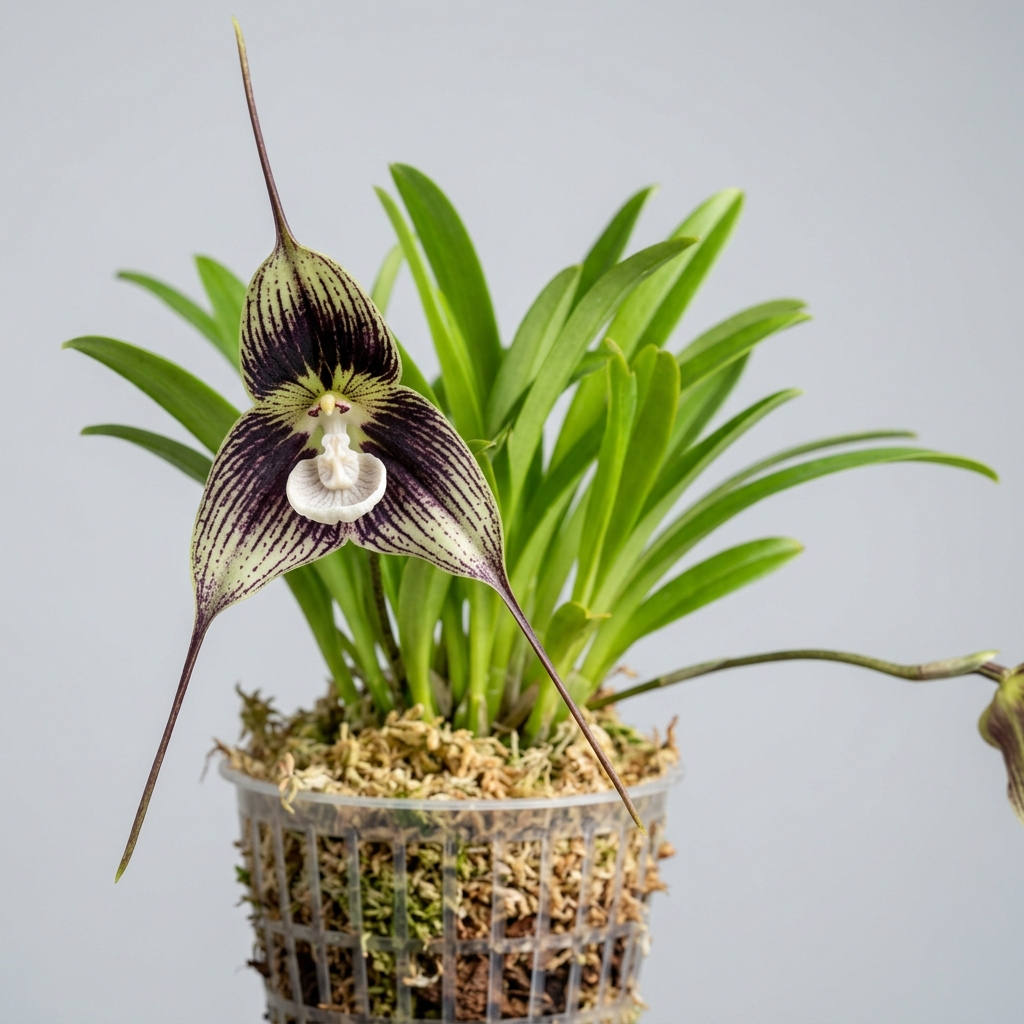
The orchid genus Dracula contains some of the most fascinating and dramatic species in the orchid world, with Dracula Vampira standing out as one of its most legendary members. Known commonly as the vampire orchid, this epiphyte is native to the cool, misty cloud forests of Ecuador, where it grows on moss-covered tree trunks. Cultivators highly prize this orchid for its large, dark, and hooded flowers that carry an air of gothic mystery, making it a coveted centerpiece for advanced orchid collections.
In cultivation, Dracula Vampira presents a rewarding challenge for growers who can replicate its highly specific cloud forest habitat. Unlike many common houseplants, this orchid eschews bright sunlight and warm temperatures, thriving instead in cool, shaded environments with high humidity and constant moisture. Its unique pendant flowering habit, where blooms emerge horizontally or downward, requires specialized potting techniques that showcase its dramatic, almost black blossoms to their fullest potential.
💡 Did You Know?
The large, pale lip of the Dracula Vampira orchid is a masterclass in evolutionary mimicry. It is shaped and textured to resemble the gills of a wild mushroom, complete with a faint musty scent. This clever disguise tricks female fungus gnats into visiting the flower to lay their eggs, successfully pollinating the orchid in the process.
🌿 Botanical Overview
Dracula Vampira is a tufted, epiphytic orchid that lacks pseudobulbs, a characteristic common to the Pleurothallidinae subtribe. Instead of storing water in thick pseudobulbs, it relies on erect, thin leaves that grow directly from short rhizomes. These leaves are narrow, leathery, and bright green, providing a vibrant contrast to the dark, moody flowers that emerge from the base of the plant. Because it lacks water-storing organs, the plant is highly sensitive to dry spells and requires consistent environmental stability.
In its native habitat, this orchid grows at elevations between 1,800 and 2,200 meters, where it is constantly bathed in cool mists and gentle breezes. This montane environment shapes its entire growth habit, dictating its need for high oxygen levels around the root zone and a continuous supply of pure, low-mineral water.
🌸 Flower Characteristics
The flowers of Dracula Vampira are truly spectacular, often measuring up to several inches across, including the long, slender tails of the sepals. The sepals are the dominant feature, displaying a striking pattern of deep purple-black or charcoal veins over a pale green or yellowish background, giving the bloom an overall dark, hooded appearance. The petals are small and inconspicuous, while the lip, or labellum, is large, white, and deeply ridged, closely mimicking the gills of a wild mushroom to attract fungus gnat pollinators.
The inflorescences are pendant or horizontal, meaning they grow downward or sideways from the base of the plant. A single flower spike can produce multiple blooms sequentially, though they typically open one at a time. The dramatic contrast between the dark sepals and the pale, fleshy lip creates a striking visual that resembles a bat or a stylized face, contributing to its common name.
Fragrance & Bloom Profile
The fragrance of Dracula Vampira is not sweet or floral, which is typical for orchids that rely on fly pollination. Instead, growers report a faint, musty, or mushroom-like scent that is generally only noticeable in close proximity or in enclosed spaces. This subtle aroma is an evolutionary adaptation designed to attract specific insect pollinators rather than to please human senses.
Blooms can appear at various times throughout the year under optimal conditions, though they are most common in the cooler months of autumn and winter. Individual flowers can last for several weeks if the humidity remains high and temperatures stay cool; however, low humidity or sudden heat spikes can cause the delicate sepals to wilt or drop prematurely.
Parentage & Hybrid Lineage
While often referred to in cultivation circles as a cultivar due to select clonal selections, Dracula Vampira is naturally a distinct species within the Dracula genus. Its lineage is pure, originating from wild populations in the Andean cloud forests of South America. In orchid hybridization, it has been used as a parent to introduce dark coloration and large flower size to various Dracula hybrids, though these crosses remain relatively rare and are primarily managed by specialist breeders.
Because documentation on specific cultivated varieties can vary, growers should treat plants labeled as Dracula Vampira with the care guidelines of the primary species. Select clones may exhibit slightly larger flowers or darker striping, but their fundamental cultural requirements remain identical to their wild ancestors.
🌱 Growing Conditions
Replicating the cool cloud forest environment is the key to success with Dracula Vampira. It requires low to moderate light levels, similar to those preferred by Phalaenopsis orchids, and must be protected from direct sunlight, which will quickly scorch its thin leaves. Ideal light levels range from 1,000 to 1,500 foot-candles, easily achieved with shaded windows or under diffused LED grow lights.
💡 Care Tip
Always pair high with active air movement. Keeping Dracula Vampira in a humid, stagnant environment will quickly lead to fungal leaf spots and root rot. A small, continuous fan nearby is essential.
Temperature control is critical; this orchid is a strict cool-grower. Daytime temperatures should ideally remain between 60°F and 68°F (15°C to 20°C), with a mandatory nighttime drop to 50°F to 55°F (10°C to 13°C). Temperatures exceeding 75°F (24°C) for extended periods can cause severe stress, leaf loss, and eventual decline. To support these temperatures, humidity must be kept consistently high, ideally between 70% and 90%, accompanied by strong, continuous air movement to prevent fungal pathogens.
Watering, Feeding & Potting Media
Due to the absence of pseudobulbs, Dracula Vampira must never be allowed to dry out completely. The potting medium should remain evenly moist but not soggy. Water the plant with pure water, such as rainwater, distilled water, or reverse osmosis water, as this species is highly sensitive to dissolved salts and chlorine found in tap water.
The ideal potting medium is high-quality New Zealand sphagnum moss or a fine, moisture-retentive bark mix. Because the flower spikes grow downward, this orchid should be grown in open-slat plastic or wooden net baskets rather than traditional solid pots. This allows the inflorescences to emerge naturally through the bottom and sides of the container. Fertilize sparingly with a highly diluted, balanced orchid fertilizer (such as a quarter-strength formulation) every two to three weeks during active growth, flushing the medium with pure water between feedings to prevent salt buildup.
Blooming Season & Care Notes
Dracula Vampira can bloom at any time of the year, but the primary blooming season typically occurs during the cooler months of autumn, winter, and early spring. When a flower spike begins to emerge from the bottom of the basket, take care not to disturb the plant or alter its orientation, as sudden changes in light or humidity can cause the developing buds to blast.
Repotting should be done every one to two years, preferably in the autumn when cooler temperatures support root recovery. Gently remove old, decaying sphagnum moss and replace it with fresh media, taking care not to damage the fine, fragile roots. Avoid repotting during the heat of summer or when the plant is actively carrying multiple developing buds.
⚠️ Common Issues
⚠️ Common Mistake
The most common mistake is letting the potting medium dry out completely. Because Dracula Vampira lacks water-storing pseudobulbs, even a single day of complete dryness can severely damage the roots and cause leaf drop.
- Root Rot:
Caused by stagnant water or compacted, decaying potting media that deprives roots of oxygen. - Leaf Spotting: Dark spots on the leaves often indicate fungal or bacterial infections resulting from high humidity combined with inadequate air circulation.
- Bud Blast:
Developing buds may dry up and turn yellow before opening, usually triggered by a sudden drop in humidity or a spike in temperature. - Heat Stress: Yellowing leaves, leaf drop, and a general lack of vigor occur when temperatures consistently exceed the preferred cool range.
- Pests:
Mealybugs, spider mites, and aphids can occasionally target the tender new growth and flowers; treat promptly with mild horticultural soap or neem oil.
❓ Frequently Asked Questions
Why are the leaves on my Dracula Vampira turning yellow and dropping?
Yellowing and dropping leaves are most commonly caused by heat stress or underwatering. Dracula Vampira is a cool-growing orchid that cannot tolerate temperatures above 75°F (24°C) for long. Ensure the plant is kept in a cool, shaded location with high humidity and that the potting medium remains consistently moist.
Can I grow Dracula Vampira in a standard plastic pot?
Growing this orchid in a standard solid plastic pot is not recommended because its flower spikes grow downward from the base of the plant. In a solid pot, the spikes will become trapped and rot. Instead, use open-slat net baskets or wire baskets lined with sphagnum moss to allow the spikes to emerge freely.
What kind of water should I use for Dracula Vampira?
This species is extremely sensitive to minerals and chemicals in tap water. Always use pure water sources such as rainwater, distilled water, or reverse osmosis water. Using tap water can lead to root burn, leaf tip dieback, and a rapid decline in plant health.
Does Dracula Vampira require a winter rest period?
No, Dracula Vampira does not require a dry winter rest period. Because it lacks pseudobulbs, it needs consistent moisture, high humidity, and regular watering throughout the year. However, you may reduce fertilizer applications slightly during the darkest winter months when growth naturally slows.
⭐ Final Growing Notes
Cultivating Dracula Vampira is a highly rewarding endeavor for the dedicated orchid enthusiast willing to provide the cool, humid conditions it demands. While its environmental requirements make it more challenging than common tropical orchids, the reward of witnessing its dark, dramatic, and otherworldly blossoms is unmatched. By focusing on consistent moisture, excellent air circulation, and cool temperatures, you can enjoy the mysterious beauty of this exceptional cloud forest species for many years.
⚕️ Health, Safety & Edibility
Understanding how a plant interacts with people, pets, and the surrounding environment is part of responsible cultivation. This section uses conservative, general guidance and does not replace professional medical or veterinary advice.
Human Safety: Species-specific human toxicity data for Dracula Vampira is limited. Use conservative handling practices and avoid intentional consumption.
Pet Safety: Pet-specific safety information for Dracula Vampira is limited, so keep it away from animals that commonly chew plants.
Edibility: Dracula Vampira should not be treated as edible. Ornamental specimens may contain natural irritants or horticultural residues that make them unsuitable for consumption.
Skin Contact: Skin irritation is not well documented for this plant, but gloves are sensible when repotting, pruning, or handling potting media.
🌱 Propagation Tip
This orchid is typically propagated by division during repotting. Ensure each division has at least four to five healthy leaves and a strong root system. Avoid dividing small or stressed plants, as they struggle to recover.
⭐ Expert Advice
If you struggle to keep temperatures cool enough during hot summer months, try placing your net basket inside a larger clay pot filled with damp sphagnum moss. The evaporative cooling effect can lower the around the roots by several degrees.

Leave A Comment