
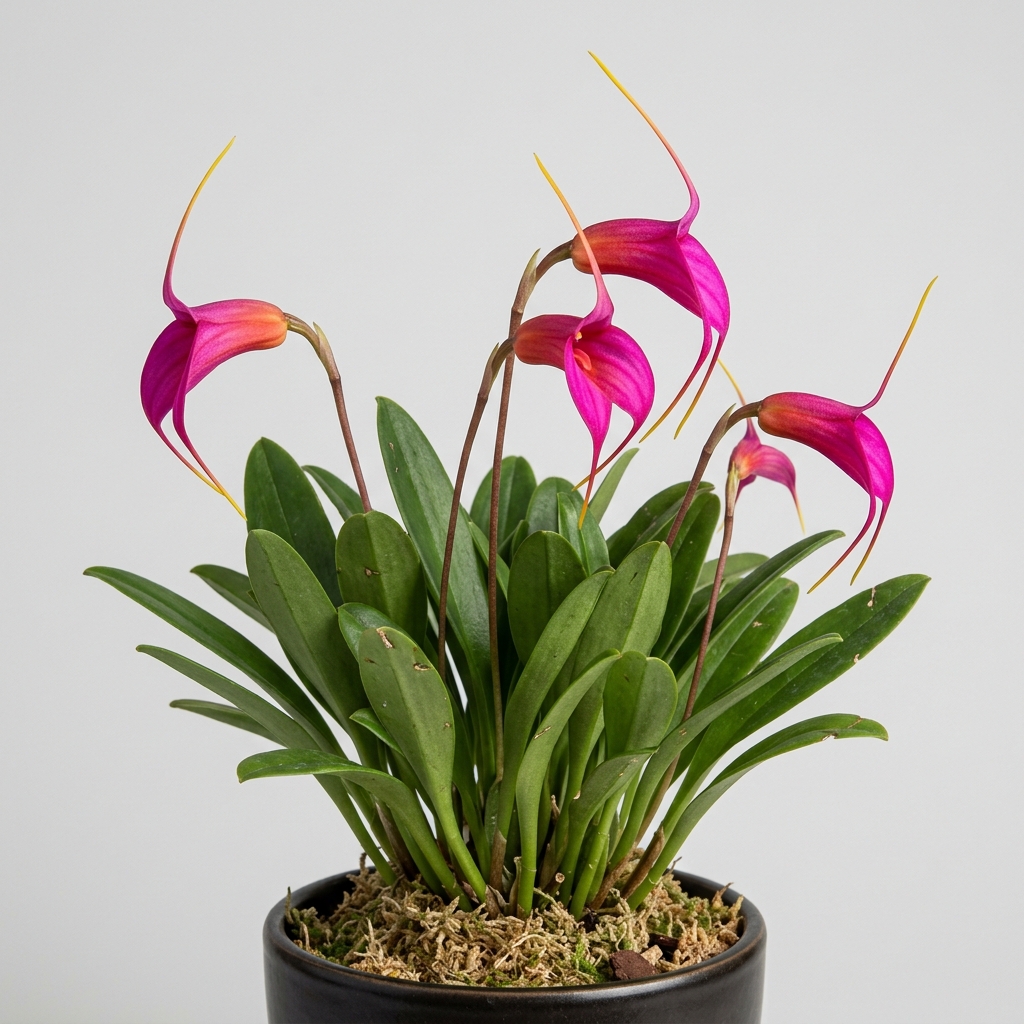
Masdevallia Amabilis is a captivating orchid highly prized by collectors for its striking, neon-bright blooms and unique architectural form. Belonging to the pleurothallid alliance, this cool-growing orchid is native to the high-altitude cloud forests of the Andes, where it thrives in misty, shaded environments. Its compact growth habit and vibrant floral display make it an exceptional choice for indoor growers with controlled setups or dedicated greenhouse hobbyists.
Unlike many common cultivated orchids, this species lacks water-storing pseudobulbs, meaning it relies on consistent moisture and high relative humidity to flourish. Growers who master its specific environmental needs are rewarded with a spectacular show of tubular, long-tailed flowers that seem to glow under soft light. Its elegant presentation and moderate size ensure it remains a standout specimen in any specialized orchid collection.
💡 Did You Know?
The striking tubular shape of Masdevallia Amabilis flowers is an evolutionary adaptation designed to attract specific pollinators, such as hummingbirds or small flies, in its native Andean cloud forests. The tiny petals and lip are hidden deep inside the fused sepals, forcing pollinators to navigate the colorful tube to reach nectar, ensuring successful pollen transfer.
🌿 Botanical Overview
Masdevallia Amabilis is a tufted, epiphytic or lithophytic orchid characterized by its small size and lack of pseudobulbs. Instead, it produces erect, single-leafed ramicauls that form dense, grassy clumps. The leaves are thick, leathery, and narrowly obovate, providing a lush green backdrop for the brilliant flowers that rise above the foliage.
In its native Andean habitat, this orchid grows on moss-covered trees or rocky rock faces where moisture is ever-present and temperatures remain cool year-round. Understanding this cloud forest ecology is key to successful cultivation, as the plant has evolved to absorb moisture and nutrients continuously from the humid air and damp substrate.
🌸 Flower Characteristics
The flowers of Masdevallia Amabilis are renowned for their brilliant coloration, typically displaying vivid shades of magenta, fuchsia, or orange-red, often with a subtle iridescent sheen. The most prominent feature of the bloom is the fused sepals, which form a narrow, tubular cup that flares open into three elongated, tail-like tips known as sepaline tails.
The actual petals and lip are tiny and hidden deep within the sepaline tube, a classic adaptation for specific pollinators in the wild. Each flower is borne singly on an erect or slightly arching inflorescence that typically extends beyond the leaves, presenting the bloom in a highly visible, elegant manner.
Fragrance & Bloom Profile
Fragrance is not consistently documented or prominent in Masdevallia Amabilis. Most growers report that the flowers are unscented, focusing their evolutionary energy instead on visual attraction through intense color and striking geometric form.
The blooms are remarkably long-lasting, often remaining pristine for several weeks if kept in cool, humid conditions. A mature specimen can produce multiple spikes sequentially or simultaneously, extending the overall display period and creating a vibrant splash of color against the dark green foliage.
Parentage & Hybrid Lineage
Masdevallia Amabilis is a naturally occurring species rather than a complex artificial hybrid, though it has been widely used in hybridization programs to introduce vivid color and compact growth to new grexes. In historical literature and commercial trade, its exact wild collection origins and early registration details are sometimes subject to variable documentation.
When purchasing this orchid, growers should note that while line-bred select clones exist, the species retains its fundamental wild characteristics. It is highly valued by hybridizers seeking to pass down its intense magenta pigmentation and robust, clumping growth habit to modern Masdevallia hybrids.
🌱 Growing Conditions
Replicating the cool, buoyant atmosphere of the Andean cloud forests is essential for keeping this orchid healthy. It thrives in cool to intermediate temperatures, ideally ranging from 50°F to 65°F (10°C to 18°C) at night, with daytime temperatures preferably not exceeding 75°F (24°C).
💡 Care Tip
Always use pure water, such as rainwater, distilled water, or reverse osmosis water, for your Masdevallia Amabilis. Its fine, delicate root system is highly sensitive to the dissolved minerals and salts found in typical tap water, which can quickly cause root burn and leaf tip dieback.
Light should be bright but strictly filtered or diffused, similar to the conditions under a forest canopy; direct sunlight will quickly scorch the thin leaves. High humidity of 70% to 80% is critical, paired with constant, gentle air movement to prevent stagnant air from encouraging fungal pathogens on the damp foliage.
Watering, Feeding & Potting Media
Because Masdevallia Amabilis lacks pseudobulbs, it has no water storage capacity and must never be allowed to dry out completely. The potting medium should remain evenly moist but not waterlogged. Pure water sources, such as rainwater, distilled water, or reverse osmosis water, are highly recommended because the fine roots are extremely sensitive to dissolved salts and minerals.
A potting mix of high-quality, fine-grade New Zealand sphagnum moss or a blend of fine fir bark and perlite works exceptionally well in plastic net pots or clay pots. Fertilize very weakly with a balanced, urea-free orchid fertilizer at one-quarter strength every two weeks, flushing the pot thoroughly with pure water between feedings to prevent salt buildup.
Blooming Season & Care Notes
While blooming can occur at various times throughout the year depending on local growing conditions, Masdevallia Amabilis typically shows its primary flowering flush in the spring and autumn. Cool night temperatures often act as a trigger for spike initiation.
Once a flower spike emerges, avoid changing the plant’s orientation or environmental conditions abruptly, as this can cause bud drop. After the bloom fades, cut the spike down to the base of the leaf stem. Repotting is best done in late winter or early autumn when temperatures are cool, allowing the fine root system to recover without heat stress.
⚠️ Common Issues
⚠️ Common Mistake
The most common mistake is letting the potting medium dry out completely. Lacking water-storing pseudobulbs, this orchid cannot tolerate drought. Even a brief period of complete dryness can severely damage the fine roots, leading to rapid leaf drop, bud blast, and eventual plant decline.
- Leaf Spotting: Often caused by high humidity combined with stagnant air; ensure continuous, gentle fan circulation.
- Root Rot: Occurs when the potting medium degrades or lacks drainage; repot annually to keep the substrate fresh.
- Bud Blast: Sudden dropping of buds due to low humidity, drafts, or rapid temperature fluctuations.
- Heat Stress: Yellowing leaves and leaf drop when daytime temperatures consistently exceed acceptable limits.
- Pests: Aphids and spider mites can occasionally target the tender new growth and flowers; treat with gentle insecticidal soap.
❓ Frequently Asked Questions
How do I prevent bud blast on my Masdevallia Amabilis?
Bud blast is typically caused by sudden environmental shifts. To prevent it, maintain high relative humidity above 70%, avoid placing the plant in drafty areas, and keep temperatures stable. Ensure the potting medium remains consistently moist while the flower spike is developing.
Can Masdevallia Amabilis be grown under LED lights?
Yes, this orchid adapts well to LED grow lights. Position the plant under low-to-medium intensity LEDs, ensuring the lights do not emit excess heat that could raise the ambient temperature. Monitor the leaves; if they turn yellowish-green or develop red tints, the light may be too intense.
What is the best potting medium for this orchid?
High-quality, long-fibered New Zealand sphagnum moss is highly recommended because it retains even moisture without compacting too quickly. Alternatively, a mix of fine fir bark, perlite, and chopped sphagnum can be used to provide excellent drainage while keeping the roots damp.
Is Masdevallia Amabilis suitable for beginner orchid growers?
It is generally considered an intermediate to advanced orchid due to its strict requirements for cool temperatures, high humidity, and pure water. However, beginners who have a temperature-controlled grow space, a terrarium, or a greenhouse can successfully cultivate it by carefully monitoring moisture levels.
⭐ Final Growing Notes
Cultivating Masdevallia Amabilis is a deeply rewarding endeavor for growers who can accommodate its specific cool-temperature and high-humidity requirements. While it demands more precise environmental control than common windowsill orchids, its dazzling, neon-bright blooms and elegant, compact growth make it an absolute jewel of the orchid world. With consistent moisture, pure water, and excellent air circulation, this Andean treasure will thrive and bring a touch of cloud forest magic to your collection.
⚕️ Health, Safety & Edibility
Understanding how a plant interacts with people, pets, and the surrounding environment is part of responsible cultivation. This section uses conservative, general guidance and does not replace professional medical or veterinary advice.
Human Safety: Masdevallia Amabilis is generally considered non-toxic to humans.
Pet Safety: It is widely reported as non-toxic to dogs and cats.
Edibility: This ornamental orchid is not edible and not intended for consumption.
Skin Contact: Safe to touch with no known irritants.
Eye Contact: May cause mild mechanical irritation upon direct contact.
Allergy Information: Low risk, though pollen may affect sensitive individuals.
Handling Advice: Wash hands.
🌱 Propagation Tip
This species is best propagated by division during repotting in the cool spring or autumn months. Ensure each division has at least five to eight healthy leaves and a robust root system. Avoid dividing the plant into too small of clumps, as larger specimens recover much faster and bloom more reliably.
⭐ Expert Advice
To trigger a heavy flush of blooms, ensure there is a distinct drop of 10 to 15 degrees Fahrenheit between day and night, especially during the autumn. This natural differential mimics its native mountain habitat and stimulates the plant to produce multiple flower spikes.




Leave A Comment