
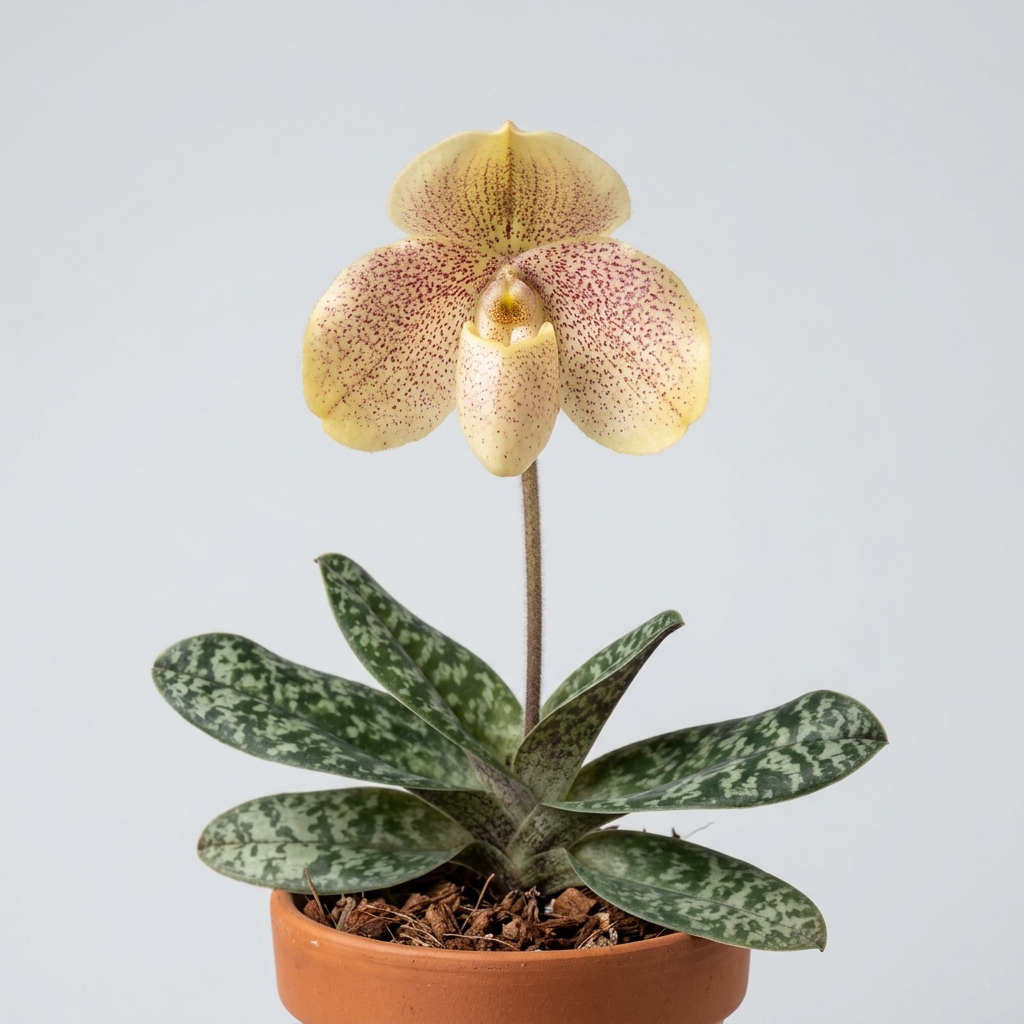
Paphiopedilum Concolor is a highly distinguished slipper orchid species celebrated for its compact growth habit and beautifully mottled foliage. Originating from the warm, humid regions of Southeast Asia, this terrestrial and lithophytic orchid has captured the attention of collectors worldwide. Its understated elegance makes it a classic representative of the subgenus Brachypetalum, offering a unique aesthetic that contrasts with larger, more flamboyant slipper orchids.
Cultivators highly value this orchid for its manageable size and its striking, pale yellow to cream-colored blooms, which are delicately dusted with fine reddish-purple speckles. Unlike some temperamental slipper orchids, it adapts reasonably well to indoor cultivation when its specific moisture and temperature requirements are met. It serves as an excellent choice for growers looking to transition from common nursery orchids to more specialized botanical species.
💡 Did You Know?
Paphiopedilum Concolor belongs to the Brachypetalum section of slipper orchids, which are native to limestone cliffs. Unlike many other orchids that prefer highly acidic conditions, this species thrives when its potting medium contains trace amounts of calcium, mimicking the natural mineral-rich runoff of its native cliffside habitats.
🌿 Botanical Overview
Paphiopedilum Concolor is naturally found growing in pockets of humus on limestone cliffs or in shaded forest floors across countries like Thailand, Vietnam, Cambodia, and southern China. This lithophytic and terrestrial nature dictates much of its care in cultivation, particularly its preference for calcium-rich environments and excellent drainage. The plant features a compact growth habit, rarely exceeding a few inches in height, making it ideal for space-limited growers.
The foliage of this species is a major selling point even when the plant is not in bloom. The leaves are thick, leathery, and oblong, displaying a striking tessellated or mottled pattern of dark green and pale grayish-green on the upper surface. The undersides of the leaves often exhibit a deep purple coloration, which helps the plant absorb limited light in its native shaded understory habitats.
🌸 Flower Characteristics
The flowers of Paphiopedilum Concolor are distinctively cup-shaped, a hallmark of the Brachypetalum section. The petals and sepals are broad, rounded, and closely set, giving the bloom a full, compact appearance. The base color ranges from a soft buttery yellow to a warm cream, overlaid with a dense dusting of tiny, precise purple or reddish-brown spots that concentrate toward the center of the flower. The pouch, or labellum, is relatively small, egg-shaped, and matches the overall coloration of the petals. Flowers are typically presented on short, sturdy, upright spikes that emerge from the center of the leaf growth, usually carrying one to two blooms per inflorescence.
Fragrance & Bloom Profile
While many slipper orchids are entirely scentless, Paphiopedilum Concolor is occasionally reported by growers to emit a very faint, sweet, or apple-like fragrance, particularly during the warmest hours of the day. However, this trait is highly variable and cultivar-dependent; many specimens may display no detectable scent at all. The blooms are remarkably long-lasting, often remaining pristine for six to eight weeks under optimal environmental conditions. This durability makes the blooming cycle a highly rewarding period for the patient grower.
Parentage & Hybrid Lineage
As a naturally occurring species rather than a man-made hybrid, Paphiopedilum Concolor possesses a pure genetic lineage that has been widely used in orchid breeding. It is a primary parent in numerous classic slipper orchid hybrids, valued for passing down its compact growth habit, mottled foliage, and warm yellow coloration. Because wild collection is strictly regulated under CITES conservation laws, modern plants available in the trade are almost exclusively grown from seed or tissue culture in professional nurseries, ensuring the preservation of wild populations.
🌱 Growing Conditions
To cultivate Paphiopedilum Concolor successfully, growers should mimic its native tropical forest habitat. It thrives in bright, filtered light, similar to the conditions preferred by Phalaenopsis orchids. Direct sunlight must be avoided, as it can easily scorch the delicate mottled leaves. Temperatures should ideally remain warm, with daytime highs between 75°F and 85°F (24°C to 29°C) and a slight drop at night to around 60°F to 65°F (15°C to 18°C) to encourage robust growth and eventual blooming. High relative humidity of at least 60% is essential, supported by gentle, continuous air movement to prevent stagnant air pockets that encourage bacterial pathogens.
💡 Care Tip
Always water this orchid early in the morning to ensure that any water splashed into the leaf joints or the central crown has ample time to evaporate before nightfall, significantly reducing the risk of crown rot.
Watering, Feeding & Potting Media
Unlike epiphytic orchids with large pseudobulbs, Paphiopedilum Concolor does not store significant water reserves and must never be allowed to dry out completely. The potting medium should be kept consistently damp but never soggy. Water thoroughly when the top half-inch of the medium begins to feel dry. A free-draining, fine-grade bark mix blended with perlite, charcoal, and a small amount of chopped sphagnum moss works best. Because of its lithophytic origin on limestone, many growers recommend adding a small amount of dolomite lime or oyster shells to the potting mix to maintain a slightly alkaline to neutral pH. Feed the plant with a highly diluted, balanced orchid fertilizer every two to three waterings during the active growing season, flushing the pot with pure water periodically to prevent salt buildup.
Blooming Season & Care Notes
The primary blooming season for Paphiopedilum Concolor typically spans from late spring through summer, though well-established plants can occasionally bloom at other times of the year. Once the flower spike begins to emerge from the center of the growth, avoid changing the plant’s orientation to the light source, as this can cause the developing bud to twist or stall. After the flowers fade, cut the spike down close to the base of the leaves using a sterile cutting tool. Repotting is best performed every one to two years, immediately after the blooming cycle concludes, using fresh media to prevent root suffocation as the old mix breaks down.
⚠️ Common Issues
⚠️ Common Mistake
A frequent error is treating Paphiopedilum Concolor like a desert plant or a standard epiphyte by letting the potting medium dry out completely between waterings. This lack of moisture quickly damages the fine root system, leading to dehydrated, wrinkled leaves.
- Root rot: Caused by overwatering or compacted, poorly draining media, leading to limp, yellowing leaves.
- Crown rot: Occurs when water is allowed to sit in the center of the leaf fan, especially overnight.
- Mealybugs and scale: Common pests that hide in the tight crevices at the base of the leaves and under the flowers.
- Leaf scorch: Bleached or dry brown patches on the foliage resulting from exposure to direct sunlight.
- Bud blast: The premature drying and dropping of flower buds, usually triggered by sudden drops in humidity or temperature fluctuations.
❓ Frequently Asked Questions
How often should I water my Paphiopedilum Concolor?
Water your Paphiopedilum Concolor when the top layer of the potting medium feels slightly dry to the touch, which typically translates to once or twice a week depending on your home’s humidity and temperature. Never let the roots sit in standing water, but do not allow the medium to dry out completely, as these orchids lack water-storing pseudobulbs.
Does Paphiopedilum Concolor require limestone in its potting mix?
While not strictly mandatory for survival, adding a small amount of agricultural dolomite lime, crushed oyster shells, or limestone chips to the potting medium mimics its natural lithophytic habitat. This addition helps maintain a stable, slightly alkaline pH and provides essential calcium and magnesium, which promotes stronger leaf and root development.
Why are the leaves on my slipper orchid turning yellow and soft?
Yellow, soft leaves are most commonly a sign of overwatering or poor drainage, which leads to root rot. Inspect the roots immediately; healthy roots should be firm and covered in fine brown hairs, while rotted roots will be mushy and black. If rot is present, trim the damaged roots and repot the plant into fresh, free-draining media.
Can I grow Paphiopedilum Concolor under artificial LED lights?
Yes, Paphiopedilum Concolor adapts exceptionally well to artificial LED grow lights. Position the plant under moderate-intensity LED lights for 12 to 14 hours a day, ensuring the light source is far enough away to prevent leaf scorch. If the leaves develop a reddish tint, the light may be too intense, and the plant should be moved slightly further away.
⭐ Final Growing Notes
Paphiopedilum Concolor remains a highly rewarding orchid for both novice and experienced growers who appreciate the unique charm of slipper orchids. By providing consistent moisture, moderate light, and high humidity, you can enjoy its beautifully patterned foliage year-round and its exquisite, speckled yellow blooms each summer. Its compact size and relatively forgiving nature make it an essential addition to any diverse indoor orchid collection.
⚕️ Health, Safety & Edibility
Understanding how a plant interacts with people, pets, and the surrounding environment is part of responsible cultivation. This section uses conservative, general guidance and does not replace professional medical or veterinary advice.
Human Safety: No published evidence currently identifies species-specific toxicity concerns for Paphiopedilum Concolor during normal handling. As with most ornamental plants, it should not be intentionally consumed.
Pet Safety: Published information does not indicate that this orchid commonly poses a toxicity concern for cats or dogs. However, chewing leaves, flowers, roots, or potting media may still cause mild digestive upset.
Edibility: This orchid is cultivated for ornamental display rather than food. Ornamental plants may carry fertilizers, pesticides, or other horticultural treatments that make them unsuitable for consumption.
Skin Contact: Routine handling is not generally associated with skin irritation. Gardeners with sensitive skin may prefer wearing gloves when repotting, pruning, or handling potting media.
🌱 Propagation Tip
Slipper orchids cannot be propagated by leaf cuttings or backbulbs. Instead, propagation is achieved by carefully dividing mature plants during repotting, ensuring that each new division has at least two to three healthy leaf fans and an established root system.
⭐ Expert Advice
To encourage reliable blooming, provide a slight night-to-day drop of about 10 to 15 degrees Fahrenheit during the late autumn and winter months. This natural cooling period signals the plant to initiate flower buds for the upcoming spring season.




Leave A Comment