
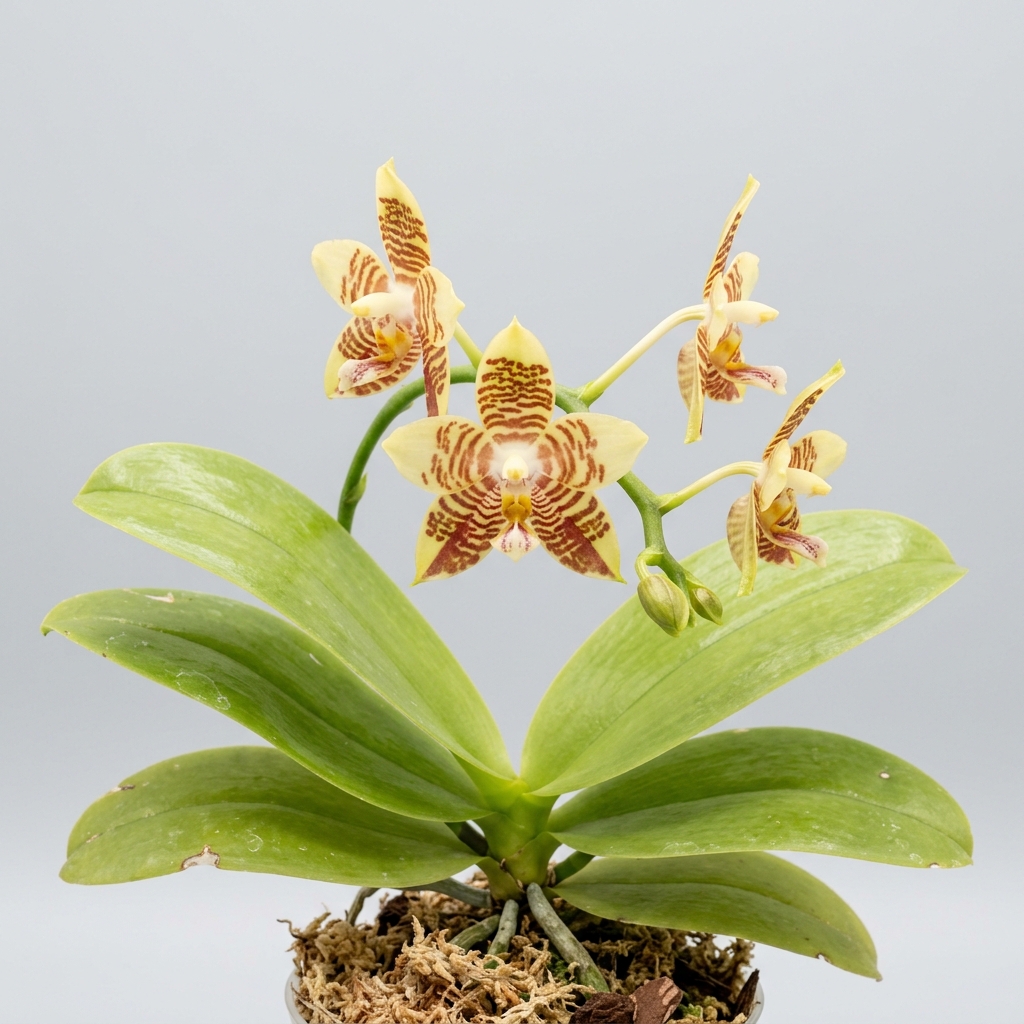
Phalaenopsis Amboinensis is a highly prized species orchid renowned for its striking, star-shaped blossoms and intense, sweet fragrance. Native to the tropical islands of Indonesia, particularly Ambon Island, this epiphytic orchid has captured the attention of collectors and hybridizers alike for generations. Its distinctive waxy flowers, marked by concentric banding, offer a dramatic departure from the standard round-petaled moth orchids commonly found in commercial nurseries.
Cultivating this species requires a slight shift from standard hybrid Phalaenopsis care, as it thrives in warmer, more humid conditions with consistent moisture. Growers value Phalaenopsis Amboinensis not only for its unique botanical aesthetic but also for its pivotal role in modern orchid hybridization, where it has contributed its robust substance, glossy texture, and fragrant genes to countless award-winning crosses.
💡 Did You Know?
Phalaenopsis Amboinensis is named after Ambon Island in the Maluku Islands of Indonesia, where it was first discovered. Unlike many modern hybrids, its flower spikes are perennial and can continue to produce fragrant, waxy blossoms from the same stem for several consecutive years, making patience a key virtue for growers.
🌿 Botanical Overview
Phalaenopsis Amboinensis is a medium-sized epiphyte that naturally grows on tree trunks in shady, humid lowland forests. It features short stems clothed in fleshy, obovate-elliptic leaves that are glossy, light green, and can grow up to ten inches in length. The plant’s growth habit is compact, making it an excellent candidate for indoor windowsill cultivation or dedicated orchid terrariums.
Unlike many hybrid moth orchids, this species produces relatively short, often pendulous inflorescences that emerge from the base of the leaves. These spikes are sequential bloomers, meaning they produce flowers one after another over an extended period, rather than opening all at once. Consequently, a single flower spike can remain active and green for multiple seasons, requiring growers to exercise patience before pruning.
🌸 Flower Characteristics
The blossoms of Phalaenopsis Amboinensis are highly distinctive, typically measuring two to three inches in diameter. The flowers are star-shaped, with thick, waxy sepals and petals that prevent rapid dehydration. The base color ranges from a creamy white to a vibrant yellow-green, overlaid with intricate, concentric bars of reddish-brown or cinnamon-orange.
The lip, or labellum, is relatively small, three-lobed, and features a yellowish-white coloration with fine pubescence near the midlobe. This complex patterning and heavy substance give the flowers a sculpted, almost artificial appearance that remains fresh on the plant for several weeks. The presentation is typically downward-facing or lateral, hanging gracefully from the short spikes.
Fragrance & Bloom Profile
One of the most compelling attributes of Phalaenopsis Amboinensis is its fragrance, which is widely described as sweet, musky, and reminiscent of tropical fruits or damp forest floors. The scent is most pronounced during the morning hours when temperatures begin to rise and light levels increase.
The blooming profile is characterized by its sequential nature. While a spike may only display one or two open flowers at any given time, the overall blooming period can span several months as new buds slowly develop at the tip of the active spike. This slow-release flowering strategy ensures a prolonged display of color and scent throughout its active cycle.
Parentage & Hybrid Lineage
As a naturally occurring species rather than a man-made cultivar, Phalaenopsis Amboinensis possesses a pure genetic lineage native to the Maluku Islands of Indonesia. It was first formally described in the 19th century and has since become a cornerstone of yellow and novelty Phalaenopsis breeding programs.
While its exact wild origins are geographically defined, its extensive use in hybridization has resulted in thousands of registered crosses. It is the direct parent of famous primary hybrids such as Phalaenopsis Amboin-Novelty and has been used to introduce waxy texture, star-like form, and fragrance into complex modern hybrids. In commercial trade, select line-bred cultivars of the species are often sold, which may exhibit enhanced color saturation or larger flower size compared to typical wild specimens.
🌱 Growing Conditions
To successfully cultivate Phalaenopsis Amboinensis, growers must replicate its warm, humid, and shaded forest habitat. It thrives in low to medium indirect light, ideally between 1,000 and 1,500 foot-candles. Direct sunlight must be strictly avoided, as the thin, glossy leaves are highly susceptible to scorching and permanent cellular damage.
💡 Care Tip
Keep this orchid in a warm, draft-free location with high . If growing indoors, place the pot on a tray filled with pebbles and water, ensuring the bottom of the pot does not touch the water directly.
Temperature management is critical for this tropical species. It prefers warm conditions year-round, with daytime temperatures ranging between 75°F and 85°F, and nighttime drops not falling below 65°F. High relative humidity of 60% to 80% is optimal, accompanied by gentle, continuous air movement to prevent stagnant moisture from settling on the foliage or crown.
Watering, Feeding & Potting Media
This species does not possess pseudobulbs for water storage, meaning it requires consistent moisture and should never be allowed to dry out completely. Watering should be frequent enough to keep the potting medium damp but not soggy. Rainwater, distilled water, or reverse osmosis water is highly recommended, as the roots can be sensitive to dissolved mineral salts.
A well-draining potting medium is essential to prevent root rot. A mix of medium-grade New Zealand sphagnum moss and high-quality fir bark works exceptionally well, providing both moisture retention and aeration. Alternatively, the plant can be mounted on cork bark or tree fern plaques if high humidity can be maintained. Feed the orchid weekly with a highly diluted, balanced orchid fertilizer, flushing the pot with pure water once a month to prevent salt accumulation.
Blooming Season & Care Notes
Phalaenopsis Amboinensis can bloom at almost any time of the year, though peak flowering activity typically occurs from late spring through autumn. Unlike standard hybrids, the flower spikes of this species are perennial and should never be cut off after the flowers fade unless the spike has turned completely brown and dry.
Active green spikes will often produce new buds in later seasons or branch out to create additional blooms. Repotting should be performed only when necessary, typically every two years as the potting medium begins to decompose. The ideal time to repot is immediately after a major flush of growth in the spring, ensuring that emerging active root tips can quickly establish in the fresh substrate.
⚠️ Common Issues
⚠️ Common Mistake
The most common mistake is cutting off green flower spikes after the blossoms drop. Because this species is a sequential bloomer, removing active green spikes eliminates the nodes where future flowers would have emerged.
- Root Rot:
Caused by overwatering or compacted, decomposing potting media that suffocates the root system. - Crown Rot:
Occurs when water is allowed to sit in the center of the leaf crown overnight; always water early in the day. - Bud Blast:
The sudden drying and dropping of developing buds, often triggered by rapid temperature fluctuations, low humidity, or drafts. - Pests:
Common pests like spider mites and mealybugs can hide in leaf axils and under leaves, feeding on plant sap and causing yellow spotting. - Foliar Burn: Bleached or blackened patches on the leaves resulting from exposure to direct, unfiltered sunlight.
❓ Frequently Asked Questions
Why are the flower spikes on my Phalaenopsis Amboinensis so short?
This species naturally produces short, compact, and often pendulous flower spikes. Unlike standard grocery store hybrids that have been bred for tall, arching spikes, Phalaenopsis Amboinensis presents its flowers close to the foliage, which is a natural adaptation to its epiphytic lifestyle in the wild.
Should I cut the flower spike off after the blooms drop?
No, you should not cut green spikes. Phalaenopsis Amboinensis is a sequential bloomer, and its spikes can remain green and active for several years, producing new flowers season after season. Only cut the spike if it turns completely yellow, brown, or dry.
Can I grow Phalaenopsis Amboinensis mounted on wood?
Yes, mounting this species on cork bark or tree fern plaques is highly successful and mimics its natural growth habit. However, mounted plants dry out much faster and require daily watering or a high-humidity greenhouse environment to thrive.
Why are the leaves on my orchid turning pale yellow?
Pale yellow leaves usually indicate that the plant is receiving too much light. Phalaenopsis Amboinensis prefers deep shade to moderate filtered light. Move the plant to a more shaded location, and ensure it is not exposed to direct afternoon sun.
⭐ Final Growing Notes
Phalaenopsis Amboinensis is a rewarding species that brings a touch of wild tropical elegance to any orchid collection. While it demands slightly more attention to humidity and temperature than common mass-market hybrids, its waxy, beautifully patterned, and fragrant flowers make the extra effort entirely worthwhile. By maintaining warm temperatures, consistent moisture, and preserving its active flower spikes, growers can enjoy the unique charm of this Indonesian treasure for many years.
⚕️ Health, Safety & Edibility
Understanding how a plant interacts with people, pets, and the surrounding environment is part of responsible cultivation. This section uses conservative, general guidance and does not replace professional medical or veterinary advice.
Human Safety: No published evidence currently identifies species-specific toxicity concerns for Phalaenopsis Amboinensis during normal handling. As with most ornamental plants, it should not be intentionally consumed.
Pet Safety: Published information does not indicate that this orchid commonly poses a toxicity concern for cats or dogs. However, chewing leaves, flowers, roots, or potting media may still cause mild digestive upset.
Edibility: This orchid is cultivated for ornamental display rather than food. Ornamental plants may carry fertilizers, pesticides, or other horticultural treatments that make them unsuitable for consumption.
Skin Contact: Routine handling is not generally associated with skin irritation. Gardeners with sensitive skin may prefer wearing gloves when repotting, pruning, or handling potting media.
🌱 Propagation Tip
While propagation from seed is complex, Phalaenopsis Amboinensis occasionally produces keikis, or baby plants, along its old flower spikes. Allow the keiki to develop several roots at least two inches long before carefully detaching and potting it.
⭐ Expert Advice
Use high-quality New Zealand sphagnum moss blended with medium fir bark to maintain the perfect balance of moisture and aeration. Flush the pot thoroughly with pure water once a month to wash away accumulated fertilizer salts.

Leave A Comment